
So. So, so so, so so. What in the Nine Circles of Dante’s Hell am I discussing today? Well, my very patient reader, I’m going to talk about one of the great loves of my life; no, not pizza. Not rugby either. And no, not Salt and Vinegar chips. At least not today.
No, today I’m discussing comic books, which in itself is nothing new on New Zealand’s 5th least favourite website. As you’re well aware of my love for the medium, there are a few things that don’t sit well with me. And because it’s your lucky day, I’m going to discuss one of them with you.
I say this because I’m a supporter, collector, and reader of comic books. There are so many fantastic things that I love about comic books, hence why I love them. But this is not all smooth sailing for me, as I just revealed, as there are aspects to the industry that, if it were up to me, I would definitely change.
However, the nature of this blog post is not to rant about all of them, but rather to shine the spotlight on one of them in particular: relaunches. If you’re a comic book reader like myself, then it’s entirely possible you already know what I’m referring to. However, sadly, not everybody is perfect, and I know this could come as a shock, but not everybody reads comic books. I know the world is a mixed-up place, isn’t it?
To those unlucky people who don’t know what I’m referring to, I’ll do my best to explain it. With the majority of Western, or at least American comic books, I’ll usually find some special information on the the first page, or the last page, or somewhere else in the comic book.
This information, usually, but not always, displays the title of the story and credits the comic’s writer, artist, inker, colourer, letterer and editor on the same page. However, it’s the bottom section of that page that I want to discuss. This bottom section would list the title of the comic book, the issue number, the month it was released1, and the volume number. And it’s the volume number I want to break down for us.
Now before I go on, let us quickly discuss the quiet part out loud. Comic books are a form of entertainment, so that means they are created by publishers for two reasons: to tell stories and to sell those stories. It’s a multi-million industry, and there’s nothing wrong about an industry that provides people with what they want. To a point.
So, comic book publishers exist to tell stories and to get paid for them. Again, there’s nothing wrong with that; it’s a business, so they need to make a profit in order to pay their staff and shareholders, as well as to pay their bills. Awesome, let’s push on.
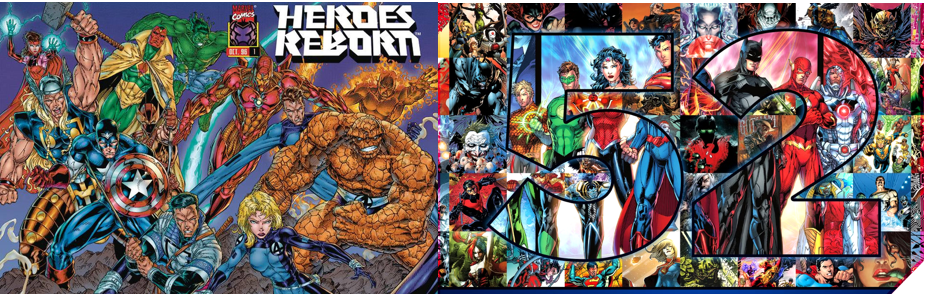
You see, a monthly comic book could be trucking along, well, monthly, and the publisher could decide to change things up, for reasons that I’ll go into. One consequence of this can sometimes mean that the comic book could be relaunched. Effectively, a comic book could be on #28, then the next issue that’s released would be a #0 issue, though typically it’s a new #1.
An example of this may look like this: The Adventures of Geek Man Vol 1, August #28, so the next issue would be: The Adventures of Geek Man Vol 2, September #1. A relaunch basically resets the numbering sequence from whatever the previous issue was, like #28, #147, or #584, to #0 or #1. The volume number changes as well, from Vol 1 to Vol 2.
That sounds interesting and harmless, right? Fair enough, right? Ok, so why would publishers relaunch a title? Great question, thanks for asking! I could be mistaken, but I believe there are several key reasons publishers may relaunch a title. Ultimately, it all comes down to money, as with most things.
1.) It’s about a sales boost. Traditionally, a new monthly issue #1 will sell more copies than your standard monthly title, especially if it’s, say, #97, #318, or #874. Granted, the sales boost is only temporary and small, but it’s still an increase. Fans would always love to get their hands on a new Punisher #1 or Wonder Woman #1.
2.) It’s a way to celebrate a new creative team. Back in the day, if a new creative team took control of a title, as in a new writer and artist together, the publisher would celebrate by declaring that the team would take the character(s) in a bold, new direction, but continue with the legacy numbering system. But now, maybe 35 issues into a run, the publisher will relaunch the title from #1, in order to promote the new creative team. I mean, if you have the hottest writer and artist working on a new title, why wouldn’t people deserve to have a new #1 to go with the new team?
3.) To draw in new readers by having a new #1 as a jumping-on point for them. Trying to start reading a monthly title that is in its 300s, 700s, or over 1000 issues can be daunting, so a new #1 can make the title more accessible to new readers.
4.) It’s a reason to flood the solicitations with variant #1 covers. By this I mean, what could be cooler than getting a new Thor #1 Cover A? By getting Cover B, C, D, and every other letter of the alphabet as well. A company could say their new #1 sold 450,000 units, but if they have 20 different variant covers, people are not necessarily buying it for the story; they just want the variants.
5.) If a comic book is getting a screen adaptation, whether it’s for a movie or television show, a publisher can relaunch the title to align it with the adaptation. And what better way than a brand new sparkly #1?
6.) This is an odd reason, but it helps with marketing and promoting trades and collected editions. I discovered my local library had two copies of Captain America Vol. 3, but they were written and drawn by different creative teams. Volume 3 is a lot more accessible than Volume 376, right?
There are other reasons, but to me, these are the top six, though they are listed as I thought of them, and no other reason. However, there is an old phrase that relates to relaunches and nearly anything else:
Just because you can do something, doesn’t mean you should.
Now, I’m an old comic book reader, as I’ve been reading and collecting them for decades. And from that experience and perspective, I find the concept of relaunches upsetting. Even though I have laid out the reasons why they happen above, that doesn’t mean I agree with them.
I want the comic industry to thrive and succeed, and I know it’s important to entice new readers; but it’s also important to retain the old readers. So, after reading this blog post, I can only assume you must be asking, “What’s his point?” Another great point, by the way.
The point is that this is the opening salvo of a brand new literary project I am undertaking. What I’m proposing to do is list all of the relaunches famous titles have had; as in giving the title a new #1. I plan on doing this across Marvel and DC to begin with, and then take it from there.
This means that the first entry into this ill-advised venture will be next week. I’m still working out the details, but the blog post will be concerning relaunches with titles that start with “A”, so I’m going in alphabetical order. I don’t know how long it’s going to take, but I’m up for the challenge, and I hope you are too.
And with that, I’m done for another week. Thanks again for reading, following, and subscribing to Some Geek Told Me. Please don’t forget to walk your dog, read a banned book, don’t believe what the office is saying about you, and I’ll see you next week.
1 If you buy a newly released comic book off the shelf in June, it would have August as the month. Many comic book publishers release their full promotional solicitations two months in advance so retailers and readers can pre-order upcoming single issues or other forms of the literature.


You must be logged in to post a comment.