
I was thinking the other day about things that seem to drag on: The Fast and the Furious franchise, election cycles, accident and emergency wait lists, time between Saga issues, and Some Geek Told Me’s Tour of the Solar System. It’s still chugging along, like the little engine that has no right to exist.
Roughly every nine weeks, another chapter is added to the tour, which is the equivalent of vomiting and having diarrhoea at the same time. So, with that rosy image in your heads, you can visit previous chapters of this magical tour.
1.) Meet the Family
2.) The Sun
4.) Mercury
5.) Venus
7.) The Moon
8.) Mars
10.) Ceres
11.) Jupiter
12.) The Galilean moons
13.) Saturn
14.) Titan
15.) The Moons of Saturn
16.) Uranus
17.) Titania
18.) The Moons of Uranus
19.) The Literary Moons of Uranus
20.) Neptune
21.) Triton
22.) The Moons of Neptune
23.) The Kuiper Belt
24.) Pluto
25.) Charon
As you can see, the last tour stop was Charon, the largest of Pluto’s moons, but we need to meet the other members of Pluto’s children. Without delaying this highly popular blog post any longer, may I present to the academy’s pleasure, the Moons of Pluto.
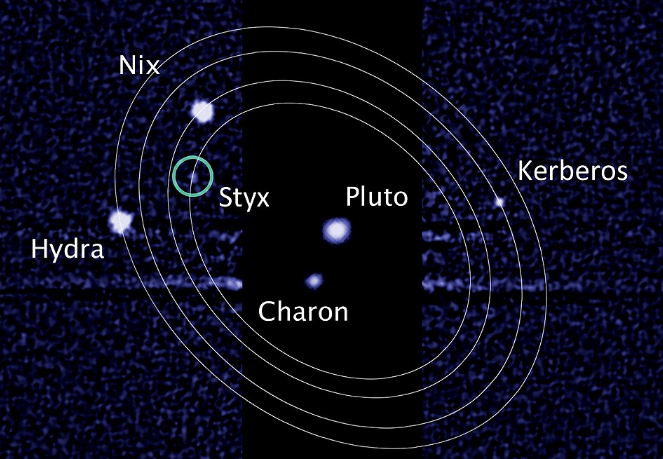
Even though the International Astronomical Union kicked Pluto out of the planetary club, it still belongs to another club; a club that only has seven known members: planets and dwarf planets in our Solar System that have moons. For the record, Pluto had five moons, and since we met Charon last time, it’s time to meet the other four. I’ll present them in the largest diameter size after Charon, of course.
Hydra
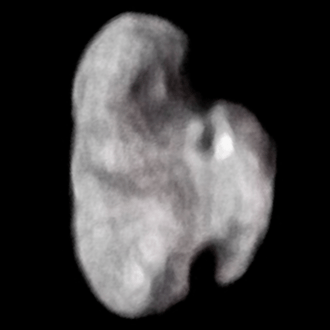
Hydra is the second-largest moon of Pluto, with a diameter of about 51 km, which, in the scale of the solar system, is practically nothing. It orbits Pluto at around 64,738 km, which is quite close. It is not tidally locked to Pluto, and I can only imagine the relief for tourists and such.
The rotation period of Hydra is only 10.3 hours, and it has an axial tilt of 110°. In dating terms, Hydra is a hot mess. It’s very interesting and mysterious, but very unstable. Its rotation is chaotic, while it flips and tumbles, because of Pluto and Charon’s gravitational influences.
Hydra was discovered on 15th May 2005, by the Hubble Space Telescope, after the New Horizons team wanted to investigate the region. So, when the New Horizons spacecraft did its flyby in 2015, it sent back some astounding images. As for its name, it sadly is not named after the terrorist group from Marvel Comics, but from Greek Mythology, where else? The Lernaean Hydra is a multi-headed monster from the 12 Labours of Hercules. Spoilers, it was the second one, and Hercules, along with his nephew, Iolaus, kicked its collective arse.
Hydra is quite small, with an elongated, non-spherical body. Scientists believe Hydra is covered in water ice, which has a 83% reflectivity, so it is one of the most reflective objects in the Kuiper Belt.
Nix
Keeping with naming celestial objects from Greek or Roman mythology, Nix was named after the Greek goddess of darkness and night, Nyx. She was also the mother of Charon, Hades’ (Pluto) ferryman. And just because I can, Nix is not named after Nyx, the character from Spawn, who is now the Queen of Hell. Yes, yet another comics reference!
Like Hydra, Nix is small and has a diameter of only 42 km, making it the third-largest moon of Pluto. Coincidentally, this is the distance of a marathon, though technically, it’s 42.2 km. Facts matter, people, facts matter. Nix is the third-farthest moon from Pluto, orbiting at an average distance of 48,694 km, which is a lot less than the Moon’s orbital distance from the Earth of 385,000 km. Nix’s orbital period is about 24 hours and 20 minutes, and it has a near-circular orbit to boot.
It was discovered by Max Mutchler and Andrew Steffl, members of the Pluto Companion Search Team. They used photos of Pluto taken in 2002, as well as images from the Hubble Space Telescope, to identify Nix in May 2005, but it wasn’t announced to the public until October 2005.
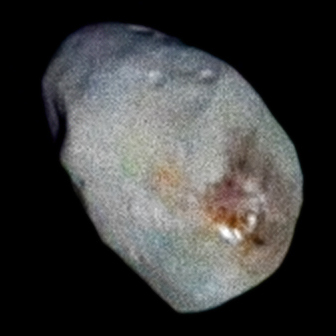
The average distance from Earth to Nix is roughly the same distance as Pluto, at 5.9 billion km, with New Horizons being the only spacecraft that has been able to complete a flyby and send images back in 2015. During the flyby, it was discovered that the moon was in a retrograde rotation, every 43.9 hours with a 132° axial tilt, flipping and tumbling like Hydra. Since its discovery, Nix’s spin rate has increased.
Nix’s surface is similar to Hydra’s, but it does have a unique red patch. It also has two craters, named Gleti and Metztli, named after moon goddesses from Dahomean and Aztec mythology. Science is so cool!
Kerberos
Kerberos was discovered on the perfect day, 28th June, and confirmed on 20th July 2011 by Mark Showalter and a team of researchers, using the Hubble Space Telescope. Ironically, they were not looking for moons, but rather to see if Pluto had any rings. Kerberos has a diameter of 19 km, making it the fourth-largest moon of Pluto. This distance is so minuscule that it’s a distance that I can run. Badly, I might add, but I can still do it.
The moon is named after Pluto’s (Hades), loyal and large three-headed dog, Cerberus, who famously guards the gates to the Underworld. He had two functions: to allow the souls of the dead to enter the Underworld, but also to prevent living souls from entering, as well as to prevent dead souls from leaving. The immortal story of Orpheus, Eurydice and Cerberus is a classic bedtime story for children.
Kerberos orbits Pluto at about 57,780 km, and it cuts an orbital path between Nix and Hydra, making it the fourth-farthest moon from the dwarf planet. For its rotation, Kerberos completes one about every 32.167 Earth days, which is 772.008 hours.
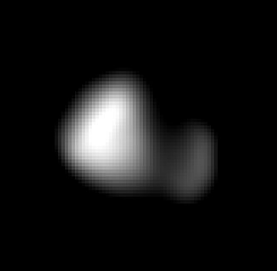
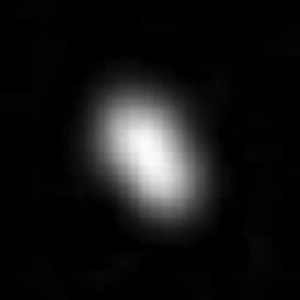
And just like Hydra, Nix, and a gymnast, Kerberos spends a lot of time flipping and tumbling. One leading theory for its creation is that Kerberos is a contact binary. This means it could have been formed from combining two objects, since Kerberos has two lobe-like features. The smaller lobe is roughly 5 km across, but the bigger lobe is 8 km across.
Credit: NASA/JHUAPL/SwRI
Styx
We have now moved onto the final known moon of Pluto, Styx. It is the smallest of all of Pluto’s moons, with a diameter of 16 km, which again, is within the realms of a running distance for me. It was discovered in June 2012 by Showalter and a team of researchers again. The discovery was later verified in July 2012.
Styx is a popular name in pop culture, considering there’s a band, a video game, and yet another Marvel character that shares the name. The moon’s name has two sources, though it depends on who you ask. The first reference is the River Styx, which is one of the rivers that run through the Underworld, and the same river that Charon ferries the souls of the dead across; and the second reference is the Greek goddess, who was the personification of the River Styx, and possibly the daughter of Nyx (Nix). It’s not like her parents filed a birth certificate as such.
Styx is actually the closest moon to Pluto, averaging a distance of 42,650 km, which in cosmic terms is a coat of paint. Like Styx’s siblings, it is not a sphere, but elongated and lumpy, as well as flipping and tumbling. It takes about 20 days to complete a rotation.
I have to add two things as general statements about the Plutonian system.
Firstly, the information, data, and knowledge gained from Voyager 2′s 1989 flyby of the outer planets and moons significantly enhanced humanity’s understanding of these cosmic objects. This understanding can also be applied to New Horizons’ flyby of Pluto and its moons in 2015
Standing on the shoulders of giants.
I remember when the information was being released to the public, and, being me, I was explaining it to other staff members, because they made the mistake of asking me a question about it.
Secondly, a very basic observation has been made; Pluto is a hobbit. It is about 20% times smaller than the Earth, as you could fit 170 Plutos inside it. Pluto is also smaller than seven moons in the Solar System, which includes the Moon. So that being the case, why does something like Pluto, a dwarf planet, have five moons, when its much larger sibling, Earth, only has one?
It’s a fair question. Since no one was present, or at least not communicating with scientists, when the Solar System was formed, scientists must rely on observable and detectable evidence to prove their answers.
The leading hypothesis is that since Pluto is located inside the Kuiper Belt, it’s not out of the realm of possibility that either one or multiple collisions of Kuiper Belt Objects (KBOs) have resulted in three things:
1.) KBOs have been smashed into each other and produced smaller objects.
2.) These new objects have been disturbed and knocked out of their orbit, and left drifting within the Kuiper Belt.
3.) These objects have been caught in Pluto’s gravity well, as small as it is, and have settled into a stable orbit around Pluto.
Clearly, the time frame for these events to occur is longer than it will take for New Zealand to win the FIFA World Cup. Maybe.
With advancements in technology, scientists may discover that Pluto could still have some hidden children out there. Who knows? However, what I do know is that this week’s 6-7 minute lecture is finished. What’s your favourite moon of Pluto? Do you have any awesome facts about Charon, Hydra, Nix, Kerberos, or Styx? As always, please let me know.
Thanks again for reading, following, and subscribing to Some Geek Told Me. My Twitter and Mastodon accounts are still ticking over with content that will surely bore you, so you should definitely check them out and dazzle your family, friends, and enemies with the information.
As I’m packing up, I need to give you a heads-up about three things. The FIFA World Cup is starting next month, so don’t be surprised if you notice some increased posts about the World Cup across my three accounts. I also have a few movie previews/reviews planned soon, which will include Star Wars: The Mandalorian and Grogu, Supergirl, The Odyssey, and Spider-Man: Brand New Day. I haven’t decided about Masters of the Universe, or Disclosure Day, but my bank account could make that decision.
The final point is that some new amazing followers and readers don’t already know that we are slowly reaching the first of my two holidays from running New Zealand’s 5th least favourite website. Basically, it will be my mid-Winter break, which is around the end of June-start of July, which is followed by the mid-Summer break, also widely known as the Christmas holidays.
Please don’t forget to walk your dog, read a banned book, thank the bus driver, and I’ll see you next week for the Star Wars: The Mandalorian and Grogu Preview. Cool bananas and take care!


You must be logged in to post a comment.