
18th May 2026. That was the last time we visited the Solar System’s worst tour. We’ve been ranting about movies, football, movies, 1963, movies, and more movies since then, but today marks its glorious return! I know, I’m very sorry for keeping the people of Internet land away from this amazing and highly educational blog post, which is Some Geek Told Me’s Tour of the Solar System.
Since the turning of the Earth and the resurrection of dead comic book characters are sadly very predictable, may I offer you the opportunity to search through the predictable and very serious past entries of the tour. They are:
1.) Meet the Family
2.) The Sun
4.) Mercury
5.) Venus
7.) The Moon
8.) Mars
10.) Ceres
11.) Jupiter
12.) The Galilean moons
13.) Saturn
14.) Titan
15.) The Moons of Saturn
16.) Uranus
17.) Titania
18.) The Moons of Uranus
19.) The Literary Moons of Uranus
20.) Neptune
21.) Triton
22.) The Moons of Neptune
23.) The Kuiper Belt
24.) Pluto
25.) Charon
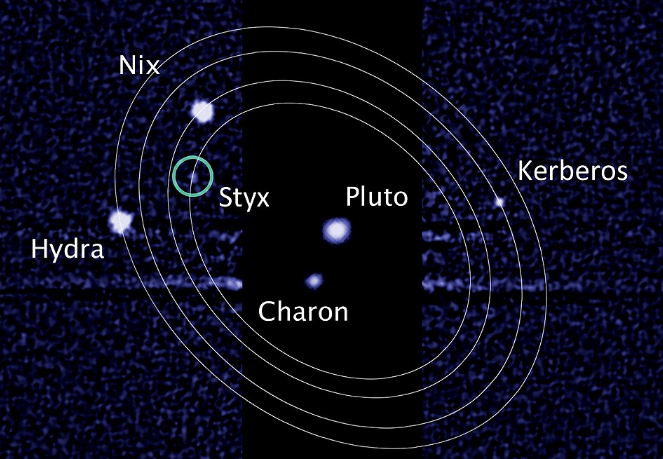
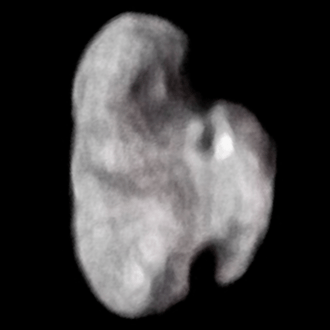
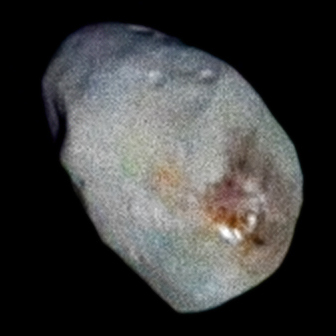
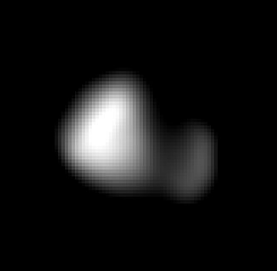
26.) The Moons of Pluto
The last stop on the tour was Charon, the largest moon of Pluto, and then the remaining moons of Pluto. So, like the New Horizons spacecraft, we must leave Pluto and its quirky children and venture out into the Kuiper Belt to meet another member of the family: Haumea. Here’s nothing else left to say, but strap yourself in, because we’re off to Haumea!
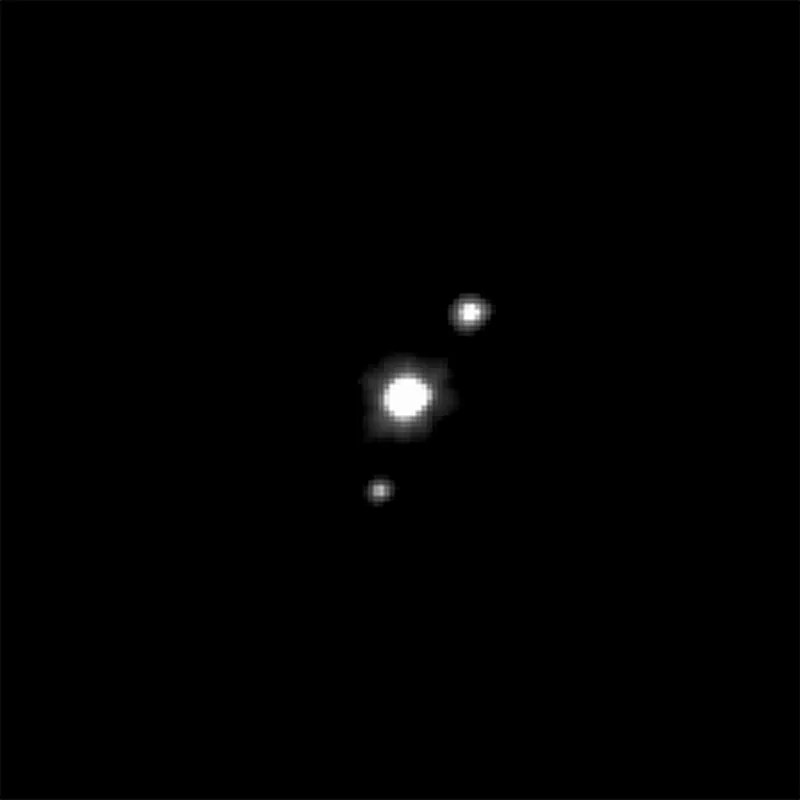
We are going to leave Donald Trump’s new trade war with his northern neighbour and visit Haumea, the third recognised dwarf planet in our Solar System. And when discussing a new acquaintance, the extremely polite thing to do is ask what their age is. So, in Haumea’s case, it is about 4.5 billion years old, similar to Pluto and other Kuiper Belt objects.
And just so we’re all on the same page, Haumea is pronounced as hau·may·uh. Now you know.
One of the leading theories about Haumea’s formation is that it formed from the remnants of the Sun’s formation and the creation of the planets and moons. However, it is believed that a proto-Haumea was struck by a huge object, resulting in a gigantic collision. This collision altered the shape and spin of the dwarf planet that would become Haumea.
The discovery of Haumea is not an easy one to discuss or explain, as it’s not cut and dry. The way I understand it, two different research teams both claimed Haumea’s discovery in 2005, with a team led by Mike Brown basing their claim on images from 2004, while the José Luis Ortiz Moreno-led team based their claim on their images from 2003.
Haumea’s name is just as complicated, because both teams put forward different names, with Moreno’s team proposing Ataecina, the goddess of spring, nature, fertility, and the underworld from Iberian culture; though ultimately, a member of Brown’s team, David Rabinowitz, suggested Haumea, the Hawaiian goddess of childbirth and fertility. And wouldn’t you know it, on 17th September 2008, the International Astronomical Union (IAU) announced the name to the public and media; although the working name for it was Santa.
Haumea has some other interesting facts to make you swipe right, as it’s part of a very elite club: it has a ring. No, Beyoncé didn’t put a ring on it, but it’s still there. The ring was discovered in 2017, and it’s believed to be about 70 km wide, at a radius of 2,287 km from the centre of Haumea. This gives Haumea the title of the only known dwarf planet and object in the Kuiper Belt to have a ring system.
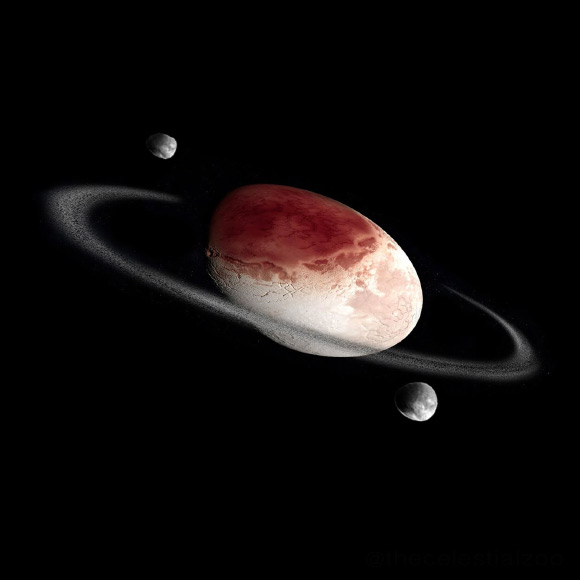
And speaking of a system, Haumea has something else going for it. You see, Haumea does not just have one moon, but two. Discovered in 2005, though their names were not revealed until the Haumea announcement on 17th September 2008. And, funnily enough, they were called Hiʻiaka (goddess of dance and patroness of the Big Island of Hawaii) and Namaka (goddess of water and the sea), who were named after the daughters of Haumea. One leading theory for Haumea having a ring and two moons is that it is the result of the heavy impact I mentioned earlier in its life.
What makes it remarkable for a dwarf planet to have a ring and two moons is the size of it. Its diameter is only about 1,544 km, which works out to be roughly the length of Great Britain from north to south; a drive from Madrid, Spain, to Paris, France; or the length of New Zealand, from Cape Reinga to Slope Point. Compared to the Earth, Haumea is about 1/7 the width of it.
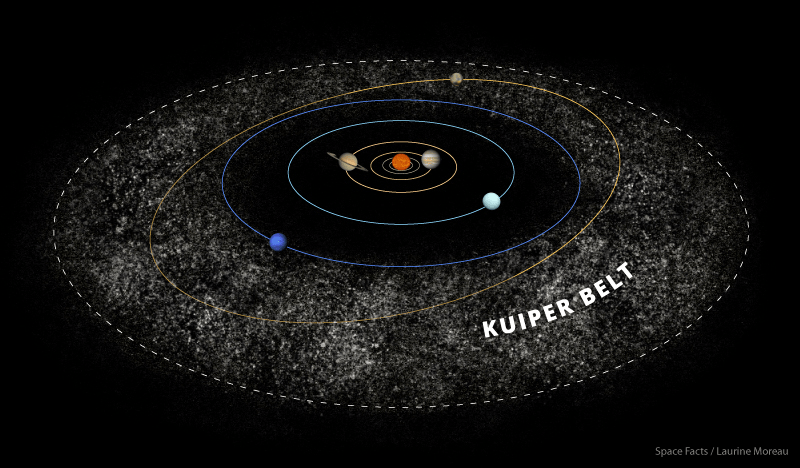
Haumea’s distance from the Sun is interesting. Since its orbit places it past Neptune, Haumea is a Trans-Neptunian object (TNO), as well as a Kuiper Belt Object (KBO), because it resides in the, yes, you guessed correctly, the Kuiper Belt. Its average distance from the Sun is 6.5 billion km, which is quite staggering.
Another measurement is the AU, or the astronomical unit. This cool measurement is the average distance from the Earth to the Sun, which works out to be about 150 million km, so that’s 1 AU; Haumea is 43 AU. Its perihelion, which is its closest point to the Sun, is about 5.19 billion km, while its aphelion, the furthest point away from the Sun, is about 7.69 billion km. Haumea also has an orbital speed of about 4.53 km/s.
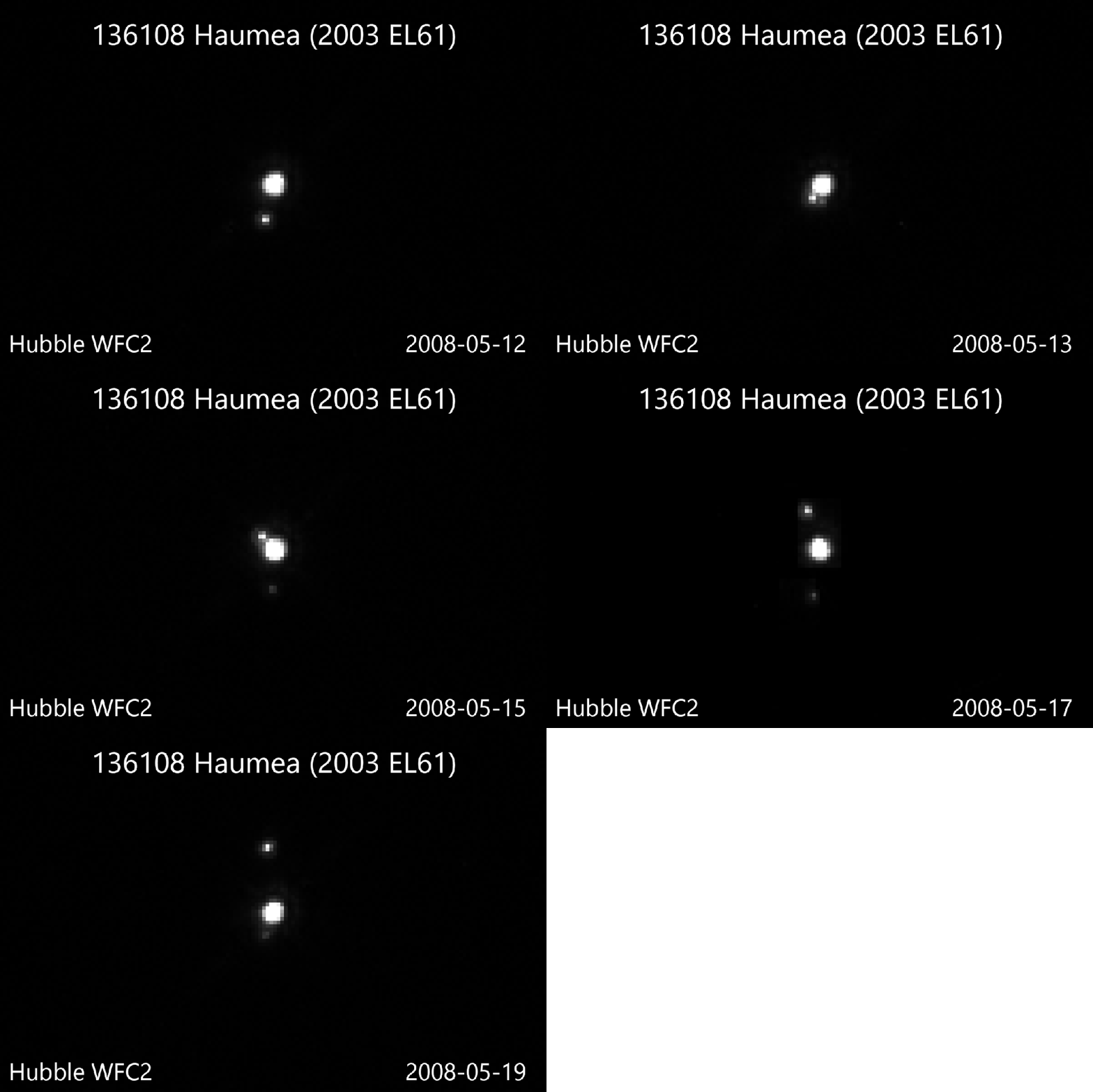
This, of course, you would know all too well: at that distance, light from the Sun would take along time to reach Haumea, six hours to be precise. In comparison, light from the Sun takes about 8 minutes and 20 seconds to reach Earth. Six hours equates to watching four football games, back to back, but also the run time of the Back to the Future Trilogy, including trailers.
Do you remember when I explained about the proto-Haumea being hit by another object and altering its shape and spin? Of course you do, because you get nothing but straight A’s. You see, because of that impact, Haumea’s rotation is freaky. Not just freaky, but that-will-cost-you-extra-freaky. It has a rotation rate of about four hours, which makes it one of the fastest rotating large objects in our Solar System. The Flash would be so proud.
An extension of this is the time it takes for Haumea to make one orbit around the Sun. As it’s been established, the general rule for orbits in the Solar System is that the closer an object is to the Sun, the shorter the length of time to make one complete orbit around the Sun. Because of this, the opposite is true: the further an object is from the Sun, the longer it takes to make one orbit.
To elaborate on this, it takes Earth approximately 365.25 days to complete one full orbit around the Sun, which makes a year. However, Haumea takes 285 Earth years to make the same journey. To make sense of this measurement, when Haumea was roughly in its present location in time and space; in 1741, George II was the King of Great Britain and Ireland, Great Britain and Spain were fighting each other in The War of Jenkins’ Ear, the Indian kingdom of Travancore had defeated the infamous Dutch East India Company at the Battle of Colachel/Kolachel, with the War of the Austrian Succession in the background, along with the eruption of Oshima–Ōshima and the Kampo tsunami. In 1741, the estimated total world population was about 700 to 750 million people.
Haumea is not exactly the best place to unwind; I mean, it’s not Ibiza or Tahiti. Yes, the travel cost and distance are a concern, but so is the temperature. The average surface temperature of Haumea is about -241°C, which is −151.8 °C colder than the coldest temperature recorded on Earth.
As for Haumea’s atmosphere, to the best of my understanding, Haumea does not have a detectable atmosphere, though future monitoring technology may reveal it. For Haumea’s physical features, it is believed to be 90% covered in a substance like pure crystalline water ice, because of how much light it reflects. And like Pluto, Haumea has tholin-like compounds, which have reddened parts of the surface, as represented in one area as a large dark red patch.
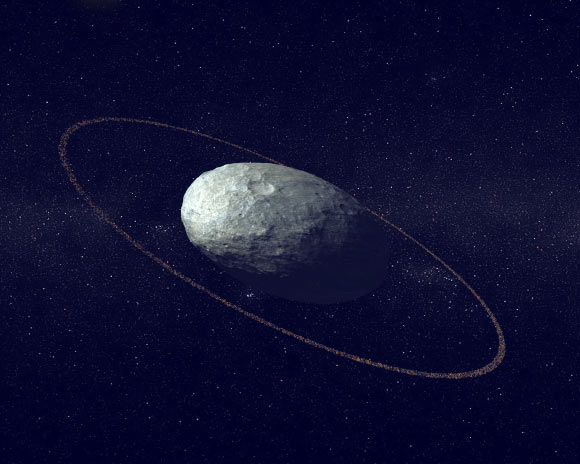
To cap this tour off with Haumea, we need to discuss its shape. One of the criteria for a cosmic object to be classified as a planet is that the object needs to have sufficient mass to assume hydrostatic equilibrium. Basically, it means that the object needs to be nearly round. Strictly speaking, the inner and outer planets are relatively round, like a football or basketball.1
Haumea is very different from the rest of its family members. When large cosmic objects are spinning, gravity likes to pull them into a shape that reflects a sphere. Because of this, the fast spin causes its centrifugal force to push outward at the equator. This can be observed with the Earth, because it bulges at the equator and flattens at the poles; thus, Earth is actually an oblate spheroid.
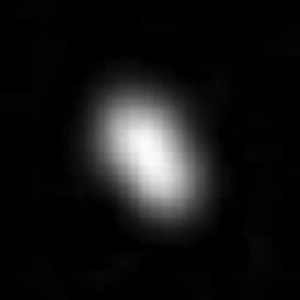
But if we go back to Haumea, its extremely fast and powerful spin has caused deformation. Because of its fast spin, the centrifugal force has stretched and pushed Haumea out into an elongated shape, similar to an egg or a rugby ball. Essentially, Haumea is not a sphere; it’s more of an oval shape, like an elongated triaxial ellipsoid. Science is cool.
And with that amazing fact, we shall bring this week’s rant to a close. What’s your favourite fact about Haumea? As always, please let me know. Thanks again for reading, following, and subscribing to Some Geek Told Me. Spring is just around the corner for us; Autumn for others, so if you want daily information to help you with this transition, my poorly written anti-social media accounts are still operating on Twitter and Mastodon. Yes, I know it’s called X; I just don’t want to call it that.
Please don’t forget to walk your dog, read a banned book, watch some panda fail videos, and if you ever repeat any of the information I write about, and someone asks you where you learnt it, just say, “Some Geek Told Me.” Take care, and I’ll see you next week.
1 Once again, suck it Flat Earthers!


You must be logged in to post a comment.