We Didn’t Start the Fire: 1957

As the tariffs continue, so do the days of our lives. In our daily routines, we can choose what we do, including dissecting a 36-year-old song, even though it has been analysed before.

Because you’re a clever person who likes to get at least 10 hours of sleep and loves eating Vegemite, you would have realised I’m talking about one of my dumbest ideas, explaining the historical references in Billy Joel’s We Didn’t Start the Fire.

I started this pointless project in February 2024, and I’m still stuck in the 50s. I’ll probably retire before I finish it. For those unfortunate people who have missed out on the past entries, fear not, for I have the complete list.

 We Didn’t Start the Fire: The Beginning 

We Didn’t Start the Fire: 1948-1949.

We Didn’t Start the Fire: 1950

We Didn’t Start the Fire: 1951

We Didn’t Start the Fire: 1952

We Didn’t Start the Fire: 1953

We Didn’t Start the Fire: 1954

We Didn’t Start the Fire: 1955

We Didn’t Start the Fire: 1956

After reflecting on the historical events of 1956, I’m ready to delve into 1957, which promises to be just as wild and challenging. Like before, get ready for an adventure because we are traveling back in time with our destination set for 1957. Let’s do this!
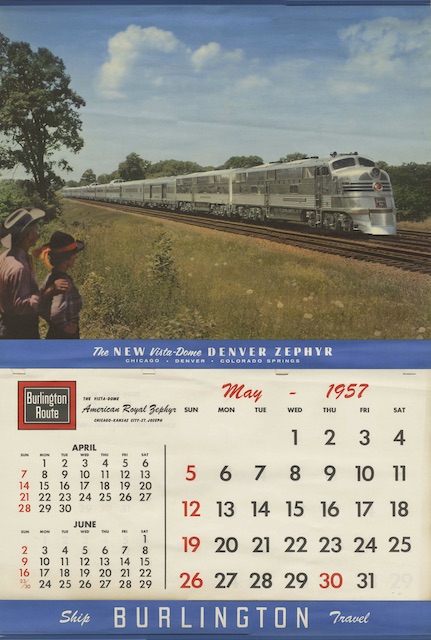

Credit: Burlington

1957

Little Rock

Little Rock is located in Arkansas, United States, and in 1957, it was a flashpoint for the Civil Rights Movement. It centred around nine African American students who were integrated into Little Rock Central High School. These students become known as The Little Rock Nine.

Through a ruling from the Supreme Court that declared that the laws that established segregated schools were unconstitutional, and the backing of the NAACP (National Association for the Advancement of Colored People), the nine students were enrolled at Little Rock Central High School.

The school was racially segregated, so black students attending an all-white school did not go down well for everybody. Among several protests against the integration, Orval Faubus, the Governor of Arkansas, deployed the Arkansas National Guard to support the protesters, as well as to block the students from entering the school.

If you remember from the 1952 blog, Dwight D. Eisenhower was the President of the United States of America, and this situation annoyed him. His response was to issue an executive order, which federalised the Arkansas National Guard. He ordered them to support the integration and along with the 101st Airborne Division, escorted and protected the students while at school. This drama was named The Little Rock Crisis.

As a non-American, it’s difficult to quantify a modern example of the Little Rock Crisis. My only answer is to point out the legacy that it brought to the public school system in the United States, by guiding the way in the desegregation of public schools.

The Little Rock Nine being escorted by the National Guard to Little Rock Central High School, Arkansas, 1957. Credit: Everett Collection

Pasternak

Boris Pasternak was a Russian poet, composer, literary translator, and novelist. He was born in Moscow, which was then part of the Russian Empire before it was transformed into the Soviet Union. He is included on this list because he wrote a small and uncomplicated book that you may have heard of: Doctor Zhivago.

Pasternak gave typed manuscripts to foreigners in 1956, knowing they wouldn’t be published in the USSR. The manuscripts were then smuggled to Milan, Italy. Doctor Zhivago was released in 1957, and I’m going to do an awful job at explaining this, but the novel focuses on wars, separation of families, love, and characters. So many characters, with just as many names.

The 1958 Nobel Prize for Literature was awarded to Pasternak for Doctor Zhivago, and it remains a masterpiece and beloved the world over for its themes. Over the years, the book has sold millions of copies and has been adapted for television, theatre, and film, with special mention to 1965’s Doctor Zhivago, where it was nominated for 10 Academy Awards and won five.

Doctor Zhivago. London: Collins & Harvill, 1958. Credit: Raptis Rare Books

Mickey Mantle

We haven’t discussed baseball for some years now, but this entry will change that. Mickey Mantle was a professional baseball player who played primarily as a centre fielder for the New York Yankees, between 1951–1968.

Mantle earned many different baseball awards, championships, and trophies, but that’s not why he’s on the list. In 1957, Mantle made The Major League Baseball (MLB) All-Stars team. For those of you not up with the play, the All-Stars are players made up from teams in the American League and National League.

This fixture became an annual event on the MLB calendar. Now what made Mantle’s inclusion in the 1957 game special was that it was the sixth year in a row that Mantle had made the All-Stars team.

For a contemporary equivalent, you could go with Mike Trout, but the All-Stars also covered Major League Soccer (MLS-Football), National Basketball Association (NBA), National Football League (NFL), and National Hockey League (NHL), so you could take your pick from them as well.
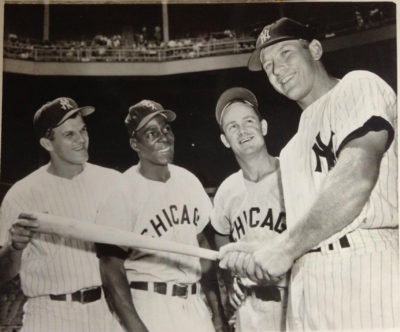
Bill Skowron, Minnie Minoso, Nellie Fox, and Mickey Mantle at the 1957 All-Star game. Credit: Unknown

Kerouac 

This is quite rare, but we have a second book entry. On the Road was written by Jack Kerouac, and was released in September 1957. Kerouac based this book on his travels with his friends across the United States, and in some circles, it’s considered a memoir.

The book highlights the Counterculture generation, like the Beat movement, and was controversial with the characters’ carefree lifestyle, drugs, and travelling, along with the music. On the Road has sold over 4 million copies worldwide, with ongoing sales of around 100,000 copies annually. 

On the Road has gone on to influence and inspire many different entertainment creators like Hunter S. Thompson, David Bowie, Matty Healy, Jerry Garcia, and Van Morrison, but also Jim Morrison and Bob Dylan.

Front cover for the first edition of On the Road by Jack Kerouac. Credit: The Viking Press

Sputnik 

I wasn’t born in the 50s, so I can’t imagine the fear and tension that came with Sputnik. Launched on 4th October 1957 by the Soviet Union, Sputnik 1 was the world’s first artificial satellite. It was only 58 cm in diameter, and it carried a low-power radio transmitter that broadcasted a beeping noise at regular intervals, which could be heard by radio listeners around the world.

It achieved an Earth orbit with an apogee (farthest point from Earth) of 940 km and a perigee (nearest point) of 230 km, along with circling the planet every 96 minutes. The satellite remained in orbit until 4th January 1958, when it fell back and burned in Earth’s atmosphere. It had travelled 70 million km around the planet before deorbiting. 

Known simply as Sputnik, this 83.6 kg device caused anxiety throughout the West, which marked the beginning of the space age between the United States and the Soviet Union. 

The legacy of Sputnik can be seen in various spacecraft and satellites launched by the USSR that bear its name, as well as in the thousands of satellites launched by other countries and companies. Just consider where NASA, ESA, SpaceX, Blue Origin, and Virgin Galactic would be today without the influence of Sputnik.
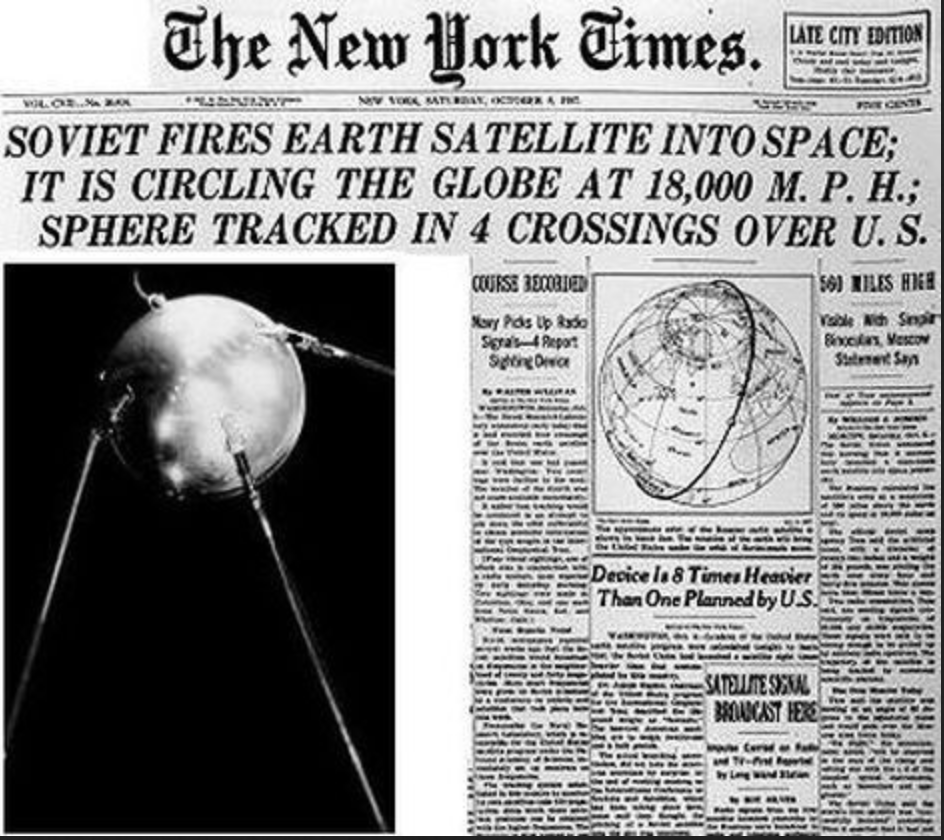
On Oct. 4, 1957, the Space Age began as the Soviet Union launched Sputnik 1, the first artificial satellite, into orbit. Credit: The New York Times

Chou En-Lai

Chou En-Lai, also known as Zhou Enlai, served as the first Premier of the People’s Republic of China from its establishment in 1949 until he died in 1976. He was also the country’s foreign minister, a position he held from 1949 to 1958, during which he travelled extensively.

In 1950, he signed a treaty that committed China and the Soviet Union to co-operate. Furthermore, he played a crucial role in facilitating Richard Nixon’s historic meeting with Mao Zedong in China in 1972.

In modern times, you could go in two different ways, either as a foreign minister or an intermediary. For the foreign minister angle, you could just promote your foreign minister, however, the intermediary is a lot easier. Think of Henry Kissinger and President Jimmy Carter for the Middle East, Alexander Haig for Argentina and the United Kingdom, and recently, Emmanuel Macron for Ukraine and Russia.
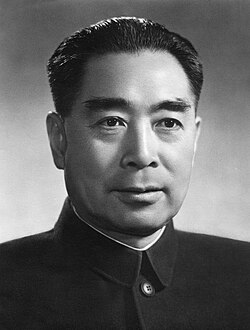
Zhou Enlai (Chou En-Lai), Premier of China. Official portrait, 1950s. Credit: anonymous, Public domain, via Wikimedia Commons

Bridge on the River Kwai 

The Bridge on the River Kwai was a war film based on a book of the same name. Released in 1957, the film tells the story of Allied prisoners of war in Japanese-occupied Thailand, who are forced to build a bridge over the Kwai River, linking Thailand to Burma (Myanmar) for the Japanese, via a railway.

Directed by David Lean, the film went on to earn US$30.6 million, against its US$2.8 million budget. It found universal acclaim, winning seven Oscars at the 1958 Academy Awards, three Golden Globes, and four British Academy Film Awards. The Bridge on the River Kwai has been described as not only the greatest war film ever made, but also one of the greatest films ever made.

I’ve been lucky enough to have seen it, and it’s phenomenal. Seriously, it’s one of those times when you should believe the hype about a film, it’s that good. Some modern films that swept the Academy Awards include Titanic (1997), The Lord of the Rings: The Return of the King (2003), and La La Land (2016).

So for 1957, we covered an American desegregated high school, a Russian author, a baseball player, an American author, a Soviet satellite, the Chinese Premier, and a film. We’ve been working hard on this, so 1958 will be less chaotic. Maybe.

So that’s it for another week in this ridiculous project. Cool. Thanks again for reading, following, and subscribing to Some Geek Told Me. I have accounts on Twitter and Mastodon, where I try to sound clever, so follow me if that floats your boat.

Please remember to walk your dog, read a banned book, and enjoy your 90-day pause on Trump’s tariffs. I’ll see you next week, where I’m going to discuss some news that is equally part exciting and scary. Take care and Slava Ukraini!

Who wants a trade war with penguins?

I’m going to start with an apology. Today’s blog post was supposed to be about We Didn’t Start the Fire’s 1957 historical references; as I spoke about this last week. Now, I’m very sorry to let the fans of this project down, because as I was writing the blog, something extraordinary happened, and I simply couldn’t ignore it.

So in my infinite wisdom, I decided to put a pin in the 1957’s historical references, and actually discuss a trade war. Due to our interconnected world, trade serves as a vital link among us. Surprisingly, it seems that the President of the United States is beginning a trade war with penguins, elephant seals, and seabirds.

Let’s analyse this carefully to determine its truthfulness, or if it is simply the mainstream media attempting to humiliate a 78-year-old convicted felon.

On 2nd April 2025 (local time), President Trump unveiled his hotly anticipated new tariff scheme, which was dubbed Liberation Day. Again, as you know, he declared a trade war against various countries and territories around the world, including my own.

I don’t have enough time to discuss how unusual it is that Russia, Belarus, and North Korea were omitted from the tariff list. My time is too valuable for that, as well as addressing the fact that these tariffs aren’t truly tariffs. Instead, they are based on a flawed formula meant to reflect the trade deficit between the United States and countries or territories.

No, I won’t mention those two things at all. I won’t even talk about how global markets are melting down, with at the time of writing, US$6.6 trillion was been wiped away. I would never stoop that low to discuss and mock those important matters.

And you can forget about me ever mentioning that the White House is now reframing the tariffs as sanctions. Nope, not by me, or on my account. There’s no way I would ever discuss that.

However, there is one tiny thing I would like to discuss. When the former McDonald’s employee and casino bankrupter revealed his list of countries and territories that he wanted to punish for not buying enough US-made items and goods, he included a rather strange entry: The Heard and McDonald Islands.


Credit: White House

The Heard and McDonald Islands are some of the most isolated places on the planet. They lie in the Southern Indian Ocean, about 3,850 km from Australia, where the islands are an Australian external territory. It’s roughly the same latitude as Madagascar, about two-thirds of the way from Antarctica and Madagascar.

The islands’ total land area is only 372 km2, with a coastline stretching 101.9 km. The Heard and McDonald Islands are home to two volcanoes and hundreds of thousands of fauna, such as penguins, elephant seals and seabirds.

But one of the strangest things about the Heard and McDonald Islands is the human population, which is zero. Yes, that’s correct, not a single person lives there. They are uninhabited by humans.

According to the data revealed by the White House, the Heard and McDonald Islands have a trade deficit of 10%, which has resulted in the world’s most famous 78-year-old convicted felon, slapping a 10% tariff on the islands.

Putting aside the suicidal nature of the financial and economic illiteracy of the tariffs, we have a problem. If we are to believe the White House’s data and figures, and why would we not, it means the Heard and McDonald Islands have a trade deficit with the United States.

From the United States perspective, the Heard and McDonald Islands are exporting more goods and services to the United States than they are importing from the United States, hence the trade deficit. But here’s the problem: if the Heard and McDonald Islands are uninhabited by humans, then who or what the fuck is trading with the Americans?

I hope you’re sitting down because the answer is penguins, elephants seals, and seabirds. I like to stay informed about world events, but I’ll be honest, I had no idea that a collection of penguins, elephants seals, and seabirds, living on islands near Antarctica, had not only mastered the ability to understand human language, finance, and commerce, but also have the means to conduct trade with humans. I feel really stupid and ignorant for not knowing this.

I have so many questions about this:

  • Do the different species of animals trade separately or collectively?
  • What do they trade? Is it eggs, feathers, shit, or something else?
  • If it’s shit, is penguin shit more valuable the elephant seal shit?
  • Do the penguins, elephant seals, and seabirds get along with each other, or are there different factions working against each other, whether it’s politically or financially?
  • How likely is a civil war to break out on the Heard and McDonald Islands, over the tariffs?
  • How do they communicate with the humans?
  • What do the penguins, elephant seals, and seabirds import from the United States?
  • Who are the American importers, and how are they surviving with the 10% tariff slapped on by the Heard and McDonald Islands?
  • What is the currency of the Heard and McDonald Islands?
  • Are Australian penguins, elephant seals, and seabirds, really taking jobs away from American humans, or American fauna?
  • Is this not the greatest example of evolutionary biology ever discovered?
  • How is this not the biggest news story in the history of the world; animals trading with humans?
  • Has anybody spoken to Sir David Attenborough about this? What are his thoughts?
  • Do the Heard and McDonald Islands only trade with the United States?
  • By starting a trade war with the Heard and McDonald Islands, does the White House hope to bring back more American jobs?
  • Does Elon Musk wish to export Teslas to the Heard and McDonald Islands?

The questions are endless because I’m just stunned at this revelation. This startling information is hard to understand and comprehend since it must be true and accurate. Otherwise, the US government would look like a group of people who wouldn’t be able to organise a party at a brewery. This would be one of the biggest displays of incompetence the US government have committed since Signalgate.

I mean, Trump, armed with his stable intellect, and his posse of loyal henchmen, could never make a mistake, right? Because that would be bigly. Nah, I bet every single penguin, elephant seal, and seabird on the Heard and McDonald Islands is woke.

And this ladies and gentlemen, is the world we live in. Welcome.

That’s another blog post for another week. Thanks once again for reading, following, and subscribing to Some Geek Told Me.

That’s three political blog posts in a row, so that’s enough for now. I’m going to finish We Didn’t Start the Fire: 1957, so we can discuss history, music, people, and politics…damn.

Please don’t forget to walk your dog, read a banned book, tell Sir David Attenborough about tariffs on the Heard and McDonald Islands, and I’ll see you next week to continue We Didn’t Start the Fire.

Seriously, can someone please talk to Sir David Attenborough? His response would be amazing.


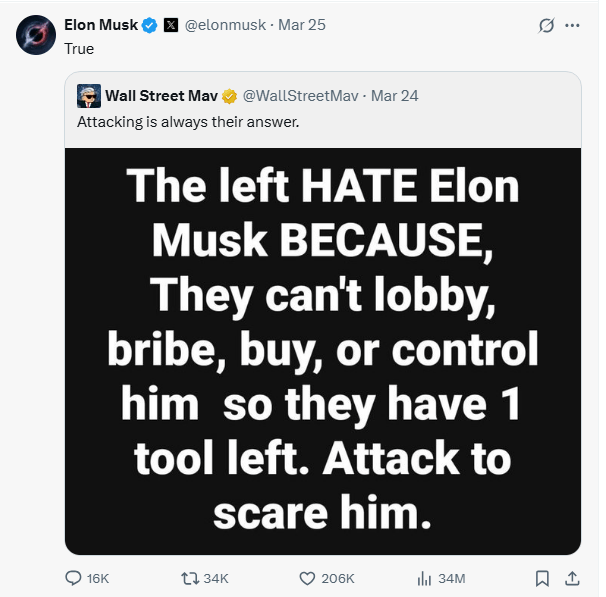
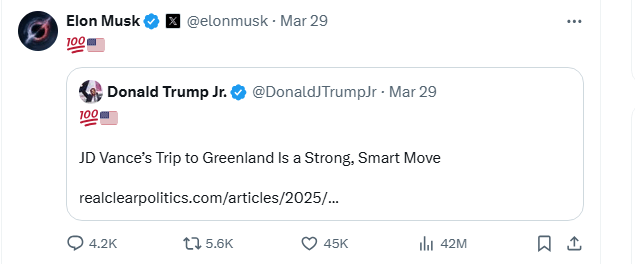
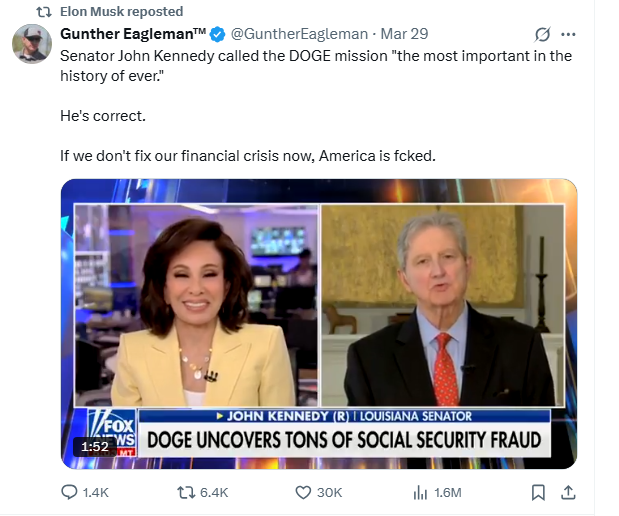
Cherry picking Elon Musk’s delightful and inspiring tweets

Following on from last week’s award-winning blog post on Elon Musk and Tesla, I thought I would include an epilogue of some sort. And when I mean award-winning, I mean…wait, do I need to explain that joke?

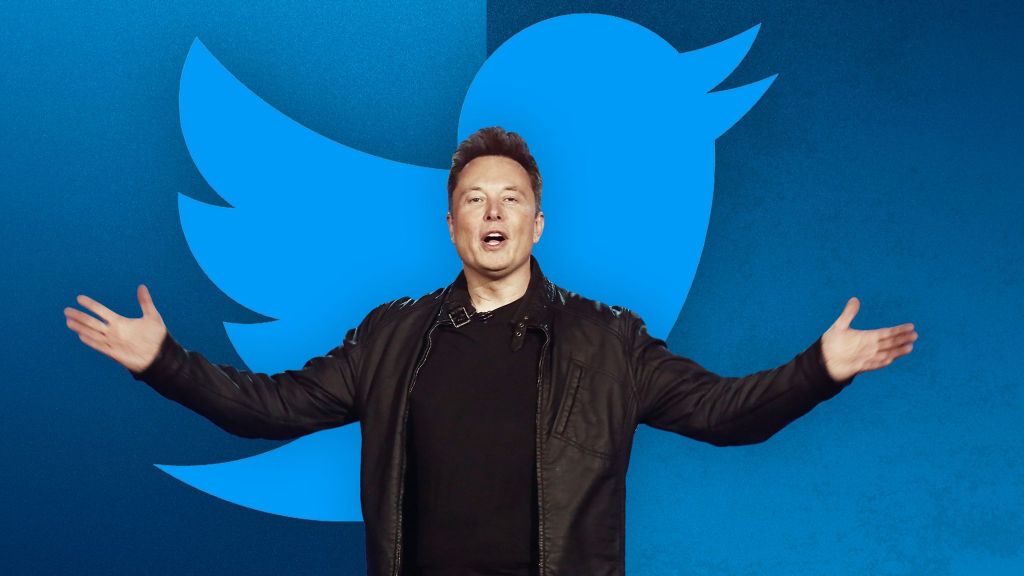
Anyway, Musk is a busy man. He’s mismanaging DOGE (Department of Government Efficiency), selling Teslas at the White House, launching and blowing up rockets with SpaceX, selling and buying his companies to himself, and doing interviews with Fox News.

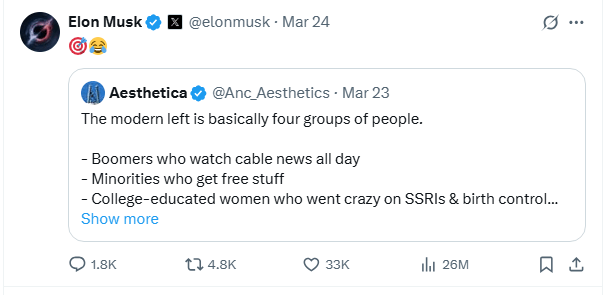
To everyone’s surprise, Musk still manages to find time to share his innermost thoughts and ideas with his 218.8 million followers on Twitter.1 Because of this, I talked to my Chief Consultant for Bad Ideas and decided to examine what Musk has been posting and reposting on his account lately.

Three things to remember before we start this stupid idea:
1.) I’m only going back a week at the most, because, well, that’s all I can tolerate.
2.) I’m focusing on the different posts and reposts that Musk has done on his Twitter account. I’m not including anything other people have said about him, that is not on his account.
3.) Since this is my account, I get to decide what happens. Because of this, I will be selectively choosing posts and reposts, which make Musk stand out for various negative reasons.

Awesome, so let’s read what nonsense the richest person on the planet has to say on nearly everything.


Credit: Sky News

Make of these posts as you will. That’s a lot to take in, as it was only over a few days, and that’s not counting all of the other stuff on his account. Musk is on social media more than George Takei, and that’s saying something!

Love him or hate him, Elon Musk is not going anywhere, least of all on Twitter, which Musk recently sold to xAI, an artificial intelligence start-up company, for US$33 billion. Just to clarify, Musk owns xAI, so he purchased and sold a company to himself. I have enough problems remembering to remind myself about things to buy at the supermarket.

Anyway, like I said last week, Musk is a complicated person, and his posts and reposts are a small window into the mind of a man who is one bad day away from becoming a real Bond villain.

That’s another blog post for another week. Thanks once again for reading, following, and subscribing to Some Geek Told Me.

Please don’t forget to walk your dog, read a banned book, and if you can, please donate to the rescue relief in Myanmar, where a 7.7-magnitude earthquake hit the country and killed over 1,600 people. From personal experience, earthquakes are hell, so if you can donate, please do. I’ll see you next week because we’re going back to 1957. Can’t wait.


1 I know Twitter has been rebranded as X, but it’s still Twitter to me; just like the Gulf of Mexico. Sorry, I’m a jerk.

Is Tesla a way to save the world or it is a swasticar?

Saying Elon Musk is a complicated person is like saying, “Star Wars is just a movie.” There’s more to him than being the richest person in the world, which is starting to have some truly horrible consequences. He’s making the news for good and bad reasons, but we are so deep into the rabbit hole that, at this stage, I don’t think there’s much difference.

I’ll be honest here, I’ve tried to be balanced with this topic, but it’s awkward.

I admire Musk’s work with SpaceX and The Boring Company because they are creative and inventive companies that are pushing human development and advancement. It may not be popular, but I don’t care that he’s the wealthiest person in the world, because if its not him, its going to be Jeff Bezos or some other loser that has not become Batman.

I’m not particularly fond of billionaires in general, but I think Musk is impressive for his contributions to scientific development. However, I believe that billionaires should be taxed at a higher rate, regardless of where they reside.

However, my admiration of Musk can only go so far. His shenanigans with DOGE (Department of Government Efficiency), his anti-woke crusade, the buyout of Twitter (X) to ensure/suppress freedom of speech, and his not-so-subtle sympathising with Nazis, have slowly turned him into a financial and social pariah.


Image by Blomst from Pixabay

This amazing transition brings us to Tesla. Although Musk did not start Tesla, Inc., he is now Tesla’s face to the world. When you think of Tesla, you think of Musk, like Jeff Bezos and Amazon, Bill Gates and Microsoft, Steve Jobs and Apple, and Ronald McDonald and some random burger chain.

To help combat climate change, I believe Tesla is a crucial player in this effort. As one of the world’s leading electric car manufacturers, it employs over 125,000 people. While it is a business focused on making a profit, it also provides a valuable resource to the world: electric cars.

I’m naive about many things in this beautiful world, but I understand how capitalism and businesses work, because I purchase products from major corporations, including food, books, shoes and clothes; they are a necessary burden. But they provide a service or product, that we, the consumers, want.

Tesla is no different in that regard, so I have no major ill will towards them. They have a great concept and I wish them all the luck in the world with their electric cars. If I had the money, I would own an electric car of some type.

But Tesla is in trouble, because of Musk’s actions and speeches. The backlash towards Musk is justified because his personal life is clashing with his professional and business life. It’s been a snowball of conservative actions, topped off with his ascension to DOGE, and he is, for all of the optics, a Nazi sympathiser.

Tesla dealerships are getting graffitied and attacked, while the cars are being fire-bombed, destroyed, vandalised, scratched, and defaced, whether they are on a lot, in car parks, or at people’s homes. This has meant that Tesla stock has taken a hit, not just across North America, but around the world. It’s a global boycott.

About four years ago, a former colleague of mine and her husband bought a second-hand Tesla with the help of a bank loan. She often spoke about how owning a Tesla was a dream for her because she believed strongly in the electric car industry and its potential to combat climate change.

Last week, my wife was talking to another mother at school, who revealed that she had purchased a second-hand Tesla 10 months ago, for the same reasons my ex-work colleague had. However, she also explained in the last few weeks, members of the public have been yelling and cursing at her, with one man calling her a Nazi.

She reinforced to my wife that had she got the car, “…before Elon become a dickhead. We didn’t know he liked Nazis. We haven’t done anything wrong.”

I am both impressed and proud of the resistance against the actions of the richest person on Earth. It’s truly remarkable what people can stand up to—if you can’t confront an ultra-wealthy Nazi sympathiser, then who can you stand up to?

On the other hand, Tesla was not Musk’s creation, but he is their poster boy. What happens if Tesla’s stock keeps falling? Job losses, that’s what. How many of the 125,000 workers will lose their jobs, because of Tesla’s financial issues? 10%? 25%? 75%?

Would the total collapse of one of the world’s largest electric car manufacturers be a positive thing? The oil and gas industry would say yes, but climate activists and other electric car manufacturers would say no.

To the best of my understanding, Musk owns 12.8% of Tesla stock, which is worth about US$97.8 billion. His net worth is estimated to be around US$327.3 billion, so his Tesla stock works out to about 30% of his wealth.

If Tesla collapsed and Musk lost all of the money in Tesla stock, he would still have at least US$220 billion.

If Tesla collapsed, what would the 125,000 workers have? Could the electric car industry recover from that disaster? I don’t want to find out.

So, as a global village, we have a dilemma. Do we continue the destruction of Tesla vehicles and the company, until it is completely destroyed, because of its connection to Musk? Should we then destroy and cancel Twitter (X), SpaceX, the Boring Company, Neuralink, as well as OpenAI?

Or do we ignore Tesla, and allow Musk to continue his harmful rhetoric and policies, without any more pushback or punishment?

Or maybe, there’s a compromise. What if society could stop cancelling Tesla, but Musk could still be held accountable?

Hear me out. Because of the huge number of stocks he holds, Musk is the CEO of Tesla. But imagine if Tesla drew a line in the sand and wanted to put distance from itself and Musk, by forcing Musk out of the company; either by buying him out, or firing him as CEO.

This way, Musk faces consequences, but Tesla could survive and continue its mission to combat climate change, alongside other electric car manufacturers. I know it sounds like a foolish idea, but just imagine if that were possible.

I genuinely appreciate the protests, but destroying Tesla won’t eliminate Musk; it would instead devastate hundreds of thousands of lives through job losses. And who benefits from that? The oil and gas industry, that’s who.

If there is an end game with the protests, it has to be to put pressure on Tesla to act, and force Musk out, or fire him. That is the best scenario I can think of, and that result would make me happy. But hey, what do I know? Also, on a shameful note, I really do like the term, swasticar. It’s really clever.

Anyway, how do you propose we solve the Musk-Tesla problem? Does it need to be solved? As always, please let me know.

That’s another blog for another week. Thanks once again for reading, following, and subscribing to Some Geek Told Me. If I didn’t have this weird writing project, I don’t know where I would be, so again, thank you.

Please don’t forget to walk your dog, read a banned book, continue to pressure Israel and Russia for ceasefires, and I’ll see you next week.


15th March 2019: Six years later

I’ve mentioned this before, but sometimes I struggle to find humour in discussing certain topics. Not that I’m an expert in comedy—far from it—but today’s blog post is one of those times when I can find very little humour.

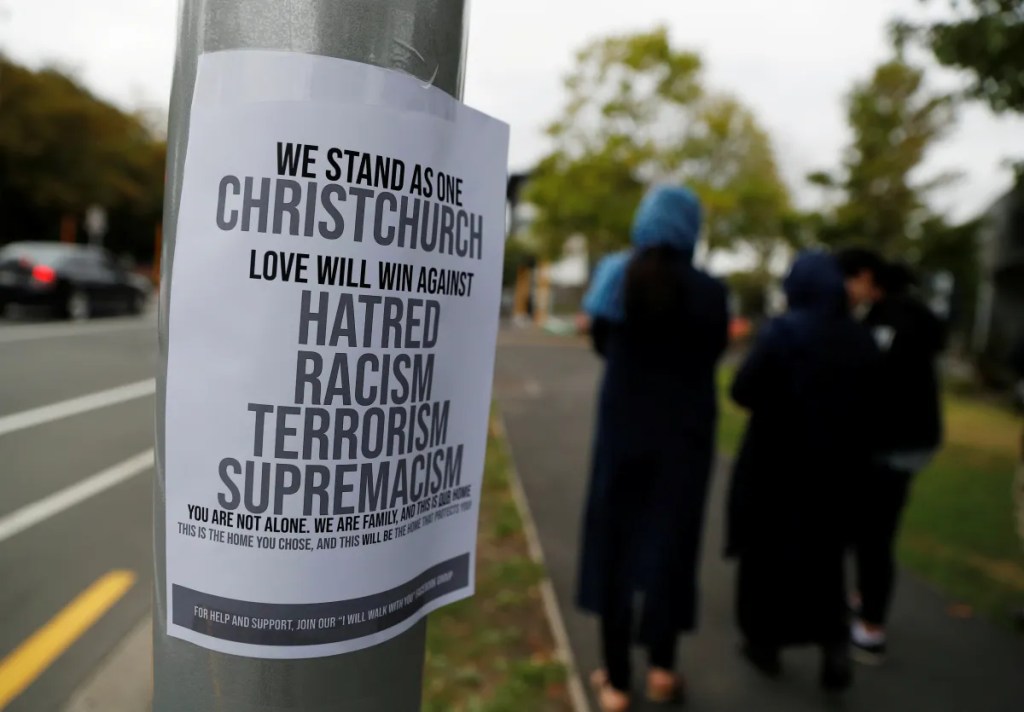
To make sure we all understand what I’m talking about, let’s very quickly establish the facts. On 15th March 2019, a lone gunman, armed with a collection of firearms, including semi-automatic rifles, shot and killed 51 people and injured 89, at the Al Noor Mosque, and Linwood Islamic Centre, in Christchurch, New Zealand. This event became known as the Christchurch mosque shootings or the Christchurch mosque attacks.

I’m not going to rehash the events of 15th March 2019, minute by minute. Professional journalists and reporters have done that already, so I can’t add anything new to the conversation.

The purpose of this blog post is to express my feelings and emotions about the sixth anniversary of the deadliest shootings in modern New Zealand history.

I have a strong connection to Christchurch, even though I no longer live there. I attended university in the city, played football, and met my wife there. It’s where we got married, and additionally, my first child, UMC1, was born in Christchurch. I was even present during the ML6.3 earthquake that struck on 22nd February 2011, which tragically resulted in the loss of 185 lives.

We moved away from Christchurch in early 2016, but it’s still important to us.

Christchurch features a large public open space in the city centre known as Hagley Park, which was one of my favourite places to run. I would always run in an anti-clockwise direction around the park, with Al Noor Mosque on my right-hand side, directly across from the park. The mosque is a famous and significant site for both the city and the Muslim community.

As for the Linwood Islamic Centre, it was only opened in 2018, but I lived only three blocks from the future site, so I know the area quite well. I wasn’t in Christchurch when the shootings happened, but six years later, I am still a mixed bag of emotions surrounding it.

Before I continue, I want to clarify that I did not know anyone who was shot or injured, so families of the victims and survivors will have a much more personal experience than I do. I don’t want to disrespect anyone’s experience, I simply want to express my emotions and feelings because I believe our country and the world are forgetting the lessons that day taught us.


Credit: Combating Terrorism Center

Let’s start with easy emotions, like shame and sadness. Six years later, I’m still ashamed and saddened those murders happened in Christchurch, let alone in New Zealand. The city and country are forever linked to that day and will have to carry an albatross around their necks, until the end of time. Granted, the albatross will gradually decrease in mass and weight, but it will always be there.

There’s also the sadness and shame in educating and explaining to our tamariki (children) about that day, because it relates to them, directly and indirectly.

This brings us to the shame and sadness towards the Muslim community of Christchurch, New Zealand, and the world. Some of the people attending the two mosques were born in New Zealand, while others were born overseas, with some being refugees.

I still feel sad and ashamed for the families having to travel; especially from other countries to mourn their loved ones, because they should have been safe here in New Zealand. They should’ve been, and it was disgusting and unforgivable.

Besides the location, a place of worship like a mosque, church, synagogue, or temple, should be a place of safety and protection for people. It still upsets me that this evil act of hatred was committed, not just against Muslims, or Christchurch or New Zealand, but it happened at all.

My experiences of feeling shame and sadness towards the attacks are also deeply connected to my anger and rage.

  • I’m still angry someone was able to amass a collection of firearms of that magnitude with ease.
  • I’m angry that he was able to livestream the first shootings on Facebook.
  • I’m angry that a white migrant shot and killed other migrants because they were from a different ethnic background to him.
  • I’m angry that the gunman believed in the conspiracy theory of the Great White Replacement. Long-time followers and readers of this account will understand my views towards conspiracy theorists and the garbage they peddle.
  • I’m angry that it happened in New Zealand, and of course, Christchurch.
  • I’m angry not only for the Muslims in Christchurch, New Zealand, and around the world, but also for the Muslims where I live.
  • I’m angry that this evil act empowered supporters of conspiracy theories, the alt-right, and anti-Islam groups in New Zealand to speak up.
  • I’m angry for the victims and their families because this should not have happened.
  • And I’m angry as a white, straight non-Muslim New Zealand male. This country has been slowly working towards diversity and inclusion for over 170 years, so the whole thing is a nightmare.

Having said that, you can’t have light without the dark, and just like the Christchurch earthquakes, you can’t have dark without the light. The 15th of March 2019 was one of the worst days in living memory for my country, but it allowed hope and pride to take centre stage.

  • The way the city, country and government, rallied around the victims and their families, was and still is excellent.
  • The flowers, hakas, and tributes were wonderful.
  • The denouncing of hatred towards people of our community and country was powerful.
  • The work towards pressuring social media companies to regulate more of their content, especially around hate speech and livestreaming, was impressive.
  • Closing the gun law loopholes and making semi-automatic firearms illegal was swift and direct.
  • There were stories of bravery, love, compassion, and humanity that were uplifting.
  • The backlash over the upcoming film, detailing the shootings was glorious by the New Zealand public.

Ultimately, what gave me hope and made me proud as a New Zealander, was the amazing response to the shootings. The world looked at New Zealand at one of our lowest and darkest days, so we did what New Zealanders only know how to: we embraced the victims and families because they were us; and told hate groups to fuck off, because this event would not stop us from doing the right thing, as in being a nation of diversity and inclusion.

There are many other emotions I could talk about, but the main one that remains is frustration, which concerns what’s currently happening in New Zealand and around the world.

  • In New Zealand, our new government have said they are open to rolling back the assault weapons ban, “…because it punishes the good and responsible gun owners.”
  • Taking his cues from the President of the United States of America, our Deputy Prime Minister Winston Peters, wants to start an anti-woke crusade, to weed out DEI hires, because, according to him, diversity and inclusion are tools of the left.
  • Attacks and prejudice towards the LGBTQIA+ community are increasing the world over.
  • Because of Hamas’ actions, anti-Muslim attacks are rising, along with antisemitism, because of the actions of the Israeli government.
  • For all the optics, the richest man in the world, Elon Musk, seems to be at the very least, a Nazi-sympathiser.
  • The Great White Replacement conspiracy theory is still being pushed by popular anchors, hosts, and influencers.
  • People are still making racist jokes online and in person; along with spewing hate speech on social media platforms, with little or no recourse.
  • Fascism is being dragged into the 21st century for a reboot.

I feel frustrated, because to me, a lot of the lessons of tolerance, compassion, diversity and inclusion, surrounding the shootings, are getting lost in the noise of prejudice, hatred, nationalism and extreme behaviour; even here in New Zealand.

We have been slowly falling back into the mindset of, “…if another group of people are different from me, or if I don’t understand them, that makes them wrong.”

It’s frustrating to witness the tremendous efforts that have been made to rebuild and move forward from the shootings, been slowly eroded due to everyday life. The rise of disinformation, misinformation, conspiracy theories, and hate groups, along with various governments claiming that diversity and inclusion weaken us, is both disheartening and morally wrong.

We already have enough violence in Ukraine, Palestine, Congo, South Sudan, and Myanmar; we don’t need to add to it. We need to get back to educating our family, friends, and the public, that diversity, inclusion, tolerance, and compassion are strengths, and they are the glue that binds us together, not separating us. And we do this through actions, not just words.

I think that’s enough for today. I need my precious beauty sleep because my wrinkles are becoming deeper and wider. Thanks once again for reading, following, and subscribing to Some Geek Told Me.

Just like last week, please don’t forget to walk your dog, read a banned book, continue to tell Nazis to fuck off, and I’ll see you next week.


Tour of the Solar System: Neptune

In a world filled with people being scared of maps, rainbows, school lunches, questions, and all of the LGBTIQA+ community, it’s nice to know that through the madness, there is something that is still constant and reliable, which is the poor quality of these blog posts.

If you thought the worst tour in the Solar System was over, think again! It’s making a comeback, just like the rise of fascism in the 21st century. Yes, Some Geek Told Me’s Tour of the Solar System is back for its 20th entry.

For the previous entries, please do yourself a favour and check them out. Or not. It’s not like the formula for winning the lottery or the unified field theory is hidden inside them. Or are they?

1.) Meet the Family

2.) The Sun

3.) Planets vs. Dwarf planets

4.) Mercury

5.) Venus

6.) Earth

7.) The Moon

8.) Mars

9.) The Asteroid Belt

10.) Ceres

11.) Jupiter

12.) The Galilean moons

13.) Saturn

14.) Titan

15.) The Moons of Saturn

16.) Uranus

17.) Titania

18.) The Moons of Uranus

19.) The Literary Moons of Uranus

We’ve spent a few months talking about Uranus and its moons; four to be precise, so now it’s time to turn our collective attention to its wayward sibling, Neptune.

As always, the disclaimer for the tour is that there are no refunds, and discounted tickets are not available. Sweet, let’s push on and meet Neptune, just don’t tell Neil deGrasse Tyson, Brian Greene, Brian Cox, or Jocelyn Bell Burnell, because they would point and laugh at me.


Side-by-side photos of Neptune taken by Voyager 2 in 1989, Hubble in 2021 and Webb in 2022. Photograph: AP

We have finally arrived at the final planet in the Solar System, that we know of. Sorry, Pluto. Neptune is the eighth planet from our local star, the Sun, and it is also the fourth largest planet in the Solar System. It’s the fourth Outer Planet or Gas Giant, and formed around the same as Uranus, about 4.5 billion years ago.

As we traverse this entry, you will see that Neptune and Uranus share a lot of similarities, with some people calling them twins; like Venus and Earth. Not identical twins of course, but still fraternal.

Like the other planets we have met, with Earth and Uranus being the exceptions, the name Neptune comes from Roman mythology. The planet is named after Neptune, the god of oceans, and brother to Jupiter and Pluto. If it helps, Neptune is the Greek equivalent of Poseidon.

Like its twin, Neptune was discovered through mathematical prediction, but also observations of Uranus. Its discovery was built on many different astronomers’ work, because even in 1612 and 1613, Galileo observed and recorded Neptune as a fixed star, while he surveyed space with his small telescope.

However, over the night of 23rd-24th September 1846, Neptune was officially discovered by three astronomers, Johann Galle, Urbain Le Verrier, and John Couch Adams. It only took about three months for the name of Neptune to stick with the press, and the rest, just like the Concorde, is history.

Since Neptune is a gas giant, you would expect it to be larger than the home planet of Salt and Vinegar chips, and you would be correct. Neptune has a diameter of about 49,528 km, which means you could fit 57 Earths inside it. Hopefully, there would still be some Earths left in the multiverse after that rearrangement.

Speaking of Earth, we share something in common with our older, bigger sibling. Not only do we like the colour blue, but we both have an elliptical orbit. Actually, to be fair, all eight planets have one. At its perihelion, which is its closest point to the Sun, the distance is 4.46 billion km, with its aphelion is 4.54 billion km, which works out to be an average orbital distance of 4.5 billion km, along with an average orbital speed of 5.43 km/s. That’s an impressive speed, though it’s still slower than The Flash.

Because of Neptune’s massive distance from the Sun, it roughly takes 4 hours and 12 minutes for sunlight to reach the planet. That is the same length of time as Blade Runner and Uncut Gems combined, as a reference.

Neptune’s rotation is on a whole new level of awesome. The length of time that it takes Neptune to complete one rotation on its axis, which equals one day, is about 16 hours, measured by Earth’s standards. However, one year on Neptune, which is the time it takes to complete one single orbit of the Sun; just one orbit, takes about 165 Earth years.

For context, and roughly speaking, the last time Neptune was in its present location in time and space, when this charming blog post was published, the year was 1860. The First Taranaki War in New Zealand, between the British Crown and Māori had started; the chemist, Stanislao Cannizzaro presented his table of atomic weights at the Karlsruhe Congress; and the slave population in the United States was close to 4 million, with the Civil War starting the following year.

Here is a fun fact for people looking for an icebreaker at a singles event. Every 248 Earth years, Pluto has such a batshit crazy orbit, that it brings it inside Neptune’s orbit. This lasts for about 20 years, and the last time it happened was between 1979-1999. That meant from 1979 to 1999, Neptune, not Pluto, was the furthest planet in our Solar System.

Earth’s axial tilt is 23.4°, which is how and why we have the changing of seasons. Neptune has a similar tilt at 28.32°. This means Neptune has seasonal changes like Earth, but instead of seasons lasting three months like us, Neptune’s seasons last over 40 years, because of its 165-year orbit. And you thought your commute to work was long.

As you can imagine, because of its long distance from the Sun, it’s not really the place Wham! could party to Club Tropicana. Neptune’s temperature and atmosphere are like an episode of the Twilight Zone. The average temperature on Neptune is a balmy -200 °C, which is -110.8°C colder than the lowest temperature recorded on Earth, at −89.2 °C; which is still slightly colder than my feet, at any given time during winter.

Neptune’s atmosphere isn’t that much better. It has a mixture of hydrogen, helium, methane, hydrogen deuteride, ethane, ammonia, water ice, and ammonium hydrosulfide; you know, all the stuff that life as we know it hates. Remember that Neptune is a gas giant, and not for its obsession with baked beans.

Neptune’s blue colour comes from the methane in its atmosphere, and scientists have observed a huge, dark spot in its southern atmosphere, quite similar to Jupiter’s Great Red Spot. 

The Great Dark Spot is a massive, oval-shaped storm or vortex roughly the size of Earth. However, advancements in technology have allowed scientists to observe that the Great Dark Spot has significantly decreased in size over the years.

If Sauron, the Dark Lord of Middle-Earth, was allowed an expansion pack, he would include Neptune in it. As I have said previously, there are only four planets in the Solar System with rings, Jupiter, Saturn, Uranus, and of course, Neptune. It can’t compete with its siblings over its quantity of rings, but it has five more rings than Earth does.

Some things in this life are worth repeating, but I love scientists and their work. However, their ability to give things cool names, sometimes works out. Starting near Neptune and moving outward, the planet has five rings and four arcs, which include stellar names like Galle, Leverrier, Lassell, Arago, and Adams (rings), with Liberté, Egalité, Fraternité, and Courage (arcs).

If you have been keeping up, you would have noticed that Liberté, Egalité, and Fraternité, are the motto of the French Revolution and Republic, which means, liberty, equality, and fraternity. You have to love the French though, just not their rugby.

Neptune has moons as well, 16 to be completely accurate, although there could be more to be discovered. Triton is by far the largest moon, with all of them being named after characters in Greek mythology, in some way connected to Poseidon (Neptune).

I’ve shared quite a bit about Neptune already, but there’s one more topic I’d like to discuss: its winds. Neptune is the windiest planet in the Solar System, with winds that are three times stronger than those on Jupiter and nine times stronger than those on Earth.

They can reach speeds of over 2,000 km/h, which is supersonic, meaning the winds are travelling faster than the speed of sound, which is 1,235 km/h. Imagine clouds of frozen methane being whipped around the planet faster than the speed of sound. The fastest wind speed ever recorded on Earth was 408 km/h. These are mind-crushing numbers.

There’s more to talk about Neptune, but like I said, I’ve shared enough today. What is your favourite fact about Neptune? As always, please let me know.

Thanks again for reading, following, and subscribing to Some Geek Told Me. I’m still hanging out on Twitter and Mastodon, posting daily facts about things that interest me, and some things that don’t.

Please don’t forget to walk your dog, read a banned book, continue to tell Nazis to fuck off, and I’ll see you next week.

Slava Ukraini!


The Comic Book Characters with the Best Porn Star Names

To introduce some levity to this crazy old world of ours, occasionally, my wife will remember that my blog exists, and when that happens, she’ll ask what my next blog post will be about. Usually, I can tell her about my latest stupid idea, but this time, I asked her if she had good ideas. She laughed at this and replied that she was a good idea.

Anyway, after she threw out a few suggestions, she talked about me making a list of comic book characters with the best porn actor or actress names. I gave her a two-pronged answer; yes, that was a good idea, and no, I don’t want to know how you came up with that idea.

It seems pretty straightforward: To create a list of comic book characters—both heroes and villains—whose names could easily be mistaken for those in a porn movie. If you weren’t familiar with these comic book characters and heard one of these names in a porn movie, you probably wouldn’t think twice about it.

There is a catch, though. To finalise the list, I had to consult my wife. If she reacted neutrally or negatively to a name, it didn’t make the cut. Conversely, if she had a positive reaction—such as smiling or laughing—the name was added to the list. This meant I had to throw a lot of names at her, often during the most inconvenient times of the day.


Image by Tumisu from Pixabay

Three more things to point out:

1.) I have not included group names, like The Enforcers, and The Hand, or alien races, because that would be another list for another day.
2.) Every single name on this list is real, I have not made up any of them.
3.) I hope the characters will forgive me for creating this list, though in my defence, I didn’t create the names.

That was a rare, short introduction from me today. Weird. I’ve grouped them by alphabetical order, with male and female names mixed, regardless of their origin. And with that, away we go!


Abra KadabraBeast Boy  Beast Girl  Big Barda  
Black Mask  Blob  Boom-Boom  Bullseye  
Candyman  Colossal Boy  Colossus  Condiment King  
Conquest  Doc Seismic  Doctor Hurt  Doctor Octopus  
Dream Girl  Duke of Deception  Elasti-Girl  Elongated Man  
EnchantressEruptor  Fiddler  Finisher  
Giganta  Grand Director  Growing Man  Heat Wave  
Hush  Impulse  Invincible  Juggernaut  
Lock-Up  Man of Miracles   Martian Manhunter  Masked Marauder   
Mister Alpha  Mister Terrific  Night NurseNightcrawler  
Nightmask  Overdrive  Peek-a-Boo  Piledriver  
Plastic Man  Polka Dot Man  Power Girl  Prankster  
Prowler  Punisher  Puppet Master  Rainbow Raider  
Rampage  Rhino  Ringmaster  Scream  
Screwball  Shaggy Man  Shredder  Shrinking Violet  
Smasher  Spawn  Speed Demon  Spore  
Sugar Man  Supergirl  Superman  Sweet Boy  
Taskmaster  Ten-Eyed Man  Toyman  Vandal Savage  
Violator  White Rabbit  Wonder ManWonder Woman

What other names should be on this shameful and terrible list? As always, please let me know. And with that, this blog post is brought to a close.

Thanks once again for reading, following, and subscribing to Some Geek Told Me. I usually end my blog posts with my moronic little phrase of remembering to walk your dog and to read a banned book, but today, my ending is different, because some people in authority have forgotten something, and it’s simple to remember.

If Russia stops fighting, there will be no more war. If Ukraine stops fighting, there will be no more Ukraine.

From the bottom of my geek-infused soul, Slava Ukraini.

Take care and I’ll see you next week, for the return of the Solar System’s worst tour.


Movie Review: Captain America: Brave New World

Last week, I published Captain America: Brave New World-Preview, and since I saw the movie last Tuesday, it’s time to discuss it. Writing these previews/reviews may seem like a bad idea, and make no mistake, they are, but they keep me entertained, instead of trading comic books under a bridge at night. It’s a very popular trend in New Zealand, like giving tax cuts to landlords and running boot camps for young offenders.

Sorry, my snowflake liberal woke heart was bleeding again. Being the CEO of New Zealand’s 5th least favourite website is a busy job because I work hard enough, it could become the 6th. Maybe.

Right, where was I? Oh yes, the review. Like last time, I had purchased my ticket days early, so I just walked into the cinema, without anybody checking my ticket. Again. After opening a second mortgage to pay for the snacks, I got to sit in the middle of the back row, like I always do, because…say it with me, I’m a geek. Altogether, there were only six people in the theatre.

They played trailers for Thunderbolts* and The Fantastic Four: First Steps, which I have to admit, The Thing looks far more comic-accurate than his appearances in the previous three films. I haven’t included 1994’s unreleased The Fantastic Four, since it seems the majority of the world will never get to see it.

As always, let’s go over the rules of the review.

1.) Please be aware there will be spoilers concerning the movie, so proceed with extreme anxiety and caution.

2.) The aim of my reviews are not to rip apart the subject or trash it. If I liked the subject enough to watch or read it, then I’ll give my honest (possibly biased) opinion.

3.) I’m not a professional critic, so I’m not going to dive into deeper concepts and themes, or the art of filmmaking. I’m just a geek; always have been, and always will be.

So, I’m not here to shag spiders, let’s get on with the review!


Credit: Marvel Studios/Disney

Firstly, did I like the movie? Yes, I did, but not for the reasons I thought I would. These reasons are not listed in any particular order; they simply reflect my thoughts as they come to mind. Captain America: Brave New World isn’t the best superhero film Marvel has produced, nor is it the worst. It may not be great, but it’s certainly not terrible. Overall, it’s a solid film.

Things I liked:

It’s been a while since I’ve seen Sam Wilson fight using his wings. As you know, I haven’t watched The Falcon and the Winter Soldier series, but I was impressed by his fighting style, even though I’m not an expert on combat techniques.

I think the way Wilson uses his wings as extra limbs, is similar to how Doctor Octopus fights. His reach is incredible, and I can imagine how challenging it would be to fight against him, especially if he has his shield.

One aspect I appreciated was the reference to the 2021 film The Eternals, specifically the corpse of the Celestial Tiamut. Although The Eternals did not receive a warm reception from fans and critics, the filmmakers could not ignore the presence of Tiamut’s corpse, which had been resting in the Indian Ocean for years, and it was important for them to acknowledge that.

Also having the new alloy discovered on “Celestial Island”, turning out to be adamantium, was a shock to me. I honestly sat with my mouth open for about 20 seconds, before I remembered to shut it. This is a stepping stone or at least a bridge to the introduction to Wolverine and the X-Men. How Marvel Studios are going to force the X-Men into the MCU is going to be interesting, as they are my favourite Marvel super-team.

I thought Anthony Mackie was great at portraying a new Captain America, by trying to do the right thing, as well as coping with his ability to live up to the name of Captain America. It was a hard thing to balance, and I think Mackie was awesome at it.

His discussion with Isaiah Bradley about meeting with President Ross was to me, accurate and smart. Knowing he can’t trust Ross, and how Bradley feels about the government, Wilson basically said, “I want to keep my friends close, and my enemies even closer.” By refusing Ross’ offer, Wilson would never learn what Ross is planning or what is going to happen next.

And speaking of Thaddeus “Thunderbolt” Ross, Captain America: Brave New World felt like a sequel to 2008’s The Incredible Hulk. It features the return of Liv Tyler’s Betty Ross and Tim Blake Nelson’s Samuel Sterns, aka The Leader, but has Ross facing the consequences of his actions during that movie.

By now, you probably know that Ross transforms into the Red Hulk. I liked his transformation scene, where his skin and clothes appeared to be burning from the intense heat radiating off him. They didn’t have to include that detail, but they did, and it made the scene really cool.

It was also helpful to people who had not seen The Falcon and the Winter Soldier, when Joaquin Torres (Danny Ramirez) known as the Falcon, explained his connection to Wilson, but also where Wilson got his new flying harness from.

I know I’ve spoken about not having Disney+, so I’ve been unable to watch The Falcon and the Winter Soldier, but as I was watching Captain America: Brave New World, it occurred to me that I haven’t seen She-Hulk: Attorney at Law. After the film, it made me think about new questions about some of the characters that could have been answered after that series.

Having members of the Serpent Society appear in the forms of Giancarlo Esposito as Sidewinder and Jóhannes Haukur Jóhannesson as Copperhead, was a surprise. I haven’t had a lot of history with the Serpent Society, I know The Lizard League from Invincible better, but I still appreciate their appearances.

The aerial battle over Celestial Island was, by all accounts, extremely well done. All of the fight scenes were well-choreographed and impressive.

Since this was an MCU movie, there was always going to be a cameo, and it was like Yoda turning up to give Luke a pep-talk. Having Bucky turn up was positive and negative because he helped Wilson to understand things about himself that he already knew, and that it also reinforced the importance of The Falcon and the Winter Soldier series.

In saying that, Wilson’s line about not taking the super-soldier serum while fighting Red Hulk was priceless.

Things I disliked:

Like I said earlier, Captain America: Brave New World felt like a sequel to The Incredible Hulk. Negatively, it turned the spotlight away from Mackie’s Captain America and put it on the Hulk characters. I think it may have stunted the plot and the development of some of the characters. Also being an unofficial The Incredible Hulk sequel without Bruce Banner, made it strange. Very strange.

With Red Hulk featuring in the trailers and various marketing spots, I feel Marvel gave away the Red Hulk’s identity to movie fans, who were not already comic book fans. I felt that the way they promoted the film, certainly gave the impression that Ross was Red Hulk. Marvel didn’t really try to hide it at all, unlike in the comics, where it was so secret that readers didn’t even know.

The treaty bothered me for a few reasons. Firstly, and I could be wrong about this, but I felt the treaty concerning the adamantium from Celestial Island, seemed quite complicated. Was the treaty truly explained in its entirety and how it works or even named? Was it the International Adamantium Treaty, the Adamantium International Treaty, or the I-Found-It-First Treaty?

The top 11 largest economies in the world are the United States, China, Germany, Japan, India, the United Kingdom, France, Italy, Canada, Brazil, and Russia. The countries involved with the treaty, were the United States, India, France and Japan.

If this was the case, why were China and Germany not part of the treaty, since their economies are larger than Japan, India, and France? Why was the United Kingdom, Italy, Canada, Brazil, or Russia not invited to join? China’s location to the Indian Ocean means they are closer than Japan and France; why were they not part of the treaty?

Also what about other countries that are close to Celestial Island, that didn’t get an invitation, such as Australia, Indonesia, Malaysia, Pakistan, Iran, South Africa, or even Wakanda? Imagine if the Kingdom of Wakanda could develop technology made of vibranium and adamantium? Does Latveria care? Is this an opening for Doctor Doom to enter global politics?

I was glad to see Sterns return, even as the main antagonist, but I was disappointed by his appearance. Yes, his head was deformed, but I wanted to see his infamous forehead. Seeing Sterns’ slightly distorted head, pales in comparison to what he could or should have looked like. I don’t know why the filmmakers made that decision, but it was a let down, as well as Sterns not calling himself, the Leader.

Lastly, let’s discuss Captain America’s fight with Red Hulk. It’s not so much about the fact that Cap won; I can accept that. What I find troubling is the absence of any other superheroes to lend a hand. The fight lasted only about 8 to 15 minutes, yet in the MCU, which is filled with heroes, nobody came to help Captain America. Not a single one?

Marvel Studios has been building this expansive universe for 17 years and has introduced many characters. Yet, we are led to believe that no one was nearby or powerful enough to assist Captain America during a fight that was being broadcast live on television? I find that hard to accept.

So, what about my preview questions?

  • How accessible will Captain America: Brave New World be to viewers who have not seen the Disney+ TV show, The Falcon and the Winter Soldier? I felt it was possible to accept the events and characters in The Falcon and the Winter Soldier and not have seen them, to enjoy the movie. However, there were times in the film where having watched the series, would have greatly helped the movie experience, in addition to having watched She-Hulk: Attorney at Law.
  • I understand this film is set after The Eternals, but will there be any references to other MCU events? Hell yes. I think The Eternals, The Incredible Hulk, Captain America: The Winter Soldier, Captain America: Civil War, Avengers: Infinity War, and Avengers: Endgame, were the largest references to the film. Mainly The Eternals, and The Incredible Hulk though, with the teasers for the X-Men and Secret Wars to come.
  • Will there be any Avengers cameos in the film, especially from Bruce Banner? As discussed earlier, Bruce Banner did not appear, but Bucky did.
  • Where is the film’s continuity in the MCU? Captain America: Brave New World is set around February 2027.
  • Is the plot going to make sense, or will it be confusing? The most confusing plot lines in the film were centred on the existence of the adamantium treaty; and the machinations of Sterns, which covered the stolen adamantium, creating Red Hulk, and discrediting Ross.
  • Will there be screen time detailing Wilson’s life outside of the costume? This was difficult, because this may have been addressed in The Falcon and the Winter Soldier. When Wilson was at the bar, the bartender knew who he was, without the mask or costume, plus the film gave the impression that Wilson knew Xosha Roquemore’s character of Leila Taylor, as they were romantically linked in the comics.
  • Will the film follow Red Hulk’s origin in the comics, or will they do something different? In the comics, Ross, with the assistance of Leader, M.O.D.O.K., and Doc Samson, manages to siphon gamma energy from Banner, when he is imprisoned. In the film, Sterns had been adding gamma radiation to Ross’ pills.
  • Is it believable for Wilson to be able to go toe-to-toe with Red Hulk, when his power level is gigantic? I was sceptical about this, but I was reminded throughout the film that Captain America’s shield and flying harness are made from vibranium, which would allow, to a certain level, Wilson to absorb Red Hulk’s attacks. He wouldn’t be invincible, but he would be better protected than not having the shield or flying harness. I’m satisfied with the result.
  • Will Wilson be working with or for the government? There’s a subtle difference. It’s a moot point because Ross withdrew his offer for Wilson to restart the Avengers. However, having Ross imprisoned in the Raft by the end of the film, where he sent many superhumans after the Civil War, was poetic justice. The film also ended giving the audience the impression that Wilson was going to restart the Avengers, with an unknown connection to the government.
  • How accepting is the public of Wilson being Captain America? From what I saw and heard, the public was very supportive about this. I need to add two things about this; 1.) I have no idea about how the transition was handled in The Falcon and the Winter Soldier. 2.) The opinions of heads of government agencies, or even Ross’ true feelings towards Wilson, were not for the public’s ears.
  • Is S.H.I.E.L.D still operating? As far as I understand, S.H.I.E.L.D is still operating in the MCU, but it has changed. In saying that, there were no S.H.I.E.L.D agents in the film, that I know of.
  • Will the Leader’s appearance be comic-accurate? Will it be CGI or practical effects? From my understanding, Nelson wanted practical effects to be used for Sterns’ disfigurement because it certainly looked like that. I was hoping for a hybrid of CGI and practical effects, only because I wanted to see the most famous forehead in all of comics in a live-action production.
  • As a non-American myself, will the villains be Americans or non-Americans? Yes, we did have the United States and Japan involved in a small conflict over Celestial Island, for access to adamantium. However, no one country was made out to be the villain, which did surprise me. Yes, Sterns and Ross were Americans and had shady dealings, which caused a lot of death and destruction, but the Serpent Society were an international group. I was glad it wasn’t a case of America (us) versus another country (them) because it’s been done before and it’s boring; especially for someone like me, who is a non-American.
  • Will Captain America only be protecting the United States and no other country? This is similar to the previous question, but it is slightly different. Captain America and Falcon go out of their way to prevent the American-Japanese conflict from escalating, by unravelling the mystery behind the mind-controlling threat, but also stopping the missiles from hitting the American and Japanese fleets. It would have been lazy writing for Captain America to have been all in, to fight and protect the United States, because he’s a soldier. People make that mistake, because, and I could be wrong here, that Cap is not about fighting wars, he’s about preventing and stopping them. He stands for democracy, liberty and justice, which are not just American values, but values shared all over the world.

But what do I know? I’m a nobody with a pop culture and science addiction.

Have you seen Captain America: Brave New World? Please tell me your thoughts about it, I would love to know.

That’s it for another week, with another preview/review done. I think the next one could be Thunderbolts* in May, but I’ll have to double-check. Thanks again for reading, following, and subscribing to Some Geek Told Me. For any new followers and subscribers, I put up a new blog every Monday night, NZ time.

The world is an interesting place currently, and this tiny project allows me to exercise a small slice of sanity. I would love to do this for a living one day, but that day is not today. Mainly because I have the literary talent of a doorknob.

Thanks once again for reading, following, and subscribing to Some Geek Told Me. Remember to walk your dog, read a banned book, remember that Crimea is Ukraine, and I’ll see you next week. Also, as a favour to me, please remember that even though Nazis, Neo-Nazis, and Nazi sympathisers are similar but technically different, please tell them to fuck off. I know it’s not very polite or nice, but seriously, they’re Nazis and they suck. 2025 has no place for them.

See you later, alligator.


Movie Preview: Captain America: Brave New World

Welcome back, dear reader, to New Zealand’s fifth-least favourite website! As I promised, I’m committed to watching more superhero movies in theatres. My concern is that if people don’t go to see them—whether they are from Marvel, DC, or another studio—they might stop making these films altogether. So, I’m off to see another one!

Much to my shame, but I still haven’t seen Blue Beetle, Thor: Love and Thunder or The Marvels. Blue Beetle is still sitting on my watchlist (sorry), but short of subscribing to Disney+, I don’t know how to watch Thor: Love and Thunder or The Marvels. My wife said that when she lands a job, she will pay for Disney+, so until then, we’re going back to the waiting game.

My last preview/review was Deadpool & Wolverine, and so my new target is another Marvel film, Captain America: Brave New World, which opened in New Zealand on 13th February, just in time for Valentine’s Day.

If the information is to be believed, Captain America: Brave New World is the 35th film in the MCU (Marvel Cinematic Universe). I’m still waiting in eternal hope for Sleepwalker and Darkhawk to make an appearance. Yes, 90’s comics were crazy, but there were some gems to be found amongst the chaos.

I’ve been saving my coins, and I purchased a ticket to our only cinema for Tuesday 18th February. I like to purchase my ticket early to gain the best seat, because, you know, I’m a geek. I wonder if they’ll be checking tickets? They usually don’t.

Anyway, back to the pointless blog post.

Captain America is not only an enduring character but a legacy one as well. He’s been around since late 1940-early 1941, but that’s been Steve Rogers, and since you’re movie fans, you know that Steve Rogers (Chris Evans) retired as Captain America at the end of Avengers: Endgame, way back in 2019, before COVID-19, the Israel-Hamas War, and the second coming of everybody’s favourite convicted felon.

The shield has been passed to Sam Wilson (Anthony Mackie), who was previously known as the Falcon. In the comics, Wilson was introduced in 1969 and has been kicking arse and taking names ever since. Wilson’s had a long friendship with Rogers over the years, and he’s an amazing martial artist, tactician and strategist.

I remember owning a fragile, coverless Captain America #213, featuring both Rogers and Wilson, and it was my first introduction to the Falcon. As with any character who can fly, I felt a sense of jealousy and wanted to understand how he could do that!

Mackie has been awesome at portraying a powerless superhero because not every superhero has superpowers.1 Adding the wing harness and other gadgets, along with his training and experience, Wilson is the most obvious choice for the new Captain America. That includes John Walker, the U.S. Agent.

According to reports, the film’s budget was US$180 million, and it’s only the second time in the MCU, that a character has been given their own solo movie for a fourth time, with Captain America: The First Avenger, Captain America: The Winter Soldier, and Captain America: Civil War. The first quadrilogy was with Thor.

I remember seeing a trailer for Captain America: Brave New World at the Deadpool & Wolverine screening, with some lady asking loudly, “I thought Hulk was green. Why’d they change his colour?!” I had the biggest grin on my face upon hearing that.

Since this is just a preview, there shouldn’t be any spoilers. However, having read the comics, I plan to play the game and will withhold a specific detail about Red Hulk’s identity from the blog post. I’ll include it in next week’s review, though.

Anyway, I’ve wasted enough time, so let’s get on with the preview!


Credit: Lego and Brick Central

Am I looking forward to watching Captain America: Brave New World?

I always ask this question, because the answer is always yes. I’ve said this before, but my goal is to view new superhero movies at the cinema, rather than waiting for them to go to a streaming service. I used to see every MCU and DCEU film at the cinema, but I got into the bad habit of waiting for them to stream. However, I’m back on board to watch them at the cinema.

I’m a little nervous about the film for two reasons. The first is the Purple Titan in the room; MCU movies have been taking a battering at the box office, and with critics lately. I feel Marvel Studios need to knock this out of the park to get people excited to go to the cinema to see Thunderbolts* and The Fantastic Four: First Steps, later in the year, as well as cementing Mackie as Captain America. I believe fatigue over superhero movies is upon us, so this film needs to work.

The second reason is I have not seen The Falcon and the Winter Soldier, the six-episode TV show on Disney+. I’ve read the summary of each episode via the Wikipedia entry, but I don’t know if that will be enough. Hopefully, the movie will be tailored to all people, regardless if they have seen the TV show or not. Like I said, hopefully.

What is the movie about?

According to Marvel.com, the premise is this:

Anthony Mackie returns as the high-flying hero Sam Wilson, who’s officially taken up the mantle of Captain America. After meeting with newly elected U.S. President Thaddeus Ross, Sam finds himself in the middle of an international incident. He must discover the reason behind a nefarious global plot before the true mastermind has the entire world seeing red.

What can we expect?

The running time is 118 minutes, so just under two hours, which is an okay length of time before your bladder explodes. The rating is M, which is fair, but not as distinctive as R, with Deadpool & Wolverine.

Considering it’s a Captain America movie, I can only imagine there’s going to have a lot of politics, betrayal, intrigue, rogue countries, companies, or organisations, but also some flying action and shield-slinging. Oh, and a Red Hulk.

I know the cast has Anthony Mackie as Captain America (Sam Wilson) and Harrison Ford as President Thaddeus Ross, a character that has popped up a few times in the MCU. He was previously played by William Hurt, but Ford took over the role after Hurt died in 2022.

I believe Liv Tyler has returned as Betty Ross, as well as Tim Blake Nelson as Samuel Sterns (The Leader), both last seen in The Incredible Hulk, from 2008.

I’ve tried hard not to investigate the cast too much, in fear of spoilers. Having said that, I do know we have Danny Ramirez as Joaquin Torres (Falcon), and Carl Lumbly as Isaiah Bradley (The VERY first Captain America). I also know the film has Shira Haas, Giancarlo Esposito, Xosha Roquemore, Takehiro Hira, and Jóhannes Haukur Jóhannesson, whose roles I’ve deliberately been ignorant about.

Since this is an MCU film, there are probably going to be cameos of major and minor characters or some comic-based reference to someone or something.

Do I have concerns?

I always have concerns when working with characters I know, as adapting projects can be complex. I previously mentioned two reasons for my anxiety regarding the film, but I will only highlight one of them in the list. I realise that The Falcon and the Winter Soldier, may have already addressed many of the questions I have.

Here are some of my questions:

  • How accessible will Captain America: Brave New World be to viewers who have not seen the Disney+ TV show, The Falcon and the Winter Soldier?
  • I understand this film is set after The Eternals, but will there be any references to other MCU events?
  • Will there be any Avengers cameos in the film, especially from Bruce Banner?
  • Where is the film’s continuity in the MCU?
  • Is the plot going to make sense, or will it be confusing?
  • Will there be screen time detailing Wilson’s life outside of the costume?
  • Will the film follow Red Hulk’s origin in the comics, or will they do something different?
  • Is it believable for Wilson to be able to go toe-to-toe with Red Hulk, when his power level is gigantic?
  • Will Wilson be working with or for the government? There’s a subtle difference.
  • How accepting is the public of Wilson being Captain America?
  • Is S.H.I.E.L.D still operating?
  • Will the Leader’s appearance be comic-accurate? Will it be CGI or practical effects?
  • As a non-American myself, will the villains be Americans or non-Americans?
  • Will Captain America only be protecting the United States and no other country?

Hopefully the film will answer all of these questions and more.

Ok, that’s it for me. The only other thing to do is watch the movie on Tuesday and report about it. I hope Captain America: Brave New World is a success, both financially and critically, because the genre needs it. I’m feeling positive about it, but I felt positive about the 2023 Rugby World Cup, so we’ll just have to see.

Thanks once again for reading, following, and subscribing to Some Geek Told Me. Remember to walk your dog, read a banned book, remember that it was Russia that invaded Ukraine, and I’ll see you next week for the Captain America: Brave New World review. See you later, alligator.

Also, do we really need a second Nakba? No. No, we don’t.

Take care.


1 Not Batman though, because he’s super-rich, super-paranoid, and super-arrogant. You know I’m preaching the truth.

We Didn’t Start the Fire: 1956

I know the last We Didn’t Start the Fire was released in December 2024, and you might have thought it was over. But just like Rambo, it’s never truly over. One day, this project will be finished—if I ever manage to write faster. However, that day is not today. So, without further ado, Some Geek Told Me proudly presents one of my least well-conceived ideas: discussing the historical references in We Didn’t Start the Fire.

For any unlucky readers who have missed the previous entries, the list is here:

 We Didn’t Start the Fire: The Beginning 

We Didn’t Start the Fire: 1948-1949.

We Didn’t Start the Fire: 1950

We Didn’t Start the Fire: 1951

We Didn’t Start the Fire: 1952

We Didn’t Start the Fire: 1953

We Didn’t Start the Fire: 1954

We Didn’t Start the Fire: 1955

We are well and truly committed to this insane project because this blog post is the ninth entry, which is tragic and hilarious, in equal measure. So, just like the eight previous entries, strap yourself in, because we are going back in time, to 1956 to be precise. Let’s go!


Credit: 68.media.tumblr.com

1956

Bardot 

Our first historical reference is about the French actress, singer, and model, Brigitte Bardot. Bardot started acting in 1952, but in 1956, she starred in four movies; Naughty Girl, Plucking the Daisy, The Bride Is Much Too Beautiful, and And God Created Woman.

These films put the world’s spotlight on Bardot, which made her one of the first women to be given the name, sex kitten, which describes a woman who exhibits sexual aggression.

Bardot quickly became a global icon for sexual revolution, with And God Created Woman becoming the highest-grossing foreign film ever released in the United States at the time, earning $4 million. Bardot went on to a have a successful career in entertainment, and retired from the industry in 1973.

She also became involved with animal rights, setting up The Brigitte Bardot Foundation in 1986, for animal protection.

Some contemporary examples, although similar, but different, could be famous female actresses and animal rights activists like Alicia Silverstone or Evanna Lynch.

Bridget Bardot in the 1956 film “And God Created Woman.” Credit: Iéna Productions

Budapest 

In 1956, the Hungarian People’s Republic was controlled and influenced by policies from the Soviet Union. Economic decline and political repression were slowly eating away at the country, so on 23rd October, university students and other citizens, began to protest in the capital city of Budapest. What happened next was known as the Hungarian Revolution of 1956, or the Hungarian Uprising.

They were against the Soviet Union’s policies and its influence on Hungary, and demanding Hungarian independence. The students clashed with the ÁVH (State Protection Authority), which was a special police group. These protests started a revolution across the country, but the Soviet Union started to push back.

On 4th November, Soviet tanks rolled into Budapest to end the uprising, which led to some infamous and iconic images, and by 11th November, the uprising was crushed. Soviet forces had brutally cracked down on the protests with over 30,000 troops and over 1,000 tanks.

The human cost of the failed revolution was 2,500-3,000 Hungarian citizens were killed, 13,000 were wounded, and 200,000 fled the country in exile. 26,000 people were arrested, with 22,000 sentenced and imprisoned, and 13,000 were interned. 229 people were executed. The Soviets suffered 722 killed and 1,540 wounded.

The revolution was famous around the world, not just for the brave actions of the students and citizens, but also for the awful and bloody response from the Soviet Union.

Some modern examples of revolutions and brutal crackdowns from oppressive governments include the Second Intifada with Palestine and Israel (2000-2005), the Arab Spring (2010-2012), the Tulip Revolution (2005), the Hong Kong protests (2019-2020), along with civil wars involving Syria, Libya, Yemen, and Sudan.

Though to be fair, I think the best/worst example would be the 1989 Tiananmen Square protests and massacre.

The Soviet repression of the Hungarian Revolution saw T-54 tanks patrolling the streets of Budapest. Credit: Nagy Gyula

Alabama 

Alabama refers to three events in 1956, with the first being the Montgomery bus boycott, in Montgomery, Alabama, United States. This was during the American Civil Rights movement, with the boycott centred on social and political protests, campaigning against racial segregation on the local public bus network.

The campaign lasted from 5th December 1955-20th December 1956, and it brought national and international attention to the cause, with the now famous Rosa Parks, an African-American woman, refusing to surrender her seat to a white person on a bus. This action led to her arrest.

The Montgomery bus boycott was a key moment in the civil rights movement, because the Montgomery Bus Line mandated that African-Americans were not to be employed as drivers, but were also forced to ride in the back of the bus, and were often ordered to give up their seats to white people. 75% of the bus system’s riders were African-Americans.

Reports detailed that many African-American passengers were assaulted on the buses, short-changed, treated poorly by the drivers, and sometimes were left stranded, even after paying their fare. The boycott led to the 1956 Supreme Court decision Browder v. Gayle, which ruled that Alabama’s segregation laws for buses were unconstitutional. Martin Luther King, Jr., the MIA’s (Montgomery Improvement Association) president, became a major civil rights leader because of the boycott.

The second event was on 10th April 1956. Tensions were running high, with some white men attacking Nat King Cole during a performance in Birmingham, Alabama.

The third event involved Autherine Lucy, who became the first African-American student to enrol at the University of Alabama. There were many riots protesting Lucy’s attendance at the university, but despite them, she continued to attend. Three days later, the university suspended her “for her own safety,” prompting the university’s president to resign in protest.

Montgomery Bus Boycott March. Credit: Socialist Alternative

Khrushchev

Nikita Khrushchev was the First Secretary of the Communist Party of the Soviet Union, which effectively meant he was the leader of the Soviet Union, from 1953 to 1964. Now if you cast your mind back to the 1953 blog post, you’ll remember that Joseph Stalin, the positive and uplifting Soviet Union leader, had died after 30 years in power, then Georgy Malenkov took his place. He only governed for 186 days, before Khrushchev had him removed.

On 25th February 1956, at the closed session of the 20th Congress of the Communist Party of the Soviet Union, Khrushchev gave a speech and report officially called, On the Cult of Personality and Its Consequences. Unofficially, it became known as the Secret Speech. It was the speech that shook the world.

In this speech, Khrushchev did something unthinkable at the time; he started trash-talking Stalin. Even though Stalin had been dead for nearly three years, the Soviet Union had been altered, changed, influenced, and controlled by Stalin’s policies, over the course of decades.

Khrushchev was highly critical of Stalin and the way his followers still worshipped him. He also talked about the negative impacts of the purges, along with spitting out accusations and defamations towards the government.

Khrushchev wanted to introduce some reforms to the nation, which helped to kickstart the Soviet space programme, ease censorship policies, and have more open negotiations and discussions with Western leaders. In saying that, Khrushchev was in power when the Soviet Union went into Hungary to crush the uprising.

I can’t fully emphasise how important Khrushchev’s Secret Speech was, not just for the Soviet Union to move forward, but also to openly criticise the cult of Stalin and the damage Stalin had done to the country.

Drawing a contemporary comparison to the Secret Speech is challenging, as there have been numerous speeches delivered by leaders to their governments over the years, both public and private. With this in mind, I encourage you to make your own comparisons. A part of me believes that there may not be an equivalent to the Secret Speech, given its monumental impact—perhaps it is unparalleled.

Warsaw, March 1956, Polish print of the Secret Speech. Credit: Wikiwlh

Princess Grace

Grace Patricia Kelly was an American stage and screen actress, who gained international fame. She won an Academy Award, three Golden Globes and starred in classic movies like High Noon (1952), Dial M for Murder (1954), Rear Window (1954), and To Catch a Thief (1955), in addition to many television appearances.

While Kelly was at the Cannes Film Festival in 1955, with the world at her feet, she was invited to a photo session by Prince Rainier III of Monaco, at the Prince’s Palace of Monaco. From there, Kelly and Rainer started dating, and after a year, they were married, with two ceremonies occurring on the 18th April and 19th April 1956.

Kelly is on the list for two reasons; she retired from acting at age 26 years to marry Rainer, with High Society (1956) being her final film. The second reason was that by marrying Prince Rainier III, Kelly got a name upgrade, becoming the Princess of Monaco, though the public called her Grace of Monaco, or simply, Princess Grace.

A modern example of Grace Kelly would be (Rachel) Meghan Markle, the American actress. She married Prince Harry, Duke of Sussex, of the British Royal family, on 19th May 2018. With this marriage, she became the Duchess of Sussex.

Grace Kelly, kneeing at the altar on her wedding day, April 1956. Credit: Getty Images

Peyton Place

This is the first and only book for 1956’s list. Peyton Place was written by Grace Metalious and was released in 1956. Peyton Place deals with a lot of issues, including abortion, adultery, lust, murder, incest and premarital sex, which were subjects that were quite taboo in 1956.

60,000 copies of the book were sold within the first ten days of release, and it remained for 59 weeks on The New York Times best seller list. The subject matter of the book divided many people, with some banning the book; or at least trying to ban it, because of the “shocking and disgusting” themes of the book. Other people were amazed at the material, and loved reading about the sex lives of people, living in a small New Hampshire town.

The book was a best-seller and helped to usher in the sexual liberation movement, along with Metalious’ other works in the franchise. For a 21st century equivalent, maybe Fifty Shades of GreyFifty Shades Darker, and Fifty Shades Freed, by E. L. James, known as The Fifty Shades Trilogy.

Cover of the first edition of Peyton Place. Credit: Simon & Schuster

Trouble in the Suez

There is so much to this entry, I’ll try and cram it all in. The Suez Canal is a 193 km-long waterway, located in Egypt. It links the Mediterranean Sea to the Red Sea, and by definition, Africa to Asia, and Europe to Asia. It is one of the busiest waterways in the world, with an average of 56 vessels traveling the canal per day. Construction on the Suez Canal started in 1859, and 10 years later in 1869, it was completed and opened.

I could be oversimplifying this, but the Suez Crisis, as it was called, started on 29th October 1956. At the time, the canal was operated by Egypt, with the backing of the United Kingdom and France. After the 1952 Egyptian revolution, our old friend, Gamal Abdel Nasser Hussein, from the 1953 blog post, was in power in 1956.

Basically, Egypt was flirting with the Soviet Union, so the United Kingdom and the United States got jealous of this, and removed their funding for the Aswan Dam. Nasser decided to play the game as well, and nationalised the canal on 26 July 1956, from the British and French company that controlled it.

He then transferred it to the Suez Canal Authority and closed the Straits of Tiran to all Israeli ships, because of the ill will of the 1948 Arab–Israeli War, also known as the First Arab–Israeli War.

This was as popular as employing zombies as babysitters. The international community, namely the United Kingdom, France, and Israel invaded Egypt to take control of the Suez Canal. This become known as Second Arab–Israeli War, and lasted from 29th October to 7th November 1956. It didn’t last for long, but the damage was significant. At the end of the fighting, Egypt was still in control of the Suez Canal.

Pressure applied by the United States, the Soviet Union, and the United Nations, along with Egypt’s war effort, forced the three countries to retreat. The war strengthened Nasser’s position in the Arab world, but it also humiliated the British and French invasions.

Their roles as the world’s superpowers had ended, with the United States and the Soviet Union, having emerged as the two prominent superpowers in the world.

The Suez Crisis resulted in 3,200 deaths, with 177 of those deaths on the Israeli side. The crisis also left around 5,500 people wounded and around 6,000 fighters taken hostage.

The legacy of the Suez Crisis is still being felt in 2025, which is covered by two current events. The first is about the Gaza Strip. At the time, Gaza was controlled by Egypt, after the First Arab–Israeli War.

During the invasion of Egypt, Israel gained control of the Gaza Strip and Egypt’s Sinai Peninsula. Israeli forces held a four-month-long occupation of the region, before withdrawing, but not before winning freedom of navigation through the Straits of Tiran.

Years later, Israel recaptured and occupied the Gaza Strip and has never left. The Israeli military occupation of Gaza in 2025, is still relevant as it was with the wars in 1973, 1967 and 1956.

The second event is the escalating crisis concerning the Panama Canal. The United States government is demanding that the canal be handed over to them to ensure that the Panama Canal Authority is not influenced by China or other foreign countries and companies.

Will this be a repeat of the Suez Crisis, or can common sense and negotiation prevail? With the current US president, who the hell knows?

Credit: The Los Angeles Examiner

So for 1956, we covered a French actress, a failed revolution, a bus boycott, a speech, an American actress, a book, and a 10-day war. The more things change, the more they stay the same. 1957’s historical references are just as crazy as 1956, but that’s for next month.

And that’s it for another week. Thanks again for reading, following, and subscribing to Some Geek Told Me. I’m still lurking about on Twitter and Mastodon, so drop in to say hello.

Please remember to walk your dog, read a banned book, Slava Ukraini, and just like last time, go and tell a Nazi to fuck off. I’ll see you next week because I’m doing the Captain America: Brave New World: Movie preview. The preview should be terrible. Awesome.