
Some things in this world are destined to go together, like peas and carrots, Han and Chewbacca, salt and vinegar, Trump and corruption, but also my movie previews and reviews. Yes, just as the predictable nature of the Earth and Moon’s cosmic dance, as well as Newton’s third law of motion, my movie previews are followed by a review, and in this particular case, it’s Supergirl. If you missed last week’s preview, you can find it here.
I’ve been called many things in my life, but nobody has ever called me a creature of habit, even though that’s what I call myself. This is self-evident in the painfully predictable formula that I employ when covering the previews/reviews, which, fortunately, do not get picked up by mainstream media. Imagine how popular I would become? No, I’m quite happy living without doing interviews all the time.
Supergirl premiered on Thursday 25th June in New Zealand, and I saw it on Tuesday. As always with the movie rant from yours truly, the ticket was purchased in advance, so when I turned up at the cinema, I only brought a bottle of Pepsi Max, because I’m so extreme that I live life to the max!
Anyway, just like every single time I have purchased an advanced ticket, I was not asked to produce it, because why would the staff need to see something like that? Am I right? There were 12 people in the theatre, which I thought was a lot for a Tuesday night. They played the trailers for Spider-Man: Brand New Day and The Odyssey, which look cool, though I will discuss my fears for The Odyssey very soon.
As always, let’s go over the rules of the review.
1.) Please be aware there will be spoilers concerning the movie, so proceed with extreme anxiety and caution.
2.) The aim of my reviews are not to rip apart the subject or trash it. If I liked the subject enough to watch it, then I’ll give my honest (possibly biased) opinion.
3.) I’m not a professional critic, so I’m not going to dive into deeper concepts and themes, or the art of filmmaking. I’m just a geek; always have been, and always will be.
So, with that all out of the way, join me for another ill-advised rant about a big budget movie!
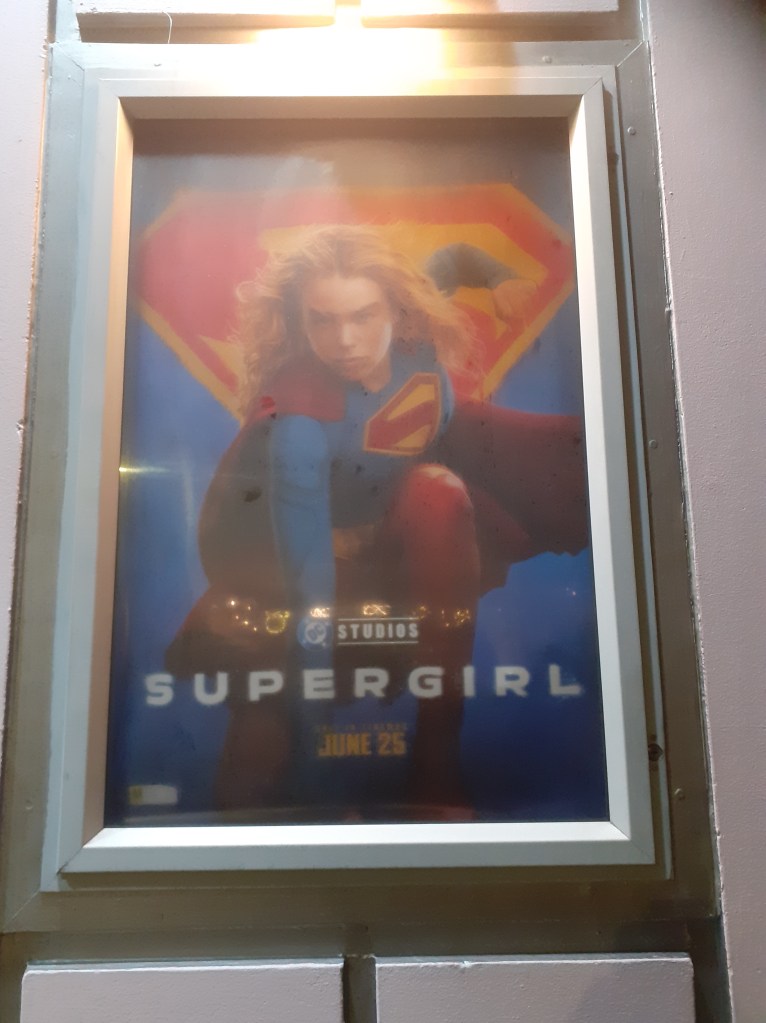
Let’s discuss the first part, because where else should we begin? Did I like the movie? The answer would have to be yes. Is it the best superhero movie I have ever seen? No, it isn’t. Is it the worst superhero movie ever? No, of course it isn’t, but I understand some people will probably want to rage because they can.
Before I go on, I want to explain the conversation I had with my wife when I got home from the cinema. I was discussing the movie, and of course, I was comparing it to the source material, Supergirl: Woman of Tomorrow. She asked if it would have been better for me not to have read the source material.
Normally, I would have said, of course not, but Supergirl has made me rethink it. It’s an interesting question: was it better or worse to have read the comic beforehand? Just something to think about.
Things I liked:
In no particular order, the best place to start is the fight scenes, which I thought were amazing. With Kara being a Kryptonian, her power levels are massive, so that would translate to her fighting ability and style. It was nice to point out that under a red star’s solar radiation, it cancels out a Kryptonian’s powers. I thought it was important to display that Kara can handle herself, with or without powers.
I thought the fights were well-choreographed, inventive and destructive. In saying that, Kara did get beaten up often, but that is not necessarily a negative thing. It showed that she could take a beating and not give up, which is shown by her fight with the alien over Ruthye’s sword. As I said, the fight scenes were great, especially having Kara being able to adapt to the environment.
And speaking of adapting, it was a clever idea to introduce planets by using a title card, as well as the colour status of its local star(s); that way, the audience has an insight into whether Kara will have her powers or not on that planet.
I thought Milly Alcock’s performance as Kara Zor-El was solid. She did a fantastic job showing the differences between Kara and her cousin, because their life experiences have shaped them, as they do for all of us. At the start of the movie, she is a bit of a mess, but, like any great character development arc, as in Batman in The Lego Batman Movie, Kara is a changed person by the end.
As I discussed in the preview, processing the trauma of losing your culture, people, parents, city, and planet would take some time, and maybe it’s something you may never 100% get over, but I think they did a fine job with that, especially with the flashbacks. It was also great that, apart from the flashbacks and the final scene, the story was set away from Earth, with Kara mixing it up with various other aliens and visiting odd planets.
I’d like to take the time to discuss something I noticed in Man of Steel that bugged me, with Superman and Supergirl correcting it. Yes, I know these characters and worlds are fictional, but in Man of Steel, we were presented with two versions of Kryptonese/Kryptonian.1 One was the written form, which, as you can imagine, looked very alien, as the symbols and characters were not from Earth.
However, the written language did not match up to the oral language, because all of the Kryptonian citizens we saw were walking around speaking English. I remember this because I saw the film on my birthday with my girlfriend at the time, who, side note, became my wife one year later. I remember feeling cheated of seeing Kryptonians speaking in their native fictional language, as we got Russell Crowe and Michael Shannon yelling at each other in English.
Flash forward 12 years, and we finally got to experience some Kryptonian in Superman, then expanded on in Supergirl, with actors having conversations in the fictional language. If you are committed to the concept that these characters are aliens, then give us an actual alien language. From that point of view, I was impressed and appreciated the effort in Supergirl.
Jason Momoa’s Lobo was in the film longer than I thought he would be. I honestly thought we had seen the last of him on Bilquis, so seeing more of him was a bonus.2 His “Super useless,” “Bastich,” and “Bye, Tits” lines were hilarious to me because that’s very on brand for him. Momoa did a great job as the Main Man, though if I’m not mistaken, he never referred to himself as the Main Man in the film. If he did, that would have been outrageous.
Krypto was chaotic as ever, and the scene where he and Kara were in the apartment was awesome. He was flying around, trying to eat the feathers that he had just liberated from destroying the pillow. The scenes where he was shot, poisoned and dying were tough, because it made me think of my mate, Indy.
Obviously, I have no information about how much CGI was used for the various aliens, because I’m sure practical effects were used as well, but the point was that they were different, creative, quirky, and scary. All of the elements that you need to bring fictional aliens to life.
By the way, I’m not going to launch into great details about the comparisons between the comic and the movie; however, I was impressed that they included the scene on Barenton, when Kara was under the influence of one of the planet’s binary stars, where one was green and possibly made of kryptonite. It was important, at least to me, to show how physically, emotionally, and mentally strong Kara had become.3
Things I disliked:
Alright, this is the part where I’m leaning into the source material, maybe too much. I thought Eve Ridley’s portrayal of Ruthye Marye Knoll was a little odd. In the comic, only Ruthye’s father is murdered by Krem of the Yellow Hills, not her entire family, but that’s fine.
The point was that Ridley seemed wooden for Act 1 and Act 2. Now this could be put down to two reasons: the first could have been that Ridley was instructed to mimic Ruthye’s character from the comic, or possibly, the creative team and/or Ridley decided to go with that tone. She did grow into her role as the film went on, which was good, but Ruthye was difficult to like for the bulk of the film, as she did some strange things.
The main villain, Krem, is interesting because he has gotten a lot of hate for being a forgettable villain, or at least, providing Kara with a low-stakes problem. I honestly understand critics’ disdain for him, I do, and I agree, to a certain degree.
I do find myself defending Krem in a way. He was never going to be a Darkseid, Mongul, Anti-Monitor, Starro, or Brainiac. He was never trying to enslave a planet or the universe, or trying to rewrite history, distort reality, attain ultimate knowledge, solve the Anti-Life Equation, or control all sentient life forms. No, he wants money and to be able to kill whomever he wants.
Yes, that is evil, but it’s nowhere near the likes or power levels of the villains I just mentioned. He was never meant to be a high-stakes villain, but similar to the Hutts in Star Wars: The Mandalorian and Grogu, where the villains are not trying to take over the universe. No, they are just trying to make as much money as possible, and if they have to kill to achieve it, all the better, just like Krem.
To me, Krem is a personal and intimate villain, creating problems surrounding Kara, but not with her, until he shoots Krypto with a poison arrow, then he becomes Kara’s business. He was never going to truly threaten Kara, but that was not the point; he was there to test Kara, emotionally and mentally. I’ve now reached the region of the rant where I need to confess something. Like I have mentioned many times, I sourced Supergirl: Woman of Tomorrow, because I wanted to know the story, thus I discovered Krem’s true fate.
At the climax of the story, Krem is defeated and at the mercy of Kara and Ruthye’s sword, but Ruthye basically repeats all of the lessons she’s learnt from Kara, back to Kara. So, at the end, after all of the shitty things Krem has done throughout the series, they don’t kill him. Kara wanted to protect Ruthye’s innocence from killing Krem by doing it herself, but Ruthye talked her down. They gave him mercy.
Decades later, Ruthyre is a very old woman, and both Kara and Krypto turn up, virtually unchanged. It’s then revealed that Kara and Ruthye did deliver justice by sending Krem to the Phantom Zone to serve out his sentence, and Kara is there to release him. Upon his release, Krem is full of regret and remorse, which his younger self lacked. He apologises to them both for his crimes.
Since Ruthye is elderly, she uses a cane to walk and hits Krem on the head, which is depicted as a silhouette. He collapses on the ground, with Ruthye walking away. Kara remains for a while before eventually moving on, with the only passage of time being the local star rising in the background. So, after reading this, I was a little unsure about whether Krem was dead, because of the position of his arms. I assumed that he was alive, as why would Kara and Ruthye punish him in the Phantom Zone, just to execute him upon release?
I mean, it’s a pretty boss thing to do, but I needed to be sure. I looked it up, and the answer was that Krem survived; he was just unconscious. I was correct, but I thought it was a strange choice to leave that up to the reader’s discretion, but hey, I’m not Tom King, nor a comic book writer. I’m just a sucker who buys them.
King came out later to clear things up and said Krem survived the ordeal, and the ending wasn’t supposed to be so confusing. Now here is where things get super weird, super fast. In the climax of the film, the roles are reversed, with Ruthye holding the sword, Krem is at her mercy, and Kara is the one talking her down.
Kara is essentially saying to Ruthye that killing Krem won’t give her justice; it will change her into something she’s not. Kara also points out that Ruthye could take revenge by surviving and living a good life. Ruthye agrees to drop the sword, walks away and not to kill Krem. As Ruthye disappears off-screen, Kara then picks up the sword and stabs Krem in the stomach for vengeance over Krypto, then stabs him in the neck for Ruthye.
Since the film’s release, Ana Nogueira, the screenwriter, received some backlash over Krem’s death, and in an interview, she stated that basically, the screenplay followed the comic, because Krem died at the end, at the hands of Ruthye. There is also a twist in this, because in the comic, Ruthye is narrating the story, as in a memoir.
She states that Kara killed him with a sword, and that was the end of Krem, but the reader knows that’s not true, before we saw him alive. This is a long-winded way of saying that I believe Nogueira thought that Ruthye had executed Krem, and then swapped his executor for Kara in the movie, to protect Ruthye.
Adapting a beloved story will always be a challenge. What things do you keep, what things do you drop, and what things do you change? Was Nogueira allowed to change elements of Superman: Woman of Tomorrow to fit a movie? Of course, it’s a yes. But, and there’s the big question, is it possible that Nogueira misinterpreted the comic’s ending and mistakenly added the wrong outcome?
And if, and it’s a rather large if, if that’s the case, why was this change in plot not picked up? Why was it ignored by the filmmakers? Someone, somewhere, in the creative process, must have noticed that the two endings were vastly different, and why wasn’t something done to correct it?
Writers are allowed to make mistakes, but why didn’t the director, producer, or anybody else stop to correct this mistake? The whole point of the comic was a personal journey about Kara finding her place in the universe and dealing with the trauma of her life, but also trying to protect Ruthye from killing Krem. By doing this, Ruthye gave compassion and mercy to both Kara and Krem.
However, in the film, Kara talks Ruthye out of killing Krem and gives me mercy, then she just executes him herself anyway. Everything she just said was a lie. The trip home would be very awkward. How would the audience react in Spider-Man: No Way Home if Tobey Maguire’s Peter Parker stopped Tom Holland’s Peter Parker from killing Willem Dafoe’s Norman Osborn, then turned around to just kill Osborn himself?
Sadly, I feel the filmmakers may have dropped the ball on that scene.
So, what about my preview questions?
- How faithful will the film be to the source material, Supergirl: Woman of Tomorrow? Overall, it’s quite faithful, which is rare in comic book movies.
- Will Lobo’s appearance feel forced? It’s still hard to say. They could have left Lobo out, and the story would still have made sense, but it was fun to see him.
- How old is Kara? That one is easy, she’s 23 years old.
- Will Kara’s life on Krypton/Argo City be shown chronologically or as a flashback? It was done through a series of flashbacks, when Kara was explaining something or when a memory was triggered.
- How much screen time will Lobo receive, and will he steal some of the spotlight from Kara? I suppose Momoa did steal some of the spotlight from Alcock, but I feel that was to be expected.
- Will everybody’s interaction with Krypto seem real, or will it look uneven? I felt the actors’ interactions with the CGI Krypto were better in Supergirl than in Superman.
- Apart from Superman, will there be any other cameos? I don’t think there were any cameos. I could have missed some, though I did notice Seth Rogen’s voice as an alien spacebus driver.
- Will Krypto get a bad-arse scene? No, he didn’t, as he was poisoned for the majority of the film.
- Is Supergirl known throughout the galaxy? Not that I’m aware of, but Krem did know of kryptonite and its effects on Kryptonians.
- What is Supergirl’s status on Earth? Is she well-known? That’s a difficult question, hence the bulk of the story happens off-Earth. However, it seems that she is known on Earth, but nothing to the levels of my famous cousin.
- Will Krem of the Yellow Hills be a believable antagonist? I discussed my answer to this amazing question in the above rant.
- Kara seems to suffer from apathy, but will this continue by the end of the movie? No, by the time she is back on Earth, she wants to commit to Earth. Her friendship and adventure with Ruthye have empowered her with new hope.
- Will audiences see Kara as a hero, standing on her own, or will she still be in her cousin’s shadow? I’ve realised that I don’t know how to quantify that. She has been around longer than Spider-Man, but deserves more attention than she gets.
- Will there be a Brainiac reference somewhere? If there was, I missed it.
This brings me to discuss something I haven’t done before: box office returns. I’ve been planning on writing a series of blogs about what makes a film successful, because Supergirl has had some low numbers in terms of box office returns. At the time of writing, the movie has earned $89.1 million, against its $170 million budget.
I’m sure there are many people with a lot more qualifications than myself who have analysed the film’s earnings, but I have three working theories.
1.) Creative differences
The knives have been brought out, with various people throwing others under the bus, because of the film’s slow performance at the box office. From what I understand, the media has said there were two cuts of the movie, the director’s cut and the studio’s cut, and to the best of my understanding, the film released was the studio’s. There have also been reports of creative differences between the director, Craig Gillespie, and James Gunn, the co-CEO of DC Studios, along with other people.
2.) Release Time
I understand that film studios plan years in advance to determine the optimal release dates for their movies. They seek to find the best window for their product, which is essentially what a film is—a product that the studio is selling to us.
I also realise that the summer months for blockbuster releases in the Northern Hemisphere are June through August. However, it’s important to note that in New Zealand, June to August is actually winter.
Supergirl was released in New Zealand on 25th June, but it’s got stiff competition to earn our precious and hard-earned money. In New Zealand, Supergirl is fighting against Masters of the Universe, Disclosure Day, The Death of Robin Hood, Toy Story 5, Minions & Monsters, and Jackass: Best and Last, with Moana, The Odyssey, and Spider-Man: Brand New Day, just around the corner.
Releasing at this time, wasn’t the best idea in the world.
3.) Female Superhero movies
This theory has two parts to it. Since the birth of the Marvel Cinematic Universe (MCU) in 2008, the now-dead DC Extended Universe (DCEU), and the new DC Universe (DCU), 57 films have been released between all of them.4 Of these 57 films, only 4 MCU films (Captain Marvel, Black Widow, Black Panther: Wakanda Forever, and The Marvels), 3 DCEU films (Wonder Woman, Birds of Prey, and Wonder Woman 1984) and 1 DCU film (Supergirl) have female lead characters.
That works out to be only 14%, compared to 54% with a male lead character. Only Captain Marvel, Black Panther: Wakanda Forever and Wonder Woman have earned over $800 million at the box office.
What does this tell us? Well, male-led superhero movies tend to do better at the box office than female-led superhero movies, hence the massive discrepancy. But why? I think it’s the perception. I think studios need to be targeting male and female movie fans differently.
For males, studios need to be promoting female-led superhero movies, as these beloved classic characters need to be seen as the arse-kickers as they actually are, just like all of the male superheroes, and to actually prove it in the movie. For females, these female-led movies are a great opportunity for promoting these strong, intelligent, and powerful women as role models, not to be sidelined as sidekicks or love interests.
Hollywood is getting better at this, displaying more diverse voices, but women like superhero movies as well, so the studios just need them to turn up and care about these characters, as I do.
Another argument has been made against superhero movies as a whole genre, with the concept of superhero fatigue settling in. This is supported by the recent low box office numbers from Marvel and DC. The problem here is that with Spider-Man: Brand New Day being released only weeks away, and Avengers: Doomsday being released in December, both of these films will earn over $1 billion each. There will be no superhero fatigue with these two films, I promise you.
Fans want amazing special effects, along with tons of action and excitement, with a drop of humour; however, what drives these movies forward are the characters, which are driven by stories that mean something to people. We want to connect them because we want to see ourselves up there, whether they are male, female, dogs, aliens, or everything in between.
For the record, I enjoyed Supergirl. It does have its issues, but it does not deserve the hate and contempt that are overflowing from all regions of the internet. I think these haters are forgetting that if more superhero movies fail at the box office, more studios will be less inclined to invest money in them. So, in the end, more failed movies mean fewer movies being released, which means the audience and fans are the real losers.
If these people are truly fans, they need to stop cheering for a movie’s failure and start getting behind and supporting it.
But anyway, what do I know? Go out and see the movie for yourself, so you can be the judge.
I’m nearly done, but I need to mention a few things.
Firstly, this is my 300th blog post. I talk about some truly weird stuff on this blog, and it may never become popular, but I keep doing this because I feel I would go crazy if I didn’t have a creative outlet. Thank you to my long-suffering wife, but also UMC1 and UMC2, for allowing me the time to sit down and waffle on about history, books, movies, flags, geography, sport, politics, and fictional characters.
And thank you to my old and new subscribers, readers, and followers of New Zealand’s 5th least favourite website. Thank you for being an audience. Seriously, thank you.
This outpouring of emotion can also mean that my mid-year break is finally upon us. I will be taking a 2-3 week break from this website, because I’ve mentioned this before, but running a blog as badly as I do takes a lot of energy. There will be a shorter and smaller post for next week.
And that’s it. Please remember to walk your dog, read a banned book, go watch the World Cup quarter-finals and I’ll see you next week.
1 I’ve seen the term for the main language for Krypton be described as Kryptonese and Kryptonian, so I’m not sure not which one is more accurate then the other. In this regard, its the reader’s choice for which one to use.
2 If you have eaten your Vegemite, you would have recognised that the planet Bilquis, was named after the artist for Supergirl: Woman of Tomorrow, Bilquis Evely.
3 In DC lore, the green star was actually an artificial kryptonite star, created to neutralise and kill Superman, much like Solaris, the evil artificial-super computer powered red star was; except Solaris was sentient, whereas this green kryptonite star was not.
4 37 from the MCU, 16 from the DCEU, and 2 from the DCU. With the two different versions of the Justice League, I have counted as two different films.


You must be logged in to post a comment.