I’ve known this blog post was coming up, but I still wasn’t prepared for it. That sounds quite ridiculous, considering that, apart from the endless staff who work for me, I plan and write the awkward content that goes on here.
Even with the title, I’m going to give you some spoilers about this blog post. Today’s lecture will not be filled with rainbows, ponies and ice creams. I’m sorry, but it really won’t. So, I won’t be offended if it’s not for you, because it’s not even for me.
Over the weekend, it marked the first anniversary of the death of our dog, Indy. See, I told you this was not going to be fun. I’m not sure how I’m supposed to navigate my feelings and thoughts around this, so I need to turn back the clock first.
It’s important to note that Indy was my future wife’s dog before I met him. He was the runt of his litter, and my wife was present when he was born. A friend of hers owned Indy’s parents and planned to sell the puppies later on. My wife initially had no intention of adopting a puppy because her living situation wasn’t ideal for one.
However, fate had other ideas, because as the weeks passed, nobody wanted him because of his small stature. If nobody adopted him, then he might have been given to an animal charity centre. My wife didn’t want that to happen to him, so they chose each other.
Indy looking fabulous at a Christmas party.
My wife and Indy became an inseparable pair, and six months later, they met me. And after many dates, the two of them asked me to join their team. Sometime later, it became official with a wedding. The interesting thing about me before I met Indy and my future wife was that I was mourning our family dog, Jack.
I was living in another city when Jack got very ill and died. I felt disconnected from that event, and I took his death really hard. During this grieving period, I purposely avoided petting or playing with dogs. It didn’t even matter that they were my friends’ dogs; I just didn’t want to touch them. It felt wrong to do that, so I avoided being around them.
As I mentioned previously, fate had other ideas. When I met my future wife for our first date, she brought Indy to keep her company. She later said that Indy was her measuring stick for her dates: if Indy didn’t like the date, or if the date didn’t like him, there would be no second date.
I knew she had brought her dog with her, but I had not fully processed what that would mean. As I sat down and tried to act like a normal single male with a beautiful woman, I needed to come to terms with the fact that there was a dog, who was begging for some pats and belly rubs. I discovered that I couldn’t say no to him.
It was weeks later that my future wife informed me that the reason we had a second date, was because I was kind to Indy and that he liked me. I had no idea that the course of my life was going to depend on whether a dog liked me or not.
The more time I spent around Indy, the more it revealed a few things about myself that were a surprise. The obvious point was that I had to acknowledge that I missed having a dog in my life.
What I didn’t realise at the time was that Indy was helping me heal the hole in my heart left by Jack’s death. He also helped me understand that being part of a team with a beautiful woman wasn’t a daunting idea. I wasn’t as frightened as I thought I would be. This little dog saved me in ways I didn’t realise I needed saving.
Indy claiming his spot in our bed.
So, let’s get back to the title of the blog. It’s been one year since Indy died, so what has life been like? I guess it depends on how honest I want to be. I would be lying if I said that it has been easy, with the first two months being pretty rough.
I know people grieve in different ways, because we are all different. But how does someone grieve and mourn for a pet? What’s the best way to do this? Having said that, I’m not sure how to explain things, but I’ll give it a go.
We have encouraged UMC1 and UMC2 to discuss Indy when they wanted to, whether to talk about his misadventures or just to state the fact that they miss him. UMC2 talks about him more than UMC1, but I know they both miss and love him.
For myself, I’m content to talk about him, but it heavily relies on the context of the discussion. Sometimes I can joke about him and retell stories, but other times, I still have to leave the room after talking about him.
I suppose the grief is always sitting there, just under the skin, and all it takes is a small scratch to reveal it. I’m left thinking, “Wow, where did that reaction come from?” I also know that he’s been gone for a year, but I still catch myself doing things, mainly out of habit.
When my wife picks me up from work, I have to stop myself from asking how Indy’s day has been.
When calling my wife from work, I have to stop myself from asking how Indy’s day has been.
I find myself wanting to check the bed before sitting on it, so I don’t hurt Indy.
We miss and love Indy, and he loved us. So what do you do with the leftover love? UMC1 and UMC2 would like to get another dog soon; however, my wife and I are not ready for that. We want to be, just not yet.
I remember reading somewhere that not loving another pet after a pet’s death is a sin. There are so many pets out there that need loving families to take care of them, and we will do that again, just not yet. My wife is worried she would compare the new dog to Indy, and that wouldn’t be fair to the new dog. As for me, I guess I have more healing to be done.
Indy catching up on some well deserved rest.
It was awkward going to Indy’s favourite places around town, but this has been getting better. We were at the beach the other day, when UMC2 pointed to a dog and stated that the dog looked like Indy’s clone. That caught me by surprise, but he wasn’t angry or sad about it; it was just an observation.
Something that has shocked me has been my ability to talk to and hug other dogs. After Jack died, I isolated my heart from dogs and avoided being around them. After Indy’s death, I didn’t want to make the same mistake, so I decided that when I would meet a dog, I would give it lots of pats and hugs. It’s not their fault, they want to get some attention from a faulty human.
This has been great because it’s allowed me to discuss the dog with the owner. Sometimes Indy comes up in conversations, and sometimes he doesn’t. It’s been helpful.
We have photos of Indy around the house, and I have photos of Indy and Jack, next to each other, on my desk. The dogs never met in life, but part of me hopes they have met in the afterlife.
This blog post is ultimately not as good as I had hoped it would be, as I have stopped several times to think about him and let the experience wash over me. The more I think about Indy, the more I have to write. But the more I write about him, the more I have to stop and compose myself.
Indy was a fucking good dog, not just to me, the boys and my wife, but to everybody. He changed my life, and as long as we continue to talk about his misadventures, our memories and love for him will never be gone.
I’m done now. Thank you for continuing to read, follow, and subscribe to Some Geek Told Me. If you have a pet, please do me a favour and hug them. I’ll see you next week for the return of We Didn’t Start the Fire.
As you good people know, I tend to write some nonsense from time to time. I also like to stretch my writing skills and avoid cramps by talking about topics that interest me. Within that collection of topics is rugby.
Now, I can imagine you could be thinking, “Ok Scott, what’s that got to do with today’s lecture?” That’s an outstanding question, by the way, you should be proud of yourself.
To answer your question, the 2025 Women’s Rugby World Cup is on. Granted, we have just had the quarter-finals over the weekend, with New Zealand to face Canada in the first semi-final, and England going up against France in the second.
To celebrate this event, I thought I would dust off a previous blog post and represent it. Why, you ask? It’s all about the positions in rugby, because they have awesome names, regardless of whether it’s the female or male game. The positions can be confusing, but I hope this guide helps you. If it doesn’t, I sincerely apologise.
Yes, I am a New Zealander, so I am biased, but rugby is one of the greatest sports on the planet, and the 2025 Women’s Rugby World Cup, which is currently being held in England, is the world’s showcase for the women’s game.
There are only four games left, so if you’re planning on watching some games, you had better hop to it! If you have seen a few of the games, then I hope you have enjoyed them and understood what was going on. So, sit back and relax while I discuss the various rugby positions.
New Women’s Rugby World Cup trophy introduced to mark an era-defining tournament that will feature representatives from all regional associations for the first time. Credit: World Rugby
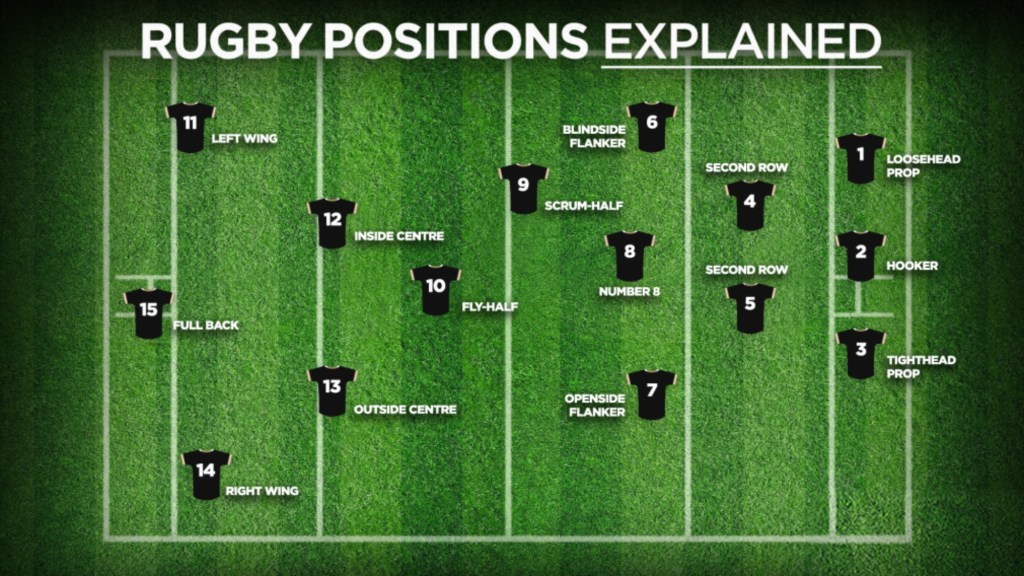
Just like any team sport that requires players to wear numbers, their number denotes their position. And rugby has some pretty messed-up positions. There are 15 (1-15) players in a team, with another 8 (16-23) as reserves, so 23 in total.
So what I’m going to do today is try to explain what these positions mean and what the player’s job is during the game. Because I’m a New Zealander, I’ll use Kiwi terminology, but I’ll add other names for positions that other countries use as well. Also, the person who gets the honour of wearing the number 8 jersey has the greatest positional name in rugby, and maybe in all of sport.
The Positional Numbers
1.) Loose-head prop
2.) Hooker
3.) Tight-head prop
4.) Lock (Second row)
5.) Lock (Second row)
6.) Blind-side flanker
7.) Open-side flanker
8.) No. 8
9.) Half-back (Scrum half)
10.) First Five (Fly half, First 5/8)
11.) Left wing
12.) Second Five (Inside Centre, Second 5/8)
13.) Centre (Outside Centre)
14.) Right wing
15.) Full back
Credit: Six Nations Rugby
Job done then, right? Great Caesar’s Ghost, the answer is no!
The team can be divided into two groups: forwards (1-8) and backs (9-15). There is no better way to illustrate the differences between the two groups than when there is a scrum or a line-out. All of the forwards are packed together into a scrum or standing in a line behind each other for a lineout. The backs, on the other hand, will be standing side by side, stretched out across the field when either a scrum or a line out is taking place.
Rugby is a sport where all body types can be used and celebrated. This is because each position needs a specialised player with a particular body type and skills. Traditionally, forwards are larger but slower players, while backs are usually leaner, but faster.
Alright then, what’s special about the positions?
Explaining the Positions:
Front Row (Props and Hooker/Numbers 1-3)
Body type in the community:
This is easy. The best way to describe what body types props and hookers would have would be a female bouncer or weightlifter. You know the type, their arms and legs are the same size; they’re born without a neck; they can bench press a small car; and they won’t take any shit from anybody.
What‘s a prop’s job in a rugby game?
Formal answer:
Their job is to “prop” up the scrum, support the hooker, and add lift to the lineout jumpers.
Informal answer:
Their job is to be a human bulldozer and to take as many defenders down as they can. They are also experts in the dark arts of the front row.
What‘s a hooker’s job in a rugby game?
Formal answer:
Their job is to “hook” the ball with their legs during a scrum and to throw the ball in at the lineout.
Informal answer:
Their job is to be an extremely niggly player who acts like they’re a saint, but they’re actually the devil in disguise. If the referee pulls them up for a penalty, the hooker will deny it, even with 20 m wide screens, showing them committing the crime.
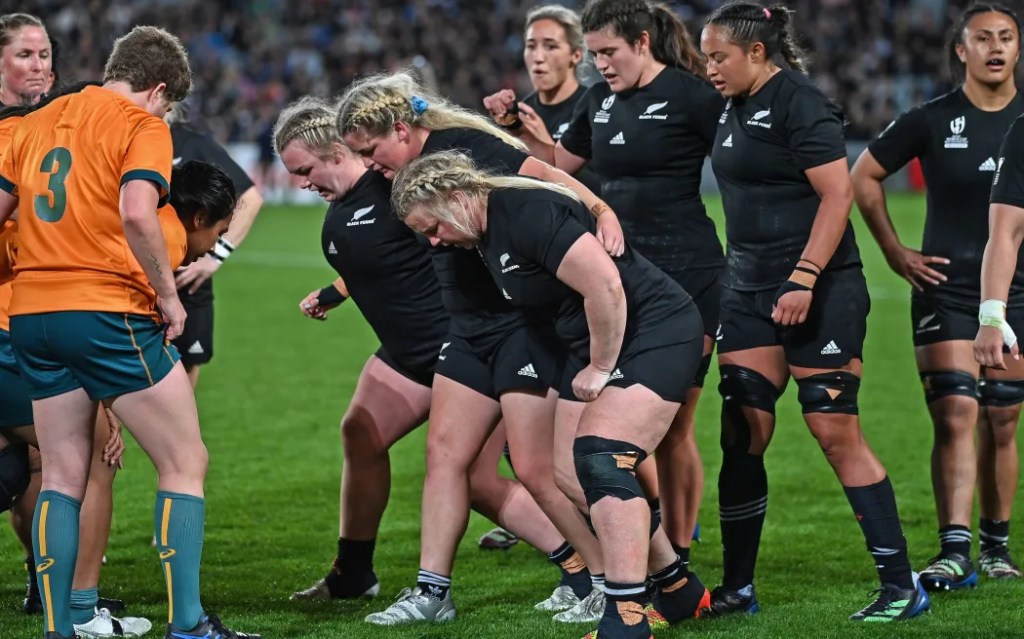
New Zealand and Australia’s front row (prop/hooker/prop) about to set a scrum. Photo: PHOTOSPORT
Second Row (Locks/Numbers 4-5)
Body type in the community:
Locks would have the body type of basketball players: tall and muscular. However, the difference here would be that instead of bouncing a ball on a court, these players have declared that they would rather suffer cauliflower ears, head trauma, broken bones, or torn ligaments than play basketball.
What‘s a lock’s job in a rugby game?
Formal answer:
A lock’s job is to form the second row in the scrum, receive the ball from the kick-off, and be a primary jumper at the lineout.
Informal answer:
Their job is to have the best shoplifting hands on the field, to be lectured by referees half their size, and to be at the bottom of every ruck and maul.
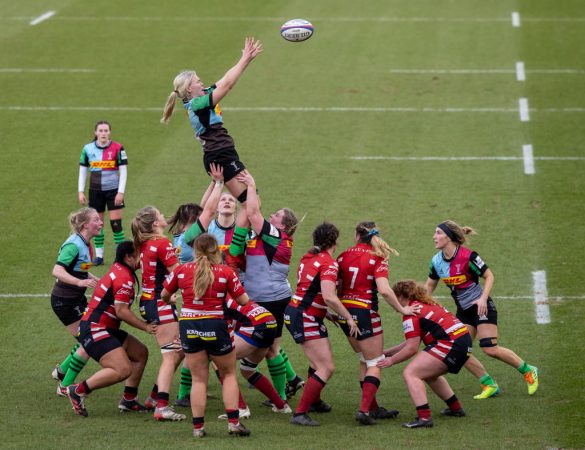
Harlequins’ lock, Rosie Galligan wins a lineout against Gloucester-Hartpury (Getty Images)
Loose Forwards (Flankers and No. 8/Numbers 6-8)
Body type in the community:
Do you remember how members of the front row would be described as bouncers? Well, if they’re the bouncers, then the loose forwards would be the crazy, tough players starting fights in the bar/club or in the line outside.
What‘s a loose forward’s job in a rugby game?
Formal answer:
A loose forward has several jobs, like being a secondary jumper at the lineout, supporting the ball carrier around the ruck, giving protection at the breakdown, and searching for the ball.
Informal answer:
There have been many epic quests throughout pop culture, like Frodo and Sam’s mission to destroy the One Ring at Mt. Doom, Thanos collecting the Infinity Stones, Ahab’s obsession with Moby Dick, Darkseid searching for the Anti-Life Equation, Ang to master the bending of all four elements, or Barbie’s quest into the real world.
But they all pale in comparison to a loose forward’s mission to hunt and find the rugby ball. They are lunatics, running around searching for the ball during tackles and breakdowns. They are either off their medication or need to be on some, because they are single-minded in their conviction to find and secure the ball for their team.
Spain vs Netherlands, while they set a scrum. The flankers are on the sides on the scrum, while No.8 is at the back.
Half-back (Number 9)
Body type in the community:
Picture any group of people working in sales with various body sizes. The half-back would be the smallest of them; toned, quick, and very talkative.
What‘s a half-back’s job in a rugby game?
Formal answer:
Like a hooker, the half-back is a singular, specialised player. Their job is to be the link between the forwards and the backs; to feed the ball into the scrum; to receive the ball from the lineout; and to gather the ball at breakdowns, to either pass, run, or kick it.
Informal answer:
The half-back’s job is to yell at everybody and to tell them where they need to be. Half-backs are also well-versed in rugby laws since they are always telling the referee what to do. They love pointing out the illegal things the opposition is doing to the referee, as well as convincing the referee that the illegal things their own team are doing are perfectly legal.
Jenny Maxwell at half-back for Scotland. Credit: The Offside Line
Inside Backs (First Five, Second Five, and Centre/Numbers 10, 12, 13)
Body type in the community:
These players are usually decisive, fast, and agile. You’ll see them at the gym working out and looking fabulous. They are the ones, typically, posing for photo shoots.
What‘s a First Five’s job in a rugby game?
Formal answer:
When the First Five receives the ball, they will either run, pass, or kick it. If they kick the ball, they need to decide if they are kicking for territory, forcing the other team to kick the ball out, forcing the other team to make a mistake, or setting up a scoring situation. They are usually the player who kicks the goals.
Informal answer:
Their job is to crush the opposition by doing three things: kicking penalty goals and conversions from anywhere on the field, landing drop goals, and forcing the opposition back 50-80 m through territory kicks. If a First Five is constantly doing this in a game, she is soul-destroying for the other team.
What‘s a Second Five and Centre’s job in a rugby game?
Formal answer:
Their job is to support the First Five, create line breaks, kick for territory, supply cover defence, and to follow set pieces.
Informal answer:
When done correctly, the deadly partnership of the Second Five and Centre can bust open teams, but also crazy enough to act like loose forwards at the breakdown. Their job is to make the game a living hell for the opposition’s back line. They’re very clever, fast, and dangerous, but still look like a model as they do it.
Dannah O’Brien (No.10) kicking one of her seven successful conversions against Italy. Photo: Sportsfile
Outside Backs (Wingers and Full back/Numbers 11, 14, 15)
Body type in the community:
These players will look like inside backs, except for one difference: their speed. These players are generally the fastest on the field, so look for people who like working out, but also sprinting. Outside backs are also great dancers because of the work they do to evade being tackled.
Formal answer:
These players need to be able to catch the high ball, but also chase it. They need to be strong enough to fend off tacklers, but also to tackle around the waist and legs. Outside backs are try-scoring machines because of their speed.
Informal answer:
These players love to humiliate teams by evading tackles, applying the side step, outrunning or chasing someone down, producing try-saving tackles, but mainly by scoring a huge amount of tries.
England’s Ellie Kildunne (fullback) in the centre of the photo, was named World Rugby women’s player for the year. Photograph: Tom Jenkins/The Observer
What’s your favourite or least favourite rugby position? Have you seen any World Cup games? As always, please let me know.
Hopefully, this guide about the positions was easy to understand. Before I go, I need to point out how tough, strong, and skilled all of these women need to be to play rugby. It can be a brutal sport to watch and experience, but it is glorious.
Thanks once again for reading, following, and subscribing to Some Geek Told Me. I’m also on Twitter and Mastodon, where I’m still posting about daily random stuff.
Please don’t forget to walk your dog, read a banned book, watch some of the last few Rugby World Cup games, and I’ll see you next week for a personal blog post. I hope it’s not sad.
I’m so glad that you’re back. The incident with the kitchen whisk is now behind us, and all is forgiven. And speaking of forgiveness, I have to plead for forgiveness, because it’s been a while since I published a blog post about the Period Table.
I have the time to explain this, so I will. In my infinite wisdom, I have decided to embark on another ill-conceived project: to explain where the names of the 118 elements that sit on the coolest table in the universe come from.
My first chapter was about discussing the elements that have been named after real people. Because that was such a great success, this chapter will be discussing the elements that have been named after objects, in particular, cosmic objects. Like before, I’m not going to present these elements in alphabetical order, because that would be too easy. No, I’m going to list them in the order you would find them on the Periodic Table.
Get ready for some more interesting pieces about history, chemistry, and astronomy. Prepare yourselves!
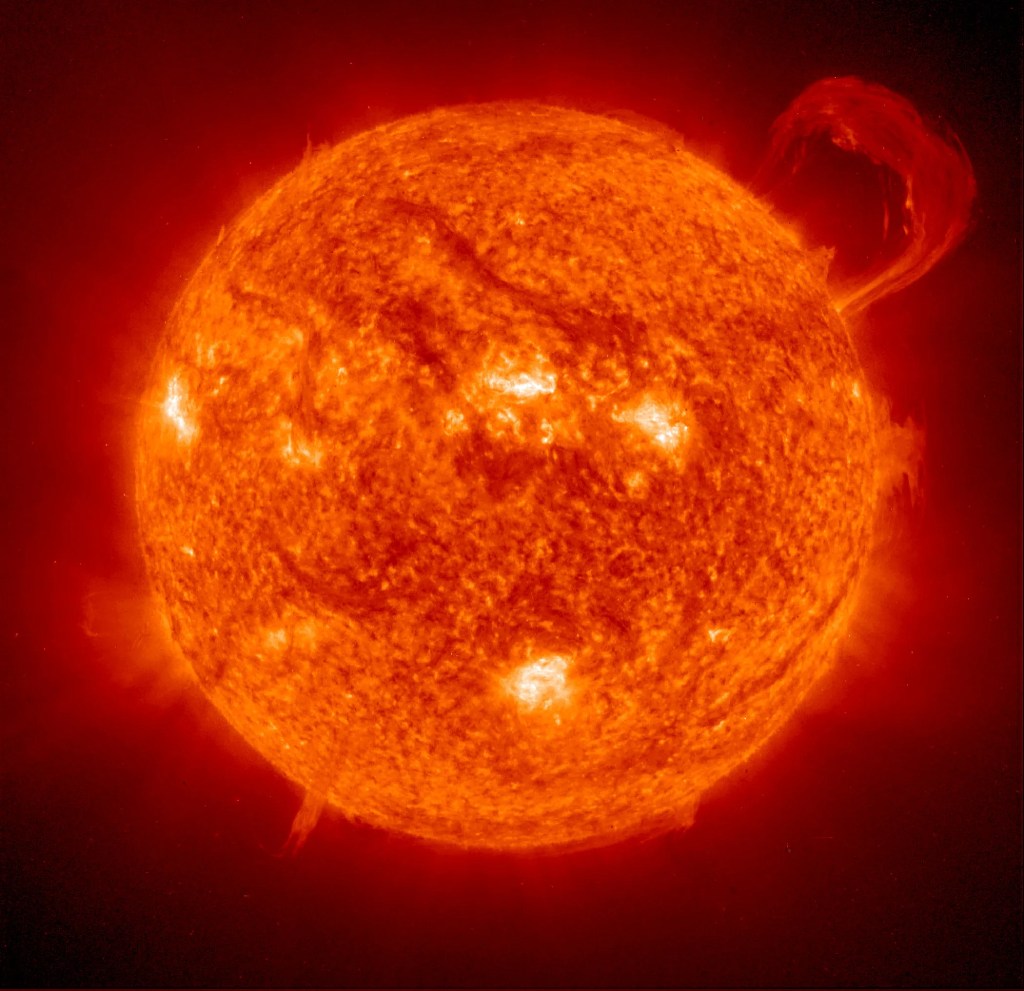
Helium is quite special, because it’s the second element on the Periodic Table. It’s a noble gas, and it was discovered in 1868 by Norman Lockyer, then isolated by William Ramsay, Per Teodor Cleve, and Abraham Langlet in 1895. Helium was the first and only element to be identified outside of Earth, which was through observations and spectral analysis of the Sun.
Since helium was discovered in our local star, Lockyer named the new element after the word Helios, which is derived from the Greek word for the Sun. Helios was also the Greek god of the Sun.
Credit: NASA
Selenium (Se): The Moon
Selenium is the first and only element on today’s list that fits into the Non-metal group on the Periodic Table. Because of this, it’s the 34th element on the table. It was discovered in 1817 by Jöns Jacob Berzelius, and possibly, Johann Gottlieb Gahn as well, though that’s difficult to accurately state.
The Greek word for the Moon is Selene, but it’s also the name of the Greek Goddess of the Moon. Berzelius named Selenium after the Moon; however, just like the Sun, an argument could be made that it’s actually named after a deity.
Palladium is the 46th element on the Periodic Table, which places it in the Transition Metals group. In 1802, it was discovered by William Hyde Wollaston, an English chemist, who also discovered osmium and rhodium.
Between the orbits of Mars and Jupiter is a region of our Solar System called the Asteroid Belt. Wollaston named Palladium after an asteroid that was located in it, Pallas, and just like Palladium, it was discovered in 1802. Pallas is the third-largest asteroid in our Solar System. Represent.
An image of the asteroid Pallas captured by the European Southern Observatory’s Very Large Telescope. (Image credit: ESO/Vernazza et al.)
Tellurium (Te): Earth
Tellurium is a metalloid and the 52nd element on the Periodic Table. Like several other elements, it was discovered and isolated by different individuals. Tellurium was discovered by Franz-Joseph Müller von Reichenstein in 1782, but isolated in 1798 by Martin Heinrich Klaproth.
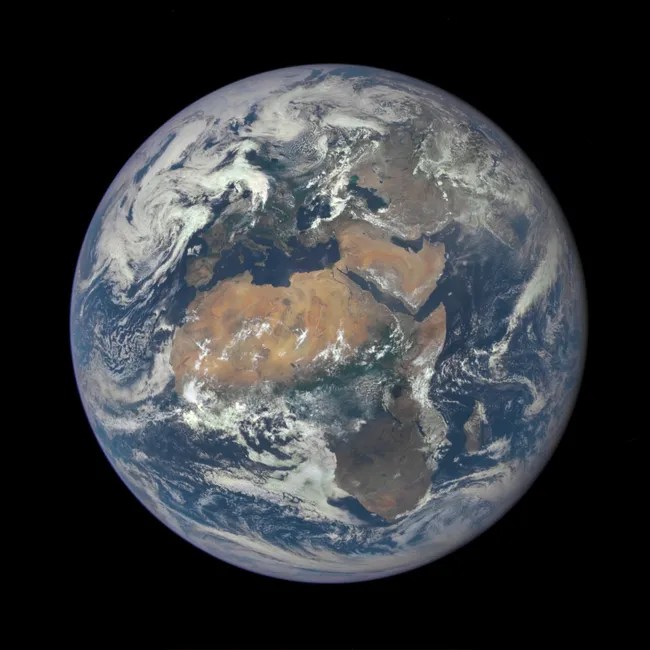
The name Tellurium comes from tellus, the Latin word for Earth; so essentially, tellurium is named after our home planet, Earth.
A NASA camera aboard the Deep Space Climate Observatory satellite caught this view of Africa and the entire sunlit side of Earth on July 9, 2015. (Image credit: NASA)
Cerium (Ce): Ceres
For this entry, we have Cerium, which is the 58th element on the Periodic Table. It can be found lounging around with the other Lanthanoids, and it was discovered by Martin Heinrich Klaproth, Jöns Jakob Berzelius, and Wilhelm Hisinger in 1803, but was first isolated by William Francis Hillebrand in 1875.
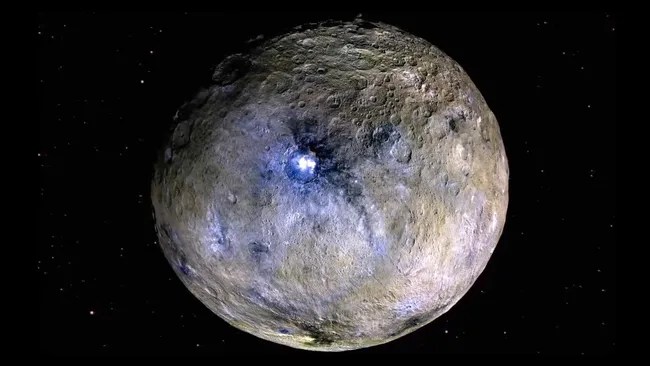
Within the Asteroid Belt, we can find the dwarf planet Ceres, which cerium was named after. Ceres was discovered in 1801, just two years before cerium was identified.
An image of dwarf planet Ceres captured by NASA’s Dawn mission. (Image credit: NASA)
Mercury (Hg): Mercury
Mercury is the 80th element on the Periodic Table, and just like the cool kids, it sits in the Transition metals group. To the best of my understanding, no one person can be credited with Mercury’s discovery, as it was in use since antiquity, which has included several ancient civilisations like the Egyptians, Qin dynasty, Mayas, and Sumerians, to name but a few.
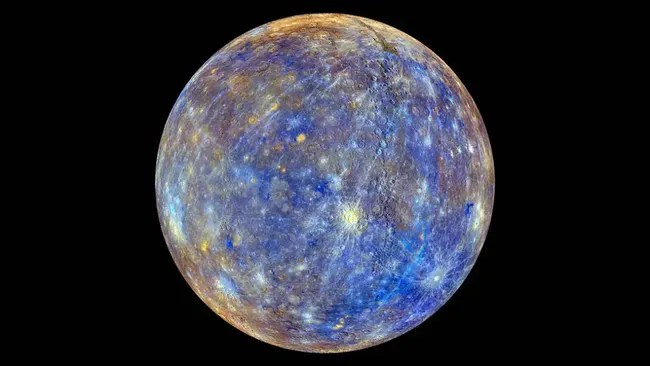
As you can imagine, Mercury is not named after Freddie Mercury, but rather the planet, Mercury, the first planet from the Sun. The element was once known as quicksilver because it is a metal that remains liquid at room temperature. This property connects it to the planet Mercury, named after the messenger of the Roman gods, who was said to speed across the night sky, just like the planet.
A colourful view of Mercury produced using images from the color base map imaging campaign during MESSENGER’s primary mission. (Image credit: NASA/Johns Hopkins University Applied Physics Laboratory/Carnegie Institution of Washington)
Uranium (U): Uranus
Located in the Actinoids group, Uranium is the 92nd element on the Periodic Table. Just like the beautiful nightmare of your ex-partner, this element is radioactive and dangerous. Uranium was discovered in 1789 by the German chemist, Martin Heinrich Klaproth, whom we have met before.
It won’t take you 20 questions to figure this one out, but Klaproth named his newly discovered element after the 1781 discovery of the seventh planet from the Sun, Uranus, by the German astronomer, William Herschel.
Please remember that the pronunciation of Uranus’ name is not Yuor-ray-nuhs or U-ran-us, as you would think. It’s actually pronounced Yoor-e-nes or Ur-an-us. Facts matter, boys and girls, facts matter.
This composite image features the ringed planet Uranus set against the blackness of space. Credit: NASA’s Chandra X-ray Observatory.
Neptunium (Np): Neptune
Sitting right next to Uranium in the Actinoids is Neptunium, the 93rd element on the Periodic Table. It was first synthesised in 1940 by Philip H. Abelson and Edwin McMillan at the Berkeley Radiation Laboratory, California, United States.
Neptunium was named after the eighth planet, Neptune, which was discovered in 1846 by Johann Galle, Urbain Le Verrier, and John Couch Adams. The element was named after the planet, because it was going to follow the pattern set down with Uranium and Uranus.
This composite image provided by NASA on Sept. 21, 2022, shows three side-by-side images of Neptune. From left, a photo of Neptune taken by Voyager 2 in 1989, Hubble in 2021, and the James Webb telescope in 2022. Credit: NASA via AP.
Plutonium (Pu): Pluto
Chilling next to Neptunium in the Actinoids group, we have the 94th element on the Periodic Table: Plutonium. For its discovery, we need to go back to between December 1940 and February 1941, when Glenn T. Seaborg, Edwin McMillan, Emilio Segrè, Joseph W. Kennedy, and Arthur Wahl first produced, isolated, and identified plutonium.
By now, you would have noticed a small pattern with the naming of the last two elements. You don’t have to be a qualified nuclear safety inspector like Homer Simpson to realise that plutonium was named after the planet, now dwarf planet, Pluto, which was discovered in 1930.
Enhanced color view of Pluto using images from New Horizons Long Range Reconnaissance Imager (LORRI) and color data from the spacecraft’s Ralph Instrument. (Image credit: NASA/Johns Hopkins University Applied Physics Laboratory/Southwest Research Institute)
That’s another nine elements down, with only 96 to go. I’ll keep chipping away at it here, on New Zealand’s 5th least favourite website. Did I miss any elements? As always, please let me know.
That’s it for another week. Thanks again for reading, following, and subscribing to Some Geek Told Me. Please remember to walk your dog, read a banned book, and never give Chuck Norris a blunt instrument, because someone will regret it. I’ll see you next week for some more amateur writing by yours truly.
I think I need to start with an apology. I’m sorry, but I have not released a new Tour of the Solar System blog post since 19th May. That is being rectified today with the latest chapter of the tour that very few people actually want or need. Yes, my loyal readers, Some Geek Told Me’s Tour of the Solar System is back!
For the previous entries on this non-award winning project, we have:
Some Geek Told Me’s Tour of the Solar System is the best tour that money can buy; I mean, it’s free, so the quality is somewhere in the middle. However, I beseech you to stay and enjoy one of the rare tour stops that is not about a singular object, but many. Prepare yourselves, because we are going to discuss…drum roll please…..The Moons of Neptune! Let’s listen to the chime and begin now.
An annotated picture of some of Neptune’s many moons as captured by the James Webb Space Telescope. The bright blue diffraction star is Triton, Neptune’s largest moon; while Hippocamp, its smallest regular moon, is too small to be seen.
Just like Jupiter, Saturn, and Uranus, Neptune has multiple moons. 16 known moons have been discovered orbiting Neptune since 1846, which makes it a very successful foster parent.1 In addition to this, their names come from Roman or Greek mythology, just like Jupiter and Saturn, but as you remember, not the moons of Uranus.
On the last stop of the tour, we visited Triton, which was the largest natural satellite of Neptune. Because that entry was so riveting, I’m only able to list the next five largest moons, even though there are 10 more moons. Sadly, these moons will not be discussed because of my lack of sleep and time, so I do repent my actions on this. 2
So, without further delay, let’s crack on and meet some of Neptune’s moons!
Proteus
Proteus is the second-largest moon of Neptune, with a diameter of about 420 km. It orbits Neptune at around 117,640 km, and it’s tidally locked to Neptune. What this means is that the amount of time it takes Proteus to execute one orbit of Neptune is the same time it takes Neptune to rotate just once. An easy example of this is with the Earth and the Moon.
Proteus is not named after the Marvel mutant, as you may have thought, but rather a shape-changing sea god from Greek mythology, who was the son of Poseidon (Neptune). It was discovered by Stephen P. Synnott on 16th June 1989, from images taken by Voyager 2, before it completed its flyby of Neptune.
Proteus’ shape is an irregular polyhedron, instead of a traditional spheroid, like the majority of cosmic objects. Another interesting fact is that Proteus has an impact crater called Pharos. What makes Pharos unique is that it’s measured to be 10–15 km deep and has a diameter of 250 km, which, if you have been keeping up, means it’s more than half the diameter of Proteus.
This image of Neptune’s satellite 1989N1 was obtained on Aug. 25, 1989 from a range of 146,000 kilometres. The resolution is about 2.7 kilometres per line pair. Credit: Voyager 2, NASA.
Nereid
Nereid is named after the Nereids, who were from Greek mythology, as they were sea-nymphs and servants to Poseidon (Neptune). Nereid has a diameter of only 340 km, making it the third-largest moon of Neptune, after Triton and Proteus. Nereid is the ninth-farthest moon from Neptune, orbiting at an average distance of 5,513,400 km.
Nereid is the second moon of Neptune to be discovered. Astronomer Gerard Kuiper made this discovery on 1st May 1949. You’ll encounter Kuiper’s name several more times during our tour, so pay attention! Trust me.
Because of Nereid’s massive distance from Earth (about 4.5-5 billion km), Voyager 2 has been the only spacecraft to fly past the moon, which happened in 1989. Nereid has an eccentric and curious orbit, which ranges from 1.4 to 9.6 million km. It takes 360 Earth days to make one orbit of Neptune, while it takes about 11 hours to make one rotation.
This Voyager view of Nereid was obtained on Aug. 24, 1989 at a distance of 4.7 million kilometres. With a resolution of 43 kilometres per pixel, this image has sufficient detail to show the overall size and albedo. Credit: NASA/JPL
Larissa
Larissa was discovered by a team of astronomers, Harold J. Reitsema, William B. Hubbard, Larry A.Lebofsky and David J. Tholen, on 24th May 1981, after many occultation observations. Its existence was confirmed with the Voyager 2’s flyby in 1989. Larissa has a diameter of 194 km, making it the fourth-largest moon of Neptune. It’s named after a nymph who was a lover of Poseidon, because in Greek mythology, the Gods had fidelity issues.
Larissa orbits Neptune at about 73,540 km, which makes it the fifth-farthest moon from the planet, placing it within Neptune’s rings. For its orbit, Larissa completes one rotation around Neptune every 13 hours and 20 minutes.
The moon is gradually twirling towards Neptune, and it is believed that it will eventually hit Neptune’s atmosphere. Another theory is that Larissa could be ripped apart by Neptune’s tidal forces to create a new ring. As for Larissa’s surface, it is heavily cratered and irregularly shaped, just like my face when I was a teenager.
These Voyager 2 images of satellite 1989N2 at a resolution of 4.2 kilometres per pixel reveal it to be and irregularly shaped, dark object. Credit: NASA/JPL
Galatea
Moving right along, we have Galatea. It’s the fifth-largest moon of Neptune, with a diameter of about 174.8 km. It was discovered in 1989 by Synnott, along with a team of astronomers, with the announcement being held on 2nd August 1989. Like several other moons on the list, Voyager 2’s images proved to be invaluable.
Galatea sounds like the name of a female professional wrestler, but alas, it’s not. Do you remember how Nereid was named after the Nereids, the sea-nymphs? Galatea was named in 1991 after one particular Nereid, because one of Poseidon’s sons, Polyphemus, was in love with her. Lucky girl. It’s also noteworthy that Polyphemus was the same Cyclops from the epic Odyssey, written by Homer.
Out of the six major moons of Neptune, Galatea is the fourth closest to the planet, with an orbiting distance of about 62,000 km. Galatea also shares other traits with its siblings, like being irregularly shaped, with some scientists believing that these irregularly shaped moons are the leftovers of some cosmic collisions.
Like Larissa, Galatea is spiralling towards Neptune and one day, it will be ripped apart or collide with Neptune’s atmosphere. Galatea also orbits the gas giant every 10 hours and 18 minutes.
Galatea as seen by Voyager 2. The image is smeared due to the combination of long exposure needed at this distance from the Sun, and the rapid relative motion of Galatea and Voyager. Hence, Galatea appears more elongated than in reality. Credit: Voyager 2/NASA.
Despina
Now, if Galatea sounds like a female professional wrestler, then Despina sounds like a female Disney villain, though the name is still interconnected with Greek Gods and relationships. Big surprise. Despina was a nymph, as she was the daughter of Poseidon and Demeter. And since Poseidon and Demeter were siblings, that meant Despina’s biological parents were also her uncle and aunty.
Despina is the sixth-largest of Neptune’s moons, and as you can guess, it was discovered by Synnott again, as well as with the Voyager Imaging Team, in July 1989.
The moon is only 150 km in diameter, which is 1/23rd the diameter of the Moon. Despina is believed to be made up of water ice and rocky material, and has an orbital period of 8 hours.
Despina as seen by Voyager 2. There is significant horizontal smearing due to the combination of long exposure needed at this distance from the Sun, and the rapid relative motion of the moon and Voyager. Credit: NASA/Calvin J. Hamilton.
Like I said earlier, there are 10 more moons to discuss, whose names are Thalassa, Halimede, Naiad, Neso, Sao, Laomedeia, Psamathe, Hippocamp, S/2002 N 5 and S/2021 N 1. Maybe one day I’ll discuss them, but not today, because I need a lot of beauty sleep. What’s your favourite moon of Neptune? As always, please let me know.
Thanks again for reading, following, and subscribing to Some Geek Told Me. My Twitter and Mastodon accounts still exist, if you feel like reading some boring facts and information. It’s an attractive offer, isn’t it? Please don’t forget to walk your dog, read a banned book, watch some games from the Women’s Rugby World Cup, and I’ll see you next week.
1 The most recent moons to be discovered were in both in 2024, with the awesome working names of S/2002 N 5 and S/2021 N 1.
2 As you know, I enjoy Shakespeare, and I enjoy even more when I can understand it.
So this is San Diego And what have you done? Another Comic-Con over And a new one just begun And so this is San Diego I hope you had fun The geek and the nerdy ones The boomers and your mum.
Can you believe that San Diego Comic-Con has already checked into the hotel, trashed the bed, glued the furniture to the ceiling, drank all of the mini-bottles, and left again?! It’s amazing that the largest geek-laden event on the planet has been and gone for another year, but this means we get to discuss it!
Before we push on further, with what will be another pulsating lecture by yours truly, let’s establish what in the Nine Circles of Dante’s Hell I’m talking about. I’ve mentioned this before, so why mess with success!
San Diego Comic-Con is an opportunity for some of the world’s leading entertainment companies to showcase their upcoming products, including toys, anime, computer games, manga, books, comics, movies, and TV shows, to the ticket-paying fans and the rest of the world.
One day I’ll get to go there. I’ll probably have to sell a kidney and take out a second mortgage, but I’ll get there one day.
I can only imagine that you can get anything you need at San Diego Comic-Con: t-shirts, back issues, DVDs, action figures, books, and information. A lot of information. After reviewing the numerous announcements that I could find, I have selected a few that caught my interest. Even George Lucas made an appearance!
Sadly, just like a mogwai, there are some rules with something that I have written.
1.) I have not read or seen every article or trailer released from San Diego Comic-Con. I can only discuss the things I know of, but also things I’m interested in. 2.) Just because a product is on my list doesn’t mean I’ll get to see or purchase it. Quite simply, if something has landed on this list, it has my attention, regardless of whether I watch or purchase it. 3.) I have included some information and trailers that were released just before San Diego Comic-Con. This is because I’m the lead writer on this venture, so what I say goes. And with that, let us be entertained by franchises and companies fighting each other for our hard-earned money!
Credit: San Diego Comic-Con
Literature: (Books and Comics)
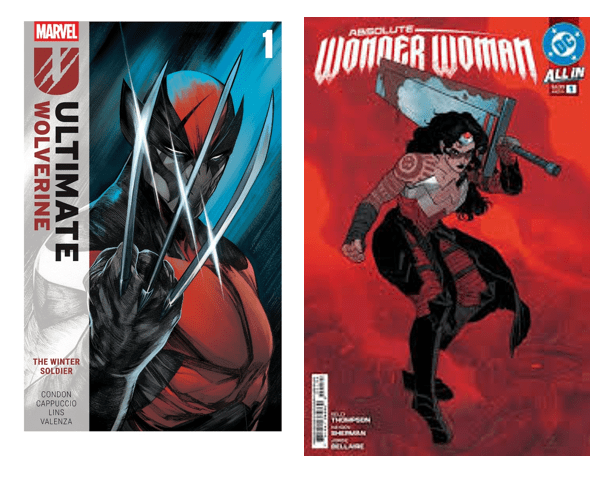
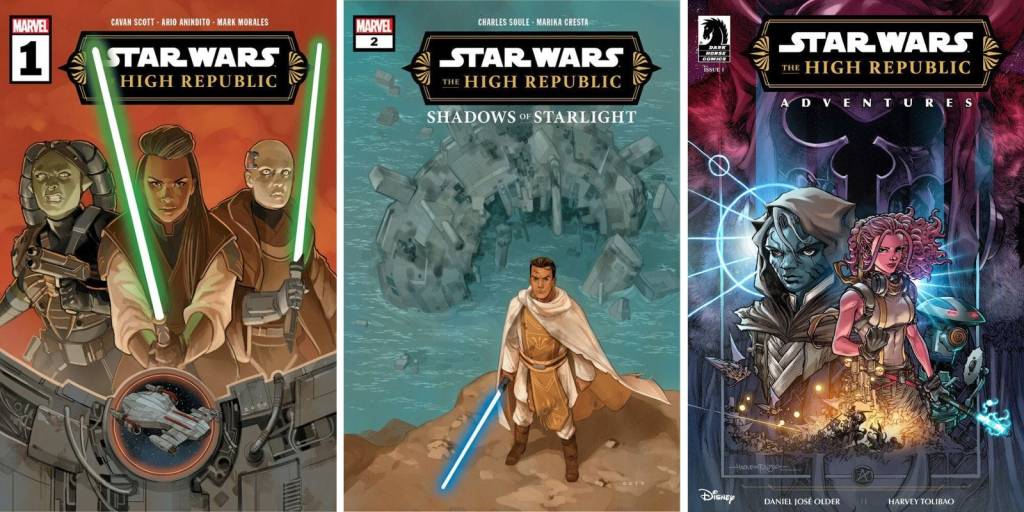
This year, this section is quite sparse for me. All of the Star Wars: The High Republic books have been released, but I have not read all of them yet. As for the comics, there were a lot of interesting announcements, namely Ultimate Endgame, but also that Absolute Wonder Woman won the Eisner award for the Best New Series, by Kelly Thompson and Hayden Sherman.
The four main announcements that I am definitely going to find are:
Deadpool/Batman #1 (From Marvel)
Credit: Marvel/DC
Batman/Deadpool #1 (From DC)
Credit: DC/Marvel
Absolute Batman 2025 Annual #1
Credit: DC
Absolute Evil #1
Credit: DC
(Yes, I’m still a sucker for the Absolute Universe. The titles are nailing the characters, they are superb.)
Movies:
Spinal Tap II: The End Continues
This is Spinal Tap is one of my favourite films, as it’s chock-full of comedy gold and gems. It came out in 1984, so I thought the time for a sequel to the film was dead and gone. Imagine my surprise when I saw the trailer for Spinal Tap II: The End Continues!
I never knew about the existence of this film, so I will definitely be watching that. It’s made me search for the original to watch it again. The premise of the film is that the band had broken up, but they are reuniting for a one-night-only show. You can dial that to 11.
Predator: Badlands
I’ve seen Prey, and I thought it was a positive chapter in the Predator franchise. As for Predator: Killer of Killers, I have not seen it, so I can’t comment about it. In saying that, Predator: Badlands looks intriguing for two major reasons.
The first reason is that the writer and director of Prey and Predator: Killer of Killers, Dan Trachtenberg, is back behind the camera for the next Predator instalment. Like I said before, even though I haven’t seen Predator: Killer of Killers, Prey was enough for me to respect Trachtenberg’s vision for the films.
The second reason is that it appears Predator: Badlands is blending Predator with Aliens concepts, namely a synthetic created by the Weyland-Yutani Corporation. Is Predator: Badlands offering us a soft reboot of Aliens vs. Predator, or is it going somewhere else? I don’t know, but I want to find out.
The Long Walk
I’ve read a lot of Stephen King books, but I have not read all of them, and The Long Walk is one of them, I’m ashamed to admit. I understand that The Long Walk is based on the book, though how faithful it is to the source material, I can’t answer that question.
The concept seems simple. Wikipedia states that, “In a dystopian United States ruled by a totalitarian regime, a group of young men enter an annual walking contest in which they must maintain a speed of at least three miles per hour or risk execution. The contest ends when only one walker remains alive.”
I’ve been a King fan since before Pennywise and Maturin emerged from the Void, or Roland Deschain’s first turning of the wheel. At some point, I will be watching The Long Walk.
Television shows:
Peacemaker: Season 2
I’ve said this before, but Peacemaker had no reason or right to be as good as it was. It was brutal, hilarious, and creative, all at the same time. Essentially, what I’m saying is that I thoroughly enjoyed it. So, my expectations for the second season have increased.
John Cena had a cameo as Peacemaker in Superman, and from what I understand, the show is set after the events of the film. It will also explore the ramifications of Christopher Smith (Cena) killing Colonel Rick Flag Jr in The Suicide Squad. If the new season is as funny as the first, it will be great!
Alien: Earth
Alien: Romulus was a hit last year, but this is the first time the Alien franchise has dipped its toes into the world of television. On paper, Alien: Earth sounds and looks interesting; a spaceship crashes on Earth, carrying some nasty human-killing creatures, including the Xenomorphs.
It looks creepy as hell, and the set designs are impressive. I could be wrong about this, but this is the first time in canon that Xenomorphs have reached Earth, and it’s going to be horrific, but only in a good way. If only I’m brave enough to watch it.
IT: Welcome to Derry
I’ve been fortunate enough to have read the novel, seen the mini-series, and both movies, so IT: Welcome to Derry will not be an unknown concept to me. From what I understand, Bill Skarsgård is back as everybody’s favourite human-eating clown-entity, Pennywise, as well as having Andy Muschietti attached to the project.
Apparently, the show is set in 1962, which makes it a prequel to the two movies. Since it’s based on work from Stephen King, we can only imagine we may have cameos from other characters. I’ll watch with one eye open.
The Legend of Vox Machina: Season 4
My wife got me into Critical Role’sThe Legend of Vox Machina, as it was something we both enjoyed watching together. I know next to nothing about the upcoming season, so I’m happy for it to be a surprise. Though it wouldn’t be nice for Grog to have a love interest! Imagine the carnage!
The Mighty Nein
And speaking of Critical Role, the Mighty Nein (or The Sensual Seven?) will be released later this year. I believe the show is set 20 years after The Legend of Vox Machina, as it’s on the same world, just a different continent.
If The Legend of Vox Machina is any gauge, then my wife and I will have to watch The Mighty Nein together.
Avatar: Seven Havens
To the best of my knowledge, there was no trailer for Avatar: Seven Havens, but Nickelodeon released an image from the show. The story is set after The Legend of Korra, with the new Avatar, who is an earthbender.
The world of Avatar: The Last Airbender still has some surprises and adventures for us to explore, and I can’t wait for UMC1 and UMC2 to experience them as well.
Courtesy of Nickelodeon
Like I said previously, I didn’t catch all of the news, so maybe I missed some important news. What announcements from San Diego Comic-Con were you interested in? As always, please let me know.
Alright, that’s another blog, for another week. Remember to walk your dog, read a banned book, speak out against the Palestinian genocide, and I’ll see you next week for the overdue return of the Solar System’s worst tour!
Oh, you’re back. I wasn’t expecting that, so welcome. I hope your week’s been treating you better than Trump, Putin, Netanyahu, or Luxon’s. Those four precious darlings just can’t catch a break. For this week’s lecture, I want to discuss a sequel of some sort that occurred last week, on 15th August, to be precise.
Sorry, if you were hoping for another fun-filled blog post, you are out of luck today. This one is all about history, baby! In May, I published the 80th VE Day Anniversary, which commemorated the unconditional surrender of Nazi Germany, on the 8th May 1945. This event brought the Second World War to a close in Europe, but, as you know, not the war itself. This day became known as Victory in Europe Day or VE Day.
The focus of the war then turned towards Imperial Japan, even though fighting in Asia and the Pacific had been going on since the Japanese invasion of Manchuria in 1931.
On 6th August 1945, the United States dropped a 64 kg uranium-235 core bomb on the Japanese city of Hiroshima. This was the first time an atomic weapon had been used against a population. Three days later, on 9th August, a second bomb, one with a 5 kg plutonium core, was dropped on another Japanese city, Nagasaki. My blog post about the 80th Anniversary of the Atomic Bombings of Hiroshima and Nagasaki can be found here. Hopefully.
Imperial Japan surrendered on 15th August 1945, but because of the time zone difference, some countries reported it as the 14th August. However, the official surrender of the Imperial Japanese forces was held on 2nd September 1945, on board the battleship USS Missouri.
Since 8th May was known as VE Day, 15th August was named Victory over Japan Day or VJ Day. An interesting point is that while various nations commemorate VJ Day on 15th August, like us in New Zealand, the United States honours VJ Day on 2nd September, the day of the official surrender.
In Japan, 15th August is known as Memorial Day for the End of the War and/or The Day for Mourning of War Dead and Praying for Peace. Regardless of what day you mark VJ Day, it celebrates the end of the Second World War.
Credit: Chesham Town Council
The VE Day celebrations were massive, and filled with happiness, relief and joy. The VJ Day celebrations were similar, but they also signalled the end of the worst conflict the world had ever seen. Over the years, it’s been estimated that 70–85 million people were killed, which worked out to be 3% of the planet’s population at the time.
The horrors and legacies of World War II are still within the living memories of people today. I can’t add anything more to the volumes of literary work that already exist on the subject, other than the dual nature of humans, bringing inhumanity unto ourselves, but also helping each other.
In New Zealand, the 80th anniversary of VJ Day was commemorated with dignity, sharing stories of courage, bravery, and sacrifice while also honouring those who lost their lives.
World War I was supposed to be the war to end all wars. Who would have thought that when the Treaty of Versailles was signed in 1919, only 20 years later, an even deadlier war was coming?
I’m uncertain about the lessons that Homo sapiens have learned from World War II. Since its end, we have made strides toward peace and tolerance, yet we continue to struggle with civil wars, genocides, ethnic cleansing, Neo-Nazis, and invasions.
Still, there is hope that one day, as a species, we can finally get it right and educate people about war in history lessons, and not through current affairs.
Just like my 80th anniversary VE Day post, I found various online photographs of people celebrating VJ Day, on 15th August 1945, or as close to that date as I could find. Again, since I’m a New Zealander, I’ve started with the celebrations in New Zealand, then moved around the globe in alphabetical order. I’m very sorry if I have missed your country, so please forgive me.
Relax and enjoy witnessing people expressing joy and relief 80 years ago, when the Second World War finally ended.
New Zealand
Victory Japan Day (VJ Day), Nelson, 1945. Nelson Provincial Museum, Kingsford Collection: 160684
A crowd of young people celebrating V-J Day at the crossing of Cuba and Manners streets, Wellington, New Zealand. Photographed by an Evening Post staff photographer on the 15th of August 1945.
Australia
Photo of a yet unidentified man dancing in the streets of Sydney, Australia at the close of World War II (August 15, 1945)
Victory in the Pacific Day celebrations in Sydney in 1945. Picture: Australian War Memorial
Canada
V-J Day celebration, Elizabeth Street August 1945. Credit: City of Toronto Archives
China
Crowds in Shanghai celebrating V-J Day, End of World War II in China. Photo by Public Domain.
India
VJ Day, India Gate New Delhi. Credit: Unknown.
Kenya
VJ Day celebrations in Nairobi, Kenya, circa August 1945 (IWM (K 9878))
Korea (Before dividing into North and South Korea)
August 15 1945, Korea celebrated its liberation from over 30 years of colonial rule under Imperial Japan. Credit: Unknown.
The Philippines
TARLAC, LUZON ISLAND, THE PHILIPPINES, 1945-09-24. VJ (VICTORY OVER JAPAN) DAY CELEBRATIONS FLOAT. Credit: Australian War Memorial.
United Kingdom
Thousands of people descended on the Mall, London, in 1945 to celebrate VJ Day. Credit: Getty Images.
People celebrate in Piccadilly Circus, London on VJ Day. Credit: Getty Images.
Celebrations in London, August 1945 (Image courtesy of IWM)
Newquay VJ Day 1945. Credit: Unknown.
United States of America
V-J Day in Times Square, a photograph by Alfred Eisenstaedt, was published in Life in 1945 with the caption, “In New York’s Times Square a white-clad girl clutches her purse and skirt as an uninhibited sailor plants his lips squarely on hers”
750,000 people gathered in “Times Square” to Celebrate Victory over Japan Day (V-J Day), following announcement of Japan’s acceptance of Postdam Declaration of unconditional surrender. Image Credit: Unknown. Reprinted with permission.
Crowds at the corner of Hollywood and Vine celebrating surrender of Japan, ending World War II – VJ Day, August 14, 1945
When Seattleites celebrated V-J Day on August 14, 1945 – marking victory over Japan and the end of World War II – it was one of the biggest impromptu parties downtown has ever seen. (MOHAI)
Like I said in the 80th VE Day blog post, we owe them a debt we can never repay. Thanks once again for reading, following, and subscribing to Some Geek Told Me. Remember to walk your dog, read a banned book, Crimea is Ukraine, and I’ll see you next week for the 2025 San Diego Comic-Con catch-up. Sounds exciting. Maybe.
Hi everybody, how are we all feeling? This week’s lecture is bittersweet, which in reality, is nothing new for this writer who suffers from delusions of grandeur. The act of transferring information and knowledge through the written word does not come easily for me. There are moments where humour can be injected into the topic, and it feels natural.
There are times when a certain unofficial degree of levity is needed, and in most cases, finding the balance between the two can be challenging, depending on the topic.
This is my long-winded way of discussing the fact that I need to acknowledge the deaths of Jim Shooter, Ozzy Osbourne, and Hulk Hogan.
Firstly, let’s discuss James (Jim) Shooter. Shooter died on 30th June, 2025, aged 73 years, at his home in Nyack, New York. For those of you not in the know, Shooter was a comic book writer, publisher, editor, and occasional fill-in artist who worked for several companies, like Dark Horse, DC, and Marvel, having broken into the industry at the age of 13. He also went to establish Valiant, Defiant and Broadway Comics.
For me, Shooter wrote some legendary storylines for DC and Marvel, but also created popular characters like Archer & Armstrong, The Beyonder, Emerald Empress, Faith Herbert, The Fatal Five, Henry Peter Gyrich, Harbingers, Karate Kid, Mordru, Parasite, Ferro Lad, Rai, Shadow Lass, Tabitha Smith, Star Brand, and Titania, and many more. I also have a soft spot for his Aric of Dacia, aka X-O Manowar.
His characters and stories were bombastic, featuring aliens, superheroes from the future, supervillains, and everything in between. I can’t fully express my gratitude to people like Shooter, people who donate their lives and careers to a medium I love.
I valued and enjoyed his work, and like several other comic book creators who have passed away, Jim Shooter will live forever, inspiring the next generation of writers to dream of aliens and superpowers, as well as the human condition. UMC2 likes Parasite for some reason, so that’s a win!
Credit: DC Comics/Marvel/CBR
Next, we have the Prince of Darkness, John Osbourne, otherwise known as Ozzy Osbourne. Osbourne was famous for different reasons, like being a reality TV star, co-creating the music festival, Ozzfest; a businessman; and advocating for charities, which have all added to the aura of this multi-talented Englishman. He was also a media personality and songwriter.
However, the main reason Osbourne was an icon was that he was the singer for the heavy metal band, Black Sabbath. He was loved the world over, mainly because, in my humble opinion, he would always find a way to relate to people through his career, on and off the stage.
I loved his music, and for me, he was one of the first nonconformists that I listened to and admired. He had a lifestyle that many people envied, being a real OG rock star, but I always appreciated his amazement of this world, and the beautiful people who live in it, as well as his unique experiences and views. He was a real showman who gave electrifying performances.
Osbourne died on 22nd July, aged 76 years, at his home in Buckinghamshire. I can’t remember the first song I heard Osbourne sing, but War Pigs is one of my favourites. Whenever I listen to it now, it will have a greater meaning.
Let me tell you something, brother, because we have finally arrived at Hulk Hogan. Born Terry Bollea, Hogan died on 24th July in Clearwater, Florida. As you will be well aware, Hogan was arguably one of the most famous professional wrestlers of all time. Where and when I grew up, we couldn’t watch World Wrestling Federation (WWF). And even if we did, I’m very confident my parents wouldn’t have let me watch it.
In saying that, all of the kids at school, myself included, still knew who Hulk Hogan was: he was the heavyweight champion of the world. It wasn’t until I got older that I managed to watch matches. My favourite wrestler was the Ultimate Warrior, but there was nothing like Hulk Hogan ripping his t-shirt, brother. Hulkamania was everywhere!
Like Dragon Ball and Dragon Ball Z, Hulk Hogan taught me the art of trash-talking, especially how ridiculous and empowering it can be. UMC1, UMC2 and I trash-talk each other from time to time, and it’s so difficult to keep a straight face when a 7-year old is explaining to his father that nobody can defeat him, and that I’m going to experience pain like never before. Added to UMC1 pointing out that he will squash his opponents like grapes before power flexing, is too much for me.
Hogan provided me with entertainment that I never knew I wanted, but I badly needed. Growing up, that kind of outlet was outstanding, brother.
Credit: WWE/Getty Images
I am also aware that all three men have had their share of controversies, which have upset and offended some people, with actions in their careers, and retirements. Those comments and issues could be discussed on this blog, but not today. Today, I’m just glad these three larger-than-life figures have injected some entertainment and life into an odd and quirky boy living in the South Pacific. For that, I am eternally grateful.
Now, because you train, say your prayers, and take your vitamins, you would have noticed that the title for this rant was: Jim Shooter, Ozzy Osbourne, Hulk Hogan, and 250. The first three parts of the title have been easy to identify, but what about 250?
Well, my dear and loyal readers, this blog post is my 250th. Yes, from my first blog post on 1st December 2020, I have now written 250 of the weirdest blog posts, this side of The New Zealand Sour Cream and Chives Preservation Society’s Swimming Carnival, or Beetroot Awareness Aotearoa’s baby matching game.
Let me tell you something, brother, those idiots are the worst. The Thing has the Yancy Street Gang, Daredevil has the Hand, and I have The New Zealand Sour Cream and Chives Preservation Society and Beetroot Awareness Aotearoa.
In the history of the universe, this achievement of writing 250 quasi-humorous blog posts is nothing, but to me, it’s everything. 250 blog posts of nonsense, utter nonsense. Maybe one day my writing will improve. Maybe.
Credit: Abode Stock
Thank you for reading, following, and subscribing to Some Geek Told Me. I have no idea what the future has in store for me or Some Geek Told Me, but here’s to another 250 oddly-written and semi-informative blog posts.
Remember to walk your dog, read a banned book, laugh at Neo-Nazis, and I’ll see you next week for the 80th VJ Day Anniversary. Look after yourselves and your family.
Welcome to a rare occurrence, a Saturday blog from Some Geek Told Me. This is a special one, since this week saw the world commemorate the 80th anniversary of the atomic bombings of the Japanese cities of Hiroshima and Nagasaki.
Given that the 80th Anniversary of VJ Day (Victory over Japan) is just around the corner, which signalled the end of the Second World War, I thought it would be important to revisit one of my previous blogs, concerning the bombings.
I’ve tidied up some of the old blog post, but the core of the message is the same: the dropping of atomic bombs on Hiroshima and Nagasaki changed the world. How it changed remains your decision and judgment.
As a history fan, I find it hard to ignore these events. However, I will not be discussing the following:
The development of the atomic bombs, through the Manhattan Project.
The justification behind the Allies’ decision to drop the bombs.
The Quebec Agreement or ThePotsdam Declaration.
The Allies warning the Japanese citizens of the bombings.
Whether Japan had the capability to defend itself, against an Allied invasion.
I’ll be discussing the impact of the two bombs on the cities of Hiroshima and Nagasaki, as well as their effects on the citizens. While this topic may not be as exciting as Fifty Shades of Grey or The Da Vinci Code, it’s important to understand and remember the lessons of history.
With that in mind, let’s now begin this week’s special lecture.
The gutted Hiroshima Prefectural Industrial Promotion Hall – now known as the A-Bomb Dome or the Hiroshima Peace Memorial – after the bombing on 6 August 1945, and the same location near Aioi Bridge in 2015. Photograph: Toshio Kawamoto/Yoshio Kawamoto/Reuters/Issei Kato
Hiroshima: 6th August 1945
At the time of the bombing, Hiroshima was the headquarters for the Chūgoku Regional Army, as well as the Second General Army. Given Hiroshima’s position for shipping and military resources, it was one of the targets selected to be hit.
Hiroshima’s population was nearly 345,000, which was made up of military personnel, citizens, including children, slave labourers and prisoners of war.
The weapon used on Hiroshima was a bomb with a 64 kg uranium-235 core, nicknamed Little Boy. It had the power of 15 kilotons of TNT.
On 6th August, at 8.15 a.m. (local time), the bomb was dropped from the Enola Gay, an American Boeing B-29 Superfortress bomber, at an altitude of 9,400 m. It fell for 44-45 seconds before detonating at 580 m, which was directly above a hospital.
The result of the first nuclear weapon being used in warfare, was nothing short of horrific.
The ground-level temperature surpassed7,000 °C.
70,000 people were instantly killed by the blast and the resulting firestorm, with under 10% being military personnel.
By the end of 1945, the death toll had risen to over 100,000, mainly through radiation and injuries.
Of the city’s buildings, 70% were destroyed (60,000), with another 7% damaged.
Nuclear shadows or blast shadows of victims were created on the city’s footpaths and walls.
A mushroom cloud was created and rose to more than 12 km high.
The blast radius of the weapon had total destruction for 1.6 km, along with fires stretching across 11 km².
Over 90% of doctors and 93% of nurses in Hiroshima were killed or injured.
For people looking for medical treatment from the weapon, many would die before any medical help could be given to them. This resulted in dead bodies lying around hospitals.
During the war, Nagasaki was an important seaport, which was one of the largest in Japan. Nagasaki was also home to four massive companies that were involved in the production of various military technology and machines. These companies employed 90% of the labour force in the city. Because of this, it was selected as a target.
Nagasaki’s population was 263,000, which consisted of Japanese citizens, Korean citizens, Korean and Chinese workers, soldiers and prisoners of war.
The Nagasaki bomb had a 5 kg plutonium core, nicknamed Fat Man. This weapon had the equivalent power of 21 kilotons of TNT.
On 9th August, at 11.01 a.m. (local time), the plutonium bomb was dropped from another American Boeing B-29 Superfortress bomber, Bockscar. It fell for 53 seconds, exploding near 500 m, which was directly above a tennis court.
As Japan and the world were still reeling after the Hiroshima bombing, a new nightmare was about to unfold.
40,000 people were instantly killed by the blast, with 60,000 injured.
By the end of 1945, the death toll had risen to an estimated 80,000, mainly through radiation and injuries.
40% of the city’s buildings were destroyed.
The industrial area sustained 68-80% of its production, was destroyed.
A mushroom cloud was created to a height of 16 km.
The blast radius of the weapon had total destruction for 1.6 km, along with fires stretching 3.2 km south of the blast radius.
Image by WikiImages from Pixabay. Photo of Nagasaki after the bombing, from a 1946 US report.
Casualties of the bombs could be collected under three main groups: radiation injuries, debris injuries, and burns.
Radiation injuries accounted for 10% of the deaths in Hiroshima and 6% in Nagasaki. Debris injuries accounted for 30% of the deaths in Hiroshima and 14% in Nagasaki, while burns accounted for 60% of the deaths in Hiroshima and about 80% in Nagasaki.
This information does not even touch upon the massive reconstruction effort of Hiroshima and Nagasaki; the aftercare needed for the survivors, named as hibakusha in Japanese; the radiation and cancer research conducted with the survivors; the cultural and historical impact on Japanese society; or even the world’s reaction and response to the bombings.
Over the last few years, I’ve explained what happened to Hiroshima and Nagasaki to UMC1 and UMC2. I haven’t gone into great detail about them, but it’s difficult to explain to children that the nuclear apocalypse of Hiroshima and Nagasaki was real. It’s not fake, this happened; not once, but twice.
The Urakami Cathedral in Nagasaki, which was obliterated on 9 August. The replacement was built in 1959. Photograph: Shigeo Hayashi/Nagasaki Atomic Bomb Museum/Reuters/Issei Kato
The bombing of Hiroshima and Nagasaki changed Japan forever, but also the world. I think the legacy of the two cities is a twisted form of doublethink.
The destruction of Hiroshima and Nagasaki can show us an example of what the worst of humanity can offer; what terrible things we can do to each other. However, it also shows us how, quite literally and figuratively, humanity can stand up after being knocked down and start to rebuild in the name of peace.
Both statements are true. They can co-exist alongside each other in your mind, and that’s alright. Though I think, just maybe, it’s about what you want to focus more on: hate or hope.
And that’s enough from me today. I hope this was enlightening for you, as I’ll be back on Monday with another thrilling post from New Zealand’s 5th least favourite website. Take care.
The world is trucking along, experiencing earthquakes in Russia; France, Canada, and the United Kingdom recognising the State of Palestine; Kash Patel hanging out with Winston Peters; and a convicted felon was discovered cheating at golf on his own golf course, as well as a new Some Geek Told Me blog, in the form of The Fantastic Four: First Steps-Movie Review.
It seems only last week that I was writing the preview for the movie, and time has passed in the only way it can: painfully slowly during the week and quickly at the weekend, bringing us to this day. So, without prancing around like a person who likes to prance around, let’s move into one of the world’s most beloved literary works, a Some Geek Told Me movie review!
You know how the classic story goes:
I buy a movie ticket days in advance.
I arrive at the cinema and purchase a drink.
I proceed to enter the theatre without anybody asking to see a ticket. Every. Single. Time. It’s amazing.
Anyway, the theatre was about 1/3 full, which for a Tuesday night, was not too shabby. It was one of those times there was no allocated seating, so I planned to go in the middle of the back row; however, a young couple had already nabbed the coveted section, so I sat a few seats away from them. No one is perfect.
As for the trailers, it was another case of showing trailers for children’s movies, and not a single movie aimed at adults. In saying that, an argument could be made that Pixar’s Hoppers could fit into both groups.
So after the trailers had finished, it was time for the Fantastic Four to enter the MCU! As always, let’s go over the rules of the review.
1.)Please be aware there will be spoilers concerning the movie, so proceed with extreme anxiety and caution.
2.) The aim of my reviews are not to rip apart the subject or trash it. If I liked the subject enough to watch it, then I’ll give my honest (possibly biased) opinion.
3.) I’m not a professional critic, so I’m not going to dive into deeper concepts and themes, or the art of filmmaking. I’m just a geek; always have been, and always will be.
I’m not here to lick windows, so let’s get on with the review!
Credit: Marvel Studios/Disney and my local cinema
First things first, did I like the movie? I did actually. I realise that the MCU has been chugging along since 2008, and The Fantastic Four: First Steps is the 37th chapter, but I liked it. I really did. I mentioned in the Thunderbolts*: Movie Review, that I hoped that the MCU could continue its momentum, so maybe they have.
Things I liked:
A few things stand out to me from this film. The first topic of conversation was the visuals, which included the sets and special effects. With the way modern movies are filmed, you have no idea if the performers are standing on a physical set or just standing in front of a green screen. It’s the same with The Fantastic Four: First Steps, since some of the sets looked so real and tangible, I couldn’t tell the difference between reality and CGI. To me, that’s a good thing.
This, of course, leads into the gorgeous retro-futuristic aesthetics, which ranged from period costumes to the buildings to the Fantasticar. Earth-828 feels like a lived-in world, and in my humble opinion, that’s an extraordinary thing.
With visuals for the characters, well, I was not disappointed. This was the first time that Mister Fantastic’s elastic powers did not look weird and fake. Also, when the Human Torch took flight to see what was causing the light show, as in the Silver Surfer’s arrival, I think there was a lens flare on the camera, coming off his flames.
The scene with Sue making her womb transparent, so Reed could see Franklin, was creative and beautiful. As a father, I would have loved to have seen UMC1 and UMC2 as Reed had done. The film-makers had thought outside the box with Sue on that one. That was transformative.
Sue also had two awesome moments, when she explained that she would not be sacrificing the world for her son, just like she would not be sacrificing her son for the world. The other was when she started pushing Galactus through Manhattan and into the teleportation portal.
Like I said last week about watching the trailers, Ben Grimm looked spectacular, and he was. It was the best live-action version of the Thing I have ever seen, and that included developing his personality, losing the angst from the previous films, and giving the public the real, “Blue-Eyed Lovin’ Thing.” Grimm was happy being the Thing, which provided an anchor point to the film.
When a comic-book character gains powers or is transformed, they traditionally look the same or have a slight variation. Within Marvel, Archangel has his wings, Wolverine has his claws, and even Bruce Banner can change into the Hulk and back again. But like Nightcrawler, Triton and many others, the Thing can not transform into his human self again, because he is a rock creature, 24 hours a day, seven days a week.
Ben Grimm is always the Thing, all of the time, but he’s alright with that. He’s upbeat, being a rock creature, so he may not like it, but he has accepted it; he’s relatable. He’s not moping about trying to find a cure, because he was too busy making friends and protecting his neighbourhood. It was stunning to see his eyebrows!
The dialogue among the members of the Fantastic Four was excellent, just as I had hoped. Each character brought something unique to the conversation. It was interesting to see Reed struggling to find an answer to a question, while Johnny was portrayed as intelligent and creative. Ben grew a beard, adding to his character development, and Sue once again demonstrated that she is the most powerful member of the team.
I had previously seen the Silver Surfer’s entrance on a video before the film opened, which featured her saying, “I herald his beginning. I herald your end. I herald… Galactus”. I have to admit, that speech did not lose any of its potency in the theatre. Julia Garner was terrific as the Herald of Galactus.
I thought Paul Walter Hauser’s Harvey Elder / Mole Man was going to be just a cameo, but he came back to play a larger role, along with a few one-liners, with one destroying Johnny by commenting on his clothes. I’m going to remember that burn.
Finally, we have reached the Destroyer of Worlds, Galactus. As I mentioned last week, 2007’s Fantastic Four: Rise of the Silver Surfer featured Galactus, but it resembled a world-eating cloud entity. The film-makers changed this by having Ralph Ineson play Galactus, and I loved it. Seriously, seeing Galactus sitting on his throne, as well as stomping around Manhattan, was staggering.
Galactus’ height will always be up for debate, but having a man hundreds of metres tall walking around is an unsightly and ludicrous image; however, it was still fantastic. Who else could wear such an audacious helmet but Galactus? I was so pleased with his appearance.
Things I disliked:
This MCU film was a little odd for me, because I really liked it. I came out of the theatre, feeling quite positive about it. Maybe I was still riding the wave from Superman, or watching Galactus and the Thing, but I was thoroughly entertained. However, as I have said before, no movie is 100% perfect.
Over the years, I have noticed a recurring theme in TV shows, movies, and comics that annoys me. While I understand that the Fantastic Four originated from a comic book, I often find it frustrating that alien invasions or attacks from other countries typically take place in the United States, specifically in New York.
DC are guilty of this, but the greatest offenders are Marvel. I know their target audience is Americans, but as a non-American, it can be tiresome to read or watch aliens or foreign countries invade America. Aliens invading New York, or at the least, the United States, has been used so many times in movies that it’s very predictable.
My example to this problem is this: the Silver Surfer arrives on Earth, and she could go anywhere on the planet, absolutely anywhere, but not only does she decide to visit the United States, but New York, no less. And the very first humans on the planet that she meets happen to be the Fantastic Four?!
Why didn’t Shalla-Bal decide to visit India or China, two of the most populous nations on Earth? She could have gone to Indonesia, Brazil, Japan, Russia, Nigeria, Pakistan, Tanzania, or Greece, but she didn’t. She went to the United States, like no other country exists.
As for the city, New York ranks about 10th in size on the globe, with Tokyo, Delhi, Shanghai, and São Paulo all larger. Why didn’t the Silver Surfer arrive in Mexico City, Cairo, Mumbai, or Beijing? Is English the only human language she knows? I understand the plot needs to be driven forward, but it still could have worked if the Silver Surfer arrived in another country, and the Fantastic Four travelled there to greet her.
Another point I want to address is that I do realise the film was not about the Silver Surfer, but the scene where Johnny talks to Shalla-Bal in her native language and forces her to confront her actions was creative. The guilt of her being the Herald of Galactus had finally caught up with her, forcing her to face her mistakes.
After surrendering to the torment, Shalla-Bal took off, then finally appeared to save Johnny and to push Galactus through the portal. It’s a small issue, but the Silver Surfer disappeared for maybe 20-25 minutes of film time, to suddenly betray her lord and master; but as the viewer, you’re not given any insight or more explanation about her betrayal. Where did she go after flying away from Johnny? What thought processes led her to rebel against Galactus?
Like I said, it’s a small issue, but as a fan, I would have appreciated seeing the Silver Surfer wrestle with her past deeds against her soul and loyalty to her lord. It would have added more depth to the character and explained why she decided to stand up to Galactus, rather than being a plot device or a deus ex machina.
For my final point, we need to discuss Franklin, because Marvel has opened Pandora’s Box for a fourth time by introducing characters with immense power levels. First, it was the Scarlet Witch, then Adam Warlock, The Sentry, and now, Franklin Richards. Four characters with reality-warping powers or super-enhanced strength abilities.
Yes, the Scarlet Witch is dead, but the multiverse is a massive place, so never say never. So this leaves Adam Warlock, the Sentry and Franklin to solve, possibly, any problem in the MCU. In the comics, Franklin is highly overpowered. I mean, in one future-set story, Franklin became Galactus.
Franklin is a significant and complex character in Marvel lore, which makes his introduction into the MCU challenging. Film-makers must take their time to explore his powers thoroughly, providing detailed attention to the plots of future projects. They need to exercise caution in how they portray him. I have concerns about their approach, as they cannot overlook Franklin, just like they cannot ignore Adam Warlock and the Sentry.
The die may have already been cast because of the time-jump in the mid-credits scene, when Sue left the room to retrieve a book for Franklin, to discover a person kneeling and talking to Franklin. That person was Doctor Doom. So, it appears that the Ruler of Latveria is trying to recruit, or maybe already has recruited Franklin, which will directly lead into Avengers: Doomsday, which is out in December 2026.
Ironically, I discovered this video explaining a theory of Doctor Doom’s origin in the MCU, which is compelling.
And speaking of theories, my theories about Galactus and Franklin were wrong, but not 100% wrong. The correct answer was a little from Theory A, and a little from Theory B, to create Theory C.
Theory C: The Silver Surfer finds Earth as per her instructions to locate planets full of life. She alerts Galactus of the snack. However, before Galactus can get his Uber ride ready, the Fantastic Four turn up to talk with him. It’s at this point that Galactus detects Franklin’s power level. He then offers Reed and Sue a deal, to trade Franklin for the Earth.
Like Superman, I have only added these criticisms because I’m just being pedantic, as I liked the majority of the movie.
So, what about my preview questions?
Where is the film’s continuity in the MCU? I would say it is set before Thunderbolts* but before or during Avengers: Doomsday.
Does Galactus destroy the Earth, or will he be defeated by the Ultimate Nullifier? To the best of my knowledge, there was no Ultimate Nullifier reference, as he was defeated by being pushed through a teleportation portal, thus saving Earth.
Will the dialogue between the members of the Fantastic Four be smart, witty, and heartfelt, or will it tank? I think overall, the dialogue was great. It was witty and sharp when it needed to be, just as it was dramatic and serious as the plot developed.
Considering the movie takes place on another Earth, will there be any main MCU cameos or references? Even though there were no direct MCU cameos and references, there were still Marvel references. We had the Fantastic Four battling Peotr the orangutan, one of the Red Ghost’s Super Apes. Apparently, John Malkovich played Red Ghost, but the scenes were cut from the film. We also had Reed mention he had been tracking the Puppet-Master, the Wizard, and Diablo, as well as featuring the Giganto fight scene, mirroring the cover of The Fantastic Four #1.
Will the Yancy Street Gang appear? Please be a yes! No, however, I believe a news report mentions, “The Yancy Street Bookies.” I may have misheard it, but that’s what it sounded like.
Does Franklin develop and grow super quickly? No, Franklin developed at the normal rate. The film established the pregnancy discovery in Act 1, then did a montage of events to signal time passing. Franklin was born, and when the mid-credits scene appeared, there was a time-jump of 2-3 years, with Franklin appearing as a preschooler.
How large a role will H.E.R.B.I.E. play? It concerned me that H.E.R.B.I.E. may have been a punching bag or been used as a jester-type character, but I was wrong. All of the members of the team treated H.E.R.B.I.E. like he was a part of the family, because he was.
Will the origin of the Fantastic Four be explained as being set in the present, but with a flashback, or will the characters gain their powers in Act 1, then have a time jump to progress the story? This was clever because when we meet the Fantastic Four for the first time, they already have their powers. Their origin story was told through the means of The Ted Gilbert Show, which used “old” TV footage of the Fantastic Four’s departure to space and arrival back to Earth, four years ago.
Are Reed and Sue aware of Franklin’s abilities? Do they witness him doing things or just detect his power level using technology? As you can imagine, both parents are concerned; Reed more than Sue, that Franklin could inherit some abilities or powers from his parents. Reed conducted several tests, and the results are negative. They only learn of Franklin’s powers because Galactus used the Power Cosmic to detect and scan Franklin while he was in the womb. Later on, Franklin resurrects Sue from the dead after the final battle.
Will the Silver Surfer betray Galactus? Yes, she did, and I’ve already discussed that question. Thanks for asking.
Will there be any Negative Zone, Doctor Doom, Annihilus, or Valeria Richards references? Yes and no. There were no Negative Zone, Annihilus, or Valeria Richards references, but Doctor Doom made a mid-credits cameo, along with his empty Latverian seat at the United Nations.
For Galactus’ origin, how will it be explained? Reed tried to explain Galactus’ origin, but because of Galactus’ power level and age, Reed was not confident of his findings, since Galactus was beyond Reed’s level of understanding and research. In saying that, Reed mentioned that Galactus may have come from a time before the Big Bang, which paired with the information Galactus was chatting about, while sitting on this space throne.
On Earth-828, is Reed considered to be the smartest person on the planet? That was unclear, but he’s certainly regarded as one of the smartest people on the planet.
Does Johnny say “Flame On!” to activate his powers? No, he didn’t; however, his action figure did.
Just before I end this awful review, I want to say how important it was to have a small tribute to Jack Kirby at the end of the film. It brought a smile and tear to my face.
Overall, I have to say well done to Marvel, because I thoroughly enjoyed it. The Fantastic Four: First Steps was indeed a great first step into Phase Six.
Anyway, don’t trust me, go watch it for yourself, so you can be the judge. Have you seen The Fantastic Four: First Steps? Please tell me your thoughts about it. I would love to know.
Ok, that’s another blog for another week. Thanks once again for reading, following, and subscribing to Some Geek Told Me. I toil away to keep myself sane and hopefully entertain you. Remember to walk your dog, read a banned book, keep pushing for more international recognition of Palestine, and I’ll see you on Saturday for an extra blog.
I have just wrapped up the first movie preview/review for the DC Universe (DCU) with Superman, but here we are once again, at the dawn of a new Marvel Cinematic Universe (MCU) film, The Fantastic Four: First Steps.
I typically don’t do movie previews/reviews back-to-back, but since DC and Marvel decided to duke it out this July at the box office, what’s a geek to do? I checked with my wife to see if I was allowed to go out twice in a month, even on a work night, and I was given the green light! Cool.
As you are well aware, The Fantastic Four: First Steps is the third MCU film to be released this year, after Captain America: Brave New World and Thunderbolts*, in addition to being the 37th film in the franchise. In New Zealand, the film opened on Thursday 24th July, which is a day before it opened in the United States. There were no advanced screenings for the film; however, I have obtained a ticket for Tuesday 29th, because, say it with me, I’m a geek.
For the uninitiated, this will be the fifth live-action movie featuring Marvel’s First Family, which includes The Fantastic Four(1994, an unreleased movie),Fantastic Four(2005), Fantastic Four: Rise of the Silver Surfer(2007), and Fantastic Four(2015). This, of course, does not include the MisterFantastic cameo in Doctor Strange in the Multiverse of Madness, or the Fantastic Four references throughout Deadpool & Wolverine, along with the Human Torch cameo.
Since 20th Century Fox owned the movie rights to the Fantastic Four and other characters related to them, they produced Fantastic Four, Fantastic Four: Rise of the Silver Surfer, and Fantastic Four, with the 2015 version being a reboot. I’ll be coming back to these films for further discussion, so in the interest of speeding up the writing process, I’ll refer to Fantastic Fouras 2005,Fantastic Four: Rise of the Silver Surferas 2007,Fantastic Fouras 2015, and The Fantastic Four: First Steps as 2025. Clear as mud?
The original 1994 film has never been released, and its history is too stupid to really mention, so we’ll just move on and not mention it again.
To lay some groundwork, Disney purchased 20th Century in 2019, and since Disney owns Marvel, it has given Marvel the first real opportunity to bring the Fantastic Four into the MCU; although Namor, a traditional Fantastic Four friend/enemy, was introduced in 2022’s Black Panther: Wakanda Forever.
The Fantastic Four were first introduced in…would you believe, The Fantastic Four#1, back in 1961, so comic book fans are well-versed with the characters and their powers. In saying that, the 2025 movie has been a long time coming.
We know that the cast has Reed Richards / Mister Fantastic (Pedro Pascal), Sue Storm / Invisible Woman (Vanessa Kirby), Johnny Storm / Human Torch (Joseph Quinn), Ben Grimm / The Thing (Ebon Moss-Bachrach), Harvey Elder / Mole Man (Paul Walter Hauser), Shalla-Bal / Silver Surfer (Julia Garner), H.E.R.B.I.E. (Humanoid Experimental Robot B-Type Integrated Electronics) being voiced by Matthew Wood, and arguably, the big attraction, Galactus, played by Ralph Ineson.
I believe the film’s budget was about $200 million, similar to Thunderbolts* and the expectations for 2025 to be a success at the box office, and with critics and fans is high, considering Superman is soaring, and recent MCU films like Thunderbolts*, Captain America: Brave New World, and The Marvels have not fared too well.
Will The Fantastic Four: First Steps be the first great step into Phase Six? Let’s not watch the paint dry because, It’s clobberin’ time!
Credit: Lego and Disney/Marvel Studios
Am I looking forward to watching The Fantastic Four: First Steps?
I always ask this question, and the answer is always yes. Apart from the two cameos from Mister Fantastic in Doctor Strange in the Multiverse of Madness and The Human Torch in Deadpool & Wolverine, we have not had a film where the Fantastic Four are set in the MCU.
As I understand it, the film is set on Earth-828, which is in the MCU’s multiverse, so at some point, the Fantastic Four will interact with the main MCU characters on Earth-616. This was hinted at with the end-credit scene in Thunderbolts*.
Like many other comic book fans, I was excited about 2007 to see the Devourer of Worlds, Galactus, in all his immense glory. However, in my personal opinion, instead of portraying a gigantic man, towering above buildings and wearing a ridiculous helmet, the studio opted for the safer, but less accurate adaptation of Galactus by presenting him as a world-eating cloud entity. It was a disappointment to say the least.
But do not despair, because in this movie, the God of Oblivion will be presented as comic book accurate as possible, with a live-action performance from Ralph Ineson, as an enormous man, rocking one of the coolest headpieces in pop culture.
To be honest, I’m going to the movie to see the Fantastic Four, but the main draw for me is Galactus. I’ve always believed, and others seem to agree, that Galactus transcends concepts of good and evil. He simply exists as a force of nature and cannot be defined by human morals.
If a lion is chasing a zebra, the zebra perceives the lion as evil. The lion is trying to kill the zebra, which places the lion as a villain and the zebra as a victim, or at the very least, a heroic figure.
However, from the lion’s perspective, it does not see itself this way. The lion is a carnivore, so if it does not hunt, kill and eat prey, it will die of starvation, and so will its family. The lion is simply operating as it was born to do, which is similar to Galactus.
If Galactus marks a planet for consumption of its life force, the sentient organisms of that planet will view Galactus as the ultimate villain. He is going to destroy their world, lives, art, history, culture and everything else, because he wants to. To them, Galactus is evil personified.
And just like the lion, Galactus does not see himself like that; he’s beyond this. Galactus is cursed with a hunger that can only be sated by the consumption of a planet’s life force. The greater the amount of life on a planet, the greater the substance for Galactus. If Galactus does not consume planets, he will die. To him, he is simply doing what he needs to do to survive.
This makes him a fascinating antagonist, because yes, he commits evil and villainous acts, but it’s not because he’s evil. If he does not destroy worlds, he will die. Galactus is choosing to live, which means all life in the universe needs to fear his arrival, or pray he never finds them.
This, of course, brings us to the Silver Surfer. The original Silver Surfer in the comics and in 2007 was Norrin Radd, who was a native of the planet, Zenn-La. Eventually, Galactus came knocking on Zenn-La’s door, so Radd offered him a deal: if Galactus left Zenn-La alone, along with his lover/wife, Shalla-Bal, Nadd would serve Galactus by seeking out other worlds for him.
The Devourer of Worlds agreed to this and shared a part of the power that he has, the Power Cosmic, and transformed Nadd into the Silver Surfer, the Herald of Galactus. As the Silver Surfer, Nadd travels the universe, seeking out worlds with an abundance of life for his master’s diet, although Nadd tries to get around this by supplying Galactus with planets that support little or no life.
In 2025, Julia Garner plays the Silver Surfer, but she is also Shalla-Bal. Whether her origin is explained or her connection to Norrin Radd is revealed or mentioned remains to be seen.
Over the years, the Silver Surfer has rejected Galactus numerous times, as well as seeking out adventure in the universe, by redeeming themselves by helping and saving lives, using the Power Cosmic. To me, the Silver Surfer is on a never-ending quest to gain back their soul by correcting their past mistakes; it’s a great character. In saying that, the character has probably changed since I read about them.
To some people in the universe, the Silver Surfer is just as guilty as Galactus for the destruction of planets. Yes, it’s true that the Silver Surfer personally does not consume a planet, but they identify the planet and reveal its location to Galactus. Whether Galactus would ever find that particular world, with or without the Silver Surfer’s assistance, is moot when it is being consumed.
The Silver Surfer offers us an amazing moral dilemma: to protect and save your family and loved ones, would you sacrifice millions of worlds and billions of sentient life-forms, in order to maintain their protection? Would you sacrifice your soul, or even a part of it, to protect the people you love, but at the cost of billions, if not trillions of people? Could you trade a planet for a person?
This awkward and complicated question of morality is presented to us in the most often mocked and ridiculed literature, which to some, is viewed as intellectually inferior or only for children: comic books.
What is the movie about?
According to Marvel.com, the premise is this:
Set against the vibrant backdrop of a 1960s-inspired, retro-futuristic world, Marvel Studios’ ‘The Fantastic Four: First Steps’ introduces Marvel’s First Family—Reed Richards/Mister Fantastic, Sue Storm/Invisible Woman, Johnny Storm/Human Torch and Ben Grimm/The Thing as they face their most daunting challenge yet.
What can we expect?
The running time is 114 minutes, which means it’s less than Captain America: Brave New World and Thunderbolts*.
In the teaser trailer and following trailers, we have been given footage of the various members of the Fantastic Four. The 2005 and 2007 special effects for Reed, Sue, and Johnny were fine for their time, with 2015 improving on them.
2005 had a budget of around $100 million, 2007 had $130 million, while 2015 had $120 million to work with. Because 2025 has the backing of Disney, bankrolling $200 million, we should expect some upgraded visuals, especially with Mister Fantastic.
To add to this, The Thing looks amazing! 2005 and 2007 required Michael Chiklis to wear practical effects to be The Thing, but for 2015‘s Thing, Jamie Bell’s performance was motion-capture. Ebon Moss-Bachrach’s portrayal of the Blue-eyed lovin’ thing was another motion-capture performance, but this version of the Thing looks a lot more comic-accurate than others presented before.
There should be great detail in examining the different relationships within the family, as well as how they interact with each other. Reed will be clever, but aloof, Sue will be caring and strong, Johnny will be a joker and playboy, and Ben…well, he’s the nemesis of the Yancy Street Gang, isn’t he?
I can also imagine the destruction caused by Galactus will be impressive, along with his size and his spaceship, Taa II. Because of the retro-futuristic aesthetics and the Silver Surfer’s visuals, we can expect to see some wonderful scenes.
This incorporates witnessing people displaying elasticity, flight, projections, invisibility, superhuman strength, H.E.R.B.I.E., and a glimmering woman on a silver surfboard that can fly. These powers should be eye candy for us.
Now, to the best of my knowledge, I have never issued a prediction for any of the movie previews before, but with 2025, I’m going to make an exception. Fuelled by the end-credit scene in Thunderbolts*, featuring a spaceship with a “4” logo on it, and the threat of Galactus, I’m wondering if Marvel is going to break something that can’t be fixed.
I think, maybe, that Galactus will win and destroy the Earth, leaving the Fantastic Four to flee to another universe, using Reed’s technology, or someone else’s powers. It would be a bold move from Marvel, but considering Galactus is such a threat, they may want to explore this by having the heroes lose.
This way, when the Fantastic Four visit Earth-616, they will be more determined to fight harder and redeem themselves, because they failed to prevent their own Earth from being destroyed. It’s just an idea, but it would shake up the MCU, and that could be a positive thing, with no time travel or rock collection that could alter it.
The last thing I want to discuss is the Fantastic Four’s fifth member. No, I’m not talking about H.E.R.B.I.E., though that would be funny. I’m talking about Franklin Richards, the son of Sue and Reed, who possesses abilities not limited to matter and energy manipulation, flight, teleportation, reality warping, precognition, astral and energy projection, telepathy, telekinesis, time-travel, and durability. Essentially, Franklin is like a Swiss Army knife; he can do anything he wants.
Two pieces of information have led me to Franklin’s admission in this section of the preview. Firstly, the details about Reed and Sue in 2025 were released to explain that they were married, then she was pregnant, and finally, she would give birth to Franklin. I don’t know what the time frame of the film is, but I remember reading these reports, along with the trailers, to identify this fact:
One of the most powerful characters in Marvel Comics, Franklin Richards, would be in the film.
The other piece of information is Galactus’ appearance. Based on a trailer I’ve seen, I have two different theories about why Galactus has arrived at Earth.
Theory A: The Silver Surfer finds Earth as per her instructions to locate planets full of life. She alerts Galactus, who turns up for a snack, then detects Franklin’s power level, and is open to giving Reed and Sue a deal, to trade Franklin for the Earth. He did it with the Silver Surfer; he can do it again.
Theory B: Using his ultra-high tech on his spaceship and the Power Cosmic, Galactus detects Franklin’s power level. He orders the Silver Surfer to pinpoint Franklin’s location to find and capture him. The Fantastic Four offer a tiny amount of resistance, but he offers Reed and Sue a deal to trade Franklin for the Earth. He did it with the Silver Surfer; he can do it again.
The question of whether Galactus was aware of Franklin’s power level before the film began is irrelevant. At a certain point during the movie, Galactus knows about Franklin’s abilities and presents his parents with a dilemma: Will they choose to save Franklin or the Earth?
The only reason I know this is because in one of the trailers, Reed is talking to the media about the proposal, which they rejected. Now, whether this was a positive or negative move from Marvel to include this key plot point in a trailer, once again, remains to be seen.
Do I have concerns?
Of course I do, I wouldn’t be a geek if I didn’t. In my defence, though, I always have concerns about comic book movies. Nevertheless, let’s proceed with my concerns for the 37th MCU film.
Where is the film’s continuity in the MCU?
Does Galactus destroy the Earth, or will he be defeated by the Ultimate Nullifier?
Will the dialogue between the members of the Fantastic Four be smart, witty, and heartfelt, or will it tank?
Considering the movie takes place on another Earth, will there be any main MCU cameos or references?
Will the Yancy Street Gang appear? Please be a yes!
Does Franklin develop and grow super quickly?
How large a role will H.E.R.B.I.E. play?
Will the origin of the Fantastic Four be explained as being set in the present, but with a flashback, or will the characters gain their powers in Act 1, then have a time jump to progress the story?
Are Reed and Sue aware of Franklin’s abilities? Do they witness him doing things or just detect his power level using technology?
Will the Silver Surfer betray Galactus?
Will there be any Negative Zone, Doctor Doom, Annihilus, or Valeria Richards references?
For Galactus’ origin, how will it be explained?
On Earth-828, is Reed considered to be the smartest person on the planet?
Does Johnny say “Flame On!” to activate his powers?
Ok, I believe that’s it, provided I don’t think of anything new. Are you planning on watching The Fantastic Four: First Steps? As always, please let me know.
I seem to be closing these vanity musings in a similar vein lately, but I meant it. Please look after yourselves. The world this week was full of scandals, controversies, border conflicts, solar and wind storage capacities, genocide, trade arguments, high food prices, passport designs, and an AI penis. It can be bleak, but not all is lost; it never is.
This may sound tired and cliché, but hundreds of millions of people around the world feel the same way, and that’s ok. It means you’re not alone, you’re never alone.
Thanks once again for reading, following, and subscribing to Some Geek Told Me. Remember to walk your dog, read a banned book, and if you’re feeling down, watch the South Park Season 27 premiere; I promise you’ll feel better. Hang in there, and I’ll see you next week for The Fantastic Four: First Steps-Movie Review.
You must be logged in to post a comment.