
There once was a man named Scott,
He thought he was funny, but he was not.
He wrote a blog,
It stunk like a bog,
Because he had the writing IQ of snot.
Just when you thought it was safe to venture online, actually, it’s not very safe, isn’t it? Thanks, Mark and Elon. Anyway, as much as I would love to discuss the world at the moment, I’m not. Why am I not going to do this? Easy, there is something more important, dear reader!
The history project that Philomena Cunk would want nothing to do with is back! Put the baby to bed, turn the jug on, put your feet up, and get ready to be bored, because Some Geek Told Me’s We Didn’t Start the Fire has returned.
I know, this is the gift that keeps on giving, yet here we are again. For previous entries, please check out the following list:
We Didn’t Start the Fire: The Beginning
We Didn’t Start the Fire: 1948-1949.
We Didn’t Start the Fire: 1950
We Didn’t Start the Fire: 1951
We Didn’t Start the Fire: 1952
We Didn’t Start the Fire: 1953
We Didn’t Start the Fire: 1954
We Didn’t Start the Fire: 1955
We Didn’t Start the Fire: 1956
We Didn’t Start the Fire: 1957
We Didn’t Start the Fire: 1958
We Didn’t Start the Fire: 1959
We Didn’t Start the Fire: 1960
We Didn’t Start the Fire: 1961
When we last left the song, we were well into the seventh verse, having just finished with 1961. So, logic and Spock would be correct, because we are going to look at 1962, which only has five references. So, shall we begin?
Lawrence of Arabia
Back in the 1957 entry, we discussed the movie, The Bridge on the River Kwai. That film was directed by David Lean, and wouldn’t you know it, he’s got another reference in the song. Lean directed Lawrence of Arabia, and it was released in 1962, which was based on the 1926 autobiography, Seven Pillars of Wisdom, by T.E (Thomas Edward) Lawrence.
The film had a budget of $15 million, but earned $70 million at the box office; Lawrence of Arabia was the highest-grossing movie of 1962. It went on to earn ten Academy Awards nominations in 1963, and won seven, as well as four BAFTA Awards and six Golden Globes. Like The Bridge on the River Kwai, Lawrence of Arabia is considered one of the greatest films ever made. I’ve been lucky enough to have seen it, and it’s a film that lives up to its hype.
We have discussed various modern movie equivalents in the past, so instead of revisiting those films, I want to take a different approach. Since Lawrence of Arabia won seven Academy Awards, I thought it would be interesting to list modern films that have also achieved this feat. The films that have won seven Academy Awards include: Dances with Wolves (1990), Schindler’s List (1993), Shakespeare in Love (1998), Everything Everywhere All at Once (2022), and Oppenheimer (2023).
British Beatlemania
I’ll tell you this for nothing: you don’t need to have worked on the Artemis II mission to understand that British Beatlemania is a 1962 documentary by Sir David Attenborough. The documentary…no, I can’t do this.
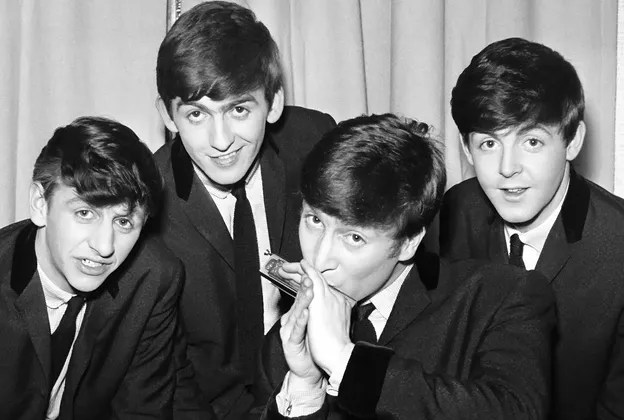
British Beatlemania refers to the British band, The Beatles and their rise to fame and popularity around the United Kingdom, the United States of America, and the world. They were part of what people would eventually call “The British Invasion”, which was the influx of British music “invading” radio stations, television shows, concerts and the record charts in the United States.
They made the list because songs such as Love Me Do, P.S. I Love You, and Please Please Me, helped kick-start Beatlemania. The crux of Beatlemania, at least to me, was having millions of people, mostly women, going crazy over the Beatles’ music, as well as the band members themselves, to the level of obsession or fanaticism. This was obviously aided by the mass media.
The Beatles had broken up before I was born, but I’ve seen footage and read stories about the craziness. My parents played a lot of Beatles’ music at home, so I get it. Some contemporary examples are Swifties (Taylor Swift) and Little Monsters (Lady Gaga), but one aspect of the Beatles’ legacy is that they are considered one of, if not the most popular and successful band ever, in part due to Beatlemania.
Ole Miss
Ole Miss would be a great name for a horse, and maybe somewhere on the planet, that horse exists; however, this entry is not about them, but it has a connection to another name in the song. Back in 1957, via the fifth verse, we had the name, Little Rock. If you remember it, great stuff; if not, I’ll give you time to read about it now.
Sorted, you’re good to go? Excellent! Like Little Rock, Ole Miss was another flashpoint in the history of race relations in the United States. Ole Miss has a few different meanings, but in context to the song, it refers to the nickname of the University of Mississippi, located in Oxford, Mississippi, and its race riot in 1962.
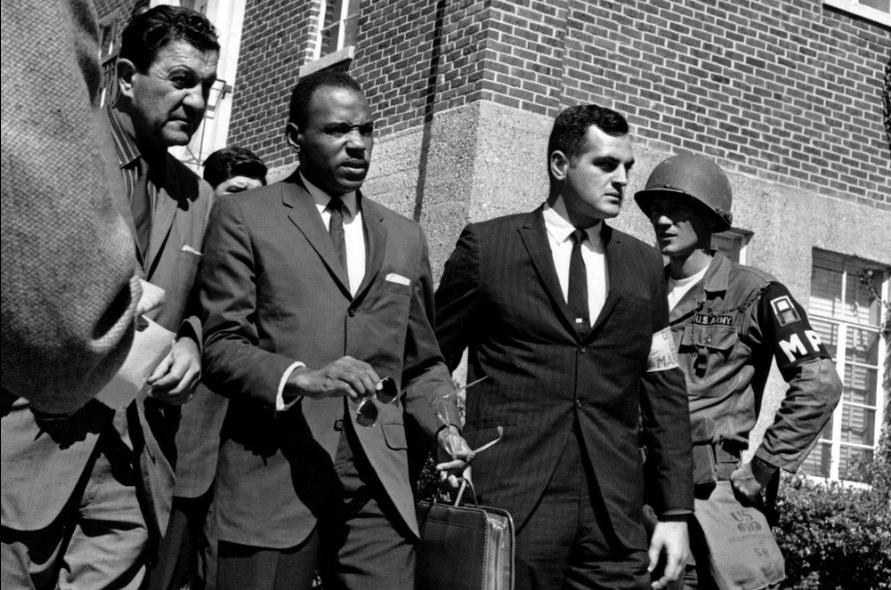
I’m not sure if I can do this event justice, but I’ll try. James Meredith, an African-American U.S. Air Force veteran, had enrolled at the University of Mississippi, and when it was discovered that he was not the white man they thought him to be, shit hit the fan, with the university officials, but also the Mississippi Governor, Ross Barnett. At the time, the University of Mississippi was an all-white university.
In an attempt to deny him entry to the university, Meredith was temporarily jailed, then released, with Barnett barring him from attending the university. President Kennedy and Attorney General Robert F. Kennedy got involved to find a way forward without violence, and allow Meredith to attend. Obviously, this incident, like nearly all of them, got out of hand.
Between 30th September and 1st October, a riot broke out on the campus involving federal law enforcement and a mob, consisting of segregationists, white supremacists, and some students. The aftermath of the riot included hijacked vehicles, destruction of buildings, and over 300 people were injured, including 28 U.S. Marshals being shot, as well as two civilians were killed. The next day, President Kennedy sent in over 30,000 troops to keep the peace and ensure Meredith could attend the university, with federal protection.
Meredith went on to graduate with a political science degree. So how does this event relate to the world of 2026? Well, how can it not? Yes, I’m not an American, but the evidence is plain to see. What the Little Rock incident did for the desegregation of high schools, the Ole Miss riot helped to bring about much-needed social reforms in universities within the United States.
John Glenn
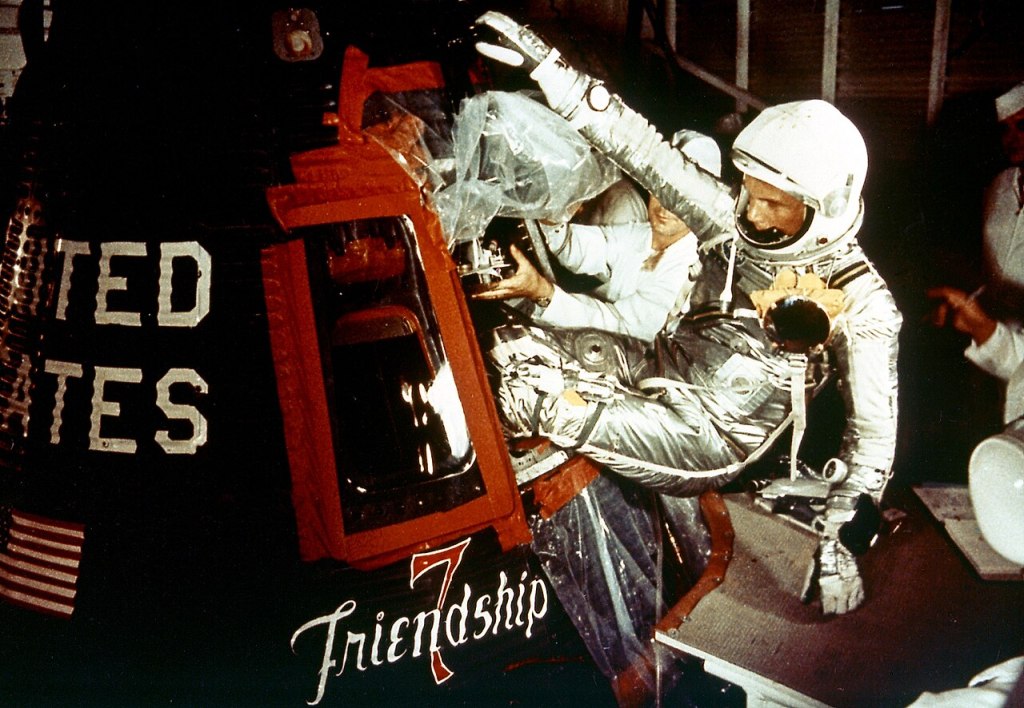
John Glenn was a politician, wartime pilot, test pilot, and astronaut. As you remember from previous entries, 1962 was at the height of the Cold War, but most importantly, the space race had started between the United States and the Soviet Union. Glenn was one of the seven astronauts chosen to fly spacecrafts for Project Mercury. These astronauts are known as the Mercury Seven.
He was included in the song because on 20th February 1962, he became the first American to orbit Earth, but he was not the first American in space. That honour belonged to Alan Shepard in 1961. Facts matter, folks, facts matter.
Anyway, Glenn completed three orbits of Earth, flying the Friendship 7 spacecraft for the Mercury-Atlas 6 mission. He completed three orbits in roughly 5 hours, 55 minutes, at speeds of over 28,000 km/ph.
A modern equivalent for a single astronaut achieving something new is sort of difficult, considering the huge advancements in space technology and flight. Instead of this, I could put forward the recent successful Artemis II mission, which is the second time I have mentioned it. I hope there’s not a third.
Liston beats Patterson
It’s been awhile since we discussed boxing, but like Thanos, it was inevitable. The boxers in question were Sonny Liston and Floyd Patterson, and they fought for the undisputed heavyweight world championship on 25th September 1962, at Comiskey Park, Chicago, Illinois.
This was Patterson’s second reign as champion, as he first won the title in 1956, lost it in 1959, and then reclaimed it in 1960. This, of course, made Liston the challenger. Liston was older and heavier than Patterson, but Patterson had started boxing professionally before Liston.
Depending on who you talk to, predictions for the fight were slightly in favour of Liston; it was strange that the champion was not the favourite. Anyway, the fight was memorable because after two minutes in the first round, Liston knocked Patterson out to become the new heavyweight champion of the world.
The story doesn’t end there, because Liston successfully defended his title in a rematch with Patterson in July 1963. Liston then fought to defend the title in February 1964 against Cassius Clay, but he was defeated. Clay changed his name a month later to Muhammad Ali. He then faced Liston for a second time in May 1965, and Liston lost again.
Essentially, Liston made the song for knocking out the world champion in the first round. Some contemporary examples were difficult to cite, mainly because champions continue to be knocked out, but it’s rare for it to happen in the first round in heavyweight fights.
The best I could find was on 29th October 19931, when the WBO Heavyweight Champion Tommy Morrison was knocked down three times in the first round by Michael Bentt, and lost the fight and title.
So for 1962, we covered a film, fanatic fans, a desegregation university riot, an astronaut, and a boxing match. 1963’s blog post is roughly seven weeks away, so I’d better prepare myself! If you’re still enjoying this project, as always, please let me know, because nothing happens in a vacuum.
So that’s it for this week. Thanks again for reading, following, and subscribing to Some Geek Told Me; it means a lot. My Twitter and Mastodon accounts are still ticking over with daily information that someone may find interesting. Maybe.
Please don’t forget to walk your dog, read a banned book, thank the bus driver, and if you ever repeat any of the information I write about, and someone asks you where you discovered it, just say, ‘Some Geek Told Me.‘ I’ll see you next week, when we discuss the Artemis II mission. Third time’s a charm!
1 If you can call 1993 contemporary, of course.
 SOME GEEK TOLD ME