
I was thinking the other day about what brilliant subject I could write about for the next blog post, when I realised that the decision had already been made for me. Yes, dear fans, it’s that time in the cycle when the greatest scientific communication of our age comes back for another round of fantastic nonsense. I have heard your prayers, and they have been answered!
Your waiting is over, for Some Geek Told Me’s Tour of the Solar System has returned once again for 2026. I know, the anticipation is immense. For previous courageous instalments, please see the list below:
1.) Meet the Family
2.) The Sun
4.) Mercury
5.) Venus
7.) The Moon
8.) Mars
10.) Ceres
11.) Jupiter
12.) The Galilean moons
13.) Saturn
14.) Titan
15.) The Moons of Saturn
16.) Uranus
17.) Titania
18.) The Moons of Uranus
19.) The Literary Moons of Uranus
20.) Neptune
21.) Triton
22.) The Moons of Neptune
23.) The Kuiper Belt
24.) Pluto
For those of you who are counting, this is my 25th entry in the tour that nobody asks for. The world seems determined to tear itself apart, but rest assured, the quality of this account is still poor, just the way you like it. The new entry is about Charon, which I briefly mentioned last time, so without further time wasting, away we go!
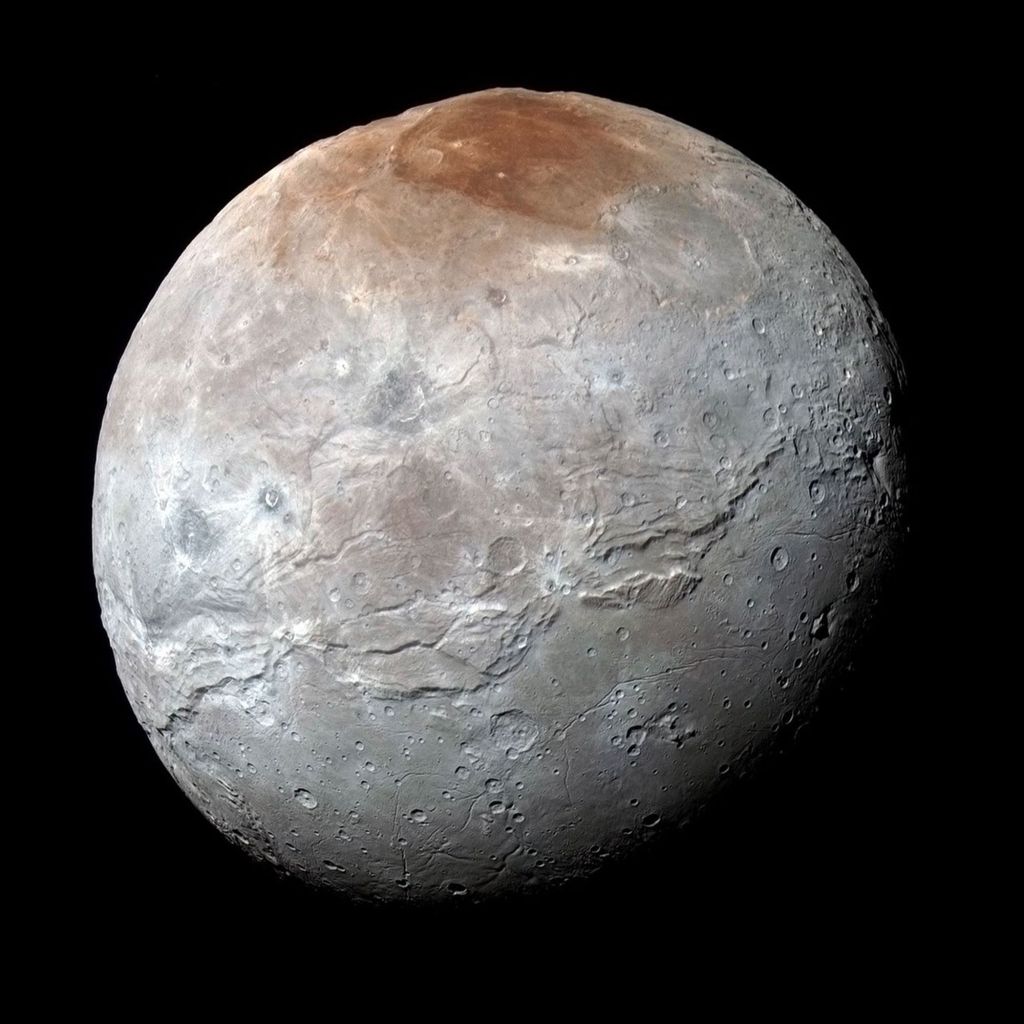
I wasn’t sure if I would ever reach Charon. I thought I would have given up by now, but here we are. We’re going to break this celestial object down, just like the others, because that’s what happens on this account: a lot of repetition and bad jokes.
As discussed on the last tour stop on New Zealand’s fifth least favourite website, Charon is one of five known moons of Pluto, and it’s also the largest. Charon’s relationship with Pluto is much like a one-night stand without contraception; this is important, and it’s going to come back. We’ll discuss this later in a safe space.
Charon has a diameter of 1,212 km, which works out to be just over half of Pluto’s diameter. For the record, having a moon which is half the size of its parent planet is extremely odd. Like freaky odd. For comparison, the distance is roughly the same as travelling from Rome, Italy, to Tilburg, in the Netherlands. Charon is small, but it can still beat Ceres in a wrestling match, as well as being the 12th-largest moon in the Solar System.
Much like the discovery of penicillin, Charon’s discovery was by accident. In 1978, James Christy, an astronomer at the U.S. Naval Observatory, had been observing Pluto to refine and determine Pluto’s orbit around the Sun. After looking at some photographic plates, Christy noticed an elongated blob.
The way I understand it, Christy consulted another astronomer at the observatory, Robert Harrington. Together, they discovered photographic plates of Pluto dating back to 1965, with the same elongated blob. The blob turned out to be Charon, Pluto’s first discovered moon.
If you’re up on your Greek mythology, you would have recognised Charon as being named after the delightful gentleman, whose job was to ferry departed souls across the River Styx and Acheron, to the Underworld, which was ruled over by…Hades, the Greek equivalent of Pluto. Coincidentally, you may have also heard of the ancient custom of placing coins on the eyes of a corpse, as the money would serve as payment for Charon, to transport their soul.
Remember that one-night stand from before? Well, the results are in, and congratulations, you’re going to be a parent! Charon orbits Pluto at a distance of roughly 19,640 km, which, in cosmic terms, is stalker-level status. This is only the start of Pluto and Charon’s freaky relationship.
To explain this, we need to take a sip of hot chocolate and concentrate, because we need to discuss Pluto’s barycenter. A barycenter, to the best of my understanding, is the most common centre of mass around which two or more cosmic objects orbit. These can include stars, planets, dwarf planets, and moons.
It can be referred to as the balance point, where gravity holds objects together within a system. This usually means the barycenter is located closer to the cosmic object with more mass, which can sometimes be located outside of the larger object. Earth’s barycenter with the Moon is situated within the Earth, about 4,671 km from its centre. Since the barycenter is not at the exact centre of the Earth, the Earth’s centre of mass follows a small, wobbly path around this point.
Another example is with the Sun-Earth barycenter, which can be found 449 km from the Sun’s centre, but it’s still inside the Sun. Since the Sun is so much larger than the Earth, the Sun also experiences a slight wobble. However, the Pluto-Charon barycenter is, once again, odd, because the point that they both orbit around is found not within Pluto, but rather outside of it.
This has led to both Pluto and Charon being mutually tidally locked to each other, which is another way of explaining that the same surfaces of Pluto and Charon are always facing each other. For more comparison, the Moon is tidally locked to Earth, but the Earth is not locked to the Moon.
Because of these facts, Pluto and Charon are sometimes referred to as a “double dwarf planet” binary system.
Charon orbits Pluto every 6.4 Earth days, with an orbital speed of 0.21 to 0.23 km/s, which, in the scale of the Solar System, is quite slow. The distance from the Sun to Charon is also remarkable, with an average measurement of 5.9 billion km. Sometimes with distance and numbers like these, it’s easier to accept it and move on.
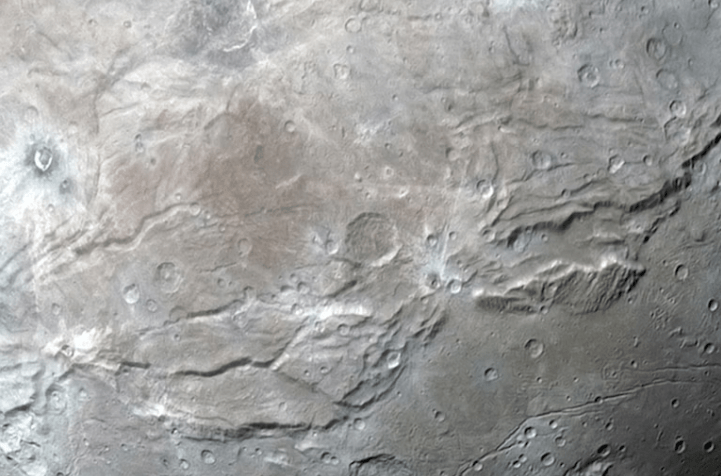
Much like Voyager 2 providing information about Triton, New Horizons‘ flyby in 2015 has gifted humanity with some extraordinary information, data, and images of Pluto’s largest moon. That’s all well and good, but is there anything else we could learn about Charon? Be careful what you wish for.
Let’s talk about Charon’s geology. Its age is believed to be around 4.5 billion years old, but to be honest, it doesn’t look a million years over 3.8 billion. The surface is very active, and is covered with water ice, canyons, carters, and some pretty gnarly names of surface features. These include, but are not limited to, Tardis Chasma, Nostromo Chasma, Kirk, Organa, Ripley, Tintin, Skywalker, Spock, Sulu, Vader, Kurbrick Mons, Gallifrey Macula, Vulcan Planitia, and, of course, the Neverland Regio, which was formerly nicknamed, Mordor Macula.
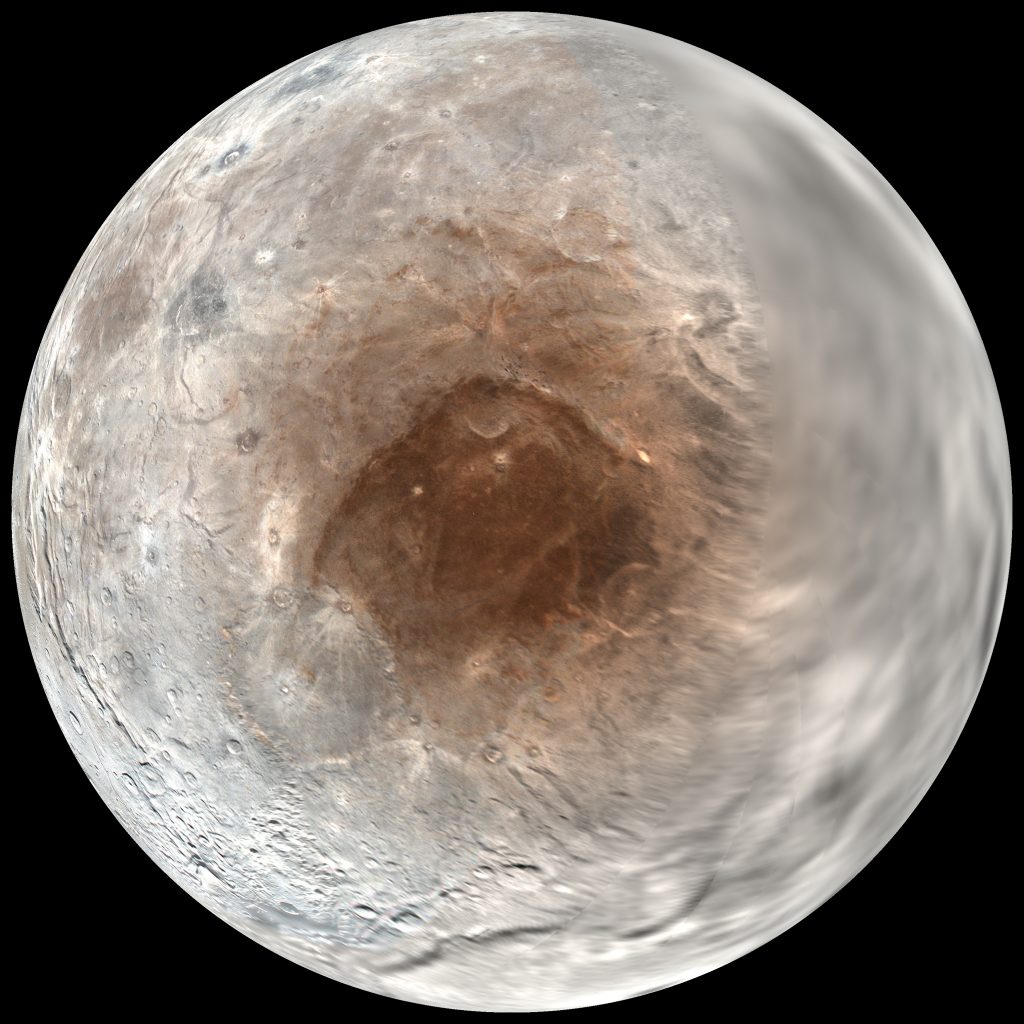
Charon’s polar cap, the Neverland Regio, is famous for being a massive reddish-brown area at its north pole. This region is made up of tholins, which are dark organic compounds. The colour comes from methane escaping from Pluto, which becomes trapped at Charon’s cold and dark pole during its decades-long winter. During this time, this methane is transformed into red, complex hydrocarbons by solar wind and ultraviolet radiation.
Other equally cool facts about Charon are:
- Charon is believed to be too small to sustain a permanent atmosphere, but it does have a crazy 120° axial tilt.
- Because Charon is mutually tidally locked with Pluto, it shares Pluto’s 248-year orbit around the Sun.
- Each season on Charon can last over 60 years.
- The average surface temperature is roughly -230°C, while during winter, it can drop even further to -258°C.
- Evidence on Charon’s surface suggests it had ancient cryovolcanic activity.
Charon is a curious little ice ball, but it is still part of our family, and we love it. What is your favourite fact about Charon? As always, please let me know.
I appreciate you continuing to join me on this fascinating tour. The narration is pathetic, but the views are amazing. Thank you for reading, following, and subscribing to Some Geek Told Me. My Twitter and Mastodon accounts are still active, pumping out non-award-winning content daily; you should check them out.
Please remember to walk your dog, read a banned book, don’t bomb schools, and I’ll see you next week for the Six Nations winners update. Stop it, I know you love it.


 SOME GEEK TOLD ME
You must be logged in to post a comment.