
The wheel has turned again, and the world is still faced with unrest, turmoil, and US$499 Trump watches. However, there is an antidote in the form of Some Geek Told Me’s Tour of the Solar System! Once again, the tour that nobody on the planet asked for, except for me, is back to entertain the masses and spark curiosity within society, or just something to read on the bus.
Some Geek Told Me’s Tour of the Solar System is the envy of the scientific community, especially in astronomy circles. Don’t be one of those professors struggling to catch up on reading blogs, because you can do that now! Past entries include:
1.) Meet the Family
2.) The Sun
4.) Mercury
5.) Venus
7.) The Moon
8.) Mars
10.) Ceres
11.) Jupiter
12.) The Galilean moons
13.) Saturn
14.) Titan
15.) The Moons of Saturn
16.) Uranus
17.) Titania
18.) The Moons of Uranus
19.) The Literary Moons of Uranus
20.) Neptune
21.) Triton
22.) The Moons of Neptune
Our journey started in January 2023, and in September 2025, we left the Neptunian System, along with the Sun, the other seven planets, their moons, a single dwarf planet, and the Asteroid Belt. We are now going to be venturing into new territory, namely the Kuiper Belt. So, ladies and gentlemen, make sure you’re wearing your thinking hats, because the tour continues!
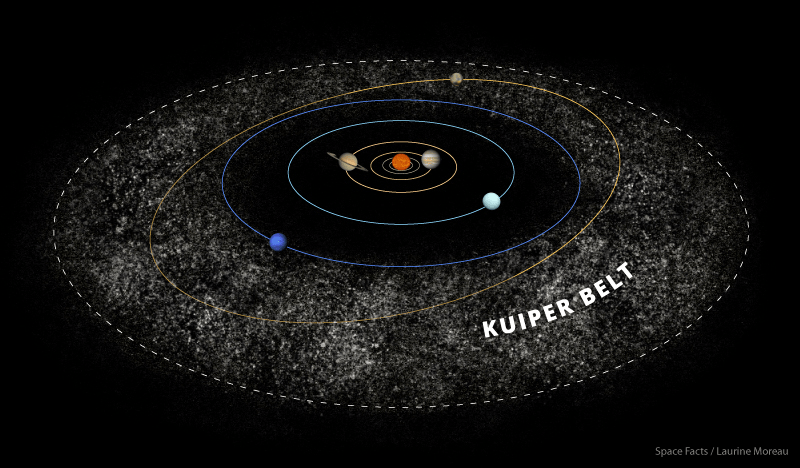
The next stop is an odd one, because just like the Asteroid Belt, the Kuiper Belt is a region of space, rather than a single object, like a planet or moon. Before we dive into what the Kuiper Belt actually is, which is not a new Ralph Lauren belt, we need to establish its name and its discovery. I know, it’s not very flashy or sick, but facts matter.
The discovery of Pluto in 1930 created a stir in the astronomy community because of the possibility of other objects being discovered beyond Pluto. It was thought that since Pluto was on a long-period orbit, it may have just been the first to be revealed, with more waiting out of view.
Over the years, various theories were created to explain what this region beyond Neptune could hold, such as those of Kenneth Edgeworth in 1943. Whatever the reality, the growing consensus was that it could be made up of thousands, hundreds of thousands, if not millions or hundreds of millions of objects, similar in size to Pluto, especially short-period comets.
In 1951, an astronomer named Gerard Kuiper proposed in a paper that this region could be in the shape of a disc, where it could be the leftovers of cosmic bodies, and through time and gravity, have changed. As the years moved on, more objects were slowly discovered in this region of space.
Fast forward to 1992, when astronomers David Jewitt and Jane Luu discovered an object, 1992 QB1, which was later named 15760 Albion. This discovery helped to reinforce Kuiper’s theory of the existence of the disc/belt in that region.
This belt was then named after Kuiper; thus, it became known as the Kuiper Belt, but it’s also known as the Edgeworth–Kuiper belt. Despite that, some astronomers believe that Kuiper and Edgeworth don’t deserve their names to be attached to it, as they support the idea that other astronomers predicted the existence of the belt before them.

That was great, but what is the Kuiper Belt? What an insightful question, well done. Someone who is far more intelligent than I am, and has actually astronomical qualifications, not just a geek with a passion for space, would be able to give you a better description than I could. However, I will try.
The Kuiper Belt is a region of space located beyond Neptune’s orbit. It is shaped like a doughnut, with the centre of it containing the Sun, inner planets, the Asteroid Belt, and the outer planets. It’s home to dwarf planets, as well as smaller rocky and icy objects. Along with that, the Kuiper Belt is a source of short-period comets.
The size of the Kuiper Belt, to me, boggles the mind. If you can remember from previous tour stops, one astronomical unit (AU) is the distance between the Sun and the Earth, which roughly works out to be 150 million km. The Kuiper Belt can be divided into two sections: the Inner region and the Scattered Disc.
The Inner region, which is the main section, begins at 30 AU at Neptune’s orbit and finishes about 50 AU. The belt extends into the Scattered Disc, which overlaps the Inner region, with some objects being measured at distances of 1,000 AU. The width of the Kuiper Belt is believed to be about 20 AU, which is gargantuan.
Like many events in Earth’s history or Deep Time, there were no people around to witness it or record information. But just like Sherlock Holmes and Batman, scientists are detectives who can look at evidence to explain the origins of the Kuiper Belt.
The Kuiper Belt is thought to be 4.6 billion years old, slightly younger than the Solar System. At the formation of the Solar System, it would have been crazy, with objects zipping around and coalescing into planets or proto-planets.
Just like the Asteroid Belt, the Kuiper Belt is the remnants or leftovers of proto-planets that failed to form and were pulled apart by gravitational forces. The difference is that the Asteroid Belt was formed by Jupiter’s gravitational pull, whereas the Kuiper Belt was created by the gravitational pull of Neptune.
Objects located within the Kuiper Belt have special labels, referred to as Trans-Neptunian objects (TNOs) and Kuiper Belt Objects (KBOs). There is a myth that TNOs and KBOs are the same thing, like the United Kingdom and Great Britain. They are similar, but different.
The United Kingdom is made up of England, Scotland, Wales and Northern Ireland; however, Great Britain consists of England, Scotland, and Wales. Great Britain is part of the United Kingdom, but the United Kingdom is not Great Britain.
The same rule applies to the Kuiper Belt. TNOs are any objects that are located and discovered beyond Neptune’s orbit, which includes the Kuiper Belt; however, KBOs are objects only located within the Kuiper Belt. All KBOs are TNOs, but not all TNOs are KBOs. It’s a subtle difference, but facts matter.

Centaurs are another type of rocky and icy objects that begin in the Kuiper Belt, but now have orbits between Jupiter and Neptune. They act as a transitional population between KBOs and comets, if that makes sense. Their orbits are unstable due to various gravitational interactions with Jupiter, Saturn, Uranus and Neptune, which can send them inwards.
This process can eventually cause them to evolve into comets or be ejected from the solar system entirely. Because of their origin, they are sometimes called “Kuiper Belt escapees.”
The distribution of objects in the belt is not even, so they are scattered. Another comparison with the Asteroid Belt is the distance between objects. Hollywood likes to add drama to space travel, like it wasn’t already dangerous, and paints the picture of asteroids hitting each other because they are so close.
The opposite is true, since the average distance of objects in the Kuiper Belt is about the distance between the Earth and the Moon, roughly 385,000 km. You will have no issue hitting another object; it’s smooth sailing.
The spacecrafts Pioneer 10 (1983) and Voyager 2 (1989) have both travelled into the Kuiper Belt, with the most recent visitor, New Horizons, in 2015, which is still sending back fantastic data and images, along with the Hubble and James Webb space telescopes studying the region.
The Kuiper Belt has many famous citizens, particularly dwarf planets, which brings us to our next tour stop, Pluto! That brings this section of the tour to a close, but we will start again in December, whether that is before or after Christmas. Good times.
What’s your favourite fact about the Kuiper Belt? As always, please let me know. Thanks again for reading, following, and subscribing to Some Geek Told Me. My Twitter and Mastodon accounts are highly popular, since I have a combined total of 174 followers; I know, Neil deGrasse Tyson can only dream of those numbers.
Please don’t forget to walk your dog, read a banned book, rainbows are not dangerous, and I’ll see you next week for some Shakespeare! I bet you can’t wait!
 SOME GEEK TOLD ME
You must be logged in to post a comment.