
It’s nice to be reassured that the important things in this crazy old world never change; Jonathan Pie keeps holding back on telling us how he really feels; Donald Trump has exonerated himself; and New Zealand’s second most popular conspiracy theorist, Brian Tamaki, is still fighting against non-Christian immigration. The more things change, the more they stay the same.
I’ve been meaning to write about Parkrun for the last few months, and this week’s blog post has been rewarded with that honour. Yay. I’ve written some truly inspiring blog posts about running, so it’s a wonder you haven’t read or heard about them. What’s that? You haven’t? Oh, never mind, nobody is perfect, except for Chuck Norris.
And with that hard-hitting introduction, let’s embark on a journey of self-discovery and punishment, as only those who suffer through running can truly understand.
SPOILER: This is not a paid advertisement. I’m not popular enough for any of that.

If you’re like me and walk around completely oblivious to the things other people take for granted, you may have never heard of Parkrun. Until August 2025, I had never either. It wasn’t until our small free community weekly newspaper was advertising it, that I took notice of it.
So, Scott, spit it out. What is Parkrun? No, it’s not a new name with Generation Alpha children that’s trending; far from it. Parkrun is a fun run, though some people believe the words “fun” and “run” should never be in the same sentence. Basically, Parkrun is a weekly 5 km fun run that is managed by volunteers for walkers and runners.
And that’s another blog post for another week. Thanks again for reading, following, and subscribing to Some Geek Told Me. Please don’t forget to walk…as if.
Parkrun was introduced in the United Kingdom in 2004 by Paul Sinton-Hewitt, but now has spread to over 26 countries, with over 10 million participants. As I said earlier, it is run by volunteers who organise the weekly 5 km runs, which are timed events for walkers and runners.
There are over 2,000 locations worldwide and over 60 locations in good, old New Zealand. I feel rather special because, as I said earlier, I had never heard of Parkrun until last year. I was only 21 years late, which is quite good for me. I’m planning on ditching dial-up internet soon, because this broadband thing seems to be popular.
Anyway, my town has a Parkrun, and wouldn’t you know it, the circuit is 5 km. Well, to be honest, I don’t know if the course is exactly 5 km, but the course consists of three laps, so maybe the course is a few metres off, but what’s five metres between friends? If you haven’t done Parkrun before, I can explain what it’s like, though I haven’t been to another course.
During the summer months, the run starts at 8 am, which is a shock to the system for a Saturday. I only live a 15-minute walk from the course, so that’s (un)lucky. Before the run starts, there’s always a meeting for the first timers, where they run through what to expect and how it operates.
The deal is that it’s free to run; however, since it’s a timed event, you need a barcode that allows your time to be recorded. To secure one, you go to the Parkrun website and register your details. You’re given a barcode, where you can download it to your phone, or, as I did, print it off and carry it in your pocket.
You can invest in other options like cards and wristbands, but they all cost. Since my barcode is looking very tatty and battered, I may one day save up for a wristband. Sadly, I’m not cool enough for that yet. Sorry, I’m like a middle-aged geek at a library, I get distracted too much. Focus, Scott, get back on track. The barcode works like this: at the finish of the race, and if you want to have an official time, you run through the chute.
People are recording the time as you cross the line, and then there will be someone handing out tokens with a barcode on them. The next step is crucial, as I usually give the people the wrong item. You will have two items in your hands now: your barcode, in whatever form that takes (print for me), and a plastic token.
At the end of the chute, there will be a third group of people waiting for you. You will give them your barcode to be scanned, and they will return it to you once this is done. Next, you will hand over the plastic token for scanning; however, you will not get this token back, as it will be recycled for the following week.
Since the run is only 5 km, runners and walkers of all abilities start at the same time, which means everyone is competing at once. The final step is to wait for the results. I believe you receive the results via email in under 90 minutes. However, for me, it’s a hollow victory.
The results contain several pieces of information
- Your official race time (Also, if this time was your new personal best).
- The total number of races you have competed in.
- The number of races you have competed in at that venue.
- Your overall placing against all of the competitors.
- Your overall placing against all of the competitors in your gender group.
- Your placing overall against all of the competitors in your gender and age group.
These results are a great way to gauge your progress each week, but there’s one key statistic that I haven’t discussed. Along with the others, there is an age-graded score, which is a percentage. All of the other statistics made sense, and I could understand them, but not the age-graded score. I made the mistake of clicking on the link that would explain it.
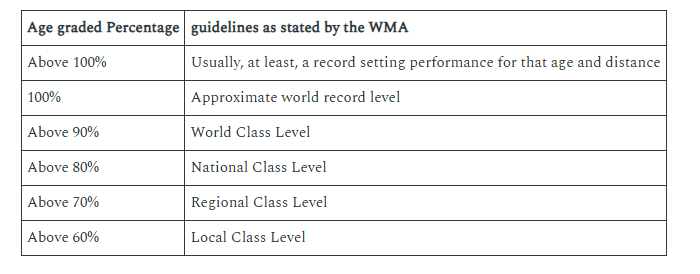
All parkrun events use age grading to allow parkrunners to compare results. Age grading takes your time and uses the world record time for your gender and age to produce a score (a percentage).
Age Grades are calculated to allow rough comparisons between our participants, and should not be taken too seriously. For example, age grading makes no allowance for different weather conditions or the varying terrains of our courses.
We do not share the actual table used to perform the calculations but it is loosely based on the tables produced by WMA, previously known as WAVA.
Finally parkrun age grade values are based on established, international proxy metrics, which are currently only available for male and female categories. Should a participant select “prefer not to say” or “another gender identity”, gender-related data will be absent.
In other words, your effort is graded against elite local, national, and international athletes. No matter how amazing your run was, even with the other finishing results, scoring under 60% humbles you a lot. Also, it’s a hell of a thing to have a 60-year-old woman and a 10-year-old boy pass you. It really builds up your self-esteem and confidence.
I find it interesting when you get to expect particular people to pass you each week, when you’ve been there enough times. Sometimes they pass me on the third lap, and I feel I’m doing well. However, the opposite is true when they pass me on the first lap, and I feel instantly defeated. Yay.
For a free weekly event, Parkrun is fast becoming a staple in my life, and even though each week you are racing against other runners, and of course, yourself, I’m still enjoying it. And in this topsy-turvy world, finding something that challenges you and makes you happy, for whatever reasons, can’t be a bad thing. If you haven’t tried Parkrun, once again, do yourself a favour and give it a go.
Have you done Parkrun before? What are your thoughts? As always, please let me know.
Thanks again for reading, following, and subscribing to Some Geek Told Me. Please don’t forget to walk your dog, read a banned book, watch the ICC Men’s T20 World Cup semi-finals (Go, New Zealand!) and final, and I’ll see you next week for the review of a movie I never want to see.
 SOME GEEK TOLD ME
You must be logged in to post a comment.