Tour of the Solar System: The Kuiper Belt

The wheel has turned again, and the world is still faced with unrest, turmoil, and US$499 Trump watches. However, there is an antidote in the form of Some Geek Told Me’s Tour of the Solar System! Once again, the tour that nobody on the planet asked for, except for me, is back to entertain the masses and spark curiosity within society, or just something to read on the bus.

Some Geek Told Me’s Tour of the Solar System is the envy of the scientific community, especially in astronomy circles. Don’t be one of those professors struggling to catch up on reading blogs, because you can do that now! Past entries include:

1.) Meet the Family

2.) The Sun

3.) Planets vs. Dwarf planets

4.) Mercury

5.) Venus

6.) Earth

7.) The Moon

8.) Mars

9.) The Asteroid Belt

10.) Ceres

11.) Jupiter

12.) The Galilean moons

13.) Saturn

14.) Titan

15.) The Moons of Saturn

16.) Uranus

17.) Titania

18.) The Moons of Uranus

19.) The Literary Moons of Uranus

20.) Neptune

21.) Triton

22.) The Moons of Neptune

Our journey started in January 2023, and in September 2025, we left the Neptunian System, along with the Sun, the other seven planets, their moons, a single dwarf planet, and the Asteroid Belt. We are now going to be venturing into new territory, namely the Kuiper Belt. So, ladies and gentlemen, make sure you’re wearing your thinking hats, because the tour continues!
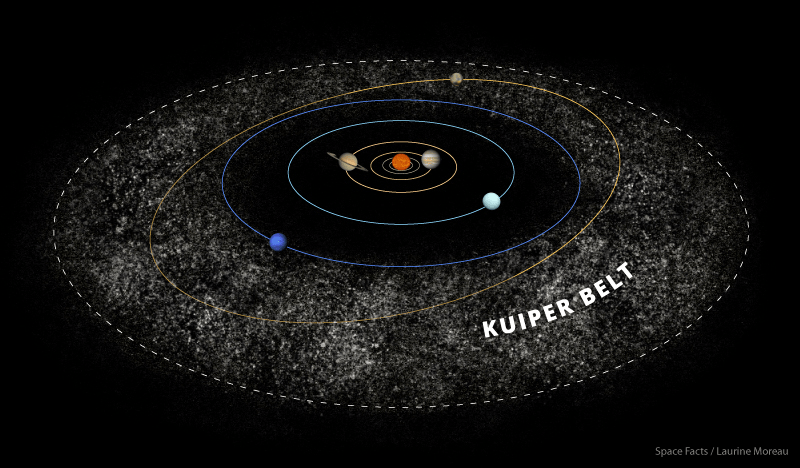

Kuiper Belt Illustration. Credit: Laurine Moreau/Space Facts

The next stop is an odd one, because just like the Asteroid Belt, the Kuiper Belt is a region of space, rather than a single object, like a planet or moon. Before we dive into what the Kuiper Belt actually is, which is not a new Ralph Lauren belt, we need to establish its name and its discovery. I know, it’s not very flashy or sick, but facts matter.

The discovery of Pluto in 1930 created a stir in the astronomy community because of the possibility of other objects being discovered beyond Pluto. It was thought that since Pluto was on a long-period orbit, it may have just been the first to be revealed, with more waiting out of view.

Over the years, various theories were created to explain what this region beyond Neptune could hold, such as those of Kenneth Edgeworth in 1943. Whatever the reality, the growing consensus was that it could be made up of thousands, hundreds of thousands, if not millions or hundreds of millions of objects, similar in size to Pluto, especially short-period comets.

In 1951, an astronomer named Gerard Kuiper proposed in a paper that this region could be in the shape of a disc, where it could be the leftovers of cosmic bodies, and through time and gravity, have changed. As the years moved on, more objects were slowly discovered in this region of space.

Fast forward to 1992, when astronomers David Jewitt and Jane Luu discovered an object, 1992 QB1, which was later named 15760 Albion. This discovery helped to reinforce Kuiper’s theory of the existence of the disc/belt in that region.

This belt was then named after Kuiper; thus, it became known as the Kuiper Belt, but it’s also known as the Edgeworth–Kuiper belt. Despite that, some astronomers believe that Kuiper and Edgeworth don’t deserve their names to be attached to it, as they support the idea that other astronomers predicted the existence of the belt before them.


The Kuiper Belt is actually doughnut shaped; Pluto’s inclined orbit is typical of other KBOs. Credit: BBC

That was great, but what is the Kuiper Belt? What an insightful question, well done. Someone who is far more intelligent than I am, and has actually astronomical qualifications, not just a geek with a passion for space, would be able to give you a better description than I could. However, I will try.

The Kuiper Belt is a region of space located beyond Neptune’s orbit. It is shaped like a doughnut, with the centre of it containing the Sun, inner planets, the Asteroid Belt, and the outer planets. It’s home to dwarf planets, as well as smaller rocky and icy objects. Along with that, the Kuiper Belt is a source of short-period comets.

The size of the Kuiper Belt, to me, boggles the mind. If you can remember from previous tour stops, one astronomical unit (AU) is the distance between the Sun and the Earth, which roughly works out to be 150 million km. The Kuiper Belt can be divided into two sections: the Inner region and the Scattered Disc.

The Inner region, which is the main section, begins at 30 AU at Neptune’s orbit and finishes about 50 AU. The belt extends into the Scattered Disc, which overlaps the Inner region, with some objects being measured at distances of 1,000 AU. The width of the Kuiper Belt is believed to be about 20 AU, which is gargantuan.

Like many events in Earth’s history or Deep Time, there were no people around to witness it or record information. But just like Sherlock Holmes and Batman, scientists are detectives who can look at evidence to explain the origins of the Kuiper Belt.

The Kuiper Belt is thought to be 4.6 billion years old, slightly younger than the Solar System. At the formation of the Solar System, it would have been crazy, with objects zipping around and coalescing into planets or proto-planets.

Just like the Asteroid Belt, the Kuiper Belt is the remnants or leftovers of proto-planets that failed to form and were pulled apart by gravitational forces. The difference is that the Asteroid Belt was formed by Jupiter’s gravitational pull, whereas the Kuiper Belt was created by the gravitational pull of Neptune.

Objects located within the Kuiper Belt have special labels, referred to as Trans-Neptunian objects (TNOs) and Kuiper Belt Objects (KBOs). There is a myth that TNOs and KBOs are the same thing, like the United Kingdom and Great Britain. They are similar, but different.

The United Kingdom is made up of England, Scotland, Wales and Northern Ireland; however, Great Britain consists of England, Scotland, and Wales. Great Britain is part of the United Kingdom, but the United Kingdom is not Great Britain.

The same rule applies to the Kuiper Belt. TNOs are any objects that are located and discovered beyond Neptune’s orbit, which includes the Kuiper Belt; however, KBOs are objects only located within the Kuiper Belt. All KBOs are TNOs, but not all TNOs are KBOs. It’s a subtle difference, but facts matter.


Some interplanetary dust particles that end up in Earth’s atmosphere may have started life in the faraway Kuiper Belt (illustrated), a region of icy objects farther from the sun than Neptune. Credit: ESA

Centaurs are another type of rocky and icy objects that begin in the Kuiper Belt, but now have orbits between Jupiter and Neptune. They act as a transitional population between KBOs and comets, if that makes sense. Their orbits are unstable due to various gravitational interactions with Jupiter, Saturn, Uranus and Neptune, which can send them inwards.

This process can eventually cause them to evolve into comets or be ejected from the solar system entirely. Because of their origin, they are sometimes called “Kuiper Belt escapees.”

The distribution of objects in the belt is not even, so they are scattered. Another comparison with the Asteroid Belt is the distance between objects. Hollywood likes to add drama to space travel, like it wasn’t already dangerous, and paints the picture of asteroids hitting each other because they are so close.

The opposite is true, since the average distance of objects in the Kuiper Belt is about the distance between the Earth and the Moon, roughly 385,000 km. You will have no issue hitting another object; it’s smooth sailing.

The spacecrafts Pioneer 10 (1983) and Voyager 2 (1989) have both travelled into the Kuiper Belt, with the most recent visitor, New Horizons, in 2015, which is still sending back fantastic data and images, along with the Hubble and James Webb space telescopes studying the region.

The Kuiper Belt has many famous citizens, particularly dwarf planets, which brings us to our next tour stop, Pluto! That brings this section of the tour to a close, but we will start again in December, whether that is before or after Christmas. Good times.

What’s your favourite fact about the Kuiper Belt? As always, please let me know. Thanks again for reading, following, and subscribing to Some Geek Told Me. My Twitter and Mastodon accounts are highly popular, since I have a combined total of 174 followers; I know, Neil deGrasse Tyson can only dream of those numbers.

Please don’t forget to walk your dog, read a banned book, rainbows are not dangerous, and I’ll see you next week for some Shakespeare! I bet you can’t wait!

Finally, my Star Wars: The High Republic post is here

Well, this blog post has been years in the making. I’ve hinted at this for some time, and now that my sponsorships are under control and I’ve completed the press tours, I feel it’s the right moment to write a blog post about the Star Wars: The High Republic series. I’m now rich and famous for running New Zealand’s fifth least favourite website, so it seems like the perfect opportunity to share my thoughts on this important subject.

Let’s establish an ugly truth before we begin: not every person on this planet has seen a Star Wars movie or TV show, or read a Star Wars novel or comic book; while some people, for some strange and unexplained reason, don’t like Star Wars. I know, it’s difficult to believe, but it’s true.

It’s been well and truly documented that I’m a geek and a fan of the world’s most famous space opera. This shouldn’t be a surprise to any of you. Seriously, it shouldn’t.

In terms of my Star Wars diet, I’ve been reading Star Wars literature in the form of novels and comic books for decades. Yes, I enjoyed the films, and since I won’t dive into that today, they left a void in me. I wanted more from that fictional universe, especially learning about the Jedi and events before A New Hope.

Enter Tales of the Jedi from Dark Horse Comics, and my prayers were answered. I think I discovered Tales of the Jedi at a library, and I was instantly hooked. Stories about the Jedi, set thousands of years before the Battle of Yavin? Sign me up.

It was a chance to tell new and exciting tales about the Star Wars universe, without being bogged down with continuity problems, since they were set thousands of years ago. I read the trades, then sourced all of the single issues, because I felt the entire series was made for me. I loved it.

Dark Horse later released Star Wars: Knights of the Republic, Star Wars: The Lost Tribe of the Sith-Spiral, Star Wars: Knight Errant, Star Wars: Jedi vs Sith, Star Wars: Republic, Star Wars: Dark Times, and one of my favourites, Star Wars: Dawn of the Jedi, among others.

Since then, various novels have been released, detailing thousands of years of Jedi and Sith, as well as the years leading up to The Phantom Menace and The Clone Wars. This also does not take away from the Canon stories exploring everything after A New Hope, either. I’ve enjoyed the Star Wars books I have read, but my love for Tales of the Jedi was enduring.

I felt I was starved for new Canon Star Wars content that was set hundreds or thousands of years before the Battle of Yavin. Legends’ stories were all over that, but the new stories seemed to be focused elsewhere. However, that changed with Star Wars: The High Republic.


My Star Wars: The High Republic novels

Essentially, The High Republic was1 a massive multi-media project, spanning novels (adult, young adult, middle-grade, young readers) comic books, audio drama, web series, manga, reference books, and short stories, with one animated TV show (Star Wars: Young Jedi Adventures), and one live action TV show (Star Wars: The Acolyte). The creators were a mix of seasoned Star Wars writers and new writers, not including the multiple artists.

The High Republic was set about 150 years before A New Hope, with both the Galactic Republic and the Jedi Order being at their prime. This is a time when thousands of Jedi patrol the galaxy, and new worlds are being discovered, and are invited to join the Republic. It’s an era of potential and exportation, when relative peace and security are a steady theme within the galaxy.

That sounds amazing, but would people want to read stories about Jedi travelling to distant worlds to mediate, or just enjoy having easy and stress-free lives? No, the Jedi needed a challenge to push them to become better. The Sith are still hiding throughout this time, so if the Sith aren’t the villains, the Jedi need someone else to fight!

This beautiful transition brings us the Drengir and the Nihil. The best way to explain the Drengir is that they are a sentient carnivorous plant species who have a connection to the Dark Side of the Force. They also have a hive-mind that is controlled by the Great Progenitor, who acts like the Borg Queen.

They had tentacles, thorns, various poisons, huge mouths, and an unending appetite for meat, which came in the form of whatever organisms they could find. During the series, the Drengir were wiping out villages, settlements, and colonies scattered across the galaxy.

The main villains of the series were the Nihil, who were described as space vikings. The creators put in a lot of effort in fleshing them out, since they were led by Marchion Ro, an Evereni who had an all-consuming hatred of the Republic and the Jedi.

The Nihil had a caste system, and they terrorised worlds and spaceships with raids, killing anyone that got in their way and taking whatever they wanted. Their spaceships had Path Engines, which were an engineering masterpiece and a secret weapon.

As I understood it, a normal spaceship that had a hyperdrive could make jumps through hyperspace across massive distances. However, Path engines allowed the Nihil to make micro-jumps through hyperspace, or even within a planet’s atmosphere. It meant the Nihil could make micro-jumps within a space battle and destroy or conquer spaceships with ease.

Throughout the series, they executed various gigantic plans across the galaxy to spread fear, terror, and to lay claim to new territories, as well as humiliating the Republic and destroying the Jedi Order. They did this through the aforementioned plans, but they also had an ace up their sleeve.

Marchion Ro used unique creatures. Called by several names, like The Shrikarai, the Nameless, and Shrii-ka-rai, these creatures were Force Eaters, which meant they survived and consumed the Living Force. As you can guess, their Force-sensitive victims were drained of the Living Force, and their bodies were converted to husks. And if their victims were Force-sensitive, it meant that their greatest strength became their greatest weakness.

Having a Nameless approach someone who was Force-sensitive would distort reality for that person, and affect them emotionally, physically, and mentally; but the main reason the Nameless were deadly was that Jedi were supposed to be mindful of their feelings and be able to suppress fear, but the Nameless made the Jedi afraid. They made the Jedi feel fear.

It’s an interesting take to see the brave Jedi being reduced to crying and screaming messes on the ground, when a non-Force-sensitive lifeform would be unaffected.

And speaking of Force-sensitive people, the creators have, in my opinion, been courageous in presenting other organisations that are connected to the Force, other than the Jedi and the Sith. Just because you are sensitive to the Force does not automatically mean you are destined to fall into the two camps of Jedi or Sith. It was great to see other organisms using the Force and helping communities, by not using a lightsabre.2

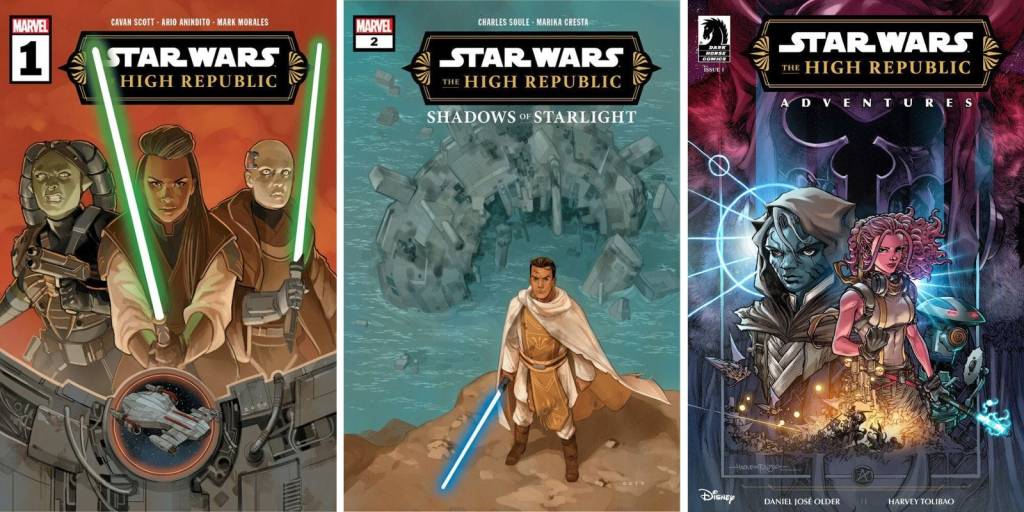
Phase III Star Wars: The High Republic Comics. Credit: Marvel & Dark Horse

Across the series, we have been introduced to many new and different Jedi. This relates to their species, type of lightsabre they use, and rank in the Jedi order, which is nothing new, since we were exposed to this with The Phantom Menace. However, the creators introduced something I believe I have never seen or heard of before: the way organisms feel, experience, and perceive the Force is different.

Albert Einstein explained with his theory of special relativity that there is no universal clock, so nobody experiences time the same way; we all experience time differently. This is much the same as how a lifeform experiences and perceives the Force, which will be different from everybody else. One Jedi experiences the Force as an ocean, another as music, and another as a forest. It was a cool concept.

We met new Jedi like OrbaLin, Burryaga Agaburry, Lily Tora-Asi, Sav Malagán, Ram Jomaram, Qort, Lula Talisola, Vernestra Rwoh, and Porter Engle, to name but a few. It was interesting to read about them in a novel, then discover them in a comic book, and vice versa. Star Wars: The High Republic also introduced lots of non-Jedi characters like Chancellor Lina Soh, Sevran Tarkin, Alys “Crash” Ongwa, Ty Yorrick, Tey Sirrek, Zeen Mrala, and Geode, along with many more.

The series was released in phases, which included the various media from January 2021 to June 2025. The main focus was the novels, with the comics, manga, and audio dramas still accessible to stand alone. The web series was released before the launch, so readers could understand the characters better and the time period.

With each phase, new content would slowly be released across, roughly 18 months, then go into hiatus, to reset for the new phase. Each phase was divided into Waves (1-3), which would include a novel, a young adult novel, and a middle-grade novel, so three books per wave meant nine books per phase.

Through the different phases, two main comic books were running, Star Wars: The High Republic from Marvel, and Star Wars: The High Republic Adventures, first released from IDW, then Dark Horse took over publication with Phase II.

Multiple comic book mini-series were also released through the three phases, along with one-shots, six manga, and three audio dramas (also available as scripts). The picture, art, and reference books were published near the end of each phase, but I could be wrong about that.

Phase I: Light of the Jedi was the first entry into the series, with nine novels. They set up the scene for the golden era of the Republic and the Jedi, which was about 150 years before A New Hope, where Jedi numbers were in their thousands. The Nihil, Drengir and their mischief-making were introduced across the phase.

Phase II: Quest of the Jedi was different for two reasons. The first reason was that the time period shifted, because we journeyed back another 100 years, before Phase I, to where the Outer Rim was still being explored. I think it was done to allow the readers to process the events of Phase I and to answer some questions that were raised. The other reason was that, instead of nine novels being released like in Phase I, only six were published in Phase II.

Phase III: Trials of the Jedi had another time jump and picked up the story one year after the events of Phase I. Some characters had died, and others grew through character development. I would like to add extra information to Phase III, but I can’t.

The thing is, even though Star Wars: The High Republic has finished, I have not finished reading Phase III. Nine books were published in this phase, and not counting the comic books and manga, I have only read the first four: Escape from Valo, The Eye of Darkness, Defy the Storm, and Temptation of the Force.

My local bookstore is still waiting for the paperback editions of Beware the Nameless, Tears of the Nameless, Into the Light, A Valiant Vow, and Trials of the Jedi, along with the script of the Tempest Breaker audio drama.

I have the final chapter in the series, the Marvel one-shot, Star Wars: The High Republic: Finale, waiting patiently to be read, only after the other six books have been located and read. It’s difficult because I really want to read it, but I’ve waited this long, so I can wait some more.

I’ve really enjoyed reading Star Wars: The High Republic. Meeting both old3 and new characters and travelling to new planets has been a thrilling experience. I’ve been eagerly waiting for a massive Star Wars project like this for over half my life.

The motivations behind the actions of characters, along with their visual designs, have been quite beneficial in the different media, which have allowed the creators to explore and showcase various characters in new ways.

A lot of them were complex, because as children, we were taught a person is either good or bad, but life isn’t as binary as that, with people having the potential for both good and bad. I thought it was a mature choice from the creators to reflect that.

As for reflection, I know a lot of people complained about the inclusion of many LGBTQIA+ characters in the stories. Personally, I found their complaints to be hilarious, because it’s a fact that not every Star Wars fan is a middle-aged straight white male.

As a business model, if you’re selling products involving fictional characters, you want any person, of any background, to be able to pick one of your products and to be able to see themselves in it. You want to cater to as many people as possible. Star Wars should be for anybody, not just the die-hard fans, because you want the next generation to fall in love with it, just like you did.

It’s also been clever not to have the Sith as the antagonists, because other factions hate the Jedi as well. They were hiding at the time, so why expose themselves? Because they do that in The Phantom Menace, after thousands of years of waiting, planning, and killing themselves.

I loved this series, but I have only two small disadvantages with it. The first is the cost, though that depends on how far you want to dive into the project. If you’re only interested in the novels, then the story will make sense. And if only comic books float your boat, then you can still enjoy the story as well.

However, if you’re anything like me, you would want to read as much as you can, to fully explore this time period, with novels and comic books, so it’s going to cost you. Though in saying that, you can take your time with the collection, so there’s no hurry.

The other point is probably criticism towards me rather than the series. Because there were so many characters, I sometimes found myself reading about a character that I couldn’t remember. I would have to stop, quickly research that character, curse myself for being stupid for forgetting them, then continue reading.

I hope the Star Wars franchise creates another multi-media project like The High Republic, because if they do, I’m there. When UMC1 and UMC2 are interested, the novels are waiting for them. Not the comics, though, that’s another discussion.

And with that, this overly bloated blog post is finished. Have you read any of the Star Wars: The High Republic or have any thoughts about it? As always, please let me know.

Thanks again for reading, following, and subscribing to Some Geek Told Me. Please remember to walk your dog, read a banned book, try to close a revolving door, and I’ll see you next week.


1 I believe the main High Republic story has finished, but some comics from Phase II are being released to expand upon this time period.

2 Yes, I know I have used “lightsabre” rather than “lightsaber.” I use British/New Zealand English, not American English, so I’m sorry, but not sorry.

3 I’m looking at you, Yoda.

Jane Goodall and Nigel Latta: Hope and understanding

I’ve been chugging along with this vanity project for nearly five years, but now and then, I have to bring the room’s mood down. Sadly, this blog post is one of those times, with the last one being nearly eight weeks ago.

Jane Goodall and Nigel Latta, two people I have admired for years, recently died, so I thought I had better acknowledge them and pay my respects.

From what I understand, Dr Jane Goodall died in her sleep on 1st October, in Los Angeles, California. She was 91 years old. Goodall was famous around the world for various reasons, but mainly for her decades of research on chimpanzee behaviour. I’m likely underselling her, but Goodall was a scientist, author, and advocate for the natural world, including animal rights.

I love animals, especially pets; however, Jane Goodall was one of these people who helped me to understand that if you have a love for animals, why would you eat them? It’s one of the reasons why I have almond milk now, as well as being a semi-vegetarian, which means I eat meat, but only chicken and fish. I don’t eat mammals any more, and one day I’ll go full vegetarian. I’m working on it.

Goodall came to New Zealand, not long ago, where she was on tour. I saw the tickets advertising the event, and I really wanted to go. I’ve admired her work for years, but I couldn’t justify spending a small fortune on tickets, flights, and accommodation, which would only be for me, and not my family.

Because of that, I decided I couldn’t afford to go. I was disappointed about it, but I accepted it. Looking back on it now, I am filled with regret. Goodall spoke about many different things, as she reinforced the notion that if you wanted the world to change, you needed to change first; she was very inspiring.

Jane Goodall with Motambo, an orphan at the Jane Goodall Institute’s Tchimpounga Chimpanzee Rehabilitation Center in Pointe Noire, Republic of Congo. Credit: The Jane Goodall Institute.

For my international community, you may not have heard of Nigel Latta, but my New Zealand followers would have. Latta died from cancer on 30th September, aged 58, in Auckland. Now, for those of you not in the know, Latta was an author and broadcaster, but he was also, arguably, the most famous psychologist in the country.

Latta helped people across the community through his books and television shows, to help us better understand ourselves mentally, emotionally, and physically, but also our loved ones, and how to pick ourselves up and keep trying.

Understanding why and how people make decisions has helped me, not only in figuring out other people, but also myself, especially as a parent, raising two geeky boys.

I remember I was in Napier on holiday, when I was walking along, and I saw Latta with his family having lunch. By then, he was a household name, and I had really enjoyed his TV shows. An idea suddenly popped into my head that I should go over and say hello and thank him for his work.

I got a few steps towards him when I fully took in the scene. He was spending quality time with his family, so I quickly changed my mind, since I didn’t want to break up that scene for him, so I turned around and kept on walking.

It would have been great to have met him, but I don’t regret my decision. Latta was very relatable with his commentaries and greatly helped so many people.

Credit: RNZ / Cole Eastham-Farrelly

Both Goodall and Latta, like many others, have influenced my nerdy and geeky life in subtle ways, and I feel extremely lucky to have lived when they did, having heard their various messages of hope and change.

In my usual memorial blog posts, I typically spend more time talking about the person’s achievements and their impact on the world; however, instead of that, I think it would be far better if Jane Goodall and Nigel Latta did it for me. So, because of that, I have collected some of Goodall and Latta’s quotes and messages, as they are a far more fitting tribute than what I could ever come up with.

“Young people, when informed and empowered, when they realize that what they do truly makes a difference, can indeed change the world.” 

“Lasting change is a series of compromises. And compromise is alright, as long as your values don’t change.”

“Change happens by listening and then starting a dialogue with the people who are doing something you don’t believe is right.”

“You cannot get through a single day without having an impact on the world around you. What you do makes a difference, and you have to decide what kind of difference you want to make.”

“You cannot share your life with a dog, as I had done in Bournemouth, or a cat, and not know perfectly well that animals have personalities and minds and feelings.”

“Chimpanzees, gorillas, orangutans have been living for hundreds of thousands of years in their forest, living fantastic lives, never overpopulating, never destroying the forest. I would say that they have been in a way more successful than us as far as being in harmony with the environment.”

“Chimps can do all sorts of things we thought that only we could do – like tool-making and abstraction and generalisation. They can learn a language – sign language – and they can use the signs. But when you think of our intellects, even the brightest chimp looks like a very small child.”

“I’m always pushing for human responsibility. Given that chimpanzees and many other animals are sentient and sapient, then we should treat them with respect.”

“We can’t leave people in abject poverty, so we need to raise the standard of living for 80% of the world’s people, while bringing it down considerably for the 20% who are destroying our natural resources.”

“What you do makes a difference, and you have to decide what kind of difference you want to make.”

“The greatest danger to our future is apathy.”

“Here we are, the most clever species ever to have lived. So how is it we can destroy the only planet we have?”

“Most of the time life is pretty unfair. Good people get cancer, while bad people live to a ripe old age.”

“I think more of us want fairness. I think more of us want to see that everyone really is afforded the same opportunities.”

What’s becoming really clear to me as I’m wandering around and looking at all the stuff that I would normally buy…it’s not so much that sugar’s hidden, but it’s kind of hidden in plain sight because it’s in almost everything.

“We have this illusion that life will go on forever, so the joy gets buried in all the everyday stuff. What we’ve learned is, and I wish I’d done this earlier in my life, connect with the joy earlier. Don’t wait for the catastrophe.”

“We live in a culture that measures our worth based on pounds, dollars, hours clocked at work and social media likes… Rewiring this mindset takes practice. Practice counting the relationships that add meaning to life, your qualities and aspirations, the trials you have overcome, the lessons you have learned.”

“Science is one of the greatest things the human race has going for it. It has given us the things that now make our lives easier, healthier, more interesting, and longer. Yet our policy makers seem to ignore good science when it doesn’t suit.”

“Things like alcohol being a group-one carcinogen, and the sobering fact that 40 per cent of households living in poverty have at least one adult in paid employment. These seem like things we should all just know. But we don’t.”

“There are a lot of people out there who think poor people are lazy, people in prison are all bad buggers, and anyone who wants to make something of themselves can. I hope this series has helped people to see that these things aren’t necessarily true. It’s important for all of us to look after all of us.”

“We are a nation of people who care about each other. Yes, there are divisions, and factions, and cynical opinion-piece writers, and toxic bloggers, but the rest of us really do care. That might seem a little hokey to some people, but it makes me feel better about it all. It confirms what I’ve always believed about us as a people: We might have our moments, but underneath it all there beats a good heart.”

“We’re all busy trying to put food on the table, pay off mortgages, and keep our jobs. Because of that there’s a lot going on that many of us simply don’t pay attention to. Things like supermarkets threatening local councils with expensive legal action if they try to restrict the hours alcohol can be sold. We’re busy trying to get ourselves signed up to free-trade agreements that have huge implications for all of us, and we’re not allowed to know what those implications are.”

All I can do is thank them and continue to implement their ideas into my life. They will be missed.

And that brings the latest entry of New Zealand’s 5th least favourite website to a close. Do you have any thoughts or comments about Jane Goodall or Nigel Latta? As always, please let me know.

Thanks again for reading, following, and subscribing to Some Geek Told Me. Please remember to walk your dog, read a banned book, tell your cat I said “Pspsps”, and I’ll see you next week.


Science advice from a 79 year-old convicted felon

I’m not sure if you fully understand how lucky the world is to have a courageous and intelligent leader, like President Donald Trump. Not only is he an amazing debater and casino owner, but he also understands how lawsuits work, as he has been able to explain what it’s like to go through the impeachment process. Twice. His legal mind is unparalleled in its knowledge of tax codes, bankruptcies, and indictments.

However, this blog post is not about singing the praises of Trump’s legal prowess, but rather, he is an untapped source of scientific information, wisdom, and knowledge. Yes, even though he has no scientific qualifications, Trump can converse with the masses and explain various scientific concepts and theories.

To celebrate his achievements in science communication, the staff of Some Geek Told Me have collected some of his wisest nuggets of scientific information. Sadly, the geeky editor of this well-respected blog has insisted on adding some extra information to Trump’s astute scientific statements. These unwanted literary additions will be indicated in italics. I’m sorry, but our editor enjoys putting in his two cents’ worth.

And with that, let us enjoy the scientific advice from a beloved politician and golfer (who is a 79-year-old convicted felon), President Donald Trump, from 2015 onwards. Let’s begin now.


In 2017, Trump heroically warned the public on the dangers of staring directly at the Sun during an eclipse without wearing solar eclipse glasses, by staring directly at the Sun during an eclipse without wearing solar eclipse glasses.
Credit: Teen Vogue

Windmills (Wind turbines)

“It is the worst form of energy, the most expensive form of energy, but windmills should not be allowed.”

  • The most expensive form of energy, in terms of cost per kilowatt, is coal power, with internal combustion engines and nuclear power more expensive than wind power (on land and offshore). Trump’s statement is false.

“[Wind turbines] are causing whales to die in numbers never seen before.”

  • There is no evidence or links to suggest that offshore wind turbines can be connected to or attributed to the deaths of large groups of whales. Trump’s statement is false.

“[Windfarms] kill the birds.”

  • Yes, it’s correct to say that wind turbines can result in bird deaths. Large blades spinning around at tremendous speeds will obviously be able to injure and/or kill birds, whether on land or offshore. In saying that, the rates of birds being killed by wind turbines are low, compared to other factors like birds flying into power lines, pesticides, and the loss of habitats, as well as wild and domestic cats.

“They say the noise [Wind turbines] causes cancer.”

  • I believe you would be hard-pressed to find any credible scientific or medical research that would link the noise generated by wind turbines to cancer rates in humans. Essentially, the noise of wind turbines does not cause cancer. Trump’s statement is false.

“[Wind turbines] start to rust and rot in eight years and, when they do, you can’t really turn them off, you can’t burn them. They won’t let you bury the propellers, the props, because there’s a certain type of fibre that doesn’t go well with the land.”

  • Just like the various car designs, every wind turbine design is different and built by different companies. However, 20-25 years is the average life span of a wind turbine. If properly maintained and in certain areas, a wind turbine could last more than 30 years. As for their waste, estimates show that 80-90% of their mass can be recycled. Trump’s statement is false.

Plastic straws

 “I don’t think that plastic [straw] is going to affect a shark as they’re eating, as they’re munching their way through the ocean.”

  • Trump’s claim that discarded plastic straws in the ocean will not affect sharks is false. Scientific evidence shows that marine wildlife like sharks, sea turtles and others do, in fact, consume single-use plastics, like straws.

COVID-19

“So, supposing we hit the body with a tremendous — whether it’s ultraviolet or just very powerful light — and I think you said that that hasn’t been checked, but you’re going to test it. And then I said, supposing you brought the light inside the body, which you can do either through the skin or in some other way, and I think you said you’re going to test that too. It sounds interesting.”

  • In 2020, when the world was going into lockdown over COVID-19, vaccines were still being developed. Trump’s suggestion of fighting the virus with light and heat was based on the evidence that a lot of viruses die when exposed to ultraviolet light on a surface. However, exposing a virus to ultraviolet light inside a human body would not kill the virus. Trump’s statement is false.

“Right. And then I see the disinfectant, where it knocks it out in a minute. One minute. And is there a way we can do something like that, by injection inside or almost a cleaning. Because you see it gets in the lungs and it does a tremendous number on the lungs. So it would be interesting to check that. So, that, you’re going to have to use medical doctors with. But it sounds — it sounds interesting to me.”

  • Although it is awkward to understand his point, Trump is wondering if we should be treating COVID-19 with disinfectant, because it can kill viruses on surfaces, so why not on the human body? This statement is not so much false as it is just wrong and dangerous. Ingesting or injecting disinfectants to kill viruses will only end up poisoning and harming you, if not kill you. Please do not do this.

Magnets

“”Think of it, magnets. Now all I know about magnets is this. Give me a glass of water. Let me drop it on the magnets. That’s the end of the magnets.”

“They want to use magnets to lift up the elevators, I said magnets will not work. Give me a cup of water, throw it on the magnets, you totally short out the system. They said, ‘How did you know that?’ I said, ‘Because I know that.”

  • Both of these statements talk about how Trump believes that magnets do not work underwater. In reality, magnets can still work effectively underwater. This is because water is basically non-magnetic, so it does not interfere with a magnetic field. However, saltwater and heat, over a period of time, can weaken them. Inferring that a magnet can not work underwater is false.

Autism

“The meteoric rise in autism is among the most alarming public health developments in history. There’s never been anything like this. Just a few decades ago, 1 in 10,000 children had autism. So that’s not a long time. And I’ve always heard, you know, they say a few, but I think it’s a lot less time than that.”

  • Trump is correct that autism rates in the United States, but also the world in general, are rising. However, the main reasons for this are that technology has evolved, which means the assessment process is more refined, as well as experts having a far better understanding and recognition of the condition. Both of these factors will drive the rates up. Trump’s statement is misleading.

“It’s [the MMR vaccine] too much liquid, too many different things are going into that baby.”

  • There is no scientific research or medical evidence to suggest a link between vaccines, like the MMR vaccine, and autism. A child can not catch autism, nor can it be given through a vaccination. Evidence reveals that autism is hereditary, so it is passed on through families, like parent to child. Trump’s statement is false.

“First, effective immediately, the FDA will be notifying physicians that the use of a — well, let’s see how we say that acetaminophen — is that OK? Which is basically commonly known as Tylenol during pregnancy, can be associated with a very increased risk of autism.”

  • Acetaminophen is a painkiller that is known under brand names like Tylenol and Panadol. While it’s true that no medication is 100% safe, various health and medical organisations around the world have issued statements saying that acetaminophen is a safe option for pregnant women to take. There is no scientific research or medical evidence to suggest a link between acetaminophen and autism. Trump’s statement is false.

Coal

“[Coal] It’s cheap, incredibly efficient, high density and it’s almost indestructible.”

  • We have already established that coal is the most expensive form of energy, at a cost of per kilowatt; it is not cheap. As for the claim that coal is almost indestructible, you can mine and burn coal, in addition to breaking it with a hammer. Trump’s statement is false.

“There is a thing called clean coal. Coal will last for a thousand years in this country [United States of America].”

  • Coal production in the United States is becoming cleaner, but the answer is more complex than that. Coal is one of the dirtiest fossil fuels that humans use. When burnt, it releases carbon dioxide, which is a major greenhouse gas that contributes to climate change. Burning coal also creates health issues, such as lung disease, smog, acid rain, and respiratory illness, as well as neurological and developmental damage. Trump’s statement is false.
  • The United States has the largest coal reserves on the planet, estimated to be around 22% of the world’s share; however, that is finite. Overall, coal production in the United States has slowed, and estimates put the current coal reserve will last for only another 400 years, depending on whether production increases or decreases. Trump’s statement is false.

Climate Change

“This ‘climate change,’ it’s the greatest con job ever perpetrated on the world, in my opinion. All of these predictions made by the United Nations and many others, often for bad reasons, were wrong. They were made by stupid people that have cost their countries fortunes and given those same countries no chance for success. If you don’t get away from this green scam, your country is going to fail.”

  • It’s becoming extremely difficult to be a politician and deny climate change now. Climate change is one, if not the biggest, threat to life on Earth. Our planet does have a natural climate change cycle, so it is a real process. However, mountains of data and evidence confirm that our current climate cycle is being accelerated by humans, caused by the large release of carbon dioxide. Trump’s statement is false.

“There is a cooling, and there’s a heating. I mean, look, it used to not be climate change, it used to be global warming. Right . . . That wasn’t working too well because it was getting too cold all over the place.”

  • Trump is referring to the fact that climate change used to be known as global warming; this is correct. However, the term has evolved to become “climate change” because the term “global warming” was not entirely accurate. If you hear the term global warming, you think of the entire planet heating up. Everywhere will be getting hotter because of the rising temperatures, thanks to the massive release of carbon dioxide through the use of fossil fuels. The reality is that generally, the hot areas will continue to get hotter, to extreme conditions. The opposite is also true, where the areas that are cold will continue to be colder, to the point of extreme weather. Climate change is a far better term to describe the effects of the planet’s rising temperature. Trump’s statement is misleading.

There is a lot more fantastic scientific advice from the world’s greatest leader (a man who was held liable for the sexual assault of E. Jean Carroll, as well as being named in the late convicted paedophile, Jeffrey Epstein’s files), but I have run out of time.

Spoiler: if you are a follower of this vanity project, you would realise that I am not a supporter of Donald Trump or his policies. I don’t want The New York Times, The Washington Post, The Guardian, CNN, Fox News, or especially The Sun, stating that I endorse Trump. This is a piss-take because I advocate for accurate scientific communication, and not spreading false scientific misinformation or disinformation. Sorry, but not sorry; I am a geek, after all.

I will revisit more of Trump’s scientific claims, as well as looking at some other things he has said that are not entirely correct, concerning one of my other favourite topics. And with that, I am done. Thanks again for reading, following, and subscribing to Some Geek Told Me

Please remember to walk your dog, read a banned book, be wary of cats that listen to you, and I’ll see you next week.

Take care and Slava Ukraini.