
The date was 16th June 2025, and it was a simpler time. We were watching the break-up of the world’s wealthiest person and the President of the United States of America; South Park Season 27 had not yet aired; New Zealand rugby supporters were happy; and the world had not yet discovered that the cause of autism was paracetamol and women were to blame.1
However, that date is also famous for being the last entry in one of the planet’s greatest literary feats, discussing the historical references in Billy Joel’s We Didn’t Start the Fire.
The answer to your first question is no, James Gunn has not contacted me about being part of the DCU. The answer to your second question is yes, it’s back. After delays with other blog posts and events, the long-awaited musical and historical breakdown has returned, much like your persistent back pain.
Since no living person is perfect2, I have collected the previous entries of this wonderful endeavour and presented them to you, just in case you have missed any of them. They include:
We Didn’t Start the Fire: The Beginning
We Didn’t Start the Fire: 1948-1949.
We Didn’t Start the Fire: 1950
We Didn’t Start the Fire: 1951
We Didn’t Start the Fire: 1952
We Didn’t Start the Fire: 1953
We Didn’t Start the Fire: 1954
We Didn’t Start the Fire: 1955
We Didn’t Start the Fire: 1956
We Didn’t Start the Fire: 1957
We Didn’t Start the Fire: 1958
If you’ve studied the teachings of Sesame Street’s greatest mathematician, you would have realised that after looking at the sequence of numbers above you, it leads you to the conclusion that 1959 is the next year in the pattern. Thanks, Count.
I’m curious to learn if there’s any positive and uplifting information that we can gather from 1959. So, like many times before, strap yourselves in, because we are going back in time! Cool.

1959
Buddy Holly
Charles Holley was born in 1936 and became a singer, songwriter, and musician. His stage name was Buddy Holly, and along with his band, the Crickets, he gained fame in musical genres like country and western, and rock and roll.
In the late 50s, his musical career was soaring, with national and international tours, as well as television appearances. Sadly, Holly is not in this song because of his musical talents. Holly and his new band were on tour, but they were having issues with the bus. The schedule was tight, and some people have said that it was poorly planned.
On 3rd February 1959, a flight was chartered from Iowa to the next gig in North Dakota. The plane was a four-seater aircraft, and on board the flight were 22-year-old Holly, 17-year-old Ritchie Valens, 28-year-old Jiles Perry Richardson Jr (The Big Bopper), and the pilot, Roger Peterson, a 21-year-old.
Soon after take-off, and flying in terrible weather conditions, Peterson lost control of the aircraft and crashed, killing everybody instantly. This incident was known as The Day the Music Died, made famous by Don McLean’s 1971 song “American Pie“.
Some contemporary examples of musicians being killed in aircraft crashes include Stevie Ray Vaughan, who died in a helicopter crash in 1990; John Denver died when his experimental plane crashed in 1997; and Aaliyah and her entourage were killed in a 2001 plane crash in the Bahamas.

Ben-Hur
Released in 1959, Ben-Hur was a film that was adapted from Lew Wallace’s book, Ben-Hur: A Tale of the Christ, but also a remake of the 1925 film Ben-Hur: A Tale of the Christ. It tells the story of Judah Ben-Hur (Charlton Heston), or just Ben-Hur, in one of Heston’s most famous roles. Ben-Hur is a Jewish man living in Roman-occupied Judea, around the same time as Jesus Christ.
With a US$15 million budget, unheard of at the time, it earned US$146 million at the box office. By today’s standards, Ben-Hur’s earnings would be a disaster for the film studio, but for 1959, this film was a smash hit.
Like The Bridge on the River Kwai (1957), Ben-Hur won several awards. This included winning 11 Academy Awards, which still holds the record, tied with Titanic (1997) and The Lord of the Rings: The Return of the King (2003), as well as three Golden Globe Awards.
Ben-Hur also raised the benchmark for various elements within the film industry, especially the size of sets, and the number of extras, animals, costumes, and other artists involved with the film; added with the legendary chariot race, places Ben-Hur as a Hollywood classic.
For examples of modern movies dominating awards, I covered this with The Bridge on the River Kwai entry. So instead of doing that, some better examples would be films quantifying their design numbers, such as Kingdom of Heaven (2005), which used around 30,000 extras, Stalingrad (2013) for the massive set designs, Marie Antoinette (2006) for the costume designs, and Alexander (2004) for using large numbers of horses and elephants.
Space monkey
For this entry, you can promote the advancement of science; however, the method is always up for debate. You can be for or against these particular scientific experiments, but regardless of your position, this historical reference requires acknowledgement and examination.
The space race between the Soviet Union and the United States of America had begun, and both nations were determined not to lose. To that end, we have “Space monkeys”, which is probably exactly what you think it is.
Space flight was still in its early stages, so they needed non-human organisms to be sent on flights to test the systems, but mainly to reduce the dangers to humans. These animals included fruit flies, mice, dogs, rabbits, frogs, and primates. The point is, a lot of these animals died being astronauts.
On 29th May 1959, NASA sent a rhesus macaque named Miss Able and a squirrel monkey called Miss Baker on a NASA JUPITER AM-18 mission. The monkeys successfully travelled a distance of 2,735 km, at a height of 579 km, with a top speed of 16,000 km/h.
Both monkeys survived the flight, making them the first two animals to be launched by NASA into space, survive and be recovered. Miss Able died four days later in post-flight surgery from an anaesthetic reaction, while Miss Baker lived until 1984.
In modern times, people still use animals in space experiments, but it’s mainly to assess how they cope and adapt to microgravity environments, rather than testing to see whether they survive space flights. Lately, these animals have included mice, fruit flies, spiders, and bobtail squids, as well as tardigrades, because they seem to be one of the resilient lifeforms ever found.

LIFE Magazine Cover b/w © Time Inc.
Mafia
As you would expect, Mafia refers to organised crime, but there is more to it, because it’s not just one reference; it’s actually several. Since I’m a geek, I’m going to add some background to this, because it’s fun to learn about things!
In 1957, a meeting involving over 100 mobsters from the United States, Cuba, and Italy took place in Apalachin, New York, dubbed the Apalachin meeting. Topics to be discussed at the meeting included the takeover of recently murdered Albert Anastasia’s crime operations, but also gambling, loansharking, and narcotics trafficking within the United States.
The meeting was discovered by law enforcement agencies, which resulted in 60 mobsters being arrested, including the host of the meeting, Joseph “Joe the Barber” Barbara, and crime boss, Vito Genovese. This meeting forced law enforcement agencies to confront two things: the sheer scale of the organised crime network in the United States, and to admit to the public that the Cosa Nostra (The Sicilian Mafia) existed in the United States.
Fast forward to 1959, when some events occurred that were directly linked to the Apalachin meeting. The 1957 arrest of Vito Genovese, the boss of the Genovese crime family, led to his conviction in 1959 for drug trafficking, and he was sentenced to 15 years. Other 1959 convictions included Vincent Gigante (7 years), Joseph Valachi (15 years), and Paul Castellano (5 years).
These convictions changed the Mafia’s power structure, as well as empowering law enforcement agencies in their war against organised crime. Obviously, organised crime has never gone away, but some modern examples of assaults on their leadership have been the conviction of crime boss, John Gotti (1992); the Justice Department indicted 14 members of the Chicago Outfit, leading to convictions under the RICO Act (2005); and FBI agents arrested 127 mobsters in a single day, known as the Mob Bust (2011).

Hula hoops
This entry is quite straightforward. When Hula Hoops hit stores in the late 1950s, they were not an original creation. They had been used for thousands of years, in various forms across different societies, including using bamboo, rattan, willow, stiff grasses, and grapevines.
The new Hula Hoops were made of plastic tubing and were a colossal hit around the world. The trend drove sales of the toy to the heights of $100 million in the United States between 1958 and 1960.
For a 2025 equivalent, I would have to say Labubu. These elf-type monsters have conquered the world, with global sales in the first half of 2025 being over $670 million.

Castro
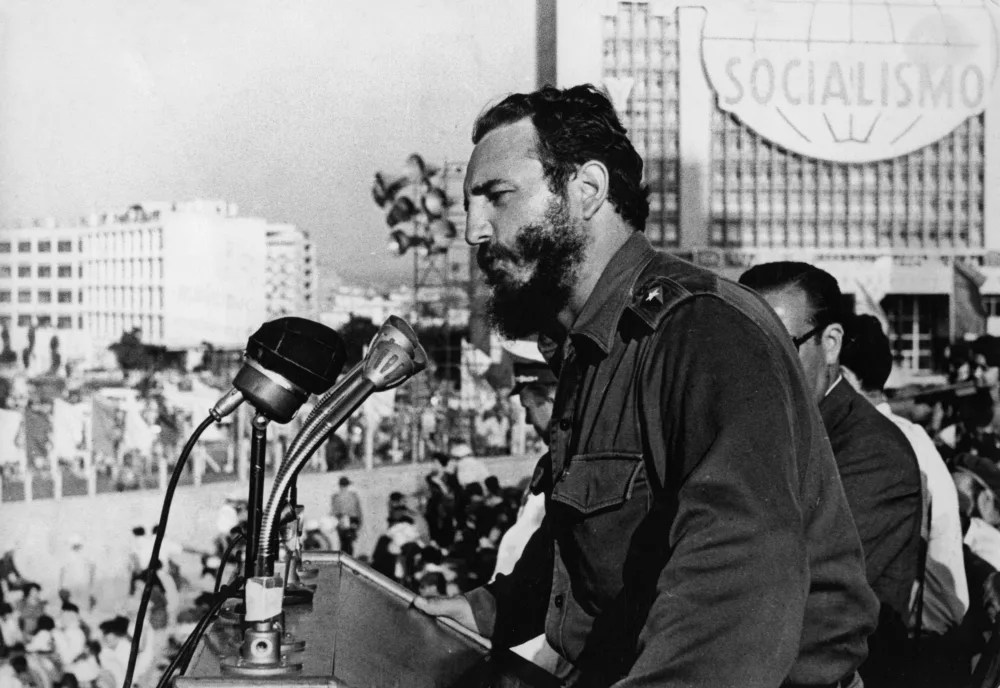
Love him or hate him, but there is no denying Fidel Castro’s influence on the 20th century. Castro was a Cuban lawyer, politician, and revolutionary, who was involved in the Revolución de Cuba (Cuban Revolution), which was an armed revolution against the Cuban dictator, Fulgencio Batista.
It began on 26th July 1953, and ended with Batista fleeing the country on 31st December 1958; though Castro’s forces (The 26th of July Movement or M-26-7) did not learn about this until the next day, when they started to take control of Cuba.
Castro became Prime Minister of Cuba on 17th February 1959 and served until 2nd December 1976, then became President of Cuba from 2nd December 1976 to 24th February 2008. Castro overhauled Cuba and transformed it into the first communist country in the Western Hemisphere, and ended up having a brutal regime, just like his enemy, Batista.
I’d like to add that Castro will return for the 1961 edition of this wonderful project. Be prepared for the Bay of Pigs Invasion.
A contemporary example of someone overthrowing an authoritarian government would be Ahmed al-Sharaa, when Syrian President Bashar al-Assad was toppled in December 2024, after 13 years of civil war.
Edsel is a no-go
This is an interesting entry because there are two points to discuss. To establish the background, Edsel refers to a brand of car created by Ford Motors, and it was named after Henry Ford’s son, Edsel, since Ford was the company’s founder.
The car was launched in 1958 and became a commercial failure. By 1959, sales for the car had dropped significantly, which included reasons such as low quality, being ugly, being vaunted too much, and being introduced during a recession. The car resulted in a loss of over $250 million for Ford Motors, so it was pulled from production in 1960.
The second point of this tale is the actual name. Edsel was a relatively common name for boys in the United States at the time. However, due to the failure of the Edsel car brand, many new parents became hesitant to name their baby boys after a name associated with a failed product. As a result, just as sales of the car declined, so did the popularity of the name Edsel.
Some 21st century examples of failed or failing car brands include the Lincoln Blackwood, Rover CityRover, Saturn Ion, Chrysler Crossfire, Aston Martin Cygnet, Nissan Murano CrossCabriolet, BMW XM, Fisker Ocean, and the Tesla Cybertruck, to name but a few.

So for 1959, we covered a musician, a movie, two astronaut monkeys, mobsters being convicted, a toy, a revolutionary leader, and a failed car brand. 1959 was busy, and like many other years in this project, it can reflect 2025 as well. But look on the bright side, we get to enter the 1960s next time! Yay!
So that brings another blog post from yours truly to a close. Thanks again for reading, following, and subscribing to Some Geek Told Me. My accounts on Twitter and Mastodon are still operating, where I post daily things concerning everything. Cool.
As a New Zealander, I would also like to apologise to the world on behalf of my country for my government’s inaction in recognising the State of Palestine. It’s not good enough, and I’m very sorry.
Please remember to walk your dog, read a banned book, stay away from Polonium-210, and I’ll see you next week for some science advice.
1 In New Zealand, Tylenol is known as the drug, Paracetamol.
2 Except for Chuck Norris, praise be his name.
 SOME GEEK TOLD ME
You must be logged in to post a comment.