
I think I need to start with an apology. I’m sorry, but I have not released a new Tour of the Solar System blog post since 19th May. That is being rectified today with the latest chapter of the tour that very few people actually want or need. Yes, my loyal readers, Some Geek Told Me’s Tour of the Solar System is back!
For the previous entries on this non-award winning project, we have:
1.) Meet the Family
2.) The Sun
4.) Mercury
5.) Venus
7.) The Moon
8.) Mars
10.) Ceres
11.) Jupiter
12.) The Galilean moons
13.) Saturn
14.) Titan
15.) The Moons of Saturn
16.) Uranus
17.) Titania
18.) The Moons of Uranus
19.) The Literary Moons of Uranus
20.) Neptune
21.) Triton
Some Geek Told Me’s Tour of the Solar System is the best tour that money can buy; I mean, it’s free, so the quality is somewhere in the middle. However, I beseech you to stay and enjoy one of the rare tour stops that is not about a singular object, but many. Prepare yourselves, because we are going to discuss…drum roll please…..The Moons of Neptune! Let’s listen to the chime and begin now.

Just like Jupiter, Saturn, and Uranus, Neptune has multiple moons. 16 known moons have been discovered orbiting Neptune since 1846, which makes it a very successful foster parent.1 In addition to this, their names come from Roman or Greek mythology, just like Jupiter and Saturn, but as you remember, not the moons of Uranus.
On the last stop of the tour, we visited Triton, which was the largest natural satellite of Neptune. Because that entry was so riveting, I’m only able to list the next five largest moons, even though there are 10 more moons. Sadly, these moons will not be discussed because of my lack of sleep and time, so I do repent my actions on this. 2
So, without further delay, let’s crack on and meet some of Neptune’s moons!
Proteus
Proteus is the second-largest moon of Neptune, with a diameter of about 420 km. It orbits Neptune at around 117,640 km, and it’s tidally locked to Neptune. What this means is that the amount of time it takes Proteus to execute one orbit of Neptune is the same time it takes Neptune to rotate just once. An easy example of this is with the Earth and the Moon.
Proteus is not named after the Marvel mutant, as you may have thought, but rather a shape-changing sea god from Greek mythology, who was the son of Poseidon (Neptune). It was discovered by Stephen P. Synnott on 16th June 1989, from images taken by Voyager 2, before it completed its flyby of Neptune.
Proteus’ shape is an irregular polyhedron, instead of a traditional spheroid, like the majority of cosmic objects. Another interesting fact is that Proteus has an impact crater called Pharos. What makes Pharos unique is that it’s measured to be 10–15 km deep and has a diameter of 250 km, which, if you have been keeping up, means it’s more than half the diameter of Proteus.

Nereid
Nereid is named after the Nereids, who were from Greek mythology, as they were sea-nymphs and servants to Poseidon (Neptune). Nereid has a diameter of only 340 km, making it the third-largest moon of Neptune, after Triton and Proteus. Nereid is the ninth-farthest moon from Neptune, orbiting at an average distance of 5,513,400 km.
Nereid is the second moon of Neptune to be discovered. Astronomer Gerard Kuiper made this discovery on 1st May 1949. You’ll encounter Kuiper’s name several more times during our tour, so pay attention! Trust me.
Because of Nereid’s massive distance from Earth (about 4.5-5 billion km), Voyager 2 has been the only spacecraft to fly past the moon, which happened in 1989. Nereid has an eccentric and curious orbit, which ranges from 1.4 to 9.6 million km. It takes 360 Earth days to make one orbit of Neptune, while it takes about 11 hours to make one rotation.

Larissa
Larissa was discovered by a team of astronomers, Harold J. Reitsema, William B. Hubbard, Larry A. Lebofsky and David J. Tholen, on 24th May 1981, after many occultation observations. Its existence was confirmed with the Voyager 2’s flyby in 1989. Larissa has a diameter of 194 km, making it the fourth-largest moon of Neptune. It’s named after a nymph who was a lover of Poseidon, because in Greek mythology, the Gods had fidelity issues.
Larissa orbits Neptune at about 73,540 km, which makes it the fifth-farthest moon from the planet, placing it within Neptune’s rings. For its orbit, Larissa completes one rotation around Neptune every 13 hours and 20 minutes.
The moon is gradually twirling towards Neptune, and it is believed that it will eventually hit Neptune’s atmosphere. Another theory is that Larissa could be ripped apart by Neptune’s tidal forces to create a new ring. As for Larissa’s surface, it is heavily cratered and irregularly shaped, just like my face when I was a teenager.
Galatea
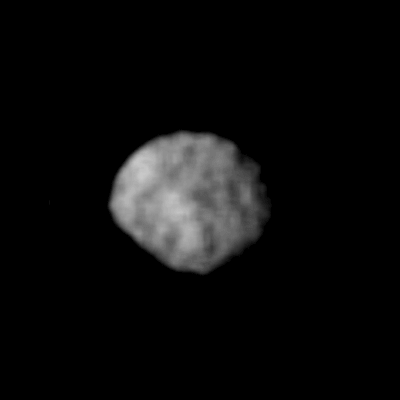
Moving right along, we have Galatea. It’s the fifth-largest moon of Neptune, with a diameter of about 174.8 km. It was discovered in 1989 by Synnott, along with a team of astronomers, with the announcement being held on 2nd August 1989. Like several other moons on the list, Voyager 2’s images proved to be invaluable.
Galatea sounds like the name of a female professional wrestler, but alas, it’s not. Do you remember how Nereid was named after the Nereids, the sea-nymphs? Galatea was named in 1991 after one particular Nereid, because one of Poseidon’s sons, Polyphemus, was in love with her. Lucky girl. It’s also noteworthy that Polyphemus was the same Cyclops from the epic Odyssey, written by Homer.
Out of the six major moons of Neptune, Galatea is the fourth closest to the planet, with an orbiting distance of about 62,000 km. Galatea also shares other traits with its siblings, like being irregularly shaped, with some scientists believing that these irregularly shaped moons are the leftovers of some cosmic collisions.
Like Larissa, Galatea is spiralling towards Neptune and one day, it will be ripped apart or collide with Neptune’s atmosphere. Galatea also orbits the gas giant every 10 hours and 18 minutes.

Despina
Now, if Galatea sounds like a female professional wrestler, then Despina sounds like a female Disney villain, though the name is still interconnected with Greek Gods and relationships. Big surprise. Despina was a nymph, as she was the daughter of Poseidon and Demeter. And since Poseidon and Demeter were siblings, that meant Despina’s biological parents were also her uncle and aunty.
Despina is the sixth-largest of Neptune’s moons, and as you can guess, it was discovered by Synnott again, as well as with the Voyager Imaging Team, in July 1989.
The moon is only 150 km in diameter, which is 1/23rd the diameter of the Moon. Despina is believed to be made up of water ice and rocky material, and has an orbital period of 8 hours.

Like I said earlier, there are 10 more moons to discuss, whose names are Thalassa, Halimede, Naiad, Neso, Sao, Laomedeia, Psamathe, Hippocamp, S/2002 N 5 and S/2021 N 1. Maybe one day I’ll discuss them, but not today, because I need a lot of beauty sleep. What’s your favourite moon of Neptune? As always, please let me know.
Thanks again for reading, following, and subscribing to Some Geek Told Me. My Twitter and Mastodon accounts still exist, if you feel like reading some boring facts and information. It’s an attractive offer, isn’t it? Please don’t forget to walk your dog, read a banned book, watch some games from the Women’s Rugby World Cup, and I’ll see you next week.
1 The most recent moons to be discovered were in both in 2024, with the awesome working names of S/2002 N 5 and S/2021 N 1.
2 As you know, I enjoy Shakespeare, and I enjoy even more when I can understand it.
 SOME GEEK TOLD ME
You must be logged in to post a comment.