
The world seems a little dark and bleak at the moment, so what better time for Some Geek Told Me’s Tour of the Solar System to return! That and I believe it’s well overdue. So it’s back, the tour nobody in the history of this planet has asked for is back for another month.
If you’re one of these unlucky people who have missed the tour stops, fear not because here is the list of the previous stops.
1.) Meet the Family
2.) The Sun
4.) Mercury
5.) Venus
7.) The Moon
8.) Mars
10.) Ceres
11.) Jupiter
12.) The Galilean moons
13.) Saturn
14.) Titan
15.) The Moons of Saturn
16.) Uranus
17.) Titania
Our last amazing tour stop was at Uranus’ largest moon, Titania. This means we’re moving on from discussing the Jake Paul and Mike Tyson fight, and on to the other moons of Uranus. Not all of them, of course, but some of them.
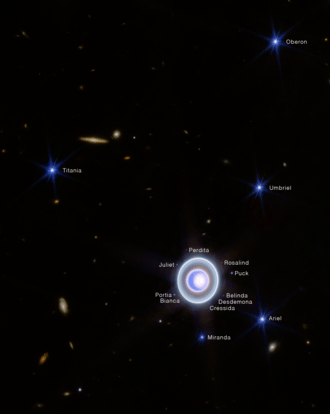
Even though Uranus’ bigger siblings, Jupiter and Saturn, can get a lot of attention from space enthusiasts, Uranus can still bring them to the yard. Uranus has 28 confirmed moons, which is more than the moons of Mercury, Venus, Earth, Mars, and even Pluto combined. That’s impressive.1
As I mentioned in my excellent blog post about Uranus, the names of its moons are not derived from Roman or Greek mythology like other moons in our solar system, but rather characters from the works of William Shakespeare and Alexander Pope. I’ve always thought this was literary genius. You would not find that information on any Flat Earth social media account, I promise you.
Since we met Titania last time, I will only discuss the next five largest moons, purely because I’m old, hungry, and tired. Plus the All Blacks won five games, then lost one, so I’m wallowing in self-doubt.
So, let’s do this!
Oberon:
Oberon is named after King Oberon, the king of the fairies, from Shakespeare’s rom-com, A Midsummer Night’s Dream. Oberon has a diameter of 1,522 km, making it the second-largest moon of Uranus, after Titania. Oberon is the farthest of Uranus’ five major moons, at an average distance of 584,000 km.
It was discovered by William Herschel in 1787; the same William Herschel who discovered Uranus in 1781. Like several other moons in the solar system, Oberon resembles our Moon, because of its colour and crater-covered surface.
And just because I think it’s cool, some of Oberon’s surface features bear names like Antony, Caesar, Coriolanus, Falstaff, Hamlet, Lear, Macbeth, Othello, and Romeo; which are named after famous Shakespearian characters.

Umbriel:
Umbriel was discovered by William Lassell in 1851. By the way, please remember Lassell’s name, because he is going to pop up again. Umbriel has a diameter of 1,169 km, making it the third-largest moon of Uranus. Its name is taken from a character in the 1712 poem, The Rape of the Lock, by Alexander Pope.
Umbriel orbits Uranus at about 266,000 km, which makes it the third farthest from the planet among its five major moons. Umbriel is covered with craters and canyons, but what makes it odd is the fact that the surface does not reflect a lot of light, which is less than half as much light as Ariel, another of Uranus’ moons of similar size. This works out to be only 16% of the light that strikes its surface is reflected.
According to spectrograph data, scientists believe that about 40% of Umbriel’s mass is a dense non-ice component, along with water ice and carbon dioxide on the surface. Umbriel is a moon that scientists would love to research more.

Credit: NASA/JPL
Ariel:
And speaking of Ariel, this moon is crazy. It’s the fourth-largest moon of Uranus, with a diameter of about 1,157 km. It was discovered in 1781, by Lassell again, on the same day of his Umbriel discovery. As for the name, Ariel was named after two characters, from the aforementioned The Rape of the Lock, but also The Tempest, by Shakespeare.
Out of the five major moons of Uranus, Ariel is the second closest to the planet, with an orbiting distance of about 190,000 km. Unlike Umbriel, Ariel is the most reflective moon of Uranus, and it’s believed that Ariel’s surface is the youngest of Uranus’ moons, making it the brightest.
Ariel is tidally locked with Uranus, meaning it rotates synchronously with its orbit, so it keeps the same face toward the planet; just like our Moon does to Earth. This process has meant that given its distance from the Sun, Ariel experiences extreme seasonal cycles of permanent day or night, that last 42 years. And if you cast your mind back to my post about Uranus, you’ll remember that this crazy-ass event occurs on Uranus as well.

Miranda:
Before you ask, no, Uranus does not have any more moons with names of characters from Sex in the City. Fans of Carrie, Charlotte, and Samantha will survive, unlike Mr. Big. Ouch. The real origin of the name comes from Prospero’s daughter, Miranda, from The Tempest, by every English teacher’s favourite cult hero, William Shakespeare.
Miranda is the fifth-largest of Uranus’ moons, but also the smallest and innermost of the moons. Relatively speaking, Miranda was discovered quite recently in 1948, by Gerard Kuiper. It had the designation of Uranus V before it was given the name, Miranda.
This moon is only 470 km in diameter, which is one-seventh the size of our Moon. Miranda’s total surface area is about equal to that of the U.S. state of Texas. Miranda is tidally locked, just like Ariel, as well as sharing the extreme seasonal cycles.
Miranda’s surface is a collection of valleys, grooves, fault scarps, and cratered highlands, but it also has terrain that could be less than 100 million years old. This suggests that the moon may still be geologically active.

Puck:
Our last stop for today is at Puck. Not named after Wolverine’s friend in Alpha Flight, but rather the spite in A Midsummer Night’s Dream, written by…and all together now, William Shakespeare! 10 points to Hufflepuff. Hufflepuff represent!
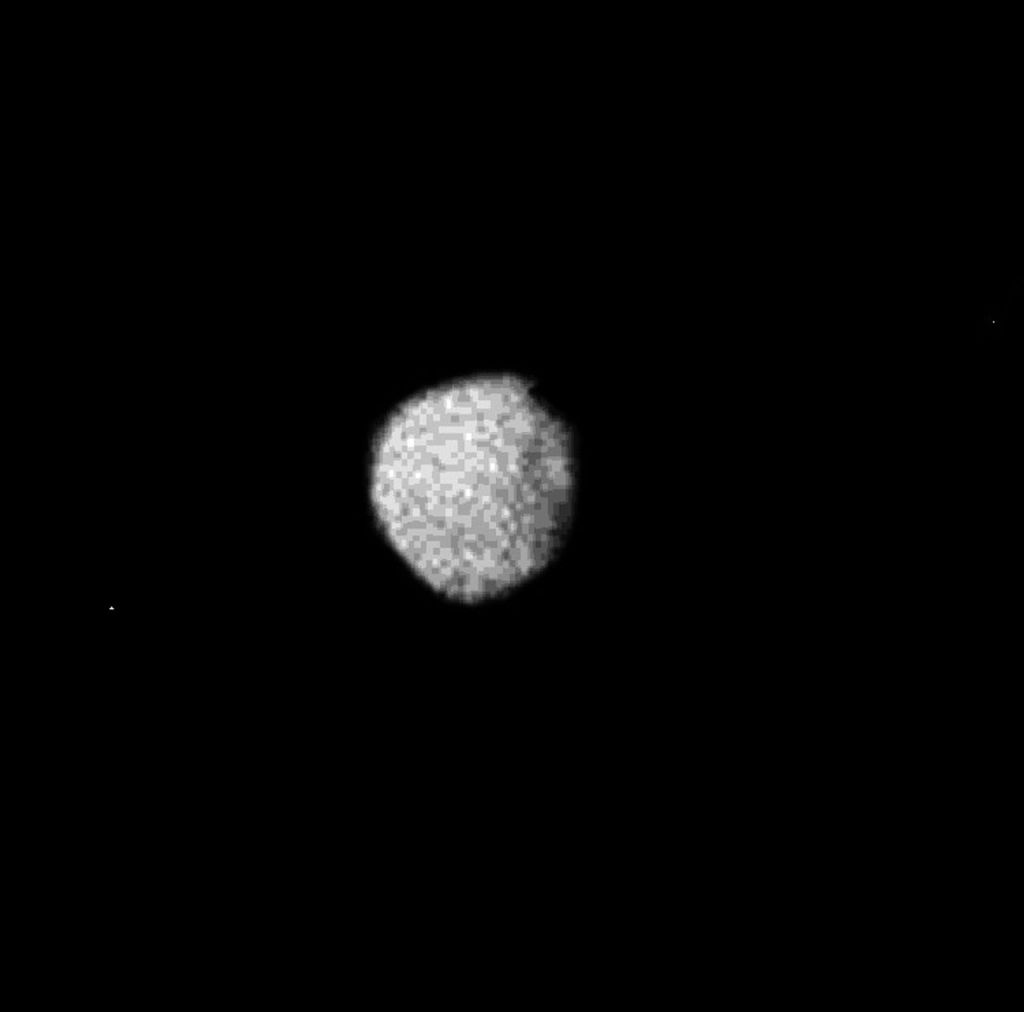
Puck is the sixth-largest of Uranus’ moons, but only has a diameter of 162 km. This strange moon was discovered by images taken by the Voyager 2 spacecraft, and Stephen P. Synnott, an astronomer and Voyager scientist at JPL, in 1985.
Puck’s orbit sits between the rings of Uranus and Miranda, the first of the planet’s large moons. It orbits Uranus in less than one Earth day and has a dark, heavily cratered surface with spectral signs of water ice.
One extra interesting thing about Puck is that the moon has three craters named Bogle, Butz, and Lob, which are named after misbehaving spirits from Scottish, German, and British folklore and legends.
There are 22 other moons to discuss, but alas, my hourly rate of $0.00 has come to an end today. What’s your favourite moon of Uranus? As always, please let me know.
Thanks again for reading, following, and subscribing to Some Geek Told Me. I’m still on Twitter and Mastodon, trying to bore people with useless facts.
Please don’t forget to walk your dog, read a banned book, watch out for Lauren Boebert’s underwater alien bases and hybrids, and I’ll see you next week.
1 Yes, it’s true that Mercury and Venus do not have any moons, but what I said still counts.
 SOME GEEK TOLD ME
You must be logged in to post a comment.