
When reading this particular blog post, imagine if you could hear a soundtrack. So the obvious question is what would it be? John Williams’ Imperial March, of course! Why? What better example of badarsery to accompany the return of the tour nobody asked for. Get ready ladies and gentlemen, because the Solar System’s worst tour of the Solar System is back!
To allow yourself time to catch up on some literary madness, the previous entries on the tour have included:
1.) Meet the Family
2.) The Sun
4.) Mercury
5.) Venus
7.) The Moon
8.) Mars
10.) Ceres
11.) Jupiter
12.) The Galilean moons
13.) Saturn
14.) Titan
15.) The Moons of Saturn
16.) Uranus
Since January 2023, I have roughly created one rant per month about the crazy, but beautiful things in our Solar System. Because this is a slow and complicated path, we have arrived at another moon. And since our last tour stop was Uranus, it’s not a leap of reasoning to discover that today’s rant is about Uranus’ largest moon, Titania.
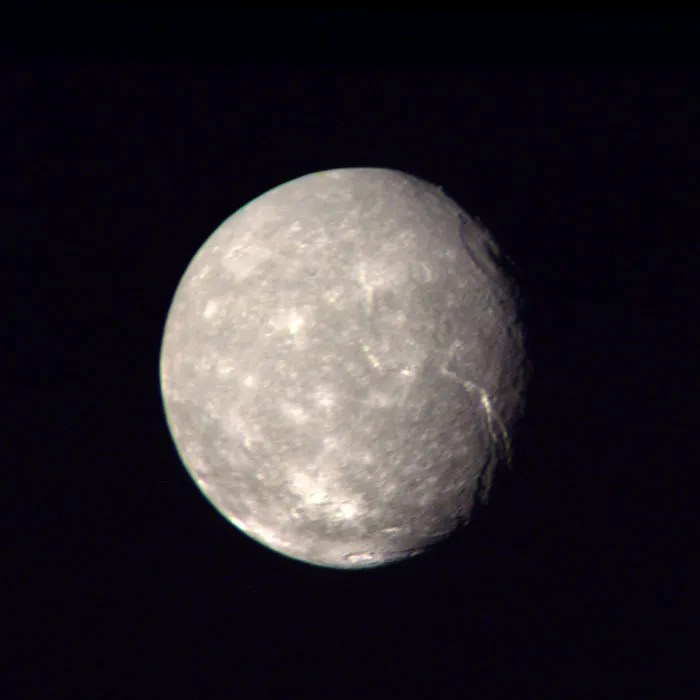
Credit: NASA/JPL
If I say the name, Titania, our society’s current understanding of the name would be, “It’s that lady from She-Hulk, right?” Yes, Titania is a Marvel character; a particularly misguided super strong woman, but for today’s rant, this is not the Titania we’re looking for.
Titania is the largest of Uranus’ 28 moons, the eighth-largest moon in the Solar System, and the 20th-largest object in the Solar System overall. Titania has a diameter of 1,578 km and a surface area similar to that of Australia. It was discovered by William Herschel on 11th January, 1787. As a reminder, Herschel was the astronomer who discovered Uranus in 1781.
Titania and her moon siblings are special because their names are not based on Roman or Greek mythology like other moons. Oh no, these moons are named after characters from the works of William Shakespeare and Alexander Pope. Titania is named after Titania, Queen of the Fairies, in Shakespeare’s rom-com, A Midsummer Night’s Dream.
A fun fact is that on the same day Titania was discovered, Herschel also discovered another of Uranus’ moons, Oberon. And if you know your Shakespeare, you’ll know that Oberon was the Fairy King and husband to Titania in A Midsummer Night’s Dream.
Titania orbits Uranus at about 436,000 km, which puts it roughly over 2 billion km from the Sun. At this distance, it takes the Sun’s light about 2 hours and 45 minutes to reach Titania. It puts things into perspective, so you may stop complaining about your daily commute.
The rotation and orbit of Titania are also quirky. Titania’s orbit of Uranus makes it the second farthest moon from Uranus, among the five major moons, after our old mate, Oberon. The orbital period is about 8.7 days and matches its rotational speed.
Titania is part of a special group of moons that are tidally locked, meaning only one side always faces the planet, similar to our Moon. Additionally, Uranus’ magnetosphere is so large that it extends to where Titania orbits.
Since a “sphere” has been name-dropped into the conversation and can drive Flat Earthers into a frenzy, let’s talk about Titania’s atmosphere and surface, because you know, why not?!
There are three recognised classes of geological features on Titania such as craters, canyons and scarps. Titania has a notable system of fault valleys, with one of them nearly 1,609 km long, named Messina Chasm. These valleys have broken the crust in two directions, which shows the tectonic extension of the crust. Titania also appears to be made from equal parts water ice and rocky materials.
Infrared measurements have also revealed Titania has water ice on the surface, along with traces of carbon dioxide. Like some other similar moons, Titania is believed to have an interior or sub-surface ocean. The ocean could be up to 50 km thick, but more research needs to be done to confirm this.
Titania does have an atmosphere, but it’s quite weak and faint, and mainly consists of carbon dioxide.
Since Titania is so far away, a lot of the first information we have about it was revealed by the Voyager 2 space probe and its flyby in 1986. The images covered about 40% of Titania’s surface, which for 1986, was an amazing feat of engineering. Only 24% of the images were within the precision required for geological mapping.
Voyager 2’s photos helped to usher in a new wave of knowledge and understanding about the moon. Since then, no other space probe has visited Titania, but there are plans to address this problem in the future.
Some other random facts about Titania include:
- Titania has an almost circular orbit.
- The average orbital speed of Titania is 3.64 km/second.
- Due to Titania’s tilt, each of Titania’s poles experiences 42 years in the sun and 42 years in the dark.
- It’s unclear whether geological processes are still occurring on Titania or not.
- The Messina Chasm is named after a location in William Shakespeare’s play, “Much Ado About Nothing.”
If Titania does have a sub-surface ocean, the question will then turn to whether life exists there or not. But that is another question for another day. And with that, our Tour of the Solar System must take a well-deserved rest.
What is your favourite fact about Titania? As always, please let me know. I wonder if The New Zealand Sour Cream and Chives Preservation Society will read this blog post?
Thank you for reading, following, and subscribing to Some Geek Told Me. I’m also on Twitter and Mastodon, where I write about truly random things.
Before I sign off, I have a favour to ask. If you have a dog, please give them a pat and a hug from me. Dogs are amazing creatures, and we are lucky to have them in our lives. Take care of yourselves, and I’ll catch you next week.
 SOME GEEK TOLD ME
You must be logged in to post a comment.