Currently, in the Southern Hemisphere, we have entered into that delightful season that is well known for being full of hope, warmth, and light: winter.
By putting on your detective hats, you would have already figured out what my special announcement, which I hinted at last week, was going to be. Yes, I’m taking a break—a Mid-Winter break, to be precise.
My most recent break was over Christmas when I had a two-week holiday from managing New Zealand’s 5th least popular website. After discussing this with the HR department, we agreed that I would take breaks every six months, at the end of June and the end of December, essentially during the start of winter and the Christmas holiday season.
I plan to catch up on sleep, eat some pizza, get more exercise, and try to make a dent in my to-read piles. It’s cold, dark, and damp here, and I have a few health issues I need to work on, so this is the best time to take a break. I bet The New Zealand Sour Cream and Chives Preservation Society, along with Beetroot Awareness Aotearoa will appreciate it!
Credit: Newshub/Getty Images
Anyway, just to clarify some things:
1.) I’ll be publishing another blog post next Monday, but just like this one, it will be greatly reduced in size and nonsense.
2.) I’ll still be posting daily stuff about stuff on Twitter and Mastodon, so that won’t change.
So that’s it. This project, born out of vanity and hubris, began in December 2020. Despite feeling tired, I find myself working on Some Geek Told Me content almost every day. Because of this, I want to express my gratitude to everyone who reads, follows, and subscribes to my ludicrous content.
Please don’t forget to walk your dog, read a banned book, keep watching the Copa América and Euro Football Championships, and I’ll see you next week.
It’s the moment you have all been waiting for! No, the ICC Men’s T20 World Cup has already started. No, the 2024 UEFA Championship just started over the weekend. No, sorry, the 2024 Copa América begins later this week. Alright, I’ll tell you, Some Geek Told Me’s Tour of the Solar System is back, baby!
Settle down, I know it’s exciting, but let’s look back on the past entries on the world’s worst tour.
As usual, not everybody is excited about the tour. After reading my post about Titan, The New Zealand Sour Cream and Chives Preservation Society felt the need to comment on it:
“For a blog about Titan, written by a person whose intelligence is in the negatives, he talked more about space probes than Titan. Nobody cares about his pro-Salt and Vinegar agenda, or the differences between rotational and orbital periods. He is an embarrassment, not only to his family and community but also to New Zealand. Utterly shameful and disrespectful.”
Wow, I wonder if the New Zealand Sour Cream and Chives Preservation Society will ever tell us how they really feel. Moving on from those haters, let’s discuss the Moons of Saturn. Yes, we’ve already talked about Titan, but that’s just the beginning of the fun.
This composite image, taken by the NASA/ESA Hubble Space Telescope on 6 June 2018, shows the ringed planet Saturn with six of its 62 known moons. With a diameter of 1,123 kilometres, Dione is the fourth-largest of Saturn’s moons and the largest of the siblings in this family portrait. The smallest satellite in this picture is the irregularly shaped Epimetheus, with a size of 143 x 108 x 98 kilometres. The image is a composite because the moons move during the Saturn exposures, and individual frames must be realigned to make a colour portrait. Credit: NASA, ESA, A. Simon (GSFC) and the OPAL Team, and J. DePasquale (STScI)
Saturn is a glorious overachiever. Not only does it have a beautiful ring system, it has more moons than any other planet in the Solar System. To the best of my understanding, Saturn has at least 146 confirmed moons, and just like Pokémon, each one is different and unique.
I’m not going to talk about all of them, mainly because I need to eat and sleep. However, these are some of the coolest and most noteworthy of them.
Rhea:
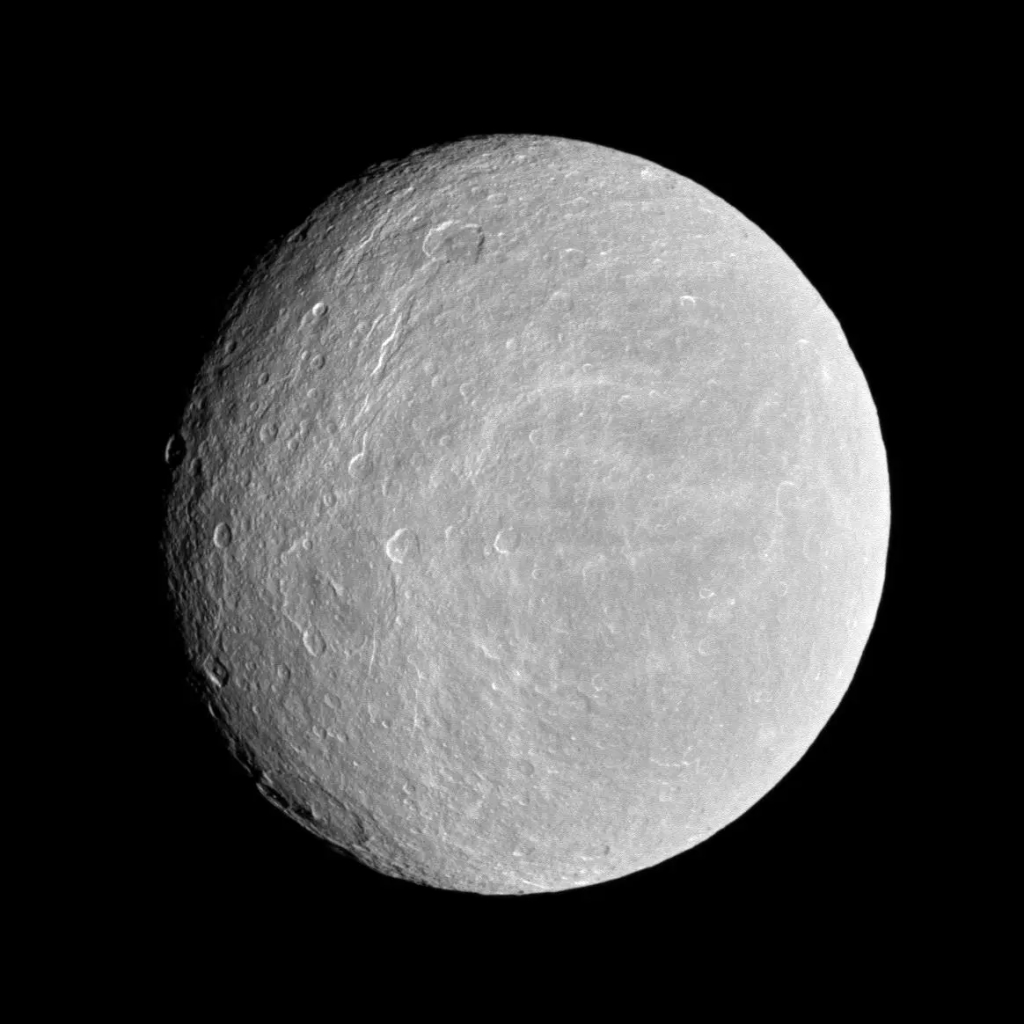
Rhea has a diameter of 1,528 km, making it the second-largest moon of Saturn, after Titan. It was discovered by Giovanni Domenico Cassini in 1672, and you might remember Cassini and the Cassini space probe from the Titan blog. Due to its craters, it’s easy to mistake Rhea for our Moon, although it has a low density since it is 75% ice and only 25% rock.
The Cassini spacecraft looks toward the cratered plains of the trailing hemisphere of Rhea. NASA/JPL/Space Science Institute
Iapetus:
Iapetus was another moon discovered by Cassini, this time in 1671. Iapetus has a diameter of 1,469 km, making it the third-largest moon of Saturn. This moon is famous for two main reasons: the first is the equatorial ridge, a mountain feature that is 20 km high and runs along the equator for 75% of the way around the moon.
The second feature is its distinctive colours, which make it look like someone spilt green paint across it or it’s being attacked by some killer space fungi. Cool stuff!
These two global images of Iapetus show the extreme brightness dichotomy on the surface of this peculiar Saturnian moon. The left-hand panel shows the moon’s leading hemisphere and the right-hand panel shows the moon’s trailing side. NASA/JPL-Caltech/Space Science Institute
Enceladus:
Enceladus may not look like much at first glance, but you would like to swipe right. It’s the sixth-largest moon of Saturn, with a diameter of 500 km. It was discovered by Friedrich Wilhelm Herschel in 1789; so remember Herschel’s name, because we’re going to talk about him on the next tour stop.
Enceladus is one of the most reflective objects in the Solar System, mainly because the surface is covered in ice. In addition to this, Enceladus also has cryovolcanoes, where instead of erupting lava, they eject things like ice particles, water vapour, and molecular hydrogen at high speeds and altitudes.
Using computer modelling and data from Cassini, scientists believe Enceladus has a gigantic subsurface ocean. This has led them to believe that the moon may harbour microorganisms in the ocean, just like Jupiter’s moons of Ganymede and Europa.
Saturn’s tiny, frozen moon Enceladus is slashed by four straight, parallel fissures or “tiger stripes” from which water erupts. These features are unlike anything else in the solar system. Researchers now have an explanation for them. (NASA/JPL/Space Science Institute image)
Mimas:
Mimas has a diameter of 396.4 km, but there’s something very familiar about it. The moon is the seventh-largest of Saturn, and it was discovered by Herschel in 1789, just a few weeks after discovering Enceladus.
The most amazing thing about Mimas is that it looks like the Death Star from Star Wars. For all we know, Mimas is a planet-killing space station, and Saturn’s rings were made from the corpses of Mimas’ victims. Maybe. Also, scientists believe Mimas has a subsurface ocean as well.
Shadows cast across Mimas’ defining feature, Herschel Crater, provide an indication of the size of the crater’s towering walls and central peak.Credit: NASA/JPL-Caltech/Space Science Institute
Hyperion:
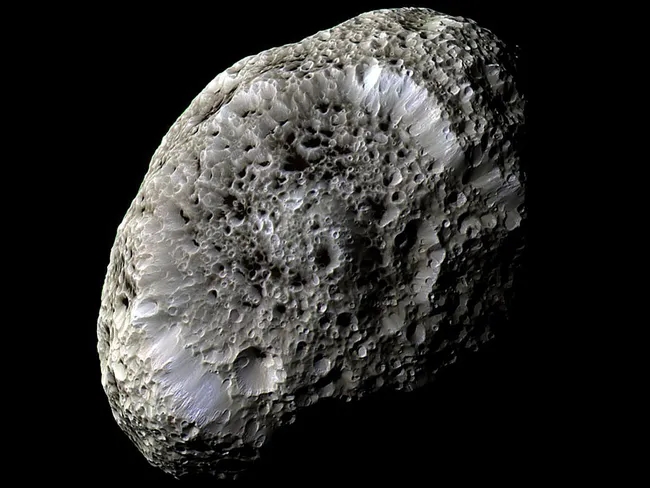
The eighth-largest moon of Saturn is Hyperion, with a diameter of 121.57 km. Hyperion’s discovery is unique, because William Lassell observed Hyperion in 1848, two days after the team of William Cranch Bond and his son, George Phillips Bond. The interesting thing is that Lassell had already come up with the moon’s name, along with beating the Bonds to publication.
I find Hyperion fascinating for a few reasons. First, its name is pretty awesome. Second, its shape is irregular and does not have hydrostatic equilibrium. The massive 10.2 km deep crater on Hyperion is particularly noteworthy. While many people have described its appearance, I’ll let you use your imagination for that.
Saturn’s moon, Hyperion, resembles a large sponge traveling through space. Its porous appearance raises questions about its composition. (Image credit: NASA, ESA, JPL, SSI and Cassini Imaging Team)
Prometheus:
Prometheus is on the list since it’s similar to Hyperion. It has a diameter of 86.2 km, and it was discovered in 1980, from photos taken by the Voyager 1 probe. Prometheus is such a wicked name for a moon, but it has something else going for it.
Although it is the 12th-largest moon of Saturn, Prometheus is an irregularly shaped elongated rock, that has ridges and valleys. To put it bluntly, it looks like a giant space potato. I love it.
NASA’s Cassini spacecraft spied details on the pockmarked surface of Saturn’s moon Prometheus (86 kilometers, or 53 miles across) during a moderately close flyby on Dec. 6, 2015. NASA/JPL-Caltech/Space Science Institute.
There are hundreds of Saturn’s moons to discuss, but I need a lot more beauty sleep. What’s your favourite moon of Saturn? As always, please let me know.
Thanks again for reading, following, and subscribing to Some Geek Told Me. I can also be found hanging out on Twitter and Mastodon, trying to sound cool. Please don’t forget to walk your dog, read a banned book, watch the UEFA Championship, and I’ll see you next week for a special announcement. It’s not that special though.
Even here in the South Pacific, there seems to be no escaping from Donald Trump. He’s here, he’s there, he’s in every courtroom, Donald Trump, Donald Trump!
Over the years, I’ve developed two vices that I’m ashamed to admit. I enjoy watching Panda Fail videos; basically, pandas failing at being pandas, but also watching billionaires complain. I can’t get enough of both of them. This awful transition brings us to Donald Trump’s recent trial.
It’s difficult to believe that the star of Home Alone 2: Lost in New York, the founder of Trump University, and the winner of the 2024 Trump International Golf Club Most Improved Player award, was found guilty on 34 felony counts of falsifying business records to make hush money payments to a porn star, in an effort to make it appear as legitimate business expenses.
I was as shocked as you were. I mean, someone at the centre of over 4,000 legal cases, involving sexual harassment, sexual assault, personal defamation lawsuits, tax disputes, real estate lawsuits, and many more, couldn’t possibly be involved with lawlessness. The whole concept is very sad.
However, a jury of 12 of Trump’s peers, found him guilty of 34 felony counts, with sentencing to happen on 11th July 2024.
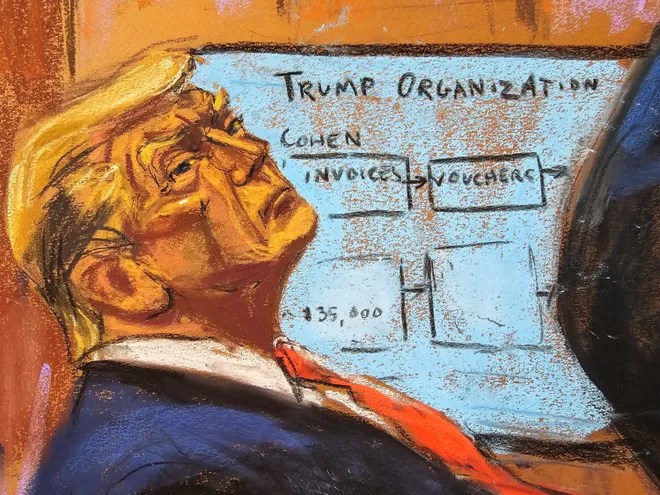
Former U.S President Donald Trump listens as defence lawyer Todd Blanche presents closing arguments during Trump’s criminal trial on charges that he falsified business records to conceal money paid to silence porn star Stormy Daniels in 2016, in Manhattan state court in New York City. 28th May 2024 in this courtroom sketch. Credit: Jane Rosenburg/Reuters.
I’m not here to discuss in detail the trial because I’m not a legal expert. I have enough trouble remembering what I said to my children last night, let alone explaining a court case. No, what I’m here to comment on is the reaction to Trump’s conviction, mainly through entertainment.
As I’m getting older, I’m finding that I prefer to experience satirical news a lot more than I did before, thanks to Trump. So because of this, may I present the best reactions to Trump’s conviction, whether it’s monologues or songs. Oh, I forgot, the last video isn’t a response to his conviction, but it ties it in quite nicely.
I love listening to billionaires complaining that life is unfair, and watching Trump’s reaction to his conviction has been hilarious. Like I said before, I do feel ashamed about this.
What’s been the best reaction or response to Trump’s conviction? As always, please let me know. I’m feeling better again, so I’m ready to be infected with a child’s new illness. Good times.
Thanks again for reading, following, and subscribing to Some Geek Told Me. Don’t forget to walk your dog, read a banned book, watch the T20 World Cricket Cup, and I’ll see you next week because the Tour of the Solar System is painfully marching forward again. Awesome.
When it comes to making terrible ideas, this blog has had some crackers over the last few years. However, the concept of talking about the historical references from a song that came out in 1989; after multiple people have already done it, ranks quite high on that list.
My previous entries in this terrible endeavour include:
Beetroot Awareness Aotearoa seem to have a bee in the bonnet about this, because their press release about my We Didn’t Start the Fire: 1950 blog is downright mean.
“This human skid mark has done another We Didn’t Start the Fire, now there’s four of them! One was too many. We wonder what idiotic new idea, he’ll think of next. Listing how many people have puked on his $5 shoes, maybe? How about listing the number of times the All Blacks have won the World Cup? No, we have it; he will name the colours of the rainbow because nobody has done that before! This moron should be kept away from spoons because he’ll cut himself. What a joke.”
Is it my imagination, or do you think a Springboks supporter may have helped in drafting this release?
Haters are going to hate, I suppose. And with that, let’s check out the We Didn’t Start the Fire’s historic references for 1951.
Credit: Pinterest
1951
Rosenbergs:
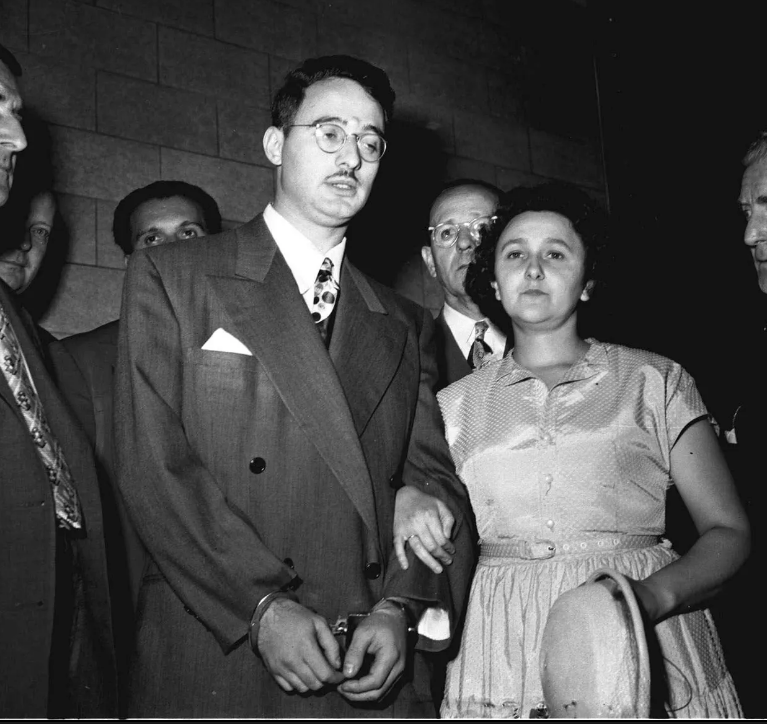
Julius and Ethel Rosenberg were a married couple, who were both born in Manhattan, New York. Being married or born in Manhattan does not automatically qualify you for this list, though. At this time, the Cold War had been established, and the Rosenbergs were part of that drama.
In 1950, Julius and Ethel were arrested and convicted in 1951 for espionage. They were spying for the Soviet Union by providing top-secret information about American technology, especially nuclear secrets. In 1953, both Julius and Ethel were executed by electrocution, at Sing Sing Prison.
The Rosenbergs are also infamous for being the first American civilians executed for espionage. Even though they’re not a 2024 equivalent for the Rosenbergs, I feel Aldrich Ames and Robert Hanssen would be the closest.
Credit: AP Images
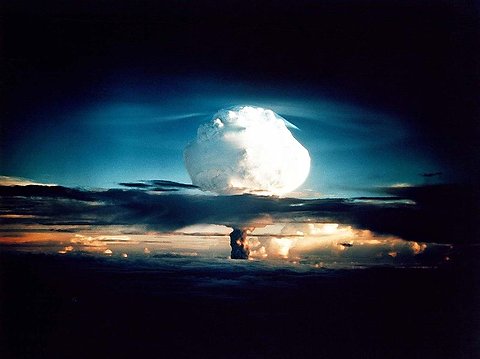
H-bomb:
This is an odd one to discuss because it isn’t about a person, place, or event, but rather an object; a very destructive object. No, I’m not talking about Hellboy’s right hand, but rather the H-bomb.
This weapon has been given various monikers over the last 70 years, such as H-bomb, thermonuclear weapon, fusion weapon, or the most well-known, the hydrogen bomb.
In 1951, during the Cold War, the United States focused on developing the next generation of nuclear weapons. The goal was to combine atomic fission and nuclear fusion to create a more powerful nuclear explosion that could release more energy than a primary nuclear weapon. The first hydrogen bomb test took place in the Marshall Islands in 1952.
As a result, the design of the hydrogen bomb has had a lasting impact, with most of the world’s nuclear warheads being based on its design.
National Nuclear Security Administration/Nevada Site Office Photo Librar. The first hydrogen bomb tested by the United States vaporized the islet of Elugelab in the Marshall Islands in the North Pacific on Nov. 1, 1952.
Sugar Ray:
Born Walker Smith Jr., Sugar Ray Robinson was a professional boxer, who fought across the Lightweight, Welterweight, Middleweight, and Light heavyweight divisions, becoming world champion six times (1 x welterweight and 5 x middleweight).
Robinson is in the song for his fight against Jake LaMotta, for the World Middleweight title in 1951. This was the sixth time the two men had fought, and the fight has been named the “St. Valentine’s Day Massacre” over Robinson’s combinations that beat the world champion, LaMotta to a bloody pulp.
In modern times, this is quite awkward. It could go either two ways; the first could be rematches between the same two boxers like Muhammad Ali vs. Joe Frazier, Erik Morales vs. Marco Antonio Barrera, Pongsaklek Wonjongkam vs. Daisuke Naito, or Manny Pacquiao vs. Juan Manuel Marquez.
As for the second way, it could be because a particular boxer went on to become an icon and legend in their weight division. For that answer, the choice is yours.
Panmunjom:
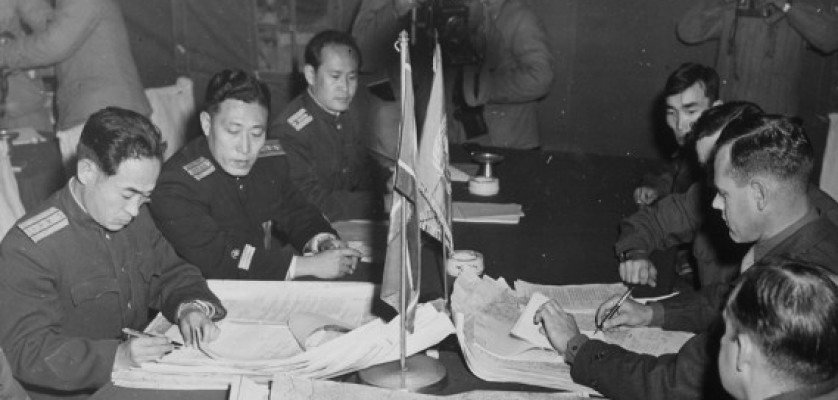
Do you remember how I mentioned that I’ll be discussing the Korean War again, from last’s month 1950 blog? Well, here we are. Panmunjom is a former village that’s near the Demilitarized Zone (DMZ), along the North Korean and South Korean border. The Joint Security Area (JSA) is also referred to as Panmunjom, and vice versa.
Panmunjom makes this list because, during the Korean War in 1951, North Korean and Chinese officials first met United Nations forces at Panmunjom for truce talks.
In 2005, I was lucky enough to visit Panmunjom, and I made a badly written blog about it. The legacy of Panmunjom is that it still provides a point of contact and meetings for the leaders of North Korea, South Korea, and others.
North Korean and U.S. militaries attempt to iron out an armistice at Panmunjom in the Korean Demilitarized Zone, October 1951. (National Archives photograph)
Brando:
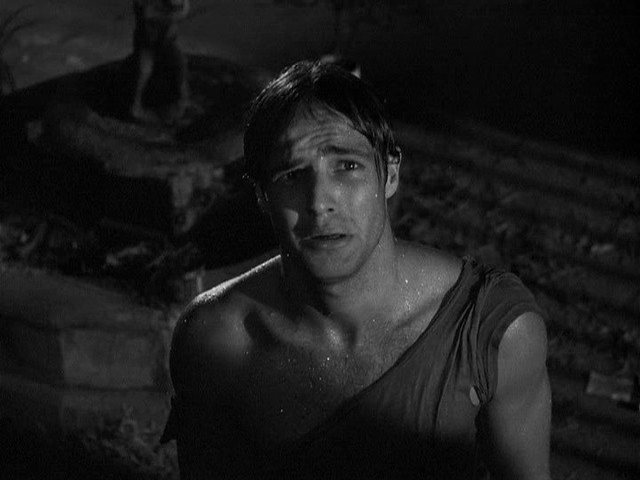
Brando refers to the Godfather himself, Marlon Brando, the great actor and activist. Brando starred in the 1951 film, A Streetcar Named Desire, as the lead male role, Stanley Kowalski. In certain circles, people say that Brando’s performance of Stanley was the best of his long career, which resulted in him being nominated for Best Actor at the 1952 Oscars.
The problem was that Brando didn’t win the award, instead, it went to Humphrey Bogart’s role as Charlie Allnut in The African Queen. This snub, as it’s been referred to, has been recorded as one of the biggest in the history of the Academy Awards.
A modern equivalent for a person being snubbed for acting at the Oscars can be somewhat subjective. However, in the spirit of the blog, maybe Margot Robbie (Barbie), Glenn Close (The Wife), Jim Carrey (The Truman Show), Amy Adams (Arrival), or Pam Grier (Jackie Brown).
Marlon Brando in A Streetcar Named Desire (1951). Credit: Warner Bros. Pictures
The King and I:
We’re back with another Rodgers and Hammerstein production, in the form of The King and I. The musical was based on Margaret Landon’s 1944 novel, Anna and the King of Siam, and also inspired the 1956 film.
The King and I first opened on Broadway in 1951, and it was a commercial and critical success, playing 1,246 performances. It also won five Tony Awards in 1952, including Best Musical. From there, the musical has been revived over the years, with the latest in 2015 (Broadway) and 2018 (West End). It remains a beloved story around the world.
Original poster for The King and I. Credit: St. James Theatre
The Catcher in the Rye:
For the first time in We Didn’t Start the Fire, a book has been mentioned. As you would expect, The Catcher in the Rye, was released in 1951, and it was written by J. D. Salinger. If you haven’t heard of the novel, then you may have heard of its protagonist, the teenager Holden Caulfield.
The novel makes the list because of the various themes it contains, like belonging, connection, sex, identity, loss, depression, innocence, and a whole lot of angst; which were unexplored topics for teenagers in early 1950s literature. The character of Holden Caulfield has become a symbol of rebellion and, you guessed it, teenage angst. Like I said before, this book has a whole lot of angst.
TheCatcher in the Rye has sold more than 65 million copies, and remains a solid-selling book, even in 2024. This controversial novel has also been banned several times in various places around the world in the 20th century, which is sadly becoming a growing trend in the 21st century.
An unwanted caveat for the novel is that in 1980, a 25-year-old Mark David Chapman, shot and killed John Lennon, outside his apartment in New York. Chapman had developed an obsession with The Catcher in the Rye; among other things, and especially with Holden Caulfield, and tried to emulate his misadventures.
First-edition cover of The Catcher in the Rye (1951) by author J. D. Salinger. Credit: Wikipedia.
So for 1951, we covered two spies, the hydrogen bomb, a boxer, a Korean village, an actor, a musical, and a novel. A useless piece of information is that 1951 holds a special connection to me, because it’s the year my father was born.
Next month, I’ll look at 1952, and if I feel motivated enough, 1953 as well, but I don’t like the odds of that. I think it’s 34-1. Did I mention that I suddenly like the number 34?
Anyway, that’s it for another week. If you’re enjoying my We Didn’t Start the Fire project, or maybe you think I’m wasting my time, please let me know.
Thanks again for reading, following, and subscribing to Some Geek Told Me. Don’t forget to walk your dog, read a banned book, watch the T20 World Cricket Cup, and I’ll see you next week, where I’m going to be petty and mean. You’ll love it.








 SOME GEEK TOLD ME
You must be logged in to post a comment.