
Guess what’s back for another week? No, it’s not Simon Cowell’s Ninja Dog UK show, it’s Some Geek Told Me’s Tour of the Solar System! If you’ve never been on the tour before, here are the previous stops:
1.) Introduction
2.) The Sun
4.) Mercury
5.) Venus
7.) The Moon
Voted least likely to help humanity in any way, Some Geek Told Me’s Tour of the Solar System is now on its eighth stop. Buckle up, because we are visiting a planet that if it was a teenage girl, then it would be the popular one. It’s Mars, the Red Planet! Wait, did you think it was Neptune?
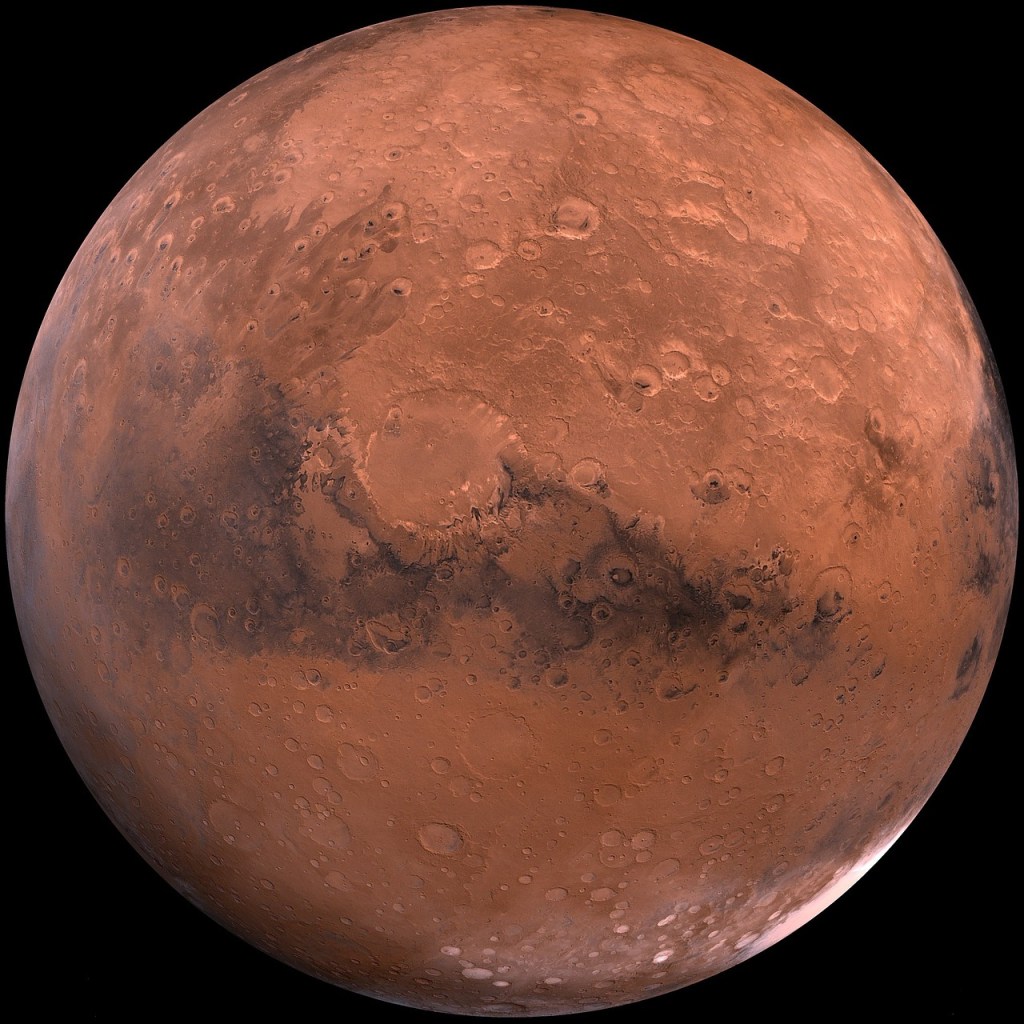
Let’s establish something before we begin? There’s so much information on Mars, that I couldn’t possibly explain it all in one blog. Well, not without a time machine, which is a good thing I don’t have one. I’m just going to talk some basic information about Mars, though everything would make a Space-denier’s right eye start twitching.
Mars is the fourth planet from the Sun, after Mercury, Venus, and us; Earth. This makes it a terrestrial planet, which formed about 4.5 billion years old, give or take a few Sundays. This makes it extremely similar to the other terrestrial planets. That’s not really a surprise is it?
Unlike other planets, it’s named after a chocolate bar…no, seriously, Mars is named after the Roman god of war; you guessed it, Mars.1
As for planetary rings, someone swiped left on Mars but swiped right for moons. Mars has two moons named Phobos and Deimos, which mean fear and panic for the former, and terror and dread for the latter. I do find it interesting that Phobos and Deimos were the sons of Ares, the Greek god of war, who was identified by the Romans as Mars.
So basically, the planet is named after a Roman god, with the two moons named after his Greek equivalent’s sons. Not confusing at all.
Mars is smaller than Earth, with a diameter close to 6,792 km, compared to Earth’s diameter of 12,740 km. This means that everybody’s favourite planet named after a god of war, is actually the seventh largest planet in the solar system. Sorry, Mercury.
Just like Earth’s orbit of the Sun, Mars’ orbit is elliptical, but it is more severe. Mars’ perihelion is 206,650,000 km, while its aphelion is 249,261,000 km. The average distance from the Sun to Mars is 228 million kilometres, with the orbital speed of Mars being 24.07 km/s, which is only slightly faster than my dog when he’s blitzing.
Alright, that’s all well and good, but what else do we know about Mars? Great question, so here’s a complicated answer. Hollywood has given us some interesting films based on Mars, like Total Recall, Mission to Mars, Red Planet, Ghosts of Mars, The Martian, and Life. Between the insanity of the films lies the truth about Mars.
A long time ago on a planet, not that far away, liquid water was on the planet’s surface. Yes, billions of years ago, Mars had not just liquid water on the surface, but oceans. The observational evidence for this is the hundreds of photos and video footage taken over the years, that have been analysed by scientists; like ancient riverbeds.
Now whether life may have existed in this ancient primordial Martian ocean, is another blog for another day; just ask J’onn J’onzz or H. G. Wells. As for the reason why Mars lost its oceans, the leading hypothesis is that the oceans were ripped away by the solar wind because Mars lost its magnetic field, which prevented this from happening.
The next question is how did Mars lose its magnetic field? Like Earth’s spinning core, Mars’ core would have created a dynamo effect, which in turn would have powered the magnetic field. However, sometime in Mars’ ancient past, something happened to change the dynamo effect, which resulted in a snowball effect: No dynamo effect, caused the magnetic field to stop being generated, which caused the oceans to be ripped away by the solar wind. As to why there were some shenanigans in the Martian core, we should just bring in a CSI team, and they’ll solve it in under 45 minutes.
Mars is now a cold, barren, dusty wasteland; almost like the background to a Mad Max film. Polar ice caps exist at both poles, but the planet is a husk. Temperatures on Mars can range from −110 °C (−166 °F) to 35 °C (95 °F). Basically, Mars has the temperatures of both Hoth and Tatooine.
For Mars’ rotation and orbital period, it takes Mars 1.04 Earth days to rotate once, which is roughly 25 hours. A Martian year equals 687 Earth days, which is about 1.9 Earth years.2
The surface of Mars is covered in a dusty inorganic compound known as Iron(III) oxide. This dust gives the planet a rusty colour, which to nobody’s surprise at all, is why Mars is referred to as The Red Planet. The terrain is mixed with volcanoes, craters, valleys, and lower flat lands.
It’s for this reason that Mars is home to Olympus Mons, which is the tallest mountain in the solar system. Olympus Mons is a massive shield volcano, that is 21.9 km high. In comparison to Earth’s tallest mountains, Mount Everest is 8.848 km (above sea level), while Mauna Kea is 9.33 km (from underwater base to summit).
Mars does have an atmosphere, but it’s very thin and weak. The atmosphere is made up of Carbon Dioxide (95.97%), Argon (1.93%), Nitrogen (1.89%), and smaller traces of Oxygen, Carbon Monoxide, and Water Vapour. If you’re planning on visiting Mars anytime soon, make sure you bring a survival/space suit. If the cold doesn’t kill you, the lack of breathable air will.
And speaking of visiting Mars, humanity has sent many landers, probes, and rovers to the Red Planet; which makes it unique because it’s the only planet that we know of except for Cybertron, that is populated by machines.
Journeying to Mars is no easy step because the average distance between Earth and Mars is about 225 million km. The human exploration and colonisation of Mars is a hot topic at the moment. There are many factors to consider about this, though namely, terraforming is one of them. Put another way, Mars hates humans and will do everything it can to kill them. Because of this, the earliest humans could be walking on Mars, will be in the 2030s. They have a lot of work to do, but they have already started.
Hopefully, when humans land on Mars, I’ll be able to watch it with UMC1 and UMC2. Of course, it depends at the very least, if a 15-year-old and a 12-year-old would want to hang out with their very uncool father.
Well, that’s it for another week. What’s your favourite Mars fact? Please let me know. The 2023 Rugby World Cup is still ticking over, so I’m still trying to find the best time to sleep, and I’m failing as usual.
Thanks once again for reading, following, and subscribing to Some Geek Told Me. I value everybody who stops by to read some of my nonsense. Please don’t forget to walk your dog, read a banned book, watch some Rugby World Cup games, Up the Wahs, and I’ll see you next week.
1 Astronomers really like Roman mythology.
2 The further you move away from the Sun, the orbital periods of the remaining planets are just going to become longer.
 SOME GEEK TOLD ME
You must be logged in to post a comment.