
Welcome, welcome, welcome, to the worst tour of the Solar System you will ever experience. I’m probably overestimating the ridiculousness of it, but I’m pretty sure Brian May, Michelle Thaller, Bill Nye, Neil deGrasse Tyson, Brian Cox, or Becky Smethurst, would not want to purchase a ticket.
This is our fifth stop in our tour of the Solar System, with the previous four being Meet the Family, the Sun, Planets vs. Dwarf planets, and Mercury. Since the last stop was everybody’s favourite small planet that has a transition metal element named after itself, the next stop is somewhere that does a very good impression of Hell: Venus.
There are many different things I’d like to discuss about Venus, and I mean a lot, but I have to concentrate on the most interesting/weird information, purely for two reasons. Firstly because there is just too much information to talk about; and secondly, a Galapagos giant tortoise can write faster than me, so I just don’t have the time. Though a DeLorean with a functioning flux capacitor would help.
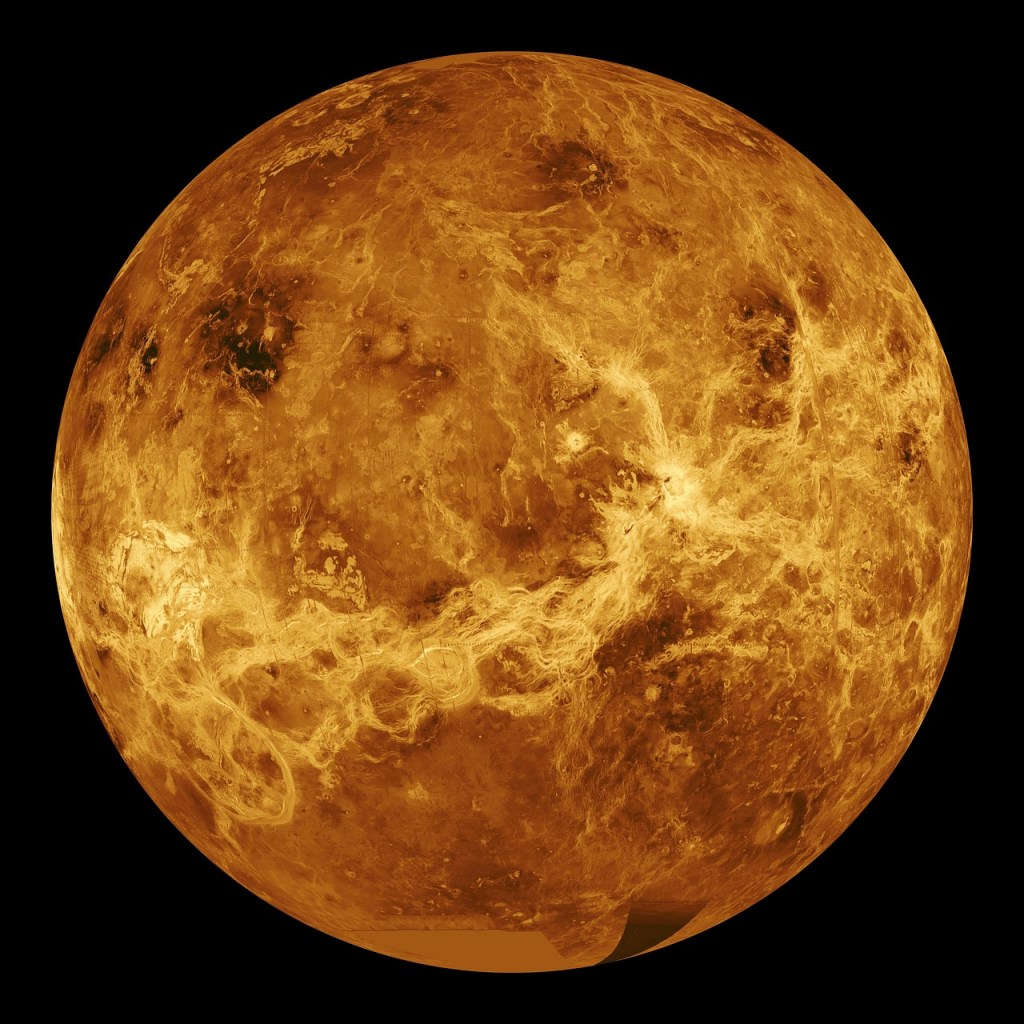
Just like Mercury, Venus derives its name from Roman mythology, in the form of the goddess of love, sex, beauty, and other things I can’t really relate to. Venus is around 4.5 billion years old, give or take a few hundred million years, which is roughly like the other terrestrial planets. Venus also has two more things in common with Mercury; it has no natural satellites (moons) or rings. Sorry, Beyoncé.
Venus’ size is slightly smaller than Earth’s, which is why some people call it Earth’s twin. They are similar because Venus has a diameter close to 12,100 km, with Earth’s diameter being 12,756 km; which means Venus would lose at an arm wrestle with Earth, but not by much.
Just like the majority of objects in our Solar System, Venus orbits the Sun. The orbital range is 107,477,000 km (66,783,112 miles) to 108,939,000 km (67,691,556 miles), which is only a difference of 1.46 million km. The average distance from Venus to the Sun is around 108,208,000 km (67,237,334 miles), and if you’ve been paying attention, this means Venus is the second closest planet to our local natural fusion factory.
So up until now, Venus seems nice and normal, but what exactly is normal? If we are comparing Venus to other planets or exo-planets, it’s probably normal; however, if we are comparing Venus to Earth,…well, if Earth is Superman living in Metropolis, then Venus is Bizarro living in Arkham Asylum. Honestly, Venus is pretty messed up. You wouldn’t just be swiping left on Venus, you would be calling the police!
Venus is actually closer to Earth than Mars, with an average distance of 41 million km vs 228 million km, respectively. But here’s the thing; even though Venus is closer to Earth, we are preparing and planning to send astronauts to Mars. That’s not an accident, by the way, it’s because we’re not stupid.
Venus is basically like a public bathroom, after an entire rugby team suffering from chronic curry diarrhoea, has been: it’s somewhere you don’t want to go.
Even though Venus is named after a goddess, and is the only planet to do so, let’s discuss why you should NEVER visit Venus.
Venus is actually the hottest planet in the Solar System. Venus has a problem, a very big problem, that humanity has been noticing here on Earth: climate change. Venus has a runaway greenhouse gas effect happening, which has created an apocalyptic problem.
The clouds on Venus are made of extremely thick and poisonous sulfuric acid, which starts at 45-70 km. This of course is only compounded by the thick atmosphere, which is made up of over 90% carbon dioxide. This means the amount of pressure on Venus’ surface is 93 times that of Earth. To put this into perspective, standing on the surface of Venus would be equivalent to being 1 km under the ocean. At this pressure, and without some amazing super-reinforced space suit, your body would be crushed.
Sounds great, doesn’t it? But wait, there’s more horror!
Because the thick atmosphere acts as a blanket, Venus traps excess heat on the surface, which makes the Human Torch look like Olaf from Frozen. Temperatures on the surface can range from 438 °C (820 °F) to 482 °C (900 °F), which is hot enough to melt Tellurium, Zinc and Lead.
Venus was the first planet that humans managed to send spacecraft to and land. This has resulted in several landers and probes over the years, making the 41 million km trek to Venus, but because of the scorching heat and crushing atmospheric pressure, Venus has killed them all. The longest surviving probe on Venus only lasted about 2 hours, before it stopped transmitting.
Mars may be the only planet inhabited by functioning robots, but Venus is the OG; its surface is littered with robotic corpses. Venus is nightmare fuel.
Venus’ orbit and rotation manage to stay in theme with freakiness. Apart from Uranus, Venus is the only other planet that rotates backward on its axis in the Solar System. This is known as retrograde rotation, and it means the Sun rises in the west and sets in the east, which is the total opposite of what happens on Earth.
Venus also rotates painfully slowly on its axis, because one day on Venus equals 243 Earth days. This is the slowest rotation of a planet in the Solar System. Congratulations Venus!! The shenanigans continue because Venus actually orbits the Sun faster than Earth at 225 Earth days. So one Venusian day actually lasts longer than one Venusian year.
There are three last things that I need to mention about Venus, among others, before I depart for my bed.
1.) The surface of Venus is covered with valleys, craters, mountains, and extreme volcanic activity. Its estimated, that 80% of Venus’ surface is covered with volcanic plains. There’s also a mountain on Venus called Maxwell Montes, which is 11 km (36,000 ft) high, and dwarfs Mount Everest at 8.848 km (29,031.7 ft).
2.) Venus appears in the sky as a small bright light, near sunset and dawn. This has led people to give Venus names like “The Morning Star” and “The Evening Star.” This makes Venus the third brightest object in the sky after the Sun and Moon.
3.) Have you ever heard of the Star Light, Star Bright poem?
Star light, star bright,
First star I see tonight,
I wish I may, I wish I might,
Have this wish I wish tonight.
Traditionally, if you had a wish and saw the first star in the evening, you could recite this poem, and your wish could come true. The universe has a funny side because, for hundreds of years, people would do this; wishing on the first star of the evening. The issue is that the first star they would wish on wasn’t really a star at all; it was a planet. So if you have ever done this, and the wish didn’t come true, it was because it was Venus.
And with that, I’m done for another week. I hope you’re still enjoying the tour, because the tour guide is rubbish, quite frankly. For next week’s modest blog, I’m going to do something I’ve never done before; no, I’m not doing a Fifty Shades of Grey review. Drum roll please…..I’m going to write a preview! So I hope it works. Maybe.
Thanks once again for reading, following, and subscribing to Some Geek Told Me. Remember to walk your dog; read a banned book; learn what DVD actually means; and I’ll see you next week.
 SOME GEEK TOLD ME
You must be logged in to post a comment.