Jobs that I would suck at: Vol 2

I have not used enough self-deprecating humour for a while, so I had an idea. An awful idea. I had a wonderful, awful idea! I know what to do. I haven’t revisited this topic since last year, so perhaps it’s time for a review. In case you haven’t read the first thrilling instalment, here it is.

I left my job in April, and since then, I’ve been thinking about the possibilities that are open to me in the future, even though I have found a new job. Yay! Although I have mentioned this before, it’s nice to have a job that pays well and that you love, but you also need to have an interest in it and be qualified. That last part is awkward, at the very least.

The idea is that there are some jobs I feel I would be great at (on paper at least), and there would be some jobs, let’s face it, I would suck at. I have a certain set of skills that are only of interest to me, but can they be transferable to any job? Doubt it.

To reinforce what I said in the first blog post about this positive and uplifting subject, I will detail three jobs that I believe I would suck at. Whether I describe myself as being terrible, horrible, ill-suited, unqualified, or just wrong, these jobs would not be for me. This does not cover the pay rate; it just looks at whether the job would be a woeful match for me.

Also, please remember that if your job may appear here today or at a later date, that’s fine for you because I’m not saying your job sucks. I’m just saying your job would suck for me since I’m awkward. If you can do any of these three jobs, you’re a better person than I am!

So without further delays or hair combing, let me explain how I would be swiping left on these three jobs. And away we go!


Image by Gerd Altmann from Pixabay

Data entry operator who works from home

This is a rather specific job, and I will explain, so just hear me out. I’ve done data entry before, years ago, of a sort. It wasn’t 100% data entry because the day was broken up with other things that went with the job, but the bulk of it was data entry.

I struggled with the job, and one of the reasons I outlived the monotony was being able to leave my little office to venture out into the big, brave world. Now, take a similar job, where the job is just data entry, but I get to work from home, and it would be a disaster.

Let’s take stock of the potential problems I would face: raiding the pantry every 15 minutes for a snack, checking my emails every 3 minutes, constantly checking on whether any parcel or letters have arrived (only on Monday, Wednesday, and Friday), doing the washing and dishes, stopping to read a book or comics, checking on various new sites about the world, and checking updates on sport scores.

Regardless of whether I needed to pick the boys up from school or not, once they were home, forget about me achieving any work. And if my wife were at home, the tiny fraction of work I would be getting done would only be getting smaller. A two-minute conversation about lunch would turn into 45 minutes of talking about cartoons.

Working as a data entry operator from home would be a massive mistake for me, because I get too distracted while I’m on the computer. Just think about how long it’s taken me to write this section. I would never need to quit the job, because I would have been fired before that. I would suck as a data entry operator working from home.

Fencer

Now, before you start asking questions, no, I’m not talking about the sport or reselling stolen property. Oh no, I’m referring to the job of actually building and installing fences. You see, I’m not exactly a handyman, as I have great difficulty with building and making things.

My mum pointed out to me once that if there was a long and complicated way of doing something, you can bet that I would do it. This would transfer over to building things, as I would just stuff it up.

And even if you took away the fact that my fences would look like they were designed by a 4-year-old, or an earthquake has installed them, there is the social side to it. I can only imagine going around different farms, building fences, and talking to various farmers.

Talking to farmers is not the problem; it would be listening to the same stories and the same jokes, time and time again. I’m not sure how I could handle building wayward fences, with gaps in them like the government’s budget, but also sounding surprised and interested, when I’ve heard the same story or the same jokes from someone, every time I see them.

I can’t hide my emotions while I wear my face; it’s a giveaway to people, so not only would I be building poor, shoddy, and terrible fences, with holes in them that a rhino could slip through, I would go crazy listening to the repeated stories and jokes told by the same people. I would suck as a fencer.

Baker

This entry can be explained and broken down into three sections, because I would suck being a baker. Firstly, getting up so I can be at work by 4 am would get old extremely quickly. By 9 am, I would have to tape my eyelids back so I wouldn’t close them and fall asleep. Being sleep-deprived and working with blunt and sharp objects is a guaranteed way to injure myself or someone else.

I would have to go to bed before the boys did, which would be a sure-fire way to damage my marriage. Secondly, being a baker, you need to be able to follow recipes and work out the same calculations. By this, I mean I would be working with the same ingredients, but just halving or doubling the recipe. Every day. I won’t lie to you, I would have mental, emotional, and physical issues with that.

I would have to follow someone’s recipe, without ever fundamentally changing it, or perhaps, ever creating anything new. This leads me to the third reason: I’m not very good in the kitchen. Yes, I can prepare dinners, which are just variations of each other, but baking? No way. Even if I was smart enough to follow the recipe, the Good Lord did not seem to bless me with baking skills.

Somehow, someway, I would just mess it up. Whether it was baking cookies, cakes, buns, scones, or anything else would be a disaster. Cooking toast? Check. Boiling soup? Check. Steaming vegetables? Check. Cooking pasta? Check. Baking chocolate chip cookies? Um…just sack me, and get it over and done with.

I would never win any reality TV baking show. Not that I would be kicked off in the first round, oh no, I would not have been good enough to be on the show in the first place. I would suck as a baker.

Again, I’m very sorry if I have mentioned any of your jobs. It’s not you, it’s me. And that’s another blog post for another week.

Thanks for reading, following, and subscribing to Some Geek Told Me. I mean it. This project helps me to scoop out the negativity and replace it with something else, less smelly, and a lot crunchier.

Please remember to walk your dog, read a banned book, 15-year-olds are still children, and I’ll see you next week, because we are finally entering the 1960s. You know what I’m talking about. Please say that you do.


Shakespeare movie adaptations that are hidden in plain sight: Vol 1

Step right up, step right up for another blog post detailing how humanity can cure cancer, solve climate change, and understand why children are weird. Oh, wait, I can’t answer any of those questions, sorry. At least not today.

Diving into the nearly five-year-old bag of suggested topics from the staff at Some Geek Told Me, I have selected a topic that, every six months or so, I decide to write, but talk myself out of it. However, the die has been cast, and the wait is over.

As hardcore followers of this amateurish attempt to educate people, you will know that this geek suffers from a Shakespeare affliction. I can’t recite speeches or explain what the hell the characters are saying. Though, to be fair, what I can do is explain the plots and the themes. Well, to be honest, it’s what I think the themes are, so I could be 80% wrong.

Granted, the works of William Shakespeare have lasted over 400 years, much to the disappointment of all secondary school students studying English. I love the motivations behind characters, both heroes and villains, as well as how relevant the stories can be to contemporary audiences.

Watching a Shakespearean movie or attending one of his plays automatically engages my brain to sit up straight, focus, listen, and try to keep up. Over the years, this has led the plays to be adapted into various media like movies, comics, novels, and TV shows, among others.

Some adaptations would keep Shakespeare’s language of Early Modern English, while others would use Modern English, but still keep to the plot. Some adaptations are set in 16th-17th-century Europe, others in modern times, while others are set somewhere in between or earlier.

For today’s lecture, we are going to look at one group of these adaptations: the movies. Typically, it’s quite easy to identify a Shakespeare movie adaptation, because of its name: William Shakespeare’s Romeo + Juliet, Henry V, Othello, Richard III, Hamlet, and Coriolanus, to select but a few.

They are direct adaptations, or as close as a film production can allow. However, young grasshopper, there are a small group of movies that are indirect adaptations of one of Shakespeare’s plays, but they are not advertised as that, for whatever reason. Several films can fit into this niche, so this blog post will be the first of many; the single consideration is that I’ll try very hard to only have one movie per play.

So, for your reading pleasure, I have collected four examples of movies that are secretly Shakespeare adaptations. I hope you enjoy this as much as I did writing it. Let’s begin now.


Image by beauty_of_nature from Pixabay

West Side Story (Romeo and Juliet)

We are going to start with a very obvious one, and for good reason. West Side Story was originally a musical adaptation of Romeo and Juliet, which had opened on Broadway in 1957. The production was a huge success, so a film was produced, based on the musical.

The film was released in 1961, which is what we will be comparing. In the Upper West Side of Manhattan, New York City, in 1957, is where we lay our scene. In comparison, Romeo and Juliet was written sometime between 1591 and 1595.

Both stories deal with star-crossed lovers, in the form of Romeo Montague and Juliet Capulet, along with Tony (Richard Beymer) and Maria (Natalie Wood) from West Side Story. The House of Montague and the House of Capulet are feuding families in Verona, with Romeo and Juliet belonging to opposite houses.

Maria’s older brother, Bernardo (George Chakiris), is the leader of the Sharks, a teenage street gang, looking to control the Upper West Side. The Jets are a rival gang of which Tony was a co-founder and former member.

Trying to keep the warring families at bay in Romeo and Juliet is Prince Escalus, with the equivalent being two characters, Lieutenant Schrank (Simon Oakland) and Sergeant Krupke (William Bramley) in West Side Story. Other similar characters are Mercutio, Romeo’s friend, and Riff (Russ Tamblyn), best friend to Tony; Tybalt, Juliet’s cousin, is Bernardo; while Count Paris, Juliet’s suitor, is Chino Martin (Jose De Vega).

The two stories follow events to their tragic conclusion, but with a subtle difference. In Romeo and Juliet, Mercutio is slain by Tybalt, Tybalt is then slain by Romeo, Paris is killed by Romeo, and both Romeo and Juliet kill themselves. Both Houses are in mourning, and thus, the feud ends.

In West Side Story, Riff is murdered by Bernardo, who, in turn, is killed by Tony. However, you are expecting Tony to kill Chino, but it’s the opposite; Chino shoots and kills Tony. Maria threatens to kill Chino, the Jets, and the Sharks because of their hatred, which has taken the lives of Riff, her brother, and her lover. In the end, she backs down, but she ultimately survives the carnage, and the feud ends.

On a personal note, Romeo and Juliet is often described as the world’s greatest love story. It’s not the ultimate love story; it’s one of the world’s greatest tragedies. Much like West Side Story, love, violence, hatred, and prejudice are woven into both tales to tell and explore the human experience. West Side Story is a love story as well as a tragedy. Tony dies, but Maria lives, so hope remains. As for Romeo and Juliet, their tragedy is complete, for never was a story of more woe, than this of Juliet and her Romeo.

The Lion King (Hamlet)

I’m sorry to point this out and possibly damage your childhood, but I am not the first person to say this; the story of The Lion King is actually Hamlet in disguise. Wait, just hear me out.

This tragedy has a prince who goes into mourning as his father, the king, has died. The prince’s uncle, his father’s brother, ascends the throne. The prince goes into exile with two friends and returns years later to a kingdom that is rotten.

If you had thought I had just explained Simba’s story when it came out in 1994, you would be correct; however, it also mirrors Hamlet’s journey, which was written between 1599 and 1601. The stories share characters and their equivalents, with Simba (Hamlet), Mufasa (King Hamlet), Scar (Claudius), Nada (Ophelia), and Zazu (Polonius), along with Timon and Pumbaa (Rosencrantz and Guildenstern).

Even though the early 17th-century royal court of Denmark is swapped for the plains of the Serengeti in Tanzania, the plots have parallel events, though not entirely. Both kings are murdered by their brothers, who take the throne and are terrible rulers; both kings appear as ghosts to their sons and give advice; Simba and Hamlet have a love interest in Nada and Ophelia, respectively; both princes go into exile; and Scar and Claudius both die at the end.

Disney could have gone all in with a more accurate adaptation with Simba killing Nala’s father by accident; Simba’s mother, Sarabi, marries Scar; Nala commits suicide by drowning; Simba goes mad with grief and vengeance; another pride of lions invades and takes over the Pride Lands; and lastly, Sarabi, Scar, and Simba, all die in the closing scene. It would have been a beautiful nightmare, with Simba/Hamlet’s story haunting a generation of children, all over the world.

10 Things I Hate About You (The Taming of the Shrew)

Viewed through a contemporary lens, The Taming of the Shrew can be some what problematic, considering it was between 1590 and 1592, when it was written. However, that did not stop Hollywood from having a crack at it. Back in 1999, 10 Things I Hate About You was released, and even though the titles were different, it was based on The Taming of the Shrew.

I hope the Bard can forgive me for breaking his comedic play down like this, but The Taming of the Shrew was set in Padua, Italy, where we met a nobleman, Baptista Minola, who has two daughters, Katherina and Bianca. Many suitors would like to marry Bianca, but her father has decreed that Bianca can only get married when Katherina does, but no man wants to because of her assertiveness, along with her quick and sharp wit.

Some plans focus on the suitors Hortensio and Gremio, but also include Lucentio, who also wishes to marry Bianca, and Petruchio, tasked with wooing Katherina. Typical Shakespearean romantic mischief ensues, with everyone ultimately finding love.

10 Things I Hate About You shares many plot points, names, and characters with The Taming of the Shrew. The film is set around the students who attend Padua High School. Walter Stratford (Larry Miller) has two daughters, and you guessed it, Katarina (Julia Stiles) and Bianca (Larisa Oleynik). Like a similar decree from Baptista Minola, Walter explains that Bianca is only allowed to date when her older sister does.

Enter Cameron James (Joseph Gordon-Levitt), who has fallen for Bianca, so he enlists help from Patrick Verona (Heath Ledger) to woo the anti-social Katherina, so Cameron can date Bianca. By the end of the film, everybody is happy like a 90s high school film should be. It also had a Shakespeare reference with Sonnet 141.

O (Othello)

If you have been keeping score, and why wouldn’t you be, we have discussed two tragedies and one comedy. I’m a bit inclined to favour the tragedies, since they can teach us a lot about ourselves. Case in point, here is another tragedy, Othello.

Written about 1603, the story of Othello is a blueprint of having it all and losing it to jealousy. It’s a cautionary tale about Othello, a military commander, who is tricked and manipulated by one of his lower-ranked officers, the traitorous Iago, into believing that his wife, Desdemona, is having an affair with another officer, the loyal Michael Cassio.

In some academic and literary circles, Iago is considered to be the worst villain in all of Shakespeare’s works, and it’s not a surprise; he ruins lives. By the end of the play, Iago had murdered his wife, Emilia, and Roderigo (a nobleman), while stabbing Cassio, but not fatally. Othello had murdered Desdemona by smothering her, because of Iago’s lies, then realised Iago was behind it all, and stabs him, but he survives.

Othello then commits suicide by stabbing himself. Iago is arrested and taken away, but famously refuses to explain his motivations. Othello has mischief and hijinks, but it is not comedic; it’s just fraught with paranoia and jealousy.

Like 10 Things I Hate About You, O is set in modern times, with American teenagers. Mekhi Phifer stars as Odin (Othello); Josh Hartnett as Hugo (Iago); and Julia Stiles is back again, but this time she plays Desi (Desdemona). We also have Andrew Keegan as Michael Cassio (Michael Cassio), Elden Henson as Roger Calhoun (Roderigo), Rain Phoenix as Emily (Emilia), John Heard as Bob Brable (Brabantio, Desdemona’s father), and Martin Sheen as Coach Duke Goulding (The Duke of Venice).

The story of O does not centre around soldiers and officers, but rather high school basketball players and students. O follows the events of Othello, with Hugo manipulating people and events, but the end is still the same. Hugo shoots and kills Roger, along with his girlfriend, Emily. Odin strangles Desi to death, then shoots himself after learning that his friend, Hugo, had caused all of the chaos. Hugo, vowing not to reveal his motivations, is arrested by the police.

As I said earlier, many more films have been based, even loosely, on Shakespeare’s works, and this blog post will return to discuss more of them. But like I also said, only one movie per play, so Romeo and Juliet, Hamlet, The Taming of the Shrew, and Othello are done, with more to follow.

Do you have a favourite movie that is secretly a Shakespeare adaptation? As always, please let me know.

That’s it for me this week. Thanks again for reading, following, and subscribing to Some Geek Told Me. Please remember to walk your dog, read a banned book, donate to a food bank, and I’ll see you next week, where I discuss comics for a change.


Jane Goodall and Nigel Latta: Hope and understanding

I’ve been chugging along with this vanity project for nearly five years, but now and then, I have to bring the room’s mood down. Sadly, this blog post is one of those times, with the last one being nearly eight weeks ago.

Jane Goodall and Nigel Latta, two people I have admired for years, recently died, so I thought I had better acknowledge them and pay my respects.

From what I understand, Dr Jane Goodall died in her sleep on 1st October, in Los Angeles, California. She was 91 years old. Goodall was famous around the world for various reasons, but mainly for her decades of research on chimpanzee behaviour. I’m likely underselling her, but Goodall was a scientist, author, and advocate for the natural world, including animal rights.

I love animals, especially pets; however, Jane Goodall was one of these people who helped me to understand that if you have a love for animals, why would you eat them? It’s one of the reasons why I have almond milk now, as well as being a semi-vegetarian, which means I eat meat, but only chicken and fish. I don’t eat mammals any more, and one day I’ll go full vegetarian. I’m working on it.

Goodall came to New Zealand, not long ago, where she was on tour. I saw the tickets advertising the event, and I really wanted to go. I’ve admired her work for years, but I couldn’t justify spending a small fortune on tickets, flights, and accommodation, which would only be for me, and not my family.

Because of that, I decided I couldn’t afford to go. I was disappointed about it, but I accepted it. Looking back on it now, I am filled with regret. Goodall spoke about many different things, as she reinforced the notion that if you wanted the world to change, you needed to change first; she was very inspiring.

Jane Goodall with Motambo, an orphan at the Jane Goodall Institute’s Tchimpounga Chimpanzee Rehabilitation Center in Pointe Noire, Republic of Congo. Credit: The Jane Goodall Institute.

For my international community, you may not have heard of Nigel Latta, but my New Zealand followers would have. Latta died from cancer on 30th September, aged 58, in Auckland. Now, for those of you not in the know, Latta was an author and broadcaster, but he was also, arguably, the most famous psychologist in the country.

Latta helped people across the community through his books and television shows, to help us better understand ourselves mentally, emotionally, and physically, but also our loved ones, and how to pick ourselves up and keep trying.

Understanding why and how people make decisions has helped me, not only in figuring out other people, but also myself, especially as a parent, raising two geeky boys.

I remember I was in Napier on holiday, when I was walking along, and I saw Latta with his family having lunch. By then, he was a household name, and I had really enjoyed his TV shows. An idea suddenly popped into my head that I should go over and say hello and thank him for his work.

I got a few steps towards him when I fully took in the scene. He was spending quality time with his family, so I quickly changed my mind, since I didn’t want to break up that scene for him, so I turned around and kept on walking.

It would have been great to have met him, but I don’t regret my decision. Latta was very relatable with his commentaries and greatly helped so many people.

Credit: RNZ / Cole Eastham-Farrelly

Both Goodall and Latta, like many others, have influenced my nerdy and geeky life in subtle ways, and I feel extremely lucky to have lived when they did, having heard their various messages of hope and change.

In my usual memorial blog posts, I typically spend more time talking about the person’s achievements and their impact on the world; however, instead of that, I think it would be far better if Jane Goodall and Nigel Latta did it for me. So, because of that, I have collected some of Goodall and Latta’s quotes and messages, as they are a far more fitting tribute than what I could ever come up with.

“Young people, when informed and empowered, when they realize that what they do truly makes a difference, can indeed change the world.” 

“Lasting change is a series of compromises. And compromise is alright, as long as your values don’t change.”

“Change happens by listening and then starting a dialogue with the people who are doing something you don’t believe is right.”

“You cannot get through a single day without having an impact on the world around you. What you do makes a difference, and you have to decide what kind of difference you want to make.”

“You cannot share your life with a dog, as I had done in Bournemouth, or a cat, and not know perfectly well that animals have personalities and minds and feelings.”

“Chimpanzees, gorillas, orangutans have been living for hundreds of thousands of years in their forest, living fantastic lives, never overpopulating, never destroying the forest. I would say that they have been in a way more successful than us as far as being in harmony with the environment.”

“Chimps can do all sorts of things we thought that only we could do – like tool-making and abstraction and generalisation. They can learn a language – sign language – and they can use the signs. But when you think of our intellects, even the brightest chimp looks like a very small child.”

“I’m always pushing for human responsibility. Given that chimpanzees and many other animals are sentient and sapient, then we should treat them with respect.”

“We can’t leave people in abject poverty, so we need to raise the standard of living for 80% of the world’s people, while bringing it down considerably for the 20% who are destroying our natural resources.”

“What you do makes a difference, and you have to decide what kind of difference you want to make.”

“The greatest danger to our future is apathy.”

“Here we are, the most clever species ever to have lived. So how is it we can destroy the only planet we have?”

“Most of the time life is pretty unfair. Good people get cancer, while bad people live to a ripe old age.”

“I think more of us want fairness. I think more of us want to see that everyone really is afforded the same opportunities.”

What’s becoming really clear to me as I’m wandering around and looking at all the stuff that I would normally buy…it’s not so much that sugar’s hidden, but it’s kind of hidden in plain sight because it’s in almost everything.

“We have this illusion that life will go on forever, so the joy gets buried in all the everyday stuff. What we’ve learned is, and I wish I’d done this earlier in my life, connect with the joy earlier. Don’t wait for the catastrophe.”

“We live in a culture that measures our worth based on pounds, dollars, hours clocked at work and social media likes… Rewiring this mindset takes practice. Practice counting the relationships that add meaning to life, your qualities and aspirations, the trials you have overcome, the lessons you have learned.”

“Science is one of the greatest things the human race has going for it. It has given us the things that now make our lives easier, healthier, more interesting, and longer. Yet our policy makers seem to ignore good science when it doesn’t suit.”

“Things like alcohol being a group-one carcinogen, and the sobering fact that 40 per cent of households living in poverty have at least one adult in paid employment. These seem like things we should all just know. But we don’t.”

“There are a lot of people out there who think poor people are lazy, people in prison are all bad buggers, and anyone who wants to make something of themselves can. I hope this series has helped people to see that these things aren’t necessarily true. It’s important for all of us to look after all of us.”

“We are a nation of people who care about each other. Yes, there are divisions, and factions, and cynical opinion-piece writers, and toxic bloggers, but the rest of us really do care. That might seem a little hokey to some people, but it makes me feel better about it all. It confirms what I’ve always believed about us as a people: We might have our moments, but underneath it all there beats a good heart.”

“We’re all busy trying to put food on the table, pay off mortgages, and keep our jobs. Because of that there’s a lot going on that many of us simply don’t pay attention to. Things like supermarkets threatening local councils with expensive legal action if they try to restrict the hours alcohol can be sold. We’re busy trying to get ourselves signed up to free-trade agreements that have huge implications for all of us, and we’re not allowed to know what those implications are.”

All I can do is thank them and continue to implement their ideas into my life. They will be missed.

And that brings the latest entry of New Zealand’s 5th least favourite website to a close. Do you have any thoughts or comments about Jane Goodall or Nigel Latta? As always, please let me know.

Thanks again for reading, following, and subscribing to Some Geek Told Me. Please remember to walk your dog, read a banned book, tell your cat I said “Pspsps”, and I’ll see you next week.


The death of a pet: One year later

I’ve known this blog post was coming up, but I still wasn’t prepared for it. That sounds quite ridiculous, considering that, apart from the endless staff who work for me, I plan and write the awkward content that goes on here.

Even with the title, I’m going to give you some spoilers about this blog post. Today’s lecture will not be filled with rainbows, ponies and ice creams. I’m sorry, but it really won’t. So, I won’t be offended if it’s not for you, because it’s not even for me.

Over the weekend, it marked the first anniversary of the death of our dog, Indy. See, I told you this was not going to be fun. I’m not sure how I’m supposed to navigate my feelings and thoughts around this, so I need to turn back the clock first.

It’s important to note that Indy was my future wife’s dog before I met him. He was the runt of his litter, and my wife was present when he was born. A friend of hers owned Indy’s parents and planned to sell the puppies later on. My wife initially had no intention of adopting a puppy because her living situation wasn’t ideal for one.

However, fate had other ideas, because as the weeks passed, nobody wanted him because of his small stature. If nobody adopted him, then he might have been given to an animal charity centre. My wife didn’t want that to happen to him, so they chose each other.


Indy looking fabulous at a Christmas party.

My wife and Indy became an inseparable pair, and six months later, they met me. And after many dates, the two of them asked me to join their team. Sometime later, it became official with a wedding. The interesting thing about me before I met Indy and my future wife was that I was mourning our family dog, Jack.

I was living in another city when Jack got very ill and died. I felt disconnected from that event, and I took his death really hard. During this grieving period, I purposely avoided petting or playing with dogs. It didn’t even matter that they were my friends’ dogs; I just didn’t want to touch them. It felt wrong to do that, so I avoided being around them.

As I mentioned previously, fate had other ideas. When I met my future wife for our first date, she brought Indy to keep her company. She later said that Indy was her measuring stick for her dates: if Indy didn’t like the date, or if the date didn’t like him, there would be no second date.

I knew she had brought her dog with her, but I had not fully processed what that would mean. As I sat down and tried to act like a normal single male with a beautiful woman, I needed to come to terms with the fact that there was a dog, who was begging for some pats and belly rubs. I discovered that I couldn’t say no to him.

It was weeks later that my future wife informed me that the reason we had a second date, was because I was kind to Indy and that he liked me. I had no idea that the course of my life was going to depend on whether a dog liked me or not.

The more time I spent around Indy, the more it revealed a few things about myself that were a surprise. The obvious point was that I had to acknowledge that I missed having a dog in my life.

What I didn’t realise at the time was that Indy was helping me heal the hole in my heart left by Jack’s death. He also helped me understand that being part of a team with a beautiful woman wasn’t a daunting idea. I wasn’t as frightened as I thought I would be. This little dog saved me in ways I didn’t realise I needed saving.


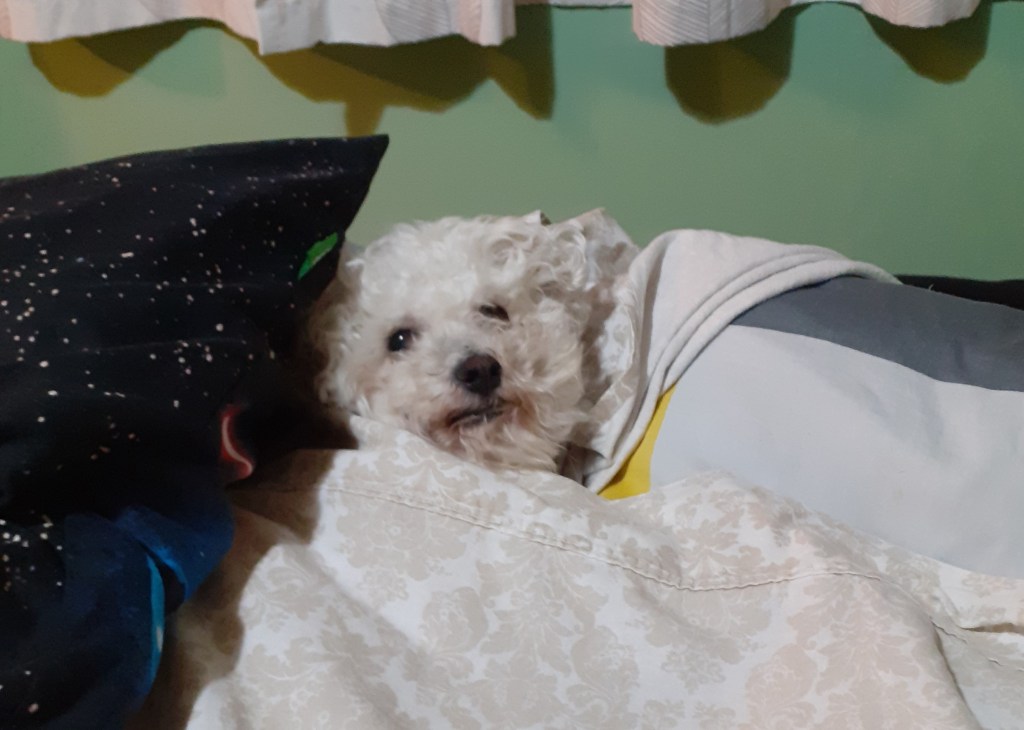
Indy claiming his spot in our bed.

So, let’s get back to the title of the blog. It’s been one year since Indy died, so what has life been like? I guess it depends on how honest I want to be. I would be lying if I said that it has been easy, with the first two months being pretty rough.

I know people grieve in different ways, because we are all different. But how does someone grieve and mourn for a pet? What’s the best way to do this? Having said that, I’m not sure how to explain things, but I’ll give it a go.

We have encouraged UMC1 and UMC2 to discuss Indy when they wanted to, whether to talk about his misadventures or just to state the fact that they miss him. UMC2 talks about him more than UMC1, but I know they both miss and love him.

For myself, I’m content to talk about him, but it heavily relies on the context of the discussion. Sometimes I can joke about him and retell stories, but other times, I still have to leave the room after talking about him.

I suppose the grief is always sitting there, just under the skin, and all it takes is a small scratch to reveal it. I’m left thinking, “Wow, where did that reaction come from?” I also know that he’s been gone for a year, but I still catch myself doing things, mainly out of habit.

  • When my wife picks me up from work, I have to stop myself from asking how Indy’s day has been.
  • When calling my wife from work, I have to stop myself from asking how Indy’s day has been.
  • I find myself wanting to check the bed before sitting on it, so I don’t hurt Indy.

We miss and love Indy, and he loved us. So what do you do with the leftover love? UMC1 and UMC2 would like to get another dog soon; however, my wife and I are not ready for that. We want to be, just not yet.

I remember reading somewhere that not loving another pet after a pet’s death is a sin. There are so many pets out there that need loving families to take care of them, and we will do that again, just not yet. My wife is worried she would compare the new dog to Indy, and that wouldn’t be fair to the new dog. As for me, I guess I have more healing to be done.


Indy catching up on some well deserved rest.

It was awkward going to Indy’s favourite places around town, but this has been getting better. We were at the beach the other day, when UMC2 pointed to a dog and stated that the dog looked like Indy’s clone. That caught me by surprise, but he wasn’t angry or sad about it; it was just an observation.

Something that has shocked me has been my ability to talk to and hug other dogs. After Jack died, I isolated my heart from dogs and avoided being around them. After Indy’s death, I didn’t want to make the same mistake, so I decided that when I would meet a dog, I would give it lots of pats and hugs. It’s not their fault, they want to get some attention from a faulty human.

This has been great because it’s allowed me to discuss the dog with the owner. Sometimes Indy comes up in conversations, and sometimes he doesn’t. It’s been helpful.

We have photos of Indy around the house, and I have photos of Indy and Jack, next to each other, on my desk. The dogs never met in life, but part of me hopes they have met in the afterlife.

This blog post is ultimately not as good as I had hoped it would be, as I have stopped several times to think about him and let the experience wash over me. The more I think about Indy, the more I have to write. But the more I write about him, the more I have to stop and compose myself.

Indy was a fucking good dog, not just to me, the boys and my wife, but to everybody. He changed my life, and as long as we continue to talk about his misadventures, our memories and love for him will never be gone.

I’m done now. Thank you for continuing to read, follow, and subscribe to Some Geek Told Me. If you have a pet, please do me a favour and hug them. I’ll see you next week for the return of We Didn’t Start the Fire.