
The historic project that skilled historians have written content about for decades has returned for 2026! Yeah, baby, Some Geek Told Me’s We Didn’t Start the Fire is back for its 14th entry. Sometimes I think about all of the various things I could have been doing, instead of writing about this, and I realise that it’s been totally worth it; much like not watching Melania.
If you’re new to this blog, then welcome! It’s always nice to have a new pair of eyes to gaze upon your weekly endeavour to make the world a better place, one badly written blog at a time. If you’re a veteran of this project, then be most welcome as well! You’ve been very patient with this project, but just in case you have skipped any of the previous entries, here they are:
We Didn’t Start the Fire: The Beginning
We Didn’t Start the Fire: 1948-1949.
We Didn’t Start the Fire: 1950
We Didn’t Start the Fire: 1951
We Didn’t Start the Fire: 1952
We Didn’t Start the Fire: 1953
We Didn’t Start the Fire: 1954
We Didn’t Start the Fire: 1955
We Didn’t Start the Fire: 1956
We Didn’t Start the Fire: 1957
We Didn’t Start the Fire: 1958
We Didn’t Start the Fire: 1959
We Didn’t Start the Fire: 1960
For the last entry, we discussed 1960, so you don’t need to be Sherlock Holmes or Batman to deduce that this blog post will be breaking down the 1961 historical references in Billy Joel’s We Didn’t Start the Fire. Get ready, because we’re going back to 1961! And with that, away we go!
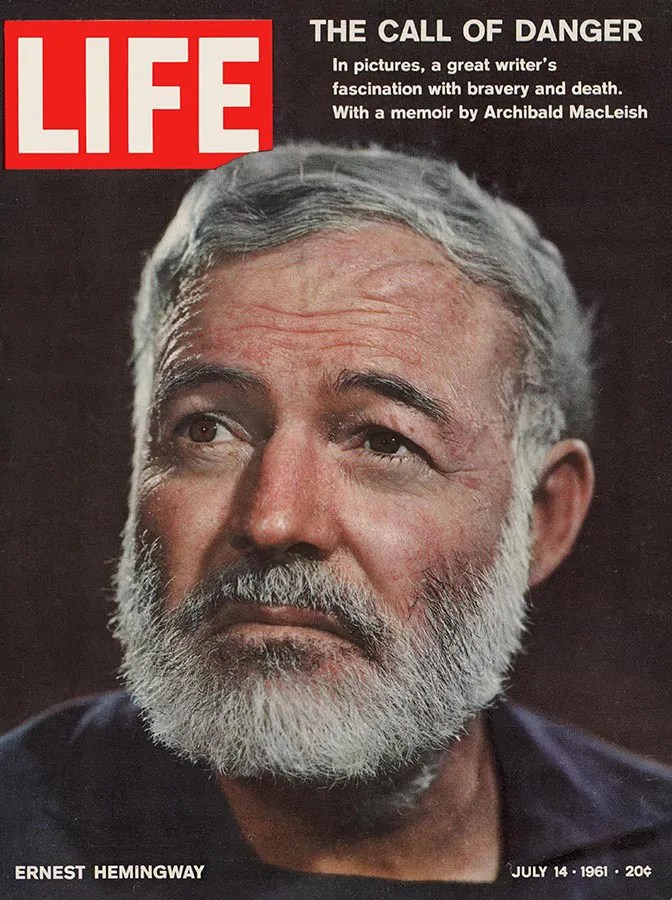
Hemingway
I’m sure at some point in your life, you have heard of Ernest Hemingway at least once. Hemingway was a writer and journalist who penned novels, such as The Sun Also Rises, A Farewell to Arms, For Whom the Bell Tolls, Across the River and into the Trees, and The Old Man and the Sea, which won the Pulitzer Prize for Fiction in 1953.
Hemingway was also a correspondent and covered the Greco-Turkish War, Spanish Civil War, Sino-Japanese War, and World War II, as well as volunteering as an ambulance driver in World War I. Throughout the 20th century, Hemingway was lauded by critics and readers, and his cult status has only grown over the years.
Now, I would love to say that Hemingway was mentioned in the song because of some amazing literary work, but sadly, that’s not the case. On 2nd July 1961, aged 61 years old, Ernest Hemingway killed himself at his home in Ketchum, Idaho. His death sent shockwaves around the world, impacting various parts of society.
For a modern example, many celebrities have committed suicide over the last 20-30 years. Still, for a famous writer to have died by their own hand, the most relevant example is Hunter S. Thompson, author of Fear and Loathing in Las Vegas, The Curse of Lono, and The Rum Diary, who killed himself on 20th February 2005.
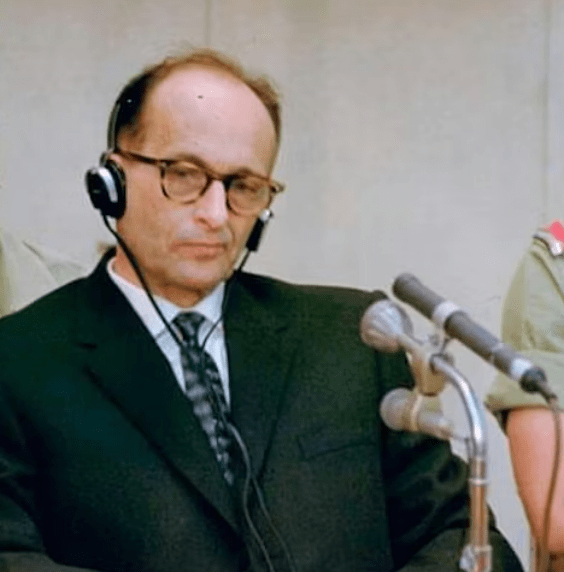
Eichmann
Given the rise of far-right parties and policies around the world, it is poignant to discuss Adolf Eichmann. Eichmann was a member of the Nationalsozialistische Deutsche Arbeiterpartei, or in English, the National Socialist German Workers’ Party. If those two names don’t register a response, you may know the party by its informal name: The Nazi Party.
Yes, Eichmann was not only a Nazi, but he was an SS (Schutzstaffel) officer and one of the architects of the Holocaust. After the end of the Second World War, Eichmann fled to Argentina in 1950, since he was implicated during the Nuremberg trials. Because of Argentina’s history of rejecting extradition, Mossad agents captured Eichmann in 1960, and he was taken to Israel to stand trial.
His trial, which became known as the Eichmann Trial, lasted from 11th April to 15th August 1961, where Eichmann faced 15 charges under Israel’s Nazis and Nazi Collaborators (Punishment) Law. He was convicted of 12 charges, but he was only partially convicted of the other three. Eichmann was sentenced to death via hanging, which was carried out on 1st June 1962.
You can be the judge whether it’s a positive or negative thing, but for a contemporary equivalent, we have a large selection of war criminals to choose from. This includes Slobodan Milosevic, Saddam Hussein, Charles Taylor, Radovan Karadžić, Nuon Chea, Théoneste Bagosora, and so many more.
Credit: Public Domain
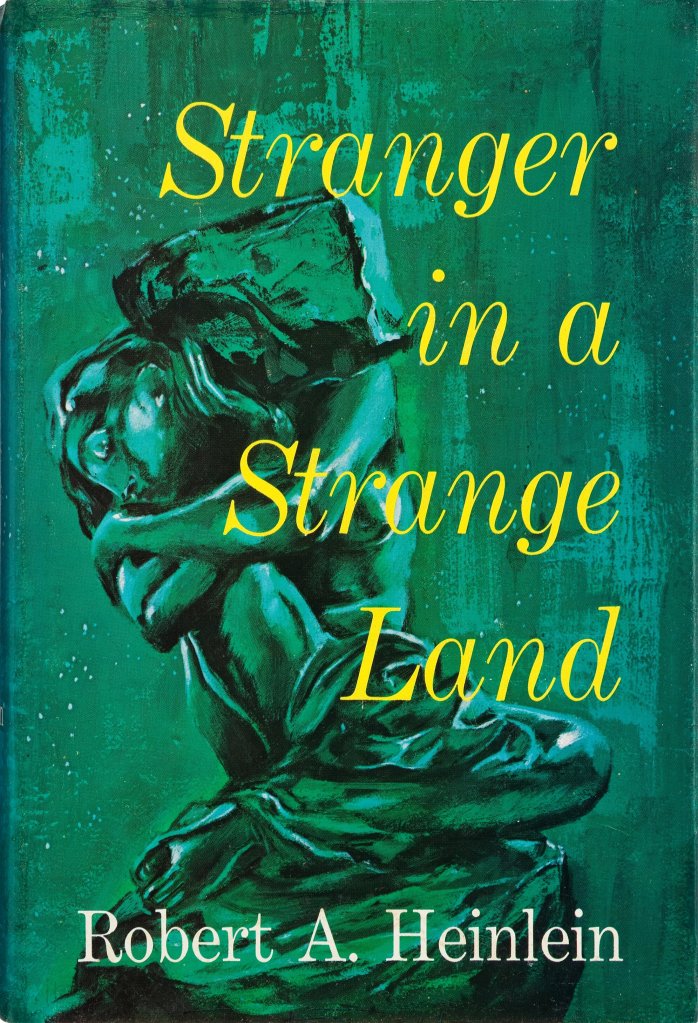
Stranger in a Strange Land
This is the first and last book reference for 1961s time in the sunshine. Written by Robert A. Heinlein and released in, surprise, surprise, 1961, Stranger in a Strange Land was famous throughout the United States and around the world. This science fiction book was about a human who was discovered on Mars and was taken back to Earth, along with the implications.
Stranger in a Strange Land divided critics and fans because of the taboo topics like religion, culture, free love, misogyny, rape, and other topics. Heinlein later explained that the book aimed to expose hypocrisy and to challenge societal norms. The book was very controversial at the time, but it also introduced terms like grok and waterbed into the lexicon.
The legacy of Stranger in a Strange Land can be seen in various media like The Ministry for the Future, The Sparrow, and The Expanse, though maybe you could think of better examples.
Dylan
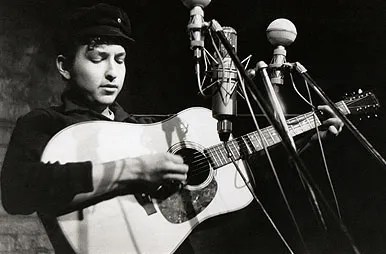
Dylan refers to Bob Dylan, the great American singer-songwriter. A few events happened to Dylan in 1961, with the first being that he had already been performing for a couple of years before he moved from Minnesota to New York in January 1961 to pursue his musical career.
Dylan managed to meet Woody Guthrie, his musical idol, as well as playing at venues around Greenwich Village, which helped him make a name for himself. This led him to feature on one of Carolyn Hester’s albums, and as the story goes, his work on the album attracted the attention of John Hammond.
Hammond was the album’s producer, and on 26th October 1961, he signed the 20-year-old Dylan to Columbia Records. This was Dylan’s first contract, and his debut album, Bob Dylan, was produced for about $400. The album sold about 5,000 copies, with Dylan on his way to stardom and a long-time relationship with Columbia Records.
For a modern example of Bob Dylan’s historical signing, I don’t have an answer. I mean, do I present someone like Bob Dylan, who signed their first contract 30-40 years ago, and they are now a household name? Or could it be someone signed their first contract only five years ago, and they are on their way to stardom? You be the judge, unless you can provide some examples of your own.
Berlin
Back in 1961, Germany was divided into two countries after World War II: West Germany and East Germany. At the time, the Cold War was also in effect, with Western Europe and NATO on one side, and the Soviet Union and the Chinese bloc on the other side. West vs East, Blue vs Red, Capitalism vs Communism, with West Germany and East Germany as a site for that proxy war.
Berlin was in East Germany, but the city was split into three Western sectors (American, British, French) and one Eastern sector (Soviet). Thus, we had West Berlin and East Berlin. The Federal Republic of Germany (West Germany) was backed by Western countries, while the German Democratic Republic (East Germany) was backed by the Eastern (Communist) bloc.1
And for me personally, there was no other symbol that represented the Cold War more than the real Iron Curtain, the Berlin Wall.
East Germany started construction on the Berlin Wall on 13th August 1961, and it was infamous. It was a 155 km concrete barrier that surrounded West Berlin, which was lined with anti-vehicle trenches, bunkers, watch towers, and guards. It also served as a de facto border between the two countries, covering 111.9 km along the border.
The function of the Berlin Wall was to stem the flow of people from the East to the West. Records show about 140 people were killed crossing or attempting to cross the wall, though this number is not a true reflection of the human cost. The legacy of the Berlin Wall was that it lasted for 28 years, until after communism in Central and Eastern Europe fell.
During the Peaceful Revolution, on 9th November 1989, sections of the Berlin Wall fell, allowing unimpeded migration from East Germany to West Germany, and vice versa. The Fall of the Berlin Wall was a watershed for world history and paved the way for the reunification of Germany on 3rd October 1990.
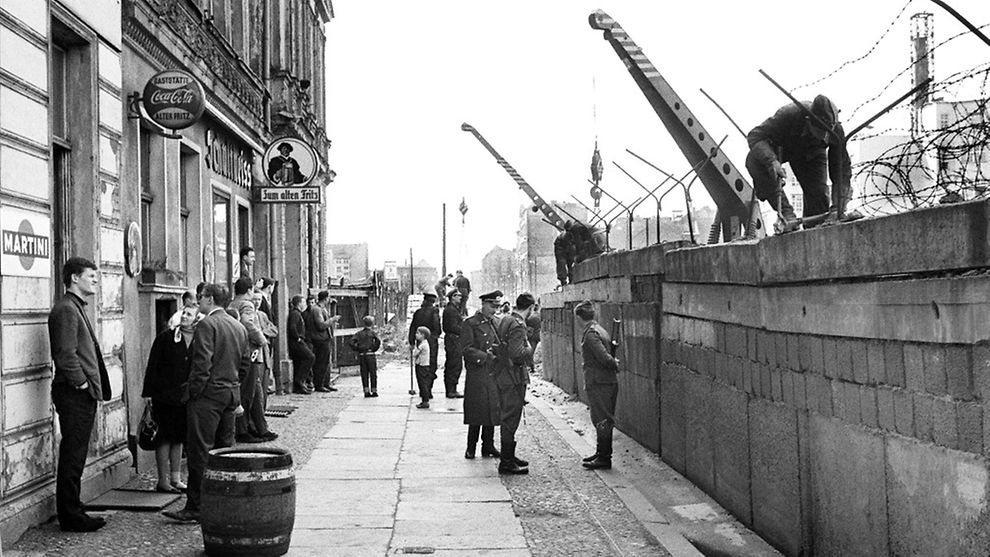
Photo: Bundesregierung/Lehnartz
Bay of Pigs Invasion
And speaking of the Cold War, let’s discuss Cuba. Do you remember the Cuban leader, Fidel Castro, from the 1959 blog post? Well, I gave a spoiler that he would return, and he’s back! Castro and his mates had transformed Cuba into the first communist country in the Western Hemisphere, but more importantly, Cuba was only a stone’s throw from the United States.
Since the Cold War was trending at the time, the United States did not like having a communist country so close to its shores. Relations with Castro had soured, and with Cuba building stronger ties with the Soviet Union, but also the injustices that were happening in the country, the U.S. government decided to overthrow Castro.
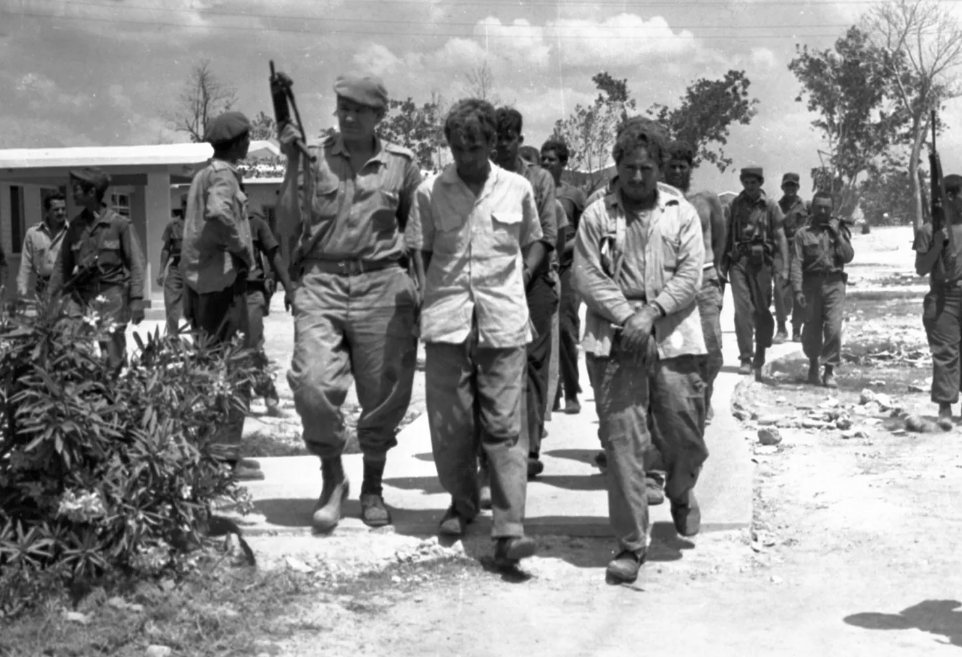
This, of course, led to the Bay of Pigs Invasion. Backed by the U.S. Navy, U.S. Air Force, and the C.I.A, ex-Cuban exiles (mainly the Cuban Democratic Revolutionary Front, and Brigade 2506) were trained to invade Cuba and oust Castro from power. On 17th April 1961, after bombing some Cuban airbases, the invasion was launched at several sites.
The main invading site was the Bay of Pigs, or Bahía de Cochinos, which is located on the south-central coast. The invasion lasted for a few days before they needed to retreat and evacuate. The American-backed Cubans were under-resourced and ill-prepared, as well as being outnumbered and outmanoeuvred by Castro’s forces. It was a humiliating and humbling experience for the U.S. government, as the invasion failed spectacularly in front of the international community.
Operation Gideon in 2020 (the Failed Coup in Venezuela) and the Russian Invasion of Ukraine in 2022 were the two best/worst examples of a failed invasion in the 21st century, where the objective was to overthrow a foreign government, or at least, to capture the leader of another country. Yes, technically Russia have not lost, but it’s been nearly four years, and they are no closer to winning.
Credit: Sovfoto/Universal Images Group/Shutterstock.com
So for 1961, we covered a writer’s death, a war criminal’s trial, a book, a musician, a wall, and a failed invasion. Like all of the years discussed in the song, their events and legacies are still with us today in 2026. Will 1962 be busier or crazier? Tune in next month, same Bat-time, same Bat-channel.
That brings another wonderful blog post to a close. Wait, I don’t think anybody has described this blog as wonderful! Thanks again for reading, following, and subscribing to Some Geek Told Me. If you’re looking for new social media to follow, then I would recommend my Twitter and Mastodon accounts, pretty please.
Please don’t forget to walk your dog, read a banned book, go and talk to a five-year-old, and if you ever repeat any of the information I write about, and someone asks you where you discovered it, just say, ‘Some Geek Told Me.‘ I’ll see you next week, and look after yourself.
1 We have briefly discussed the “Communist Bloc” in East Germany, with the We Didn’t Start the Fire: 1953 blog post, featuring that historical reference. Please read it for more details, I dare you!
 SOME GEEK TOLD ME
You must be logged in to post a comment.