
Welcome to a rare occurrence, a Saturday blog from Some Geek Told Me. This is a special one, since this week saw the world commemorate the 80th anniversary of the atomic bombings of the Japanese cities of Hiroshima and Nagasaki.
Given that the 80th Anniversary of VJ Day (Victory over Japan) is just around the corner, which signalled the end of the Second World War, I thought it would be important to revisit one of my previous blogs, concerning the bombings.
I’ve tidied up some of the old blog post, but the core of the message is the same: the dropping of atomic bombs on Hiroshima and Nagasaki changed the world. How it changed remains your decision and judgment.
As a history fan, I find it hard to ignore these events. However, I will not be discussing the following:
- The development of the atomic bombs, through the Manhattan Project.
- The justification behind the Allies’ decision to drop the bombs.
- The Quebec Agreement or The Potsdam Declaration.
- The Allies warning the Japanese citizens of the bombings.
- Whether Japan had the capability to defend itself, against an Allied invasion.
I’ll be discussing the impact of the two bombs on the cities of Hiroshima and Nagasaki, as well as their effects on the citizens. While this topic may not be as exciting as Fifty Shades of Grey or The Da Vinci Code, it’s important to understand and remember the lessons of history.
With that in mind, let’s now begin this week’s special lecture.

Photograph: Toshio Kawamoto/Yoshio Kawamoto/Reuters/Issei Kato
Hiroshima: 6th August 1945
At the time of the bombing, Hiroshima was the headquarters for the Chūgoku Regional Army, as well as the Second General Army. Given Hiroshima’s position for shipping and military resources, it was one of the targets selected to be hit.
Hiroshima’s population was nearly 345,000, which was made up of military personnel, citizens, including children, slave labourers and prisoners of war.
The weapon used on Hiroshima was a bomb with a 64 kg uranium-235 core, nicknamed Little Boy. It had the power of 15 kilotons of TNT.
On 6th August, at 8.15 a.m. (local time), the bomb was dropped from the Enola Gay, an American Boeing B-29 Superfortress bomber, at an altitude of 9,400 m. It fell for 44-45 seconds before detonating at 580 m, which was directly above a hospital.
The result of the first nuclear weapon being used in warfare, was nothing short of horrific.
- The ground-level temperature surpassed 7,000 °C.
- 70,000 people were instantly killed by the blast and the resulting firestorm, with under 10% being military personnel.
- By the end of 1945, the death toll had risen to over 100,000, mainly through radiation and injuries.
- Of the city’s buildings, 70% were destroyed (60,000), with another 7% damaged.
- Nuclear shadows or blast shadows of victims were created on the city’s footpaths and walls.
- A mushroom cloud was created and rose to more than 12 km high.
- The blast radius of the weapon had total destruction for 1.6 km, along with fires stretching across 11 km².
- Over 90% of doctors and 93% of nurses in Hiroshima were killed or injured.
- For people looking for medical treatment from the weapon, many would die before any medical help could be given to them. This resulted in dead bodies lying around hospitals.
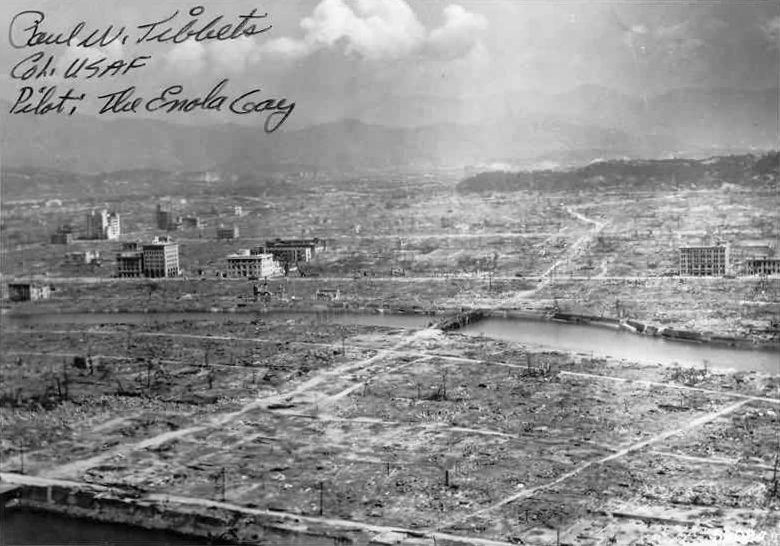
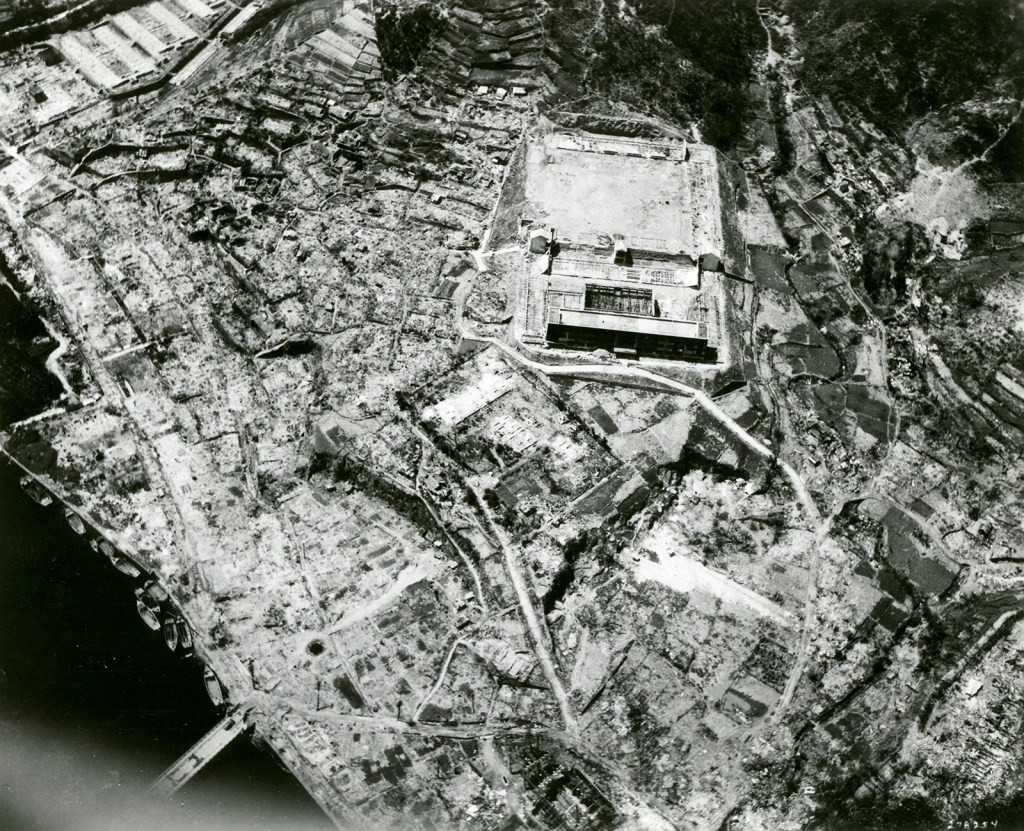
Aerial photograph of Hiroshima after it was struck by an atomic bomb on August 6, 1945.

Nagasaki: 9th August 1945
During the war, Nagasaki was an important seaport, which was one of the largest in Japan. Nagasaki was also home to four massive companies that were involved in the production of various military technology and machines. These companies employed 90% of the labour force in the city. Because of this, it was selected as a target.
Nagasaki’s population was 263,000, which consisted of Japanese citizens, Korean citizens, Korean and Chinese workers, soldiers and prisoners of war.
The Nagasaki bomb had a 5 kg plutonium core, nicknamed Fat Man. This weapon had the equivalent power of 21 kilotons of TNT.
On 9th August, at 11.01 a.m. (local time), the plutonium bomb was dropped from another American Boeing B-29 Superfortress bomber, Bockscar. It fell for 53 seconds, exploding near 500 m, which was directly above a tennis court.
As Japan and the world were still reeling after the Hiroshima bombing, a new nightmare was about to unfold.
- 40,000 people were instantly killed by the blast, with 60,000 injured.
- By the end of 1945, the death toll had risen to an estimated 80,000, mainly through radiation and injuries.
- 40% of the city’s buildings were destroyed.
- The industrial area sustained 68-80% of its production, was destroyed.
- A mushroom cloud was created to a height of 16 km.
- The blast radius of the weapon had total destruction for 1.6 km, along with fires stretching 3.2 km south of the blast radius.


Casualties of the bombs could be collected under three main groups: radiation injuries, debris injuries, and burns.
Radiation injuries accounted for 10% of the deaths in Hiroshima and 6% in Nagasaki. Debris injuries accounted for 30% of the deaths in Hiroshima and 14% in Nagasaki, while burns accounted for 60% of the deaths in Hiroshima and about 80% in Nagasaki.
This information does not even touch upon the massive reconstruction effort of Hiroshima and Nagasaki; the aftercare needed for the survivors, named as hibakusha in Japanese; the radiation and cancer research conducted with the survivors; the cultural and historical impact on Japanese society; or even the world’s reaction and response to the bombings.
Over the last few years, I’ve explained what happened to Hiroshima and Nagasaki to UMC1 and UMC2. I haven’t gone into great detail about them, but it’s difficult to explain to children that the nuclear apocalypse of Hiroshima and Nagasaki was real. It’s not fake, this happened; not once, but twice.
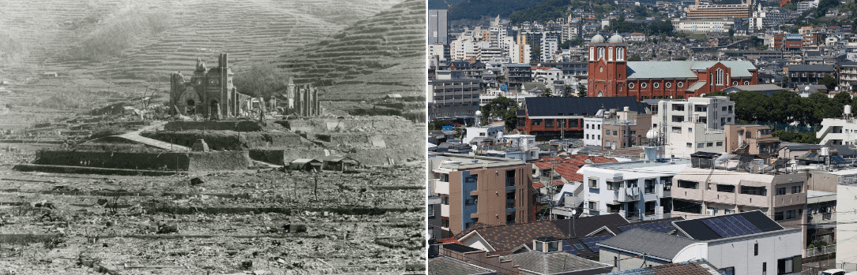
Photograph: Shigeo Hayashi/Nagasaki Atomic Bomb Museum/Reuters/Issei Kato
The bombing of Hiroshima and Nagasaki changed Japan forever, but also the world. I think the legacy of the two cities is a twisted form of doublethink.
The destruction of Hiroshima and Nagasaki can show us an example of what the worst of humanity can offer; what terrible things we can do to each other. However, it also shows us how, quite literally and figuratively, humanity can stand up after being knocked down and start to rebuild in the name of peace.
Both statements are true. They can co-exist alongside each other in your mind, and that’s alright. Though I think, just maybe, it’s about what you want to focus more on: hate or hope.
And that’s enough from me today. I hope this was enlightening for you, as I’ll be back on Monday with another thrilling post from New Zealand’s 5th least favourite website. Take care.
 SOME GEEK TOLD ME
You must be logged in to post a comment.