
Using the way-back machine, let’s travel back to 2022, where I wrote about various reviews of two television shows that I hadn’t seen at the time. I thought it was overdue to revisit this concept, but instead of writing about another television show, we’re going to look at a movie. This sounds like another excellent idea, like fire-proof matches, or ejector seats in helicopters.
We are spoiled for choice, as we are surrounded by a collection of motion pictures, whether they are shown at the cinema or through various streaming services. What an age to live in!
However, considering her spouse, the U.S. president, the Board of Peace chairman, the winner of the inaugural FIFA Peace Prize, the recent recipient of a hand-me-down Nobel Peace Prize, and convicted felony, Donald Trump, has been busy bombing Iran, I thought it would be fitting to look at Melania Trump’s movie, Melania.
Let’s establish something first. I can think of no conceivable reason why I would ever watch, Melania. Seriously, I don’t want to watch it. If I were on a long-haul flight, and I had no book, with the movie stuck on repeat, then maybe. A big maybe.
So, how does someone review a movie that they have no intention of ever watching? The answer is very simple; I read what other people have said. I had a staff meeting about this subject, and the consensus was that we should try to be fair and neutral. However, sometimes we can be biased, and today is one of those days.
Melania premiered on 29th January 2026, with a budget of US$40 million, and has made US$16.6 million worldwide, which technically makes it a flop. From what I understand, the film covers Melania’s movements and experiences around the last 20 days leading up to the second inauguration of everybody’s favourite president, Donald Trump. Sounds action-packed stuff, right?
And with that, let’s make it so!
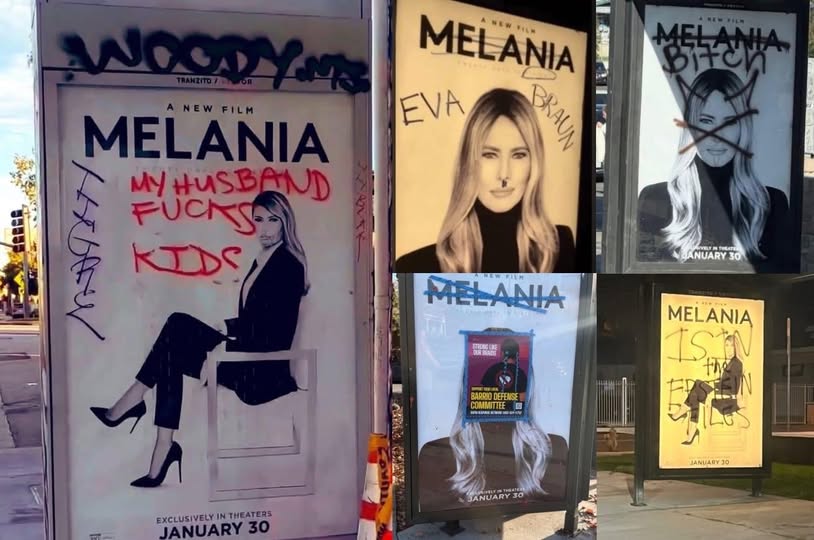
I enjoy reading humorous reviews as much as the next person, so this was a fun experience for me, unlike smelling an open bag of Sour Cream and Chives from 500 m away. Gross.
Because you demand nothing but the best from this wayward literary venture, I have collected some of the funniest reviews for Melania and have tried to group them accordingly, because I can, and it looks neat. Also, I am aware of review bombing, so thank you in advance for the heads up.
Rotten Tomatoes: (Accurate for 5th March 2026)
11% Tomatometer
98% Audience Score
Coleman Spilde: Salon.com 7th February 2026
This documentary doesn’t absolve any sins; it highlights them. “Melania” taunts the viewer and takes glee in the assumption that they can’t do anything about it.
Joseph Robinson: Fish Jelly Films (YouTube) 6th February 2026
More PR campaign than personal portrait, Melania is an astonishingly dull documentary that masquerades as a glamorous immigrant story while offering little insight beyond carefully curated image-making.
Robert Denerstein: Denerstein Unleashed 4th February 2026
By any critical standards I’m familiar with, I’ll tell you that Melania isn’t much of a documentary; it’s more like a plush Life Styles of the Rich and Famous episode that bleeds into a chorus of booming triumphalism centering on Trump’s inauguration.
Amy Nicholson: Los Angeles Times 3rd February 2026
Melania” plays like a sizzle reel for her post-political (post-spousal?) future career in which she may rouse herself to be a guest judge on a reality competition show.
Calum Cooper: Cinerama Film 3rd February 2026
Melania is shambolic, putrid, pitiful garbage: A brazen, awkward, irredeemable infomercial that ignores truth and scrutiny in favour of performative humility. It’s not just wretched – it’s offensive to the collective intelligence of the human race.
Donald Clarke: Irish Times 31st January 2026
No good impression emerges of the former Slovenian model. No bad impression emerges either. Ratner’s film achieves, rather, a sort of passive distance – as you might get by pointing a camera, for close to two hours, at a waterfall or a wheat field.
IMDb: (Accurate for 5th March 2026)
1.4/10 rating
Sleepin_Dragon: 1/10 rating 30th January 2026
I can’t pretend I sat through this to the end. There was only so much I could take, and as we left the cinema, the screen itself was empty. That probably says everything I need to say about this dire ….movie.
meltymark: 1/10 rating 30th January 2026
I’m not a political person, politics are disgusting to me on both sides of the isle and I understand Melania is not a politician and deserves some respect and dignity like all other people… but
This was not only boring, but it was also incredibly painful to watch. It reminded me of the feeling you get when a boss or person in authority is bragging about themselves and you have to just take it and act like it doesn’t repulse you and your body language and whole being just can’t take it to the point of it making you physically ill.
andrew-lundberg-1970: 1/10 rating 31st January 2026
Everything about this film is pure tragedy, and not in a meaningful or intentional way. It’s dull, self-important, and completely devoid of insight, as if it mistakes moodiness for depth and emptiness for sophistication. The pacing drags, the storytelling goes nowhere, and whatever point it thinks it’s making never arrives. If I could give it less than one star, I would. Don’t waste your time, your money, or your patience on this hollow mess.
mbvqp: 1/10 rating 1st February 2026
Melania” is an utter WASTE OF TIME and MONEY-hands down the WORST MOVIE I’ve ever seen. Its disjointed plot, uninspired performances, and cringeworthy ridiculous dialogue make it a tedious chore to sit through. Rather than offering insight, it delivers a bland, utterly uninspiring experience that adds absolutely nothing to the broader discourse. Please do yourself an enormous favour and SKIP THIS DISASTER entirely. You’ll be glad that you did!
rppratings: 1/10 rating 5th February 2026
Melania is less of a movie and more of a painfully long exercise in boredom. Calling it hollow would be generous – this film is a glossy, lifeless shell with absolutely nothing inside. It drags, it stalls, it goes nowhere, and somehow still feels longer than its runtime. Watching paint dry would’ve delivered more emotional payoff.
The “story,” if you can even call it that, is buried under endless slow shots, awkward silence, and a level of stiffness that makes mannequins look expressive. Every moment that should feel revealing or meaningful instead feels cold, staged, and completely devoid of humanity. It’s not mysterious – it’s empty.
The dialogue is flat, the pacing is brutal, and the entire thing feels like a stretched-out PR video nobody asked for. By the end, I wasn’t frustrated, I wasn’t moved – I was just stunned that something so expensive-looking could be so painfully pointless.
Melania isn’t just bad – it’s spectacularly, monumentally dull. A beautiful wrapper around absolutely nothing. A total waste of time.
JoshuaT-253: 1/10 rating 19th February 2026
There is nothing harder to describe than a movie that is simply dull and uninteresting. I could sit here and describe how nothing happens for close to 80% of the time. Just a lady sitting around waiting for things to happen. She then travels from place to place multiple times in great and tedious detail with nothing to show for it than more waiting to travel to yet another place. It has almost zero content, nothing to hold interest or to connect with at all.
Other sources:
Xan Brooks: The Guardian
30th January 2026
…No doubt there is a great documentary to be made about Melania Knauss, the ambitious model from out of Slovenia who married a New York real-estate mogul and then found herself cast in the role of a latter-day Eva Braun, but the horrific Melania emphatically isn’t it. It’s one of those rare, unicorn films that doesn’t have a single redeeming quality. I’m not even sure it qualifies as a documentary, exactly, so much as an elaborate piece of designer taxidermy, horribly overpriced and ice-cold to the touch and proffered like a medieval tribute to placate the greedy king on his throne.
Natasha Jokic: BuzzFeed
31st January 2026
…Last night, I left an empty chickpea can on my counter. When I came back 30 minutes later, small, black bugs had swarmed the tin and were crawling over my sink. I would rather relive that moment a hundred times over than have to watch another minute of the movie Melania.
Lauren Collins: The New Yorker
…Cameras followed Melania in the twenty days leading up to Trump’s second Inauguration. About nineteen of them seem to have been devoted to planning Melania’s big event, a candlelit dinner for MAGA backers and bagmen, including Bezos. Chef Chris’s menu opens with a “golden egg and caviar,” an event planner says. At this point, you think that “Melania” has broken the fourth wall, that the far-too-obvious symbolism is about to be acknowledged and then punctured or dismissed. But, no, the gilded hors d’œuvres are for real, even if, as a metaphor, they are at best incomplete. With “Melania,” you get the brittle shell, but none of the rich internal goo that makes for a compelling portrait.
Piper B.: Common Sense Media
February 2026
…People will tell you to remember that this is just a documentary and that’s why it’s boring, but that’s just plain wrong. This documentary shows no historical value other than “my husband became the president.” I would not show this to my children because I see no role model. If I want to show my kids a documentary, I’d choose one with a more empowering figure, someone they can look up to and strive to be.
Amy Nicholson: The Los Angeles Times
2nd February 2026
…I cannot recommend “Melania” as a good movie or even an interesting one. It has the feel of a soothingly looped AI screen saver, a trance-inducing spell where nothing matters so long as your high heels aren’t hurting your feet. Yet against all odds, there is a truth in her SUV-to-tarmac-to-SUV-to-tarmac insularity. Future historians will be glad to have “Melania” as a lens into this moment in time. Like everything she touches, it’s a costly artifact.
Owen Gleiberman: Variety
30th January 2026
…Melania is a documentary that never comes to life. It’s a “portrait” of the First Lady of the United States, but it’s so orchestrated and airbrushed and stage-managed that it barely rises to the level of a shameless infomercial. Is it cheesy? At moments, but mostly it’s inert. It feels like it’s been stitched together out of the most innocuous outtakes from a reality show. There’s no drama to it. It should have been called “Day of the Living Tradwife.
Vince Mancini: GQ
2nd February 2026
Melania many go down in history as one of the least revealing documentaries ever made. But if you’ve never watched the First Lady get on and off a plane, Brett Ratner’s got a movie for you.
Samuel Clench: News.com.au
1st February 2026
…Melania is like a horror film with nothing scary in it, or a crime thriller with no twists, or an action film with no fighting. It is a documentary with no interest in exploring its central figure beneath her most superficial level. It is incomprehensibly empty.
But I think the best review I have discovered is this:
Greg: Cockbuster Video
30 January 2026
Couldn’t hear what the hell was going on during the film because the whole theater was filled with dudes in red hats sucking each other off load af.
Now, in the interests of being fair, not every single Melania review is negative; some, in fact, praise the film. Different strokes for different folks, though. Should you watch the film or give it a pass? I would give it a hard pass, not even to watch it, to decry it.
It goes for a general rule of thumb for any comic, book, movie, TV show, computer game, music, chip flavour or documentary; don’t listen to anybody else’s review or opinion. If you want to experience a product, go and experience it yourself; that way, you’ll always know. If you like it, then praise the living hell out of it; if not, then go the other way.
To quote one of the 90’s greatest arse-kickers, “The power is yours!”
And that, dear friends, brings another jam-packed blog post filled with mystery to a close. Also, regardless of what happens with Trump’s non-war with Iran, Iran is due to play all of its group games of the FIFA World Cup in the United States, with the first game against us, New Zealand, on 15th June. Who knows if Trump will let them into the country or if there will be a boycott? Who knows?
Thanks again for reading, following, and subscribing to Some Geek Told Me. Please don’t forget to walk your dog, read a banned book, go watch The Creator, and I’ll see you next week.





 SOME GEEK TOLD ME
You must be logged in to post a comment.