Shakespeare movie adaptations that are hidden in plain sight: Vol 1

Step right up, step right up for another blog post detailing how humanity can cure cancer, solve climate change, and understand why children are weird. Oh, wait, I can’t answer any of those questions, sorry. At least not today.

Diving into the nearly five-year-old bag of suggested topics from the staff at Some Geek Told Me, I have selected a topic that, every six months or so, I decide to write, but talk myself out of it. However, the die has been cast, and the wait is over.

As hardcore followers of this amateurish attempt to educate people, you will know that this geek suffers from a Shakespeare affliction. I can’t recite speeches or explain what the hell the characters are saying. Though, to be fair, what I can do is explain the plots and the themes. Well, to be honest, it’s what I think the themes are, so I could be 80% wrong.

Granted, the works of William Shakespeare have lasted over 400 years, much to the disappointment of all secondary school students studying English. I love the motivations behind characters, both heroes and villains, as well as how relevant the stories can be to contemporary audiences.

Watching a Shakespearean movie or attending one of his plays automatically engages my brain to sit up straight, focus, listen, and try to keep up. Over the years, this has led the plays to be adapted into various media like movies, comics, novels, and TV shows, among others.

Some adaptations would keep Shakespeare’s language of Early Modern English, while others would use Modern English, but still keep to the plot. Some adaptations are set in 16th-17th-century Europe, others in modern times, while others are set somewhere in between or earlier.

For today’s lecture, we are going to look at one group of these adaptations: the movies. Typically, it’s quite easy to identify a Shakespeare movie adaptation, because of its name: William Shakespeare’s Romeo + Juliet, Henry V, Othello, Richard III, Hamlet, and Coriolanus, to select but a few.

They are direct adaptations, or as close as a film production can allow. However, young grasshopper, there are a small group of movies that are indirect adaptations of one of Shakespeare’s plays, but they are not advertised as that, for whatever reason. Several films can fit into this niche, so this blog post will be the first of many; the single consideration is that I’ll try very hard to only have one movie per play.

So, for your reading pleasure, I have collected four examples of movies that are secretly Shakespeare adaptations. I hope you enjoy this as much as I did writing it. Let’s begin now.


Image by beauty_of_nature from Pixabay

West Side Story (Romeo and Juliet)

We are going to start with a very obvious one, and for good reason. West Side Story was originally a musical adaptation of Romeo and Juliet, which had opened on Broadway in 1957. The production was a huge success, so a film was produced, based on the musical.

The film was released in 1961, which is what we will be comparing. In the Upper West Side of Manhattan, New York City, in 1957, is where we lay our scene. In comparison, Romeo and Juliet was written sometime between 1591 and 1595.

Both stories deal with star-crossed lovers, in the form of Romeo Montague and Juliet Capulet, along with Tony (Richard Beymer) and Maria (Natalie Wood) from West Side Story. The House of Montague and the House of Capulet are feuding families in Verona, with Romeo and Juliet belonging to opposite houses.

Maria’s older brother, Bernardo (George Chakiris), is the leader of the Sharks, a teenage street gang, looking to control the Upper West Side. The Jets are a rival gang of which Tony was a co-founder and former member.

Trying to keep the warring families at bay in Romeo and Juliet is Prince Escalus, with the equivalent being two characters, Lieutenant Schrank (Simon Oakland) and Sergeant Krupke (William Bramley) in West Side Story. Other similar characters are Mercutio, Romeo’s friend, and Riff (Russ Tamblyn), best friend to Tony; Tybalt, Juliet’s cousin, is Bernardo; while Count Paris, Juliet’s suitor, is Chino Martin (Jose De Vega).

The two stories follow events to their tragic conclusion, but with a subtle difference. In Romeo and Juliet, Mercutio is slain by Tybalt, Tybalt is then slain by Romeo, Paris is killed by Romeo, and both Romeo and Juliet kill themselves. Both Houses are in mourning, and thus, the feud ends.

In West Side Story, Riff is murdered by Bernardo, who, in turn, is killed by Tony. However, you are expecting Tony to kill Chino, but it’s the opposite; Chino shoots and kills Tony. Maria threatens to kill Chino, the Jets, and the Sharks because of their hatred, which has taken the lives of Riff, her brother, and her lover. In the end, she backs down, but she ultimately survives the carnage, and the feud ends.

On a personal note, Romeo and Juliet is often described as the world’s greatest love story. It’s not the ultimate love story; it’s one of the world’s greatest tragedies. Much like West Side Story, love, violence, hatred, and prejudice are woven into both tales to tell and explore the human experience. West Side Story is a love story as well as a tragedy. Tony dies, but Maria lives, so hope remains. As for Romeo and Juliet, their tragedy is complete, for never was a story of more woe, than this of Juliet and her Romeo.

The Lion King (Hamlet)

I’m sorry to point this out and possibly damage your childhood, but I am not the first person to say this; the story of The Lion King is actually Hamlet in disguise. Wait, just hear me out.

This tragedy has a prince who goes into mourning as his father, the king, has died. The prince’s uncle, his father’s brother, ascends the throne. The prince goes into exile with two friends and returns years later to a kingdom that is rotten.

If you had thought I had just explained Simba’s story when it came out in 1994, you would be correct; however, it also mirrors Hamlet’s journey, which was written between 1599 and 1601. The stories share characters and their equivalents, with Simba (Hamlet), Mufasa (King Hamlet), Scar (Claudius), Nada (Ophelia), and Zazu (Polonius), along with Timon and Pumbaa (Rosencrantz and Guildenstern).

Even though the early 17th-century royal court of Denmark is swapped for the plains of the Serengeti in Tanzania, the plots have parallel events, though not entirely. Both kings are murdered by their brothers, who take the throne and are terrible rulers; both kings appear as ghosts to their sons and give advice; Simba and Hamlet have a love interest in Nada and Ophelia, respectively; both princes go into exile; and Scar and Claudius both die at the end.

Disney could have gone all in with a more accurate adaptation with Simba killing Nala’s father by accident; Simba’s mother, Sarabi, marries Scar; Nala commits suicide by drowning; Simba goes mad with grief and vengeance; another pride of lions invades and takes over the Pride Lands; and lastly, Sarabi, Scar, and Simba, all die in the closing scene. It would have been a beautiful nightmare, with Simba/Hamlet’s story haunting a generation of children, all over the world.

10 Things I Hate About You (The Taming of the Shrew)

Viewed through a contemporary lens, The Taming of the Shrew can be some what problematic, considering it was between 1590 and 1592, when it was written. However, that did not stop Hollywood from having a crack at it. Back in 1999, 10 Things I Hate About You was released, and even though the titles were different, it was based on The Taming of the Shrew.

I hope the Bard can forgive me for breaking his comedic play down like this, but The Taming of the Shrew was set in Padua, Italy, where we met a nobleman, Baptista Minola, who has two daughters, Katherina and Bianca. Many suitors would like to marry Bianca, but her father has decreed that Bianca can only get married when Katherina does, but no man wants to because of her assertiveness, along with her quick and sharp wit.

Some plans focus on the suitors Hortensio and Gremio, but also include Lucentio, who also wishes to marry Bianca, and Petruchio, tasked with wooing Katherina. Typical Shakespearean romantic mischief ensues, with everyone ultimately finding love.

10 Things I Hate About You shares many plot points, names, and characters with The Taming of the Shrew. The film is set around the students who attend Padua High School. Walter Stratford (Larry Miller) has two daughters, and you guessed it, Katarina (Julia Stiles) and Bianca (Larisa Oleynik). Like a similar decree from Baptista Minola, Walter explains that Bianca is only allowed to date when her older sister does.

Enter Cameron James (Joseph Gordon-Levitt), who has fallen for Bianca, so he enlists help from Patrick Verona (Heath Ledger) to woo the anti-social Katherina, so Cameron can date Bianca. By the end of the film, everybody is happy like a 90s high school film should be. It also had a Shakespeare reference with Sonnet 141.

O (Othello)

If you have been keeping score, and why wouldn’t you be, we have discussed two tragedies and one comedy. I’m a bit inclined to favour the tragedies, since they can teach us a lot about ourselves. Case in point, here is another tragedy, Othello.

Written about 1603, the story of Othello is a blueprint of having it all and losing it to jealousy. It’s a cautionary tale about Othello, a military commander, who is tricked and manipulated by one of his lower-ranked officers, the traitorous Iago, into believing that his wife, Desdemona, is having an affair with another officer, the loyal Michael Cassio.

In some academic and literary circles, Iago is considered to be the worst villain in all of Shakespeare’s works, and it’s not a surprise; he ruins lives. By the end of the play, Iago had murdered his wife, Emilia, and Roderigo (a nobleman), while stabbing Cassio, but not fatally. Othello had murdered Desdemona by smothering her, because of Iago’s lies, then realised Iago was behind it all, and stabs him, but he survives.

Othello then commits suicide by stabbing himself. Iago is arrested and taken away, but famously refuses to explain his motivations. Othello has mischief and hijinks, but it is not comedic; it’s just fraught with paranoia and jealousy.

Like 10 Things I Hate About You, O is set in modern times, with American teenagers. Mekhi Phifer stars as Odin (Othello); Josh Hartnett as Hugo (Iago); and Julia Stiles is back again, but this time she plays Desi (Desdemona). We also have Andrew Keegan as Michael Cassio (Michael Cassio), Elden Henson as Roger Calhoun (Roderigo), Rain Phoenix as Emily (Emilia), John Heard as Bob Brable (Brabantio, Desdemona’s father), and Martin Sheen as Coach Duke Goulding (The Duke of Venice).

The story of O does not centre around soldiers and officers, but rather high school basketball players and students. O follows the events of Othello, with Hugo manipulating people and events, but the end is still the same. Hugo shoots and kills Roger, along with his girlfriend, Emily. Odin strangles Desi to death, then shoots himself after learning that his friend, Hugo, had caused all of the chaos. Hugo, vowing not to reveal his motivations, is arrested by the police.

As I said earlier, many more films have been based, even loosely, on Shakespeare’s works, and this blog post will return to discuss more of them. But like I also said, only one movie per play, so Romeo and Juliet, Hamlet, The Taming of the Shrew, and Othello are done, with more to follow.

Do you have a favourite movie that is secretly a Shakespeare adaptation? As always, please let me know.

That’s it for me this week. Thanks again for reading, following, and subscribing to Some Geek Told Me. Please remember to walk your dog, read a banned book, donate to a food bank, and I’ll see you next week, where I discuss comics for a change.


Finally, my Star Wars: The High Republic post is here

Well, this blog post has been years in the making. I’ve hinted at this for some time, and now that my sponsorships are under control and I’ve completed the press tours, I feel it’s the right moment to write a blog post about the Star Wars: The High Republic series. I’m now rich and famous for running New Zealand’s fifth least favourite website, so it seems like the perfect opportunity to share my thoughts on this important subject.

Let’s establish an ugly truth before we begin: not every person on this planet has seen a Star Wars movie or TV show, or read a Star Wars novel or comic book; while some people, for some strange and unexplained reason, don’t like Star Wars. I know, it’s difficult to believe, but it’s true.

It’s been well and truly documented that I’m a geek and a fan of the world’s most famous space opera. This shouldn’t be a surprise to any of you. Seriously, it shouldn’t.

In terms of my Star Wars diet, I’ve been reading Star Wars literature in the form of novels and comic books for decades. Yes, I enjoyed the films, and since I won’t dive into that today, they left a void in me. I wanted more from that fictional universe, especially learning about the Jedi and events before A New Hope.

Enter Tales of the Jedi from Dark Horse Comics, and my prayers were answered. I think I discovered Tales of the Jedi at a library, and I was instantly hooked. Stories about the Jedi, set thousands of years before the Battle of Yavin? Sign me up.

It was a chance to tell new and exciting tales about the Star Wars universe, without being bogged down with continuity problems, since they were set thousands of years ago. I read the trades, then sourced all of the single issues, because I felt the entire series was made for me. I loved it.

Dark Horse later released Star Wars: Knights of the Republic, Star Wars: The Lost Tribe of the Sith-Spiral, Star Wars: Knight Errant, Star Wars: Jedi vs Sith, Star Wars: Republic, Star Wars: Dark Times, and one of my favourites, Star Wars: Dawn of the Jedi, among others.

Since then, various novels have been released, detailing thousands of years of Jedi and Sith, as well as the years leading up to The Phantom Menace and The Clone Wars. This also does not take away from the Canon stories exploring everything after A New Hope, either. I’ve enjoyed the Star Wars books I have read, but my love for Tales of the Jedi was enduring.

I felt I was starved for new Canon Star Wars content that was set hundreds or thousands of years before the Battle of Yavin. Legends’ stories were all over that, but the new stories seemed to be focused elsewhere. However, that changed with Star Wars: The High Republic.


My Star Wars: The High Republic novels

Essentially, The High Republic was1 a massive multi-media project, spanning novels (adult, young adult, middle-grade, young readers) comic books, audio drama, web series, manga, reference books, and short stories, with one animated TV show (Star Wars: Young Jedi Adventures), and one live action TV show (Star Wars: The Acolyte). The creators were a mix of seasoned Star Wars writers and new writers, not including the multiple artists.

The High Republic was set about 150 years before A New Hope, with both the Galactic Republic and the Jedi Order being at their prime. This is a time when thousands of Jedi patrol the galaxy, and new worlds are being discovered, and are invited to join the Republic. It’s an era of potential and exportation, when relative peace and security are a steady theme within the galaxy.

That sounds amazing, but would people want to read stories about Jedi travelling to distant worlds to mediate, or just enjoy having easy and stress-free lives? No, the Jedi needed a challenge to push them to become better. The Sith are still hiding throughout this time, so if the Sith aren’t the villains, the Jedi need someone else to fight!

This beautiful transition brings us the Drengir and the Nihil. The best way to explain the Drengir is that they are a sentient carnivorous plant species who have a connection to the Dark Side of the Force. They also have a hive-mind that is controlled by the Great Progenitor, who acts like the Borg Queen.

They had tentacles, thorns, various poisons, huge mouths, and an unending appetite for meat, which came in the form of whatever organisms they could find. During the series, the Drengir were wiping out villages, settlements, and colonies scattered across the galaxy.

The main villains of the series were the Nihil, who were described as space vikings. The creators put in a lot of effort in fleshing them out, since they were led by Marchion Ro, an Evereni who had an all-consuming hatred of the Republic and the Jedi.

The Nihil had a caste system, and they terrorised worlds and spaceships with raids, killing anyone that got in their way and taking whatever they wanted. Their spaceships had Path Engines, which were an engineering masterpiece and a secret weapon.

As I understood it, a normal spaceship that had a hyperdrive could make jumps through hyperspace across massive distances. However, Path engines allowed the Nihil to make micro-jumps through hyperspace, or even within a planet’s atmosphere. It meant the Nihil could make micro-jumps within a space battle and destroy or conquer spaceships with ease.

Throughout the series, they executed various gigantic plans across the galaxy to spread fear, terror, and to lay claim to new territories, as well as humiliating the Republic and destroying the Jedi Order. They did this through the aforementioned plans, but they also had an ace up their sleeve.

Marchion Ro used unique creatures. Called by several names, like The Shrikarai, the Nameless, and Shrii-ka-rai, these creatures were Force Eaters, which meant they survived and consumed the Living Force. As you can guess, their Force-sensitive victims were drained of the Living Force, and their bodies were converted to husks. And if their victims were Force-sensitive, it meant that their greatest strength became their greatest weakness.

Having a Nameless approach someone who was Force-sensitive would distort reality for that person, and affect them emotionally, physically, and mentally; but the main reason the Nameless were deadly was that Jedi were supposed to be mindful of their feelings and be able to suppress fear, but the Nameless made the Jedi afraid. They made the Jedi feel fear.

It’s an interesting take to see the brave Jedi being reduced to crying and screaming messes on the ground, when a non-Force-sensitive lifeform would be unaffected.

And speaking of Force-sensitive people, the creators have, in my opinion, been courageous in presenting other organisations that are connected to the Force, other than the Jedi and the Sith. Just because you are sensitive to the Force does not automatically mean you are destined to fall into the two camps of Jedi or Sith. It was great to see other organisms using the Force and helping communities, by not using a lightsabre.2

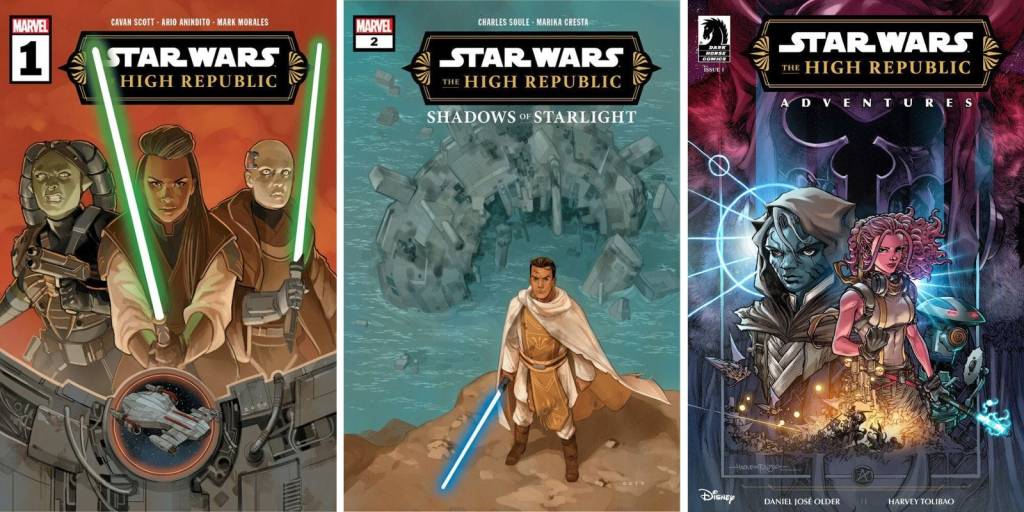
Phase III Star Wars: The High Republic Comics. Credit: Marvel & Dark Horse

Across the series, we have been introduced to many new and different Jedi. This relates to their species, type of lightsabre they use, and rank in the Jedi order, which is nothing new, since we were exposed to this with The Phantom Menace. However, the creators introduced something I believe I have never seen or heard of before: the way organisms feel, experience, and perceive the Force is different.

Albert Einstein explained with his theory of special relativity that there is no universal clock, so nobody experiences time the same way; we all experience time differently. This is much the same as how a lifeform experiences and perceives the Force, which will be different from everybody else. One Jedi experiences the Force as an ocean, another as music, and another as a forest. It was a cool concept.

We met new Jedi like OrbaLin, Burryaga Agaburry, Lily Tora-Asi, Sav Malagán, Ram Jomaram, Qort, Lula Talisola, Vernestra Rwoh, and Porter Engle, to name but a few. It was interesting to read about them in a novel, then discover them in a comic book, and vice versa. Star Wars: The High Republic also introduced lots of non-Jedi characters like Chancellor Lina Soh, Sevran Tarkin, Alys “Crash” Ongwa, Ty Yorrick, Tey Sirrek, Zeen Mrala, and Geode, along with many more.

The series was released in phases, which included the various media from January 2021 to June 2025. The main focus was the novels, with the comics, manga, and audio dramas still accessible to stand alone. The web series was released before the launch, so readers could understand the characters better and the time period.

With each phase, new content would slowly be released across, roughly 18 months, then go into hiatus, to reset for the new phase. Each phase was divided into Waves (1-3), which would include a novel, a young adult novel, and a middle-grade novel, so three books per wave meant nine books per phase.

Through the different phases, two main comic books were running, Star Wars: The High Republic from Marvel, and Star Wars: The High Republic Adventures, first released from IDW, then Dark Horse took over publication with Phase II.

Multiple comic book mini-series were also released through the three phases, along with one-shots, six manga, and three audio dramas (also available as scripts). The picture, art, and reference books were published near the end of each phase, but I could be wrong about that.

Phase I: Light of the Jedi was the first entry into the series, with nine novels. They set up the scene for the golden era of the Republic and the Jedi, which was about 150 years before A New Hope, where Jedi numbers were in their thousands. The Nihil, Drengir and their mischief-making were introduced across the phase.

Phase II: Quest of the Jedi was different for two reasons. The first reason was that the time period shifted, because we journeyed back another 100 years, before Phase I, to where the Outer Rim was still being explored. I think it was done to allow the readers to process the events of Phase I and to answer some questions that were raised. The other reason was that, instead of nine novels being released like in Phase I, only six were published in Phase II.

Phase III: Trials of the Jedi had another time jump and picked up the story one year after the events of Phase I. Some characters had died, and others grew through character development. I would like to add extra information to Phase III, but I can’t.

The thing is, even though Star Wars: The High Republic has finished, I have not finished reading Phase III. Nine books were published in this phase, and not counting the comic books and manga, I have only read the first four: Escape from Valo, The Eye of Darkness, Defy the Storm, and Temptation of the Force.

My local bookstore is still waiting for the paperback editions of Beware the Nameless, Tears of the Nameless, Into the Light, A Valiant Vow, and Trials of the Jedi, along with the script of the Tempest Breaker audio drama.

I have the final chapter in the series, the Marvel one-shot, Star Wars: The High Republic: Finale, waiting patiently to be read, only after the other six books have been located and read. It’s difficult because I really want to read it, but I’ve waited this long, so I can wait some more.

I’ve really enjoyed reading Star Wars: The High Republic. Meeting both old3 and new characters and travelling to new planets has been a thrilling experience. I’ve been eagerly waiting for a massive Star Wars project like this for over half my life.

The motivations behind the actions of characters, along with their visual designs, have been quite beneficial in the different media, which have allowed the creators to explore and showcase various characters in new ways.

A lot of them were complex, because as children, we were taught a person is either good or bad, but life isn’t as binary as that, with people having the potential for both good and bad. I thought it was a mature choice from the creators to reflect that.

As for reflection, I know a lot of people complained about the inclusion of many LGBTQIA+ characters in the stories. Personally, I found their complaints to be hilarious, because it’s a fact that not every Star Wars fan is a middle-aged straight white male.

As a business model, if you’re selling products involving fictional characters, you want any person, of any background, to be able to pick one of your products and to be able to see themselves in it. You want to cater to as many people as possible. Star Wars should be for anybody, not just the die-hard fans, because you want the next generation to fall in love with it, just like you did.

It’s also been clever not to have the Sith as the antagonists, because other factions hate the Jedi as well. They were hiding at the time, so why expose themselves? Because they do that in The Phantom Menace, after thousands of years of waiting, planning, and killing themselves.

I loved this series, but I have only two small disadvantages with it. The first is the cost, though that depends on how far you want to dive into the project. If you’re only interested in the novels, then the story will make sense. And if only comic books float your boat, then you can still enjoy the story as well.

However, if you’re anything like me, you would want to read as much as you can, to fully explore this time period, with novels and comic books, so it’s going to cost you. Though in saying that, you can take your time with the collection, so there’s no hurry.

The other point is probably criticism towards me rather than the series. Because there were so many characters, I sometimes found myself reading about a character that I couldn’t remember. I would have to stop, quickly research that character, curse myself for being stupid for forgetting them, then continue reading.

I hope the Star Wars franchise creates another multi-media project like The High Republic, because if they do, I’m there. When UMC1 and UMC2 are interested, the novels are waiting for them. Not the comics, though, that’s another discussion.

And with that, this overly bloated blog post is finished. Have you read any of the Star Wars: The High Republic or have any thoughts about it? As always, please let me know.

Thanks again for reading, following, and subscribing to Some Geek Told Me. Please remember to walk your dog, read a banned book, try to close a revolving door, and I’ll see you next week.

1 I believe the main High Republic story has finished, but some comics from Phase II are being released to expand upon this time period.

2 Yes, I know I have used “lightsabre” rather than “lightsaber.” I use British/New Zealand English, not American English, so I’m sorry, but not sorry.

3 I’m looking at you, Yoda.

The death of a pet: One year later

I’ve known this blog post was coming up, but I still wasn’t prepared for it. That sounds quite ridiculous, considering that, apart from the endless staff who work for me, I plan and write the awkward content that goes on here.

Even with the title, I’m going to give you some spoilers about this blog post. Today’s lecture will not be filled with rainbows, ponies and ice creams. I’m sorry, but it really won’t. So, I won’t be offended if it’s not for you, because it’s not even for me.

Over the weekend, it marked the first anniversary of the death of our dog, Indy. See, I told you this was not going to be fun. I’m not sure how I’m supposed to navigate my feelings and thoughts around this, so I need to turn back the clock first.

It’s important to note that Indy was my future wife’s dog before I met him. He was the runt of his litter, and my wife was present when he was born. A friend of hers owned Indy’s parents and planned to sell the puppies later on. My wife initially had no intention of adopting a puppy because her living situation wasn’t ideal for one.

However, fate had other ideas, because as the weeks passed, nobody wanted him because of his small stature. If nobody adopted him, then he might have been given to an animal charity centre. My wife didn’t want that to happen to him, so they chose each other.


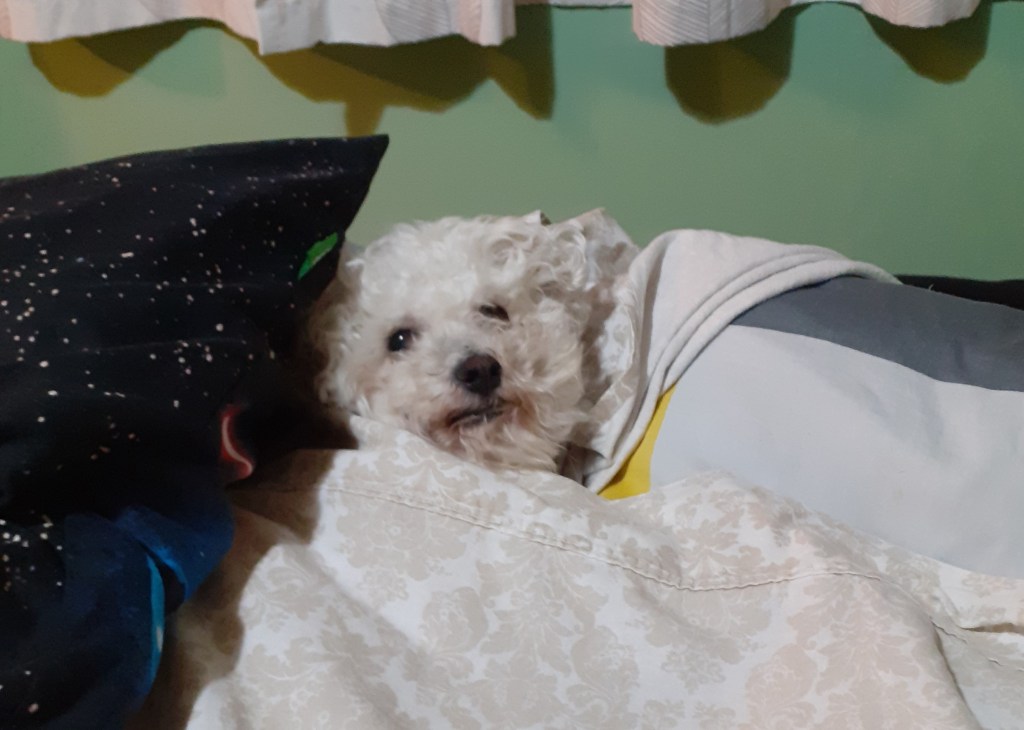
Indy looking fabulous at a Christmas party.

My wife and Indy became an inseparable pair, and six months later, they met me. And after many dates, the two of them asked me to join their team. Sometime later, it became official with a wedding. The interesting thing about me before I met Indy and my future wife was that I was mourning our family dog, Jack.

I was living in another city when Jack got very ill and died. I felt disconnected from that event, and I took his death really hard. During this grieving period, I purposely avoided petting or playing with dogs. It didn’t even matter that they were my friends’ dogs; I just didn’t want to touch them. It felt wrong to do that, so I avoided being around them.

As I mentioned previously, fate had other ideas. When I met my future wife for our first date, she brought Indy to keep her company. She later said that Indy was her measuring stick for her dates: if Indy didn’t like the date, or if the date didn’t like him, there would be no second date.

I knew she had brought her dog with her, but I had not fully processed what that would mean. As I sat down and tried to act like a normal single male with a beautiful woman, I needed to come to terms with the fact that there was a dog, who was begging for some pats and belly rubs. I discovered that I couldn’t say no to him.

It was weeks later that my future wife informed me that the reason we had a second date, was because I was kind to Indy and that he liked me. I had no idea that the course of my life was going to depend on whether a dog liked me or not.

The more time I spent around Indy, the more it revealed a few things about myself that were a surprise. The obvious point was that I had to acknowledge that I missed having a dog in my life.

What I didn’t realise at the time was that Indy was helping me heal the hole in my heart left by Jack’s death. He also helped me understand that being part of a team with a beautiful woman wasn’t a daunting idea. I wasn’t as frightened as I thought I would be. This little dog saved me in ways I didn’t realise I needed saving.


Indy claiming his spot in our bed.

So, let’s get back to the title of the blog. It’s been one year since Indy died, so what has life been like? I guess it depends on how honest I want to be. I would be lying if I said that it has been easy, with the first two months being pretty rough.

I know people grieve in different ways, because we are all different. But how does someone grieve and mourn for a pet? What’s the best way to do this? Having said that, I’m not sure how to explain things, but I’ll give it a go.

We have encouraged UMC1 and UMC2 to discuss Indy when they wanted to, whether to talk about his misadventures or just to state the fact that they miss him. UMC2 talks about him more than UMC1, but I know they both miss and love him.

For myself, I’m content to talk about him, but it heavily relies on the context of the discussion. Sometimes I can joke about him and retell stories, but other times, I still have to leave the room after talking about him.

I suppose the grief is always sitting there, just under the skin, and all it takes is a small scratch to reveal it. I’m left thinking, “Wow, where did that reaction come from?” I also know that he’s been gone for a year, but I still catch myself doing things, mainly out of habit.

  • When my wife picks me up from work, I have to stop myself from asking how Indy’s day has been.
  • When calling my wife from work, I have to stop myself from asking how Indy’s day has been.
  • I find myself wanting to check the bed before sitting on it, so I don’t hurt Indy.

We miss and love Indy, and he loved us. So what do you do with the leftover love? UMC1 and UMC2 would like to get another dog soon; however, my wife and I are not ready for that. We want to be, just not yet.

I remember reading somewhere that not loving another pet after a pet’s death is a sin. There are so many pets out there that need loving families to take care of them, and we will do that again, just not yet. My wife is worried she would compare the new dog to Indy, and that wouldn’t be fair to the new dog. As for me, I guess I have more healing to be done.


Indy catching up on some well deserved rest.

It was awkward going to Indy’s favourite places around town, but this has been getting better. We were at the beach the other day, when UMC2 pointed to a dog and stated that the dog looked like Indy’s clone. That caught me by surprise, but he wasn’t angry or sad about it; it was just an observation.

Something that has shocked me has been my ability to talk to and hug other dogs. After Jack died, I isolated my heart from dogs and avoided being around them. After Indy’s death, I didn’t want to make the same mistake, so I decided that when I would meet a dog, I would give it lots of pats and hugs. It’s not their fault, they want to get some attention from a faulty human.

This has been great because it’s allowed me to discuss the dog with the owner. Sometimes Indy comes up in conversations, and sometimes he doesn’t. It’s been helpful.

We have photos of Indy around the house, and I have photos of Indy and Jack, next to each other, on my desk. The dogs never met in life, but part of me hopes they have met in the afterlife.

This blog post is ultimately not as good as I had hoped it would be, as I have stopped several times to think about him and let the experience wash over me. The more I think about Indy, the more I have to write. But the more I write about him, the more I have to stop and compose myself.

Indy was a fucking good dog, not just to me, the boys and my wife, but to everybody. He changed my life, and as long as we continue to talk about his misadventures, our memories and love for him will never be gone.

I’m done now. Thank you for continuing to read, follow, and subscribe to Some Geek Told Me. If you have a pet, please do me a favour and hug them. I’ll see you next week for the return of We Didn’t Start the Fire.


San Diego Comic-Con 2025: What did we discover?

So this is San Diego
And what have you done?
Another Comic-Con over
And a new one just begun
And so this is San Diego
I hope you had fun
The geek and the nerdy ones
The boomers and your mum.

Can you believe that San Diego Comic-Con has already checked into the hotel, trashed the bed, glued the furniture to the ceiling, drank all of the mini-bottles, and left again?! It’s amazing that the largest geek-laden event on the planet has been and gone for another year, but this means we get to discuss it!

Before we push on further, with what will be another pulsating lecture by yours truly, let’s establish what in the Nine Circles of Dante’s Hell I’m talking about. I’ve mentioned this before, so why mess with success!

San Diego Comic-Con is an opportunity for some of the world’s leading entertainment companies to showcase their upcoming products, including toys, anime, computer games, manga, books, comics, movies, and TV shows, to the ticket-paying fans and the rest of the world.

One day I’ll get to go there. I’ll probably have to sell a kidney and take out a second mortgage, but I’ll get there one day.

I can only imagine that you can get anything you need at San Diego Comic-Con: t-shirts, back issues, DVDs, action figures, books, and information. A lot of information. After reviewing the numerous announcements that I could find, I have selected a few that caught my interest. Even George Lucas made an appearance!

Sadly, just like a mogwai, there are some rules with something that I have written.

1.) I have not read or seen every article or trailer released from San Diego Comic-Con. I can only discuss the things I know of, but also things I’m interested in.
2.) Just because a product is on my list doesn’t mean I’ll get to see or purchase it. Quite simply, if something has landed on this list, it has my attention, regardless of whether I watch or purchase it.
3.) I have included some information and trailers that were released just before San Diego Comic-Con. This is because I’m the lead writer on this venture, so what I say goes.
And with that, let us be entertained by franchises and companies fighting each other for our hard-earned money!


Credit: San Diego Comic-Con

Literature: (Books and Comics)

This year, this section is quite sparse for me. All of the Star Wars: The High Republic books have been released, but I have not read all of them yet. As for the comics, there were a lot of interesting announcements, namely Ultimate Endgame, but also that Absolute Wonder Woman won the Eisner award for the Best New Series, by Kelly Thompson and Hayden Sherman.

The four main announcements that I am definitely going to find are:

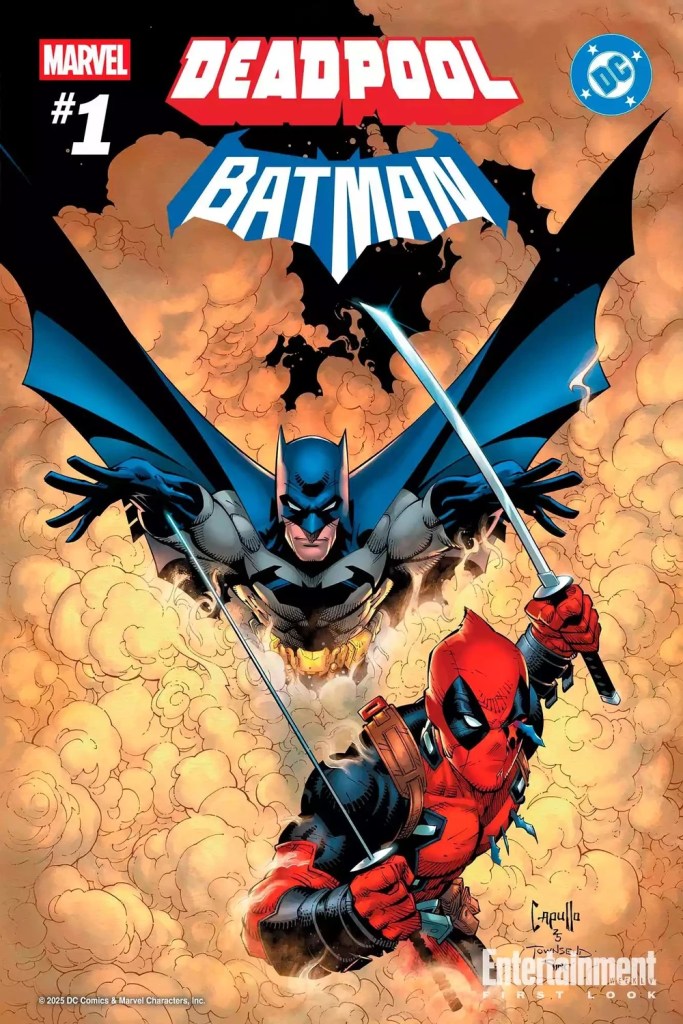
Deadpool/Batman #1 (From Marvel)

Credit: Marvel/DC

Batman/Deadpool #1 (From DC)

Credit: DC/Marvel

Absolute Batman 2025 Annual #1

Credit: DC

Absolute Evil #1

Credit: DC

(Yes, I’m still a sucker for the Absolute Universe. The titles are nailing the characters, they are superb.)

Movies:

Spinal Tap II: The End Continues

This is Spinal Tap is one of my favourite films, as it’s chock-full of comedy gold and gems. It came out in 1984, so I thought the time for a sequel to the film was dead and gone. Imagine my surprise when I saw the trailer for Spinal Tap II: The End Continues!

I never knew about the existence of this film, so I will definitely be watching that. It’s made me search for the original to watch it again. The premise of the film is that the band had broken up, but they are reuniting for a one-night-only show. You can dial that to 11.

Predator: Badlands

I’ve seen Prey, and I thought it was a positive chapter in the Predator franchise. As for Predator: Killer of Killers, I have not seen it, so I can’t comment about it. In saying that, Predator: Badlands looks intriguing for two major reasons.

The first reason is that the writer and director of Prey and Predator: Killer of Killers, Dan Trachtenberg, is back behind the camera for the next Predator instalment. Like I said before, even though I haven’t seen Predator: Killer of Killers, Prey was enough for me to respect Trachtenberg’s vision for the films.

The second reason is that it appears Predator: Badlands is blending Predator with Aliens concepts, namely a synthetic created by the Weyland-Yutani Corporation. Is Predator: Badlands offering us a soft reboot of Aliens vs. Predator, or is it going somewhere else? I don’t know, but I want to find out.

The Long Walk

I’ve read a lot of Stephen King books, but I have not read all of them, and The Long Walk is one of them, I’m ashamed to admit. I understand that The Long Walk is based on the book, though how faithful it is to the source material, I can’t answer that question.

The concept seems simple. Wikipedia states that, “In a dystopian United States ruled by a totalitarian regime, a group of young men enter an annual walking contest in which they must maintain a speed of at least three miles per hour or risk execution. The contest ends when only one walker remains alive.”

I’ve been a King fan since before Pennywise and Maturin emerged from the Void, or Roland Deschain’s first turning of the wheel. At some point, I will be watching The Long Walk.

Television shows:

Peacemaker: Season 2

I’ve said this before, but Peacemaker had no reason or right to be as good as it was. It was brutal, hilarious, and creative, all at the same time. Essentially, what I’m saying is that I thoroughly enjoyed it. So, my expectations for the second season have increased.

John Cena had a cameo as Peacemaker in Superman, and from what I understand, the show is set after the events of the film. It will also explore the ramifications of Christopher Smith (Cena) killing Colonel Rick Flag Jr in The Suicide Squad. If the new season is as funny as the first, it will be great!

Alien: Earth

Alien: Romulus was a hit last year, but this is the first time the Alien franchise has dipped its toes into the world of television. On paper, Alien: Earth sounds and looks interesting; a spaceship crashes on Earth, carrying some nasty human-killing creatures, including the Xenomorphs.

It looks creepy as hell, and the set designs are impressive. I could be wrong about this, but this is the first time in canon that Xenomorphs have reached Earth, and it’s going to be horrific, but only in a good way. If only I’m brave enough to watch it.

IT: Welcome to Derry

I’ve been fortunate enough to have read the novel, seen the mini-series, and both movies, so IT: Welcome to Derry will not be an unknown concept to me. From what I understand, Bill Skarsgård is back as everybody’s favourite human-eating clown-entity, Pennywise, as well as having Andy Muschietti attached to the project.

Apparently, the show is set in 1962, which makes it a prequel to the two movies. Since it’s based on work from Stephen King, we can only imagine we may have cameos from other characters. I’ll watch with one eye open.

The Legend of Vox Machina: Season 4 

My wife got me into Critical Role’s The Legend of Vox Machina, as it was something we both enjoyed watching together. I know next to nothing about the upcoming season, so I’m happy for it to be a surprise. Though it wouldn’t be nice for Grog to have a love interest! Imagine the carnage!

The Mighty Nein

And speaking of Critical Role, the Mighty Nein (or The Sensual Seven?) will be released later this year. I believe the show is set 20 years after The Legend of Vox Machina, as it’s on the same world, just a different continent.

If The Legend of Vox Machina is any gauge, then my wife and I will have to watch The Mighty Nein together.

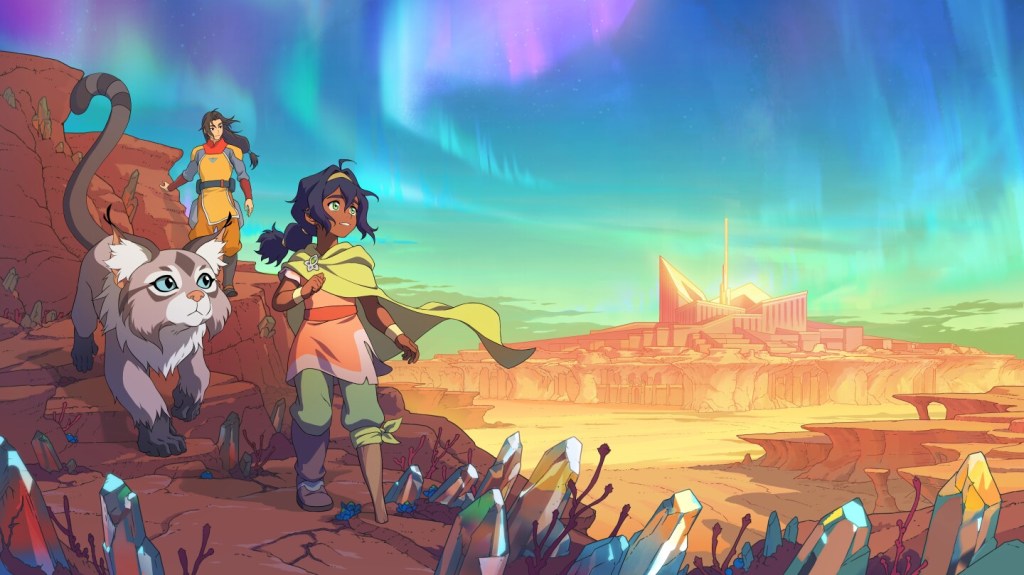
Avatar: Seven Havens

To the best of my knowledge, there was no trailer for Avatar: Seven Havens, but Nickelodeon released an image from the show. The story is set after The Legend of Korra, with the new Avatar, who is an earthbender.

The world of Avatar: The Last Airbender still has some surprises and adventures for us to explore, and I can’t wait for UMC1 and UMC2 to experience them as well.

Courtesy of Nickelodeon

Like I said previously, I didn’t catch all of the news, so maybe I missed some important news. What announcements from San Diego Comic-Con were you interested in? As always, please let me know.

Alright, that’s another blog, for another week. Remember to walk your dog, read a banned book, speak out against the Palestinian genocide, and I’ll see you next week for the overdue return of the Solar System’s worst tour!