We Didn’t Start the Fire: 1953

That’s right, ladies and gentlemen, one of the world’s worst ideas is back for another month. No, it’s not Some Geek Told Me’s The Tour of the Solar System. That hurt by the way. It’s Some Geek Told Mes We Didn’t Start the Fire’s historical references.

If you missed the previous entries of this colossal mistake, they include:

I’ve been behind with writing the 1953 references to Billy Joel’s song, because the weather here has been terrible, and I’ve been trying to stay dry and warm in winter, so I’m fighting a losing battle.

Anyway, without any more time wasting; because that’s a striker’s or centre forward’s job, let’s dissect the We Didn’t Start the Fire’s historical references for 1953.

Can’t wait.

Credit: Tavern Trove/Jacob Ruppert, Inc.

1953

Joseph Stalin:

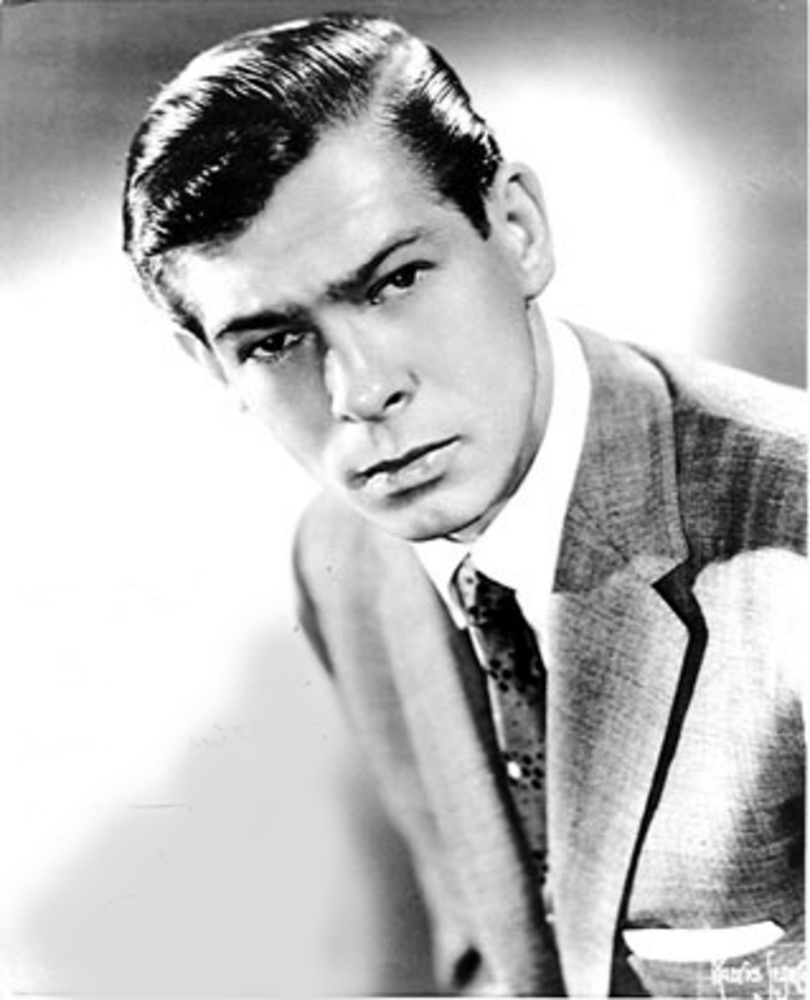
This entry on the list is not one of the most well-liked people who have ever lived. Born Joseph Vissarionovich Stalin, though known to the world as Stalin, was the brutal ruler of the Soviet Union from 1924-1953.

Stalin is a contentious figure in world history. He helped bring about the end of Adolf Hitler and the Third Reich, with the Soviet Union accounting for between 20-27 million people killed during the Second World War, the greatest death toll from any country. The bulk of these deaths came from fighting Nazi Germany.

However, before the war started, Stalin signed a non-aggression pact known as the Molotov–Ribbentrop Pact with Hitler. The pact was a plan for Nazi Germany and the Soviet Union to carve up Europe for themselves. And just like every villain team-up ever, there was betrayal when Nazi Germany invaded the Soviet Union in 1941, breaking the pact.

Viewed and regarded in the same shitty category as Hitler, Stalin seemed to look at Hitler’s crimes against humanity and said, “Hold my vodka.”

Through his leadership and regime known as Stalinism, some of Stalin’s crimes include, but not all: creating the Gulag system; the Great Famine; Collectivization, Dekulakization and Special Settlements; the Great Purge; Order No. 227; punishing Soviet prisoners of war; and refusing to punish Soviet soldiers’ war crimes.

Stalin’s direct actions like imprisonment and executions, but also his negligence, paranoia, and incompetency, caused the deaths of between 7-20 million Soviet citizens. When he died on 5th March 1953, people worldwide celebrated, after he was in power for 29 years.

Credit: The New York Times

Malenkov:

After Stalin died, there was a power vacuum that many people were trying to fill. The (un)lucky winner of that contest was Georgy Malenkov. Things did not go easily for Malenkov, because only after one week as leader, he was forced to give up control of the Communist Party of the Soviet Union.

After some time, Malenkov and Nikita Khrushchev, the party’s First Secretary, entered a power struggle over the leadership of the Soviet Union. History tells us that Malenkov lost and was removed from power, with Khrushchev becoming the new leader. Malenkov lasted only 186 days in power.

A modern equivalent would be Ex-British Prime Minister, Liz Truss, who only lasted 50 days as leader and failed to outlast a lettuce.

Official portrait of Georgy Malenkov, 1953. Credit: Dutch National Archives.

Nasser:

Nasser refers to Gamal Abdel Nasser Hussein, otherwise known as Gamal Abdel Nasser. Nasser was an Egyptian army officer, who along with Mohamed Naguib, led the 1952 Egyptian revolution, against the United Kingdom, and deposed the monarch, King Farouk I.

In 1953, Egypt was declared a republic, with Naguib becoming Egypt’s first president. Eventually, Nasser placed Naguib under house arrest and became the de facto leader of Egypt, until his election in 1956. He served as Egypt’s second president until he died in 1970.

In contemporary times, we only need to look at Venezuela’s Nicolás Maduro, Hungary’s Viktor Orbán, Cuba’s Raúl Castro, or Eritrea’s Isaias Afwerki.

President Gamal Abdul Nasser in Cairo. (Keystone / Getty Images)

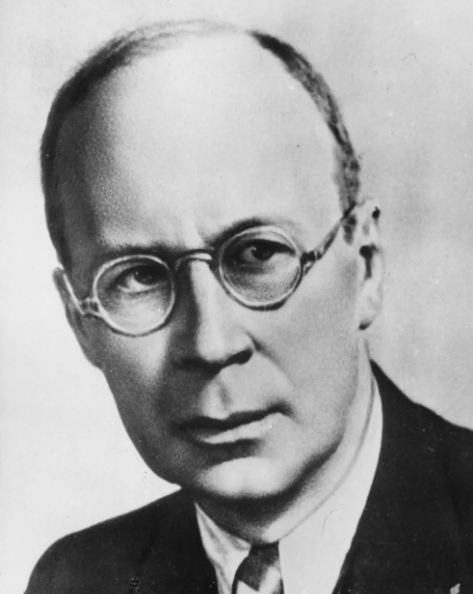
Prokofiev:

On 5th March 1953, (the same day Stalin died) Russian composer Sergei Prokofiev died at the age of 61. He had composed seven operas, seven symphonies, eight ballets, five piano concertos, two violin concertos, a cello concerto, a symphony concerto for cello and orchestra, and nine completed piano sonatas.

Some of his most beloved works were The Love for Three Oranges, the suite Lieutenant Kijé, the ballet Romeo and Juliet, and the eternal favourite, Peter and the Wolf.

For a modern composer, well, I don’t want to start a fight with anybody. If you want to choose someone for yourself, be my guest because we are blessed to live in a world full of amazing composers, and to choose one over another seems criminal, at least to me.

However, my wife added that John Williams is the cat’s pyjamas.

Sergei Prokofiev. Credit: Keystone/Hulton Archive/Getty Images

Rockefeller:

Winthrop and Barbara Rockefeller were married on 14th February 1948. Winthrop was part of the wealthy and famous Rockefeller dynasty, being John D. Rockefeller’s grandson, and John D. Rockefeller Jr.’s son. Not to be outdone, Barbara was also a successful Hollywood actress. Barbara gave birth to their son, Winthrop Paul “Win” Rockefeller, on 17th September 1948.

Fast forward to two years later, the happy couple were estranged. By 1953, divorce proceedings had started, with both parties haggling over a settlement. This was a very publicised celebrity divorce and was a constant story in the news cycle. By 1954, they had finally divorced, with Barbara receiving a $5.5 million settlement, which was a record for the time.

Three of the biggest publicised celebrity divorces in recent times would be Brad Pitt and Angelina Jolie; Ye (Kanye West) and Kim Kardashian; and Johnny Depp and Amber Heard. There are others, but come on, I need to sleep.

Winthrop Rockefeller and Barbara Sears Rockefeller walk together at the wedding, 1948. Credit: University of Arkansas at Little Rock Center for Arkansas History and Culture

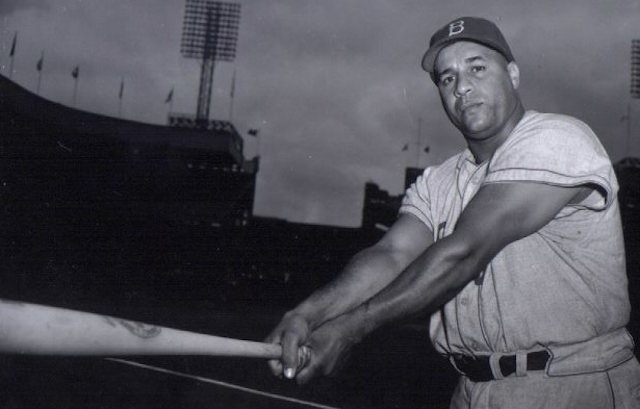
Campanella

Making the 1953 list is our first and only sportsperson, Roy Campanella. Campanella was a baseball player, who mainly played as a catcher. He started his Major League Baseball career in 1948, when he played for the Brooklyn Dodgers, until his early retirement in 1957 from a car accident.

In 1953, Campanella won the National League’s Most Valuable Player Award for the second time, after winning it in 1951, and for a third time in 1955. Campanella won the World Series in 1955 and was also inducted into the Baseball Hall of Fame in 1969.

Selecting a contemporary equivalent is difficult for me because even though I follow baseball to a certain extent, I don’t know it well enough to choose a player. I’m a rugby, cricket, football, and rugby league supporter, so baseball is not really in my wheelhouse. However, any followers and subscribers of New Zealand’s 5th least favourite website, who are also baseball fans, please let me know your opinions on the matter.

Roy Campanella. Credit: Dodger Blue

Communist Bloc:  

You may recall that during the 1950s, the Cold War had started, and 1953 was a flashpoint for Europe. “The Communist Bloc” refers to the Eastern Bloc, or the Soviet Bloc; which was a term given to the countries that were Communist states.

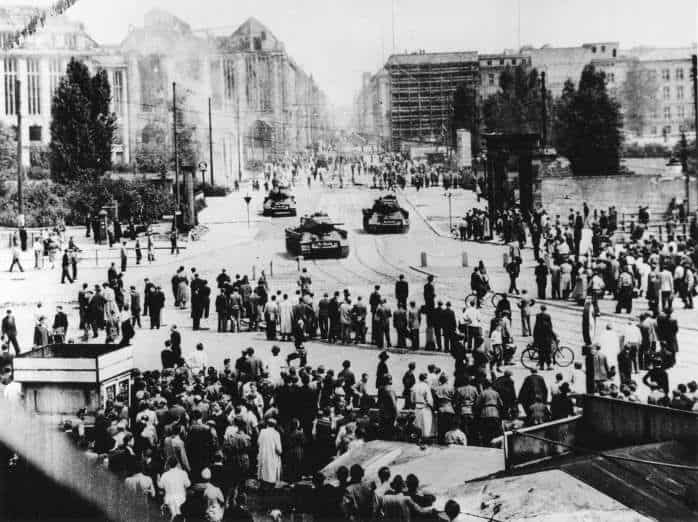
In the case of the song, we are looking at the 1953 East German uprising. This happened when construction workers rose in protest against government demands to increase productivity. The protests soon spread across East Germany, with people starting to demand better living standards and resisting the Sovietization way of life in East Germany.

At the height of the protests, one million people were on the streets, demanding more from the ruling government and the Socialist Unity Party. The main protest lasted only about two days before The Kasernierte Volkspolizei (a militarised police force) and Soviet forces rolled in and violently crushed the protests with tank support.

This was only three months after Stalin’s death, so the government wanted to stop the protests as quickly as possible. At least 125 people were killed during the crackdown.

A modern example of the 1953 East German Uprising; even though it’s not that modern, would be the 1989 Tiananmen Square protests and massacre.

Soviet tanks in East Berlin broke up the crowds, and mass arrests followed in their wake. Credit: Pinterest

So for 1953, we covered a dictator’s death and his successor’s removal, an Egyptian political icon, a composer’s death, a celebrity divorce, a baseball player, and a failed uprising. 1953 was busy, but wait until we discuss 1954! Wow!

So, that’s it for another week. Thanks again for reading, following, and subscribing to Some Geek Told Me. Please remember to walk your dog, read a banned book, watch the Paralympics Games1 and I’ll see you next week, when we check in on the Coalition of Chaos.


1 Seriously, go and watch the Paralympics Games. They deserve all the attention and support.

We Didn’t Start the Fire: 1952

We are deep into winter at the moment, so what better way to bring some light into the world than to revisit events from 72 years ago, inspired by a 35-year-old song? Yes, it’s that time again for Some Geek Told Me to take a look at We Didn’t Start the Fire.

Previous entries on this terrible series have been:

Surprisingly, Beetroot Awareness Aotearoa issued no statement about last month’s post, concerning 1951. Maybe they were too busy being knee-deep in beetroot to notice; though honestly, that sounds like a nightmare to me.

Before we start, 1952 is another special year for me, because that’s when my mother was born. So, without further fanfare, let’s give the non-ticket-paying audience what they want, and dive into We Didn’t Start the Fire’s historic references for 1952.


Credit: Chas Judd Ltd

1952

Eisenhower:

Dwight D. Eisenhower was the Supreme Commander of the Allied Expeditionary Force, during the Second World War, but that’s not why he’s on the list. In 1952, Eisenhower ran as the Republican nominee in the US Presidential election, against Illinois Governor Adlai Stevenson II.

In a landslide victory, Eisenhower won the presidency with 442 electoral votes to 89, becoming the 34th President of the United States of America. Some other recent landslide victories include Ronald Reagan, who won in 1980 with 489 electoral votes, and in 1984 with 525 electoral votes, as well as George H. W. Bush in 1988 with 426 electoral votes.

An official portrait of Dwight D. Eisenhower. Credit: Eisenhower Presidential Library

Vaccine:

This particular case highlights the incredible potential of humanity. Polio is a highly contagious infectious disease that can cause paralysis and even death, especially in children worldwide. In the 20th century, polio killed millions of people each year and became one of the most feared diseases.

A polio vaccine had been in development for several years, but it wasn’t until virologist and biomedical scientist, Jonas Salk and a team of researchers, developed the first effective one in 1952. By the end of the decade, the Salk vaccine had reached about 90 countries.

The legacy of Salk’s vaccine is that it has helped to eliminate polio from the majority of the world, saving millions of lives each year. Unlike smallpox, polio is not eradicated yet, but both IPV and OPV vaccines are helping to achieve that goal.

Credit: Yousuf Karsh

England’s got a new Queen: 

Some of the references in We Didn’t Start the Fire need some explanation and context. Others, like our next one, don’t.

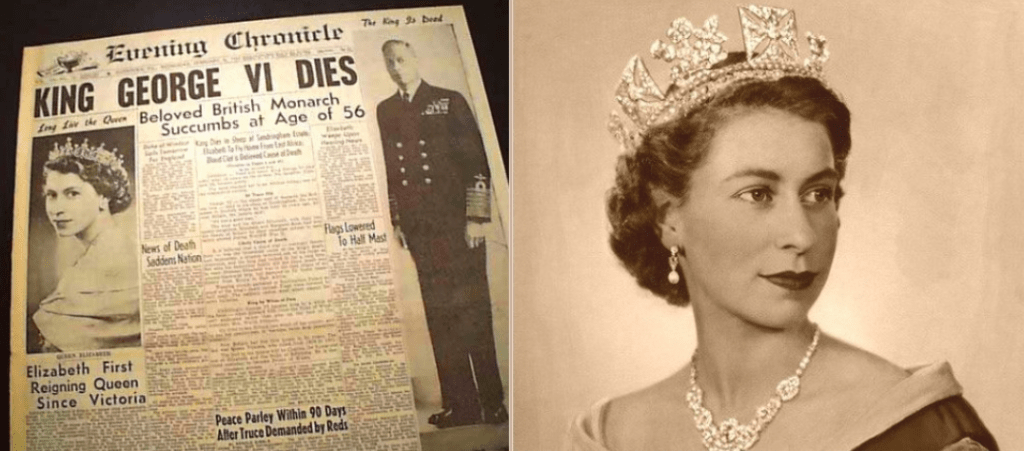
England’s got a new Queen, is exactly what you think it’s about. On 6th February 1952, 56-year-old King George VI of the United Kingdom and the Dominions of the British Commonwealth died, leaving his 25-year-old daughter, Elizabeth as the monarch. Although Elizabeth was coronated in 1953, she became Queen Elizabeth II when her father died.

The obvious equivalent for this was when on 8th September 2022, Queen Elizabeth II died at 96 years old, having reigned for 70 years. Her son, Charles, Prince of Wales, became King Charles III, with his coronation in 2023.

Credit: Evening Chronicle

Marciano:

Rocco Francis Marchegiano, otherwise known as Rocky Marciano, was a professional boxer in the heavyweight division. On 23rd September 1952, Marciano fought a title match against World Heavyweight Champion, Jersey Joe Walcott. Marciano knocked Walcott out, to become the new heavyweight champion of the world.

Marciano went on to hold the title from 1952 until 1956 when he retired from boxing at 32 years old. Marciano had 49 fights, with 49 wins, and 43 by knockouts; which included six title defence fights. He remains the only heavyweight champion to finish his career undefeated. Marciano died in a plane crash in 1969.

For modern times, there is a collection of boxers that we could compare to Marciano, but ultimately I won’t. I mean, why would you?

Liberace:

One of the great American TV entertainers was born Władziu Valentino Liberace, though he became known as just Liberace. He was a pianist, singer, actor and showman. In 1952, he was given a 15-minute network television programme, called The Liberace Show. The show displayed his many different abilities, and it quickly grew in popularity, along with Liberace.

The show ran from 1952-1969 and was made famous for the costumes, productions, performances, and Liberace’s flamboyance. The legacy of The Liberace Show was the promotion of musical variety shows, but also the creation an international cultural icon.

Santayana goodbye:

On 26th September 1952, Jorge Agustín Nicolás Ruiz de Santayana y Borrás, died aged 88. George Santayana, as he became known in English, was a famous essayist, novelist, philosopher, and poet. In academic circles, Santayana was a pillar of 20th-century thinking and coined the immortal phrase:

“Those who cannot remember the past are condemned to repeat it.”

Santayana was beloved around the world for his work and helped usher in a new understanding of the human condition. For a modern equivalent, I’m going out on a limb, but I would name Carl Sagan, but to each their own.

Credit: Harvard Square Library

So for 1952, we covered a US President, the polio vaccine, a British queen, a boxer, a music variety show, and a philosopher. That’s not bad at all, so I’ll be covering 1953 next time if you didn’t guess.

So, that’s it for another week. Thanks again for reading, following, and subscribing to Some Geek Told Me. Please remember to walk your dog, read a banned book, pat a goose, and I’ll see you next week. Look after yourself until I return.


Featured

Larry the Chief Mouser to the Cabinet Office

My Mid-Winter break is over, so the staff at Some Geek Told Me have purchased new handcuffs and chained me to my desk, with the intent of releasing me around Christmas time. Aren’t they kind and thoughtful?

Since I’m back in my writer’s chair, what insightful content will I discuss? World Peace? Cure for cancer? New climate change initiatives? New element discovered on the Periodic Table? Even though they would be great, it’s no to all of them.

In today’s rant, I want to talk about a cat named Larry. He’s arguably one of the most photographed cats on the planet. I find it interesting that his name is Larry, because that’s a pretty boss move! But there’s a small detail I need to share about Larry. To explain this, I’ll need to talk about the recent general election in the United Kingdom. These topics might seem unrelated, but trust me, they’re connected!

British politics is similar to New Zealand politics, with the fact there are many different parties in parliament, which can give rise to coalition governments, just like our current one.

Last Thursday, after being in power for 14 years, Rishi Sunak’s Conservative Party suffered its worst defeat ever. Out of a possible 650 parliamentary seats, they only won 121 seats; losing 252 Members of Parliament. It was an armageddon level event for the Tories.1

Their rivals, the Labour Party, achieved a majority of 326 seats in the House of Commons, winning 412 seats, and gaining 214 new seats. Their leader, Sir Keir Starmer, has now become Prime Minister of the United Kingdom of Great Britain and Northern Ireland, and one of the perks of being the British Prime Minister is living at the famous address, 10 Downing Street.


Larry the Cat in a Union flag bow-tie in the Cabinet Room at 10 Downing Street on April 28, 2011.
Credit: James Glossop/WPA Pool/Getty Images

We can now bring it back to Larry because his residence is also at 10 Downing Street. Larry’s official title is Chief Mouser to the Cabinet Office, an inaugural title that was given to him; however other cats have been employed by the British government, going back to the 16th century with Cardinal Thomas Wolsey, as well as the first official mouser in 1929.

Larry is a tabby cat, born a stray around 2007; making him 17 years old. He was adopted in 2011 from an animal rescue centre, by Dowling St staff, for his hunting and mousing skills. Because of this, Larry does not belong to the UK Prime Minister, since he’s a civil servant. To put this in context, when a Prime Minister needs to leave 10 Downing Street, they can’t take Larry with them.

This has led to Larry living with, and outlasting five prime ministers; David Cameron, Theresa May, Boris Johnson, Liz Truss, and now Rishi Sunak. His new housemate is, of course, Sir Keir Starmer.


Larry, outside his home at 10 Downing St.
Credit: Chris J Ratcliffe, Getty Images

If Larry is a civil servant, what are his responsibilities?

According to The Downing Street website, his responsibilities include:

  • Greeting guests to the house.
  • Inspecting security defences.
  • Testing antique furniture for napping quality.
  • Contemplating solutions to the mouse occupancy of the house.

The employment of Larry is not paid for through taxpayers’ money, but rather funded voluntarily by members of Downing St staff.


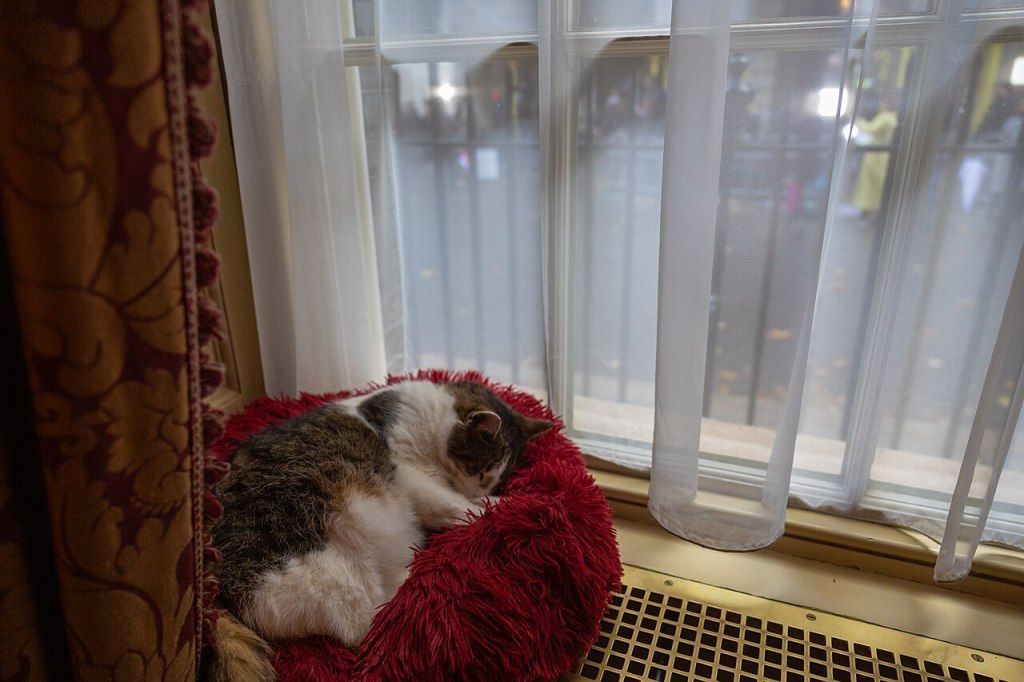
Larry sleeping in the window of 10 Downing Street. Credit: Simon Walker 

Over the years, Larry has built a reputation as a great mouser, with several confirmed kills; but it hasn’t gone all to plan.

  • In 2011, the increasing mice population at Downing St, drove Prime Minister David Cameron to throw a fork at one.
  • Larry had earned the moniker, Lazy Larry, from the media.
  • In 2012, Larry was spending more time sleeping, than hunting for mice, as well as hanging out with a female cat named Maisie.
  • Displeased his Larry’s work, an extra Chief Mouser, named Freya was employed in 2012, at 11 Downing St.

Larry is a busy and famous cat, which has created some tension with other animals. Firstly, there was Freya, who moved in next door, and they tolerated each other. In 2014, Freya moved away, forcing Larry to go back to being the sole Chief Mouser.

In 2020, Larry stalked and attacked a pigeon, but for unknown reasons, the bird escaped unharmed.

In 2022, Larry confronted a fox outside 10 Downing and chased it away.


The brutal fight between Larry and Palmerston. Credit: Steve Beck

Sir Keir Starmer has brought his family cat, JoJo to 10 Downing St, so the world will have to wait and see what happens with Larry, and his new housemate.

I must mention Larry’s rivalry with Palmerston. As the Chief Mouser for the Foreign Office, Palmerston and Larry were frenemies who had fought each other numerous times. In 2016, Palmerston even entered 10 Downing Street and had to be evicted by staff.

However, one of their best/worst fights was outside 10 Downing St’s door, which was recorded by Steve Beck, a political photographer. The brutal fight resulted in Larry losing his collar, and Palmerston receiving a badly cut ear and several deep scratches.


Larry has become a beloved icon to the British public, having photobombed politicians, paraded in front of the world’s media, and forced police officers to help him inside his home. Larry also has an unofficial social media accounts on Twitter and Mastodon.

Larry is a hard-working cat that faces daily pressure from being Chief Mouser to the Cabinet Office. I mean, not every cat could handle the responsibilities. Keep it up Larry, you’re amazing!

That’s it for me. Congratulations to the UK Labour Party, but also Ensemble and New Popular Front, from the French election. I was expecting the former, but the latter was a pleasant shock.

Thank you for reading, following, and subscribing to Some Geek Told Me. Please don’t forget to walk your dog, read a banned book, watch the Copa América and Euro Football Championships semi-finals, and I’ll see you next week.


1 I know you can’t tell, but I haven’t stopped smiling over this.

An Ode to 34

Trump.

Trump, Trump, Trump, Trump, Trump, Trump, Trump, Trump, Trump, Trump, Trump, Trump, Trump!

Even here in the South Pacific, there seems to be no escaping from Donald Trump. He’s here, he’s there, he’s in every courtroom, Donald Trump, Donald Trump!

Over the years, I’ve developed two vices that I’m ashamed to admit. I enjoy watching Panda Fail videos; basically, pandas failing at being pandas, but also watching billionaires complain. I can’t get enough of both of them. This awful transition brings us to Donald Trump’s recent trial.

It’s difficult to believe that the star of Home Alone 2: Lost in New York, the founder of Trump University, and the winner of the 2024 Trump International Golf Club Most Improved Player award, was found guilty on 34 felony counts of falsifying business records to make hush money payments to a porn star, in an effort to make it appear as legitimate business expenses.

I was as shocked as you were. I mean, someone at the centre of over 4,000 legal cases, involving sexual harassment, sexual assault, personal defamation lawsuits, tax disputes, real estate lawsuits, and many more, couldn’t possibly be involved with lawlessness. The whole concept is very sad.

However, a jury of 12 of Trump’s peers, found him guilty of 34 felony counts, with sentencing to happen on 11th July 2024.


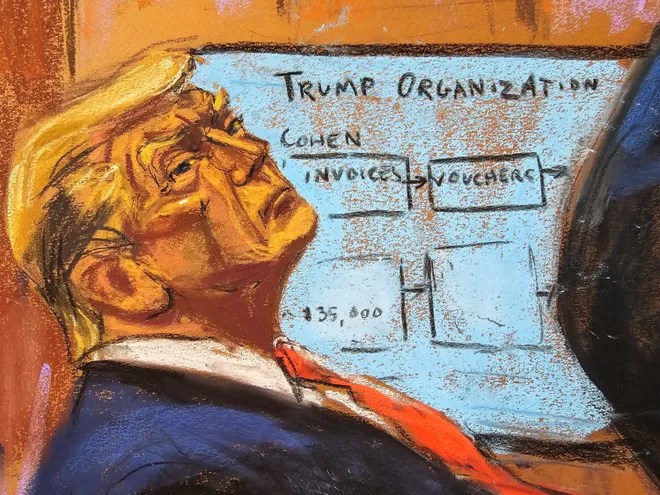
Former U.S President Donald Trump listens as defence lawyer Todd Blanche presents closing arguments during Trump’s criminal trial on charges that he falsified business records to conceal money paid to silence porn star Stormy Daniels in 2016, in Manhattan state court in New York City. 28th May 2024 in this courtroom sketch. Credit: Jane Rosenburg/Reuters.

I’m not here to discuss in detail the trial because I’m not a legal expert. I have enough trouble remembering what I said to my children last night, let alone explaining a court case. No, what I’m here to comment on is the reaction to Trump’s conviction, mainly through entertainment.

As I’m getting older, I’m finding that I prefer to experience satirical news a lot more than I did before, thanks to Trump. So because of this, may I present the best reactions to Trump’s conviction, whether it’s monologues or songs. Oh, I forgot, the last video isn’t a response to his conviction, but it ties it in quite nicely.


I love listening to billionaires complaining that life is unfair, and watching Trump’s reaction to his conviction has been hilarious. Like I said before, I do feel ashamed about this.

What’s been the best reaction or response to Trump’s conviction? As always, please let me know. I’m feeling better again, so I’m ready to be infected with a child’s new illness. Good times.

Thanks again for reading, following, and subscribing to Some Geek Told Me. Don’t forget to walk your dog, read a banned book, watch the T20 World Cricket Cup, and I’ll see you next week because the Tour of the Solar System is painfully marching forward again. Awesome.


We Didn’t Start the Fire: 1951

When it comes to making terrible ideas, this blog has had some crackers over the last few years. However, the concept of talking about the historical references from a song that came out in 1989; after multiple people have already done it, ranks quite high on that list.

My previous entries in this terrible endeavour include:

Beetroot Awareness Aotearoa seem to have a bee in the bonnet about this, because their press release about my We Didn’t Start the Fire: 1950 blog is downright mean.

“This human skid mark has done another We Didn’t Start the Fire, now there’s four of them! One was too many. We wonder what idiotic new idea, he’ll think of next. Listing how many people have puked on his $5 shoes, maybe? How about listing the number of times the All Blacks have won the World Cup? No, we have it; he will name the colours of the rainbow because nobody has done that before! This moron should be kept away from spoons because he’ll cut himself. What a joke.”

Is it my imagination, or do you think a Springboks supporter may have helped in drafting this release?

Haters are going to hate, I suppose. And with that, let’s check out the We Didn’t Start the Fire’s historic references for 1951.


Credit: Pinterest

1951

Rosenbergs:

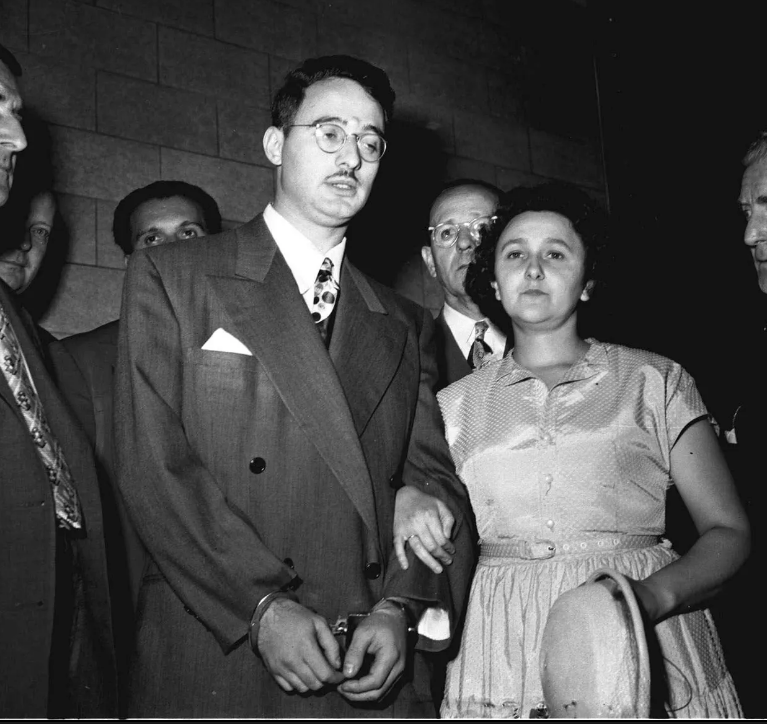
Julius and Ethel Rosenberg were a married couple, who were both born in Manhattan, New York. Being married or born in Manhattan does not automatically qualify you for this list, though. At this time, the Cold War had been established, and the Rosenbergs were part of that drama.

In 1950, Julius and Ethel were arrested and convicted in 1951 for espionage. They were spying for the Soviet Union by providing top-secret information about American technology, especially nuclear secrets. In 1953, both Julius and Ethel were executed by electrocution, at Sing Sing Prison.

The Rosenbergs are also infamous for being the first American civilians executed for espionage. Even though they’re not a 2024 equivalent for the Rosenbergs, I feel Aldrich Ames and Robert Hanssen would be the closest.

Credit: AP Images

H-bomb:

This is an odd one to discuss because it isn’t about a person, place, or event, but rather an object; a very destructive object. No, I’m not talking about Hellboy’s right hand, but rather the H-bomb.

This weapon has been given various monikers over the last 70 years, such as H-bomb, thermonuclear weapon, fusion weapon, or the most well-known, the hydrogen bomb.

In 1951, during the Cold War, the United States focused on developing the next generation of nuclear weapons. The goal was to combine atomic fission and nuclear fusion to create a more powerful nuclear explosion that could release more energy than a primary nuclear weapon. The first hydrogen bomb test took place in the Marshall Islands in 1952.

As a result, the design of the hydrogen bomb has had a lasting impact, with most of the world’s nuclear warheads being based on its design.

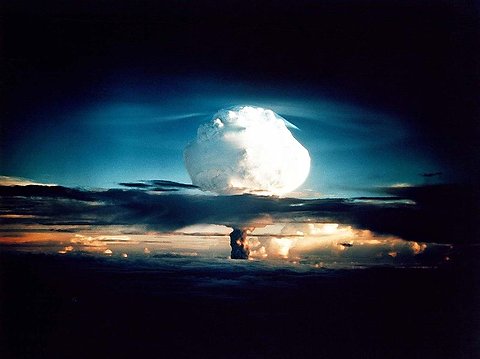
National Nuclear Security Administration/Nevada Site Office Photo Librar. The first hydrogen bomb tested by the United States vaporized the islet of Elugelab in the Marshall Islands in the North Pacific on Nov. 1, 1952.

Sugar Ray:

Born Walker Smith Jr., Sugar Ray Robinson was a professional boxer, who fought across the Lightweight, Welterweight, Middleweight, and Light heavyweight divisions, becoming world champion six times (1 x welterweight and 5 x middleweight).

Robinson is in the song for his fight against Jake LaMotta, for the World Middleweight title in 1951. This was the sixth time the two men had fought, and the fight has been named the “St. Valentine’s Day Massacre” over Robinson’s combinations that beat the world champion, LaMotta to a bloody pulp.

In modern times, this is quite awkward. It could go either two ways; the first could be rematches between the same two boxers like Muhammad Ali vs. Joe Frazier, Erik Morales vs. Marco Antonio Barrera, Pongsaklek Wonjongkam vs. Daisuke Naito, or Manny Pacquiao vs. Juan Manuel Marquez.

As for the second way, it could be because a particular boxer went on to become an icon and legend in their weight division. For that answer, the choice is yours.

Panmunjom:

Do you remember how I mentioned that I’ll be discussing the Korean War again, from last’s month 1950 blog? Well, here we are. Panmunjom is a former village that’s near the Demilitarized Zone (DMZ), along the North Korean and South Korean border. The Joint Security Area (JSA) is also referred to as Panmunjom, and vice versa.

Panmunjom makes this list because, during the Korean War in 1951, North Korean and Chinese officials first met United Nations forces at Panmunjom for truce talks.

In 2005, I was lucky enough to visit Panmunjom, and I made a badly written blog about it. The legacy of Panmunjom is that it still provides a point of contact and meetings for the leaders of North Korea, South Korea, and others.

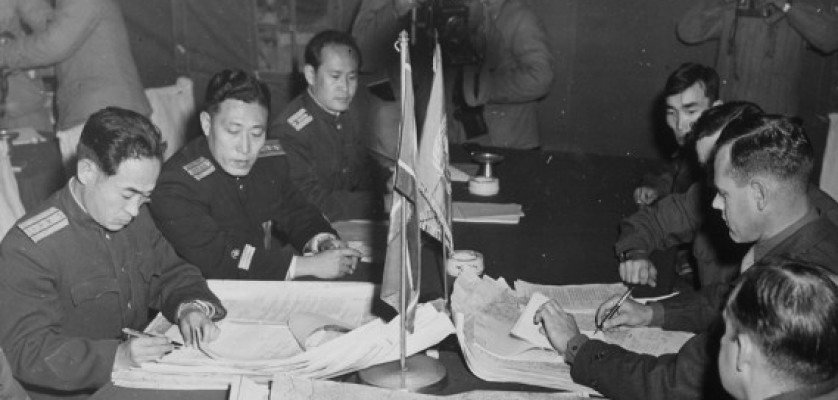
North Korean and U.S. militaries attempt to iron out an armistice at Panmunjom in the Korean Demilitarized Zone, October 1951. (National Archives photograph)

Brando:

Brando refers to the Godfather himself, Marlon Brando, the great actor and activist. Brando starred in the 1951 film, A Streetcar Named Desire, as the lead male role, Stanley Kowalski. In certain circles, people say that Brando’s performance of Stanley was the best of his long career, which resulted in him being nominated for Best Actor at the 1952 Oscars.

The problem was that Brando didn’t win the award, instead, it went to Humphrey Bogart’s role as Charlie Allnut in The African Queen. This snub, as it’s been referred to, has been recorded as one of the biggest in the history of the Academy Awards.

A modern equivalent for a person being snubbed for acting at the Oscars can be somewhat subjective. However, in the spirit of the blog, maybe Margot Robbie (Barbie), Glenn Close (The Wife), Jim Carrey (The Truman Show), Amy Adams (Arrival), or Pam Grier (Jackie Brown)

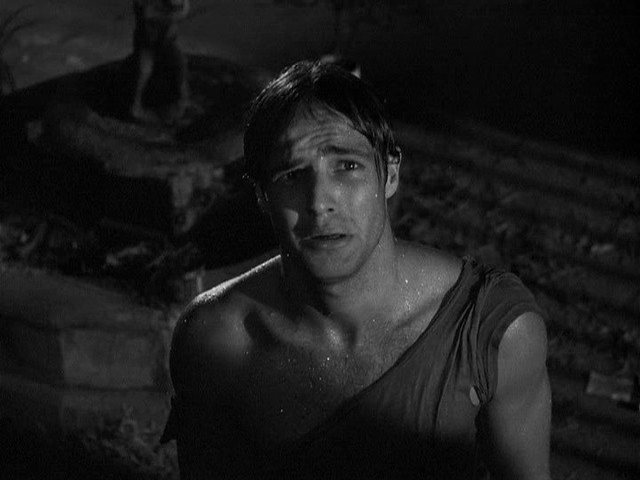
Marlon Brando in A Streetcar Named Desire (1951). Credit: Warner Bros. Pictures

The King and I:

We’re back with another Rodgers and Hammerstein production, in the form of The King and I. The musical was based on Margaret Landon’s 1944 novel, Anna and the King of Siam, and also inspired the 1956 film.

The King and I first opened on Broadway in 1951, and it was a commercial and critical success, playing 1,246 performances. It also won five Tony Awards in 1952, including Best Musical. From there, the musical has been revived over the years, with the latest in 2015 (Broadway) and 2018 (West End). It remains a beloved story around the world.

Original poster for The King and I. Credit: St. James Theatre

The Catcher in the Rye:

For the first time in We Didn’t Start the Fire, a book has been mentioned. As you would expect, The Catcher in the Rye, was released in 1951, and it was written by J. D. Salinger. If you haven’t heard of the novel, then you may have heard of its protagonist, the teenager Holden Caulfield.

The novel makes the list because of the various themes it contains, like belonging, connection, sex, identity, loss, depression, innocence, and a whole lot of angst; which were unexplored topics for teenagers in early 1950s literature. The character of Holden Caulfield has become a symbol of rebellion and, you guessed it, teenage angst. Like I said before, this book has a whole lot of angst.

The Catcher in the Rye has sold more than 65 million copies, and remains a solid-selling book, even in 2024. This controversial novel has also been banned several times in various places around the world in the 20th century, which is sadly becoming a growing trend in the 21st century.

An unwanted caveat for the novel is that in 1980, a 25-year-old Mark David Chapman, shot and killed John Lennon, outside his apartment in New York. Chapman had developed an obsession with The Catcher in the Rye; among other things, and especially with Holden Caulfield, and tried to emulate his misadventures.

First-edition cover of The Catcher in the Rye (1951) by author J. D. Salinger. Credit: Wikipedia.

So for 1951, we covered two spies, the hydrogen bomb, a boxer, a Korean village, an actor, a musical, and a novel. A useless piece of information is that 1951 holds a special connection to me, because it’s the year my father was born.

Next month, I’ll look at 1952, and if I feel motivated enough, 1953 as well, but I don’t like the odds of that. I think it’s 34-1. Did I mention that I suddenly like the number 34?

Anyway, that’s it for another week. If you’re enjoying my We Didn’t Start the Fire project, or maybe you think I’m wasting my time, please let me know.

Thanks again for reading, following, and subscribing to Some Geek Told Me. Don’t forget to walk your dog, read a banned book, watch the T20 World Cricket Cup, and I’ll see you next week, where I’m going to be petty and mean. You’ll love it.


The Multi-millionaire who could not afford an umbrella

Being a parent means that if a child in your house starts coughing and sneezing, the odds of you starting to cough and sneeze are the equivalent of The Thing winning a fight against the Yancy St Gang; it’s always going to happen.

The doctor said I have a mild dose of man flu, if a mild dose of the virus even exists. Suffice it to say, this is a strange rant today, folks, so I’m sorry about that.

In the time allotted today, I want to talk to you about the 4th July 2024. My subscribers in the United States might think I’m discussing their Independence Day, which celebrates their Declaration of Independence from the United Kingdom. This declaration was ratified on 4th July 1776, and it became well-known around the world, even in little old New Zealand.

But, it’s the 4th July 2024 that I want to discuss, although the United Kingdom is still involved. On 22nd May 2024, the Prime Minister of the United Kingdom, Rishi Sunak announced that the next UK General Election would be held on 4th July 2024, which is about six weeks away.

Some keen followers of Some Geek Told Me, may have noticed that some of the news or information that I write about, involves the UK. The obvious reason is no, I’m not an agent of SPECTRE, so I’m not trying to take down the country. I think they are doing that all by themselves.

The truth is that I lived in the United Kingdom for three years, so I have a soft place in my cold heart for the British people. Which brings me back to Rishi Sunak. Now, before I go on, let’s establish something:

  • I’m not going to discuss the motivations for Sunak and the Conservative Party for bringing forth this general election early.
  • I’m not going to talk about how after 14 years in power, the Tories have brought the NHS and the country to its knees.
  • I’m certainly not going to mention the greatest political version of self-harm, which is the apocalypse known as Brexit.
  • I’m not going to mention the recent UK local government elections, where the Tories were the victims of a humiliating defeat, on par with the Battle of Isandlwana or Newcastle losing 8-0 to the A-League Men All-Stars.
  • And I promise you, I am not going to discuss the Tories’ opening policies on the campaign trail, by bringing back national service for 18-year-olds.

I would never bring up or mention any of these things, I’m not that type of person.


CREDIT: James Veysey/Shutterstock

However, what I am going to discuss is Rishi Sunak’s announcement of the general election, because it was like a broken-down AI had written a movie script, where chimpanzees were the actors. No, that’s wrong of me, I’m sorry, I shouldn’t have dragged chimpanzees into this, because chimpanzees would have done a better job.

If you have no idea what I’m talking about, oh, you’re in for a treat. Picture this, the Prime Minister of the sixth largest economy in the world, and the second largest economy in Europe, walked outside his residence at 10 Downing Street, and discussed the general election. It sounds like a standard boring press briefing, am I right?

Now hold that image, because we have to add some beautiful details. The first point is that Sunak was talking at a single wooden podium. No other person is there supporting him, by standing next to or behind him. It’s just the Prime Minister, standing outside his house, at a podium. That’s it.

The second point was that it was raining. Seriously, it was raining. Sunak was standing at the podium talking while wearing a very nice suit and getting drenched. To make it clear, Sunak wasn’t wearing a coat or jacket; he was wearing a suit.

This also means nobody is standing next to Sunak, holding an umbrella to protect him. Sunak is one of, if not the wealthiest Prime Minister the United Kingdom has ever had. With the combined wealth of his wife, Sunak is estimated to be worth about £651 million, which I now understand, means he’s richer than King Charles III.

But despite being worth about £651 million, Rishi Sunak could not afford an umbrella or a jacket. I didn’t realise that British inflation was that bad, that even multi-millionaires couldn’t afford those items. Damn, and here I thought the inflation in New Zealand was dire.

To make this scene even more bizarre and farcical, only about three years ago, the UK government had spent around £2.6m refurbishing 9 Downing Street as a media centre, to equal White House briefings.

The implications of this mean, that even though the Tories had a £2.6m refurbished media centre next door; where it’s spacious, warm, and dry, they still held the general election announcement outside 10 Downing Street. In the rain. It’s like nobody had the original idea, that maybe, just maybe, someone should check the weather forecast, because a general election announcement is sort of a big deal, and you don’t want to stuff it up.

And to bring the Westminister Amateur Acting Guild production to a close, let’s talk about the background music. As Sunak was talking about the Tories’ small victories and discussing the general election; and please remember, he’s getting soaked by the rain, some background music was being played. And it didn’t stop.

The song “Things Can Only Get Better” was released by the band, D:Ream in 1993. It gained attention when it was used by the Labour Party in their successful general election campaign in 1997. The song was being played by Steve Bray, a political activist.

Apparently, within 24 hours of the general election announcement, the song entered the top 10 on the iTunes Charts. Being the great supporter of Tory policies that he is, physicist Brian Cox would have loved that.

For someone living on the other side of the planet, this was amazing and comical to witness. For the British public, this was an unmitigated disaster, showcasing the level of Tory efficiency. 

A British Prime Minister standing alone, outside his house in the rain, without any protection, asking the public to vote for his party; because they know what they’re doing and the public should trust them. And all to the soundtrack of a rival political party’s successful ex-campaign song. 

It would be a hilarious movie scene if it wasn’t so tragically real.

My father has said some pearls of wisdom over the years, but currently, no other statement can top this when talking about a group of disorganised people:

They couldn’t organise a piss-up at a brewery.

I can’t help but think, that the Tories are one of the greatest living examples of this. Though to be fair, the Coalition of Chaos is not that far behind them.

Here’s the video from the BBC.

And with that positive and uplifting note, I need to go to bed. Thank you for reading, following, and subscribing to Some Geek Told Me, because this project helps me to navigate this crazy world.

Please don’t forget to walk your dog, read a banned book, go and slam a revolving door, and I’ll see you next week for the return of We Didn’t Start the Fire! Can’t wait.


Until last week, I had never heard of Harrison Butker

I’m a sports fan, but even I find it difficult to follow every sport. I mean, it’s impossible. Well, maybe not for Chuck Norris, but for mere mortals like us, it is. Because of this obvious fact, I’m not an expert on North American sports, so a lot of NFL, MLB, NBA, and NHL information can easily slip by me.

It could be that some team has a new manager, another team has won 13 games in a row, another team has a new stadium, or a player has a new $200 million contract, and I wouldn’t know. My interests in these sports annually peak around the Superbowl, the World Series, the Stanley Cup playoffs, and the NBA finals, then they die down.

I do know enough, however, to understand that the New York Mets and New York Jets are terrible. At least, according to late-night hosts.

As a New Zealander, I’m just pleased I can roughly match the name of an American team to its sport. If it’s not rugby union, rugby league, cricket or football, I shamefully filter things out. However, despite all of this, I had never heard of Harrison Butker, until last week.


Image by StockSnap from Pixabay

I was on my lunch break, resting my weary feet and enjoying my Vegemite sandwiches when I read an article about Harrison Butker. This led me to discover that I didn’t know who he was, but I knew about the Kansas City Chiefs because they won Super Bowl LVIII. That news even reached New Zealand.

I’m getting off-topic as usual, but after reading the short article regarding Butker’s commencement speech at Benedictine College; which I thought was a prank, I discovered videos about him from various news sources.

It was about that time when I realised that this news story was about a real event, it wasn’t a prank. After discovering the real existence of this speech, I made the decision not to mention it to my wife. The reason was I knew it would piss her off, so I wanted to avoid mentioning it to her. The joke was on me, though.

When I got home from work, my wife asked if I had heard about some guy in America who gave a speech. With a deep and regretful sigh, I said I had. I’m not going to repeat what my wife said, but she used a lot of adjectives about Butker’s speech.

In his speech, Butker seemed to throw a lot of shade at various things, including, men, women, Joe Biden, COVID lockdowns, IVF, abortion, LGBTQ+ and others, which have brought praise and criticism across the United States, but also around the world.

Am I going to add my opinion on this topic?

No, I’m not.

Why not? Everybody has an opinion, what’s yours?

My answer is in two parts. Firstly, any person who reads, follows, and subscribes to my daily/weekly posts, will already realise my views and opinions on these topics. If not, please read three years’ worth of nonsense.

Secondly, why would I want to add my voice to the thousands of comments about the speech, when other people have already done so, with far more articulated and wittier results? 

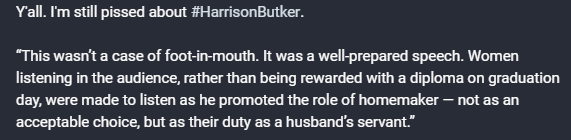
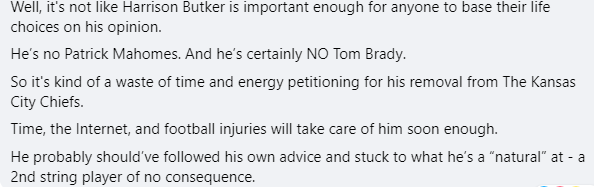
So, sit back, relax and enjoy social media and its amazing responses to Butker’s speech. I’ve removed people’s names on the posts because I hope that’s the correct thing to do.


From X

From Mastodon

From Facebook


Free speech is a double-edged sword; no one can physically stop you from speaking your mind and giving your opinion. However, it doesn’t mean you are free from consequences or repercussions, because of your words.

I’m a not smart man, but I’m wondering how long those consequences and repercussions will catch up to Harrison Butker. Maybe it won’t, I mean, we do live in reality and things don’t always go the way we want or need them to go. 

Anyway, thanks again for reading, following, and subscribing to Some Geek Told Me

Please don’t forget to walk your dog, read a banned book, go and divide by zero, and I’ll see you next week.


We Didn’t Start the Fire: 1950

Welcome to the latest instalment of my breakdown of Billy Joel’s We Didn’t Start the Fire. The two previous entries in this strange franchise are We Didn’t Start the Fire: The Beginning and We Didn’t Start the Fire: 1948-1949.

This is where I’m attempting to talk about the historical references in the song and try to relate them to our contemporary society. I know this sounds like a terrible idea, but apparently, the group known as Beetroot Awareness Aotearoa sort of agrees. After publishing my blog post concerning 1948-1949, this New Zealand-based group released their own harsh review:

Does this idiot know that the song came out in 1989, and since then, numerous people have already talked about the historical references? Can he not think of anything original or does he just steal other people’s ideas? What a buffoon!”

And with that positive and uplifting feedback, let’s check out the We Didn’t Start the Fire’s historic references for 1950.


Image from the We Didn’t Start the Fire music video

1950

Joseph McCarthy:

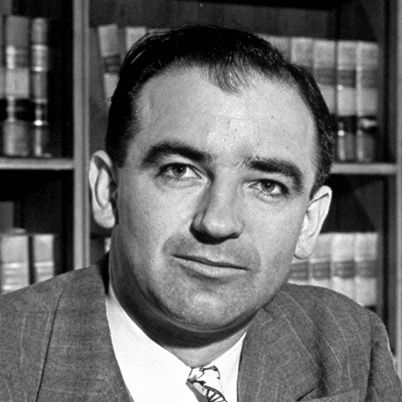
We briefly discussed Joseph McCarthy last time with 1949’s Walter Winchell, but we’ll expand it like a dog taking over your bed. McCarthy was a US senator for Wisconsin, who had a few issues that he liked to talk about. Early on in the Cold War, and during his Lincoln Day speech, McCarthy launched an anti-communist crusade.

He promoted the concept that Soviet Union and communist spies and sympathizers had infiltrated American society, through the federal and local governments, as well as in academic and entertainment circles. This led to the persecution and political repression of many people, based on being un-American and their opinions. It was during this period that the terms “The Second Red Scare” and “McCarthyism” were born.

For a modern equivalent to McCarthy, just think of everybody’s favourite twice impeached, four times criminally indicted, ex-US President, Donald Trump.

Credit: Biography.com

Richard Nixon:

Richard Nixon makes the list because in 1950, the future President of the United States of America was first elected to represent California, in the US Senate. If you’re a student of history, you’ll realise this will not be the last time Nixon makes the list. He will return.

For a modern version, I’m a bit stumped over this. I can’t compare Richard Nixon of 1950 to Richard Nixon of 1972, because they are two people with different life experiences. However, when comparing Nixon of 1950 to modern times, it would be any young politician moving up the ladder, to become a long-term politician. I’m sure every country has some. I’m looking at you Winston Peters, I’m looking at you.

Nixon in Yorba Linda, California, c. April 1950. Credit: Orange County Archives.

Studebaker:

Studebaker was an automobile manufacturer, which was based in the United States. For about 50 years, Studebaker was one of the leaders in the car industry and had built up a great reputation for their vehicles.

That changed around 1950 when Studebaker started having some major financial problems. In 1954, they merged with Packard, another automobile company to ease their financial difficulties. It didn’t work the way they thought it would, so in 1967, Studebaker ceased production and the company shut down.

Some modern equivalents would be Oldsmobile and Pontiac, or even some non-automobile companies like Kenner and Toys “R” Us.

Studebaker’s “Lazy S” logo, designed by Raymond Loewy, was used from the 1950s until 1966/1950 Studebaker Champion. Credit: Андрей Перцев/Classic Auto Mall.

Television:

Is there a greater icon for the 20th century other than television? I think not. Television or TV had been developed, improved and marketed for years before 1950, but it was slowly becoming an important household product. In the context of US history, TV was becoming an attractive way to transmit information to the public.

Data on sales of TV sets in the United States for 1950 varies. An estimated 9%-20% of households in the United States had at least one television set, but by the end of the decade, that figure had grown to nearly 90%. The age of television was upon us, and it changed the way people from around the world, consumed news and entertainment forever.

In the 21st century, the easiest and best example of a different communication network would be the Internet. You can watch your favourite team play live while riding on the train, watch your favourite TV show on your lunch break, or stream the latest news via your phone or laptop. Outrageous.

Credit: © Frank Martin/ Getty Images

North Korea, South Korea:

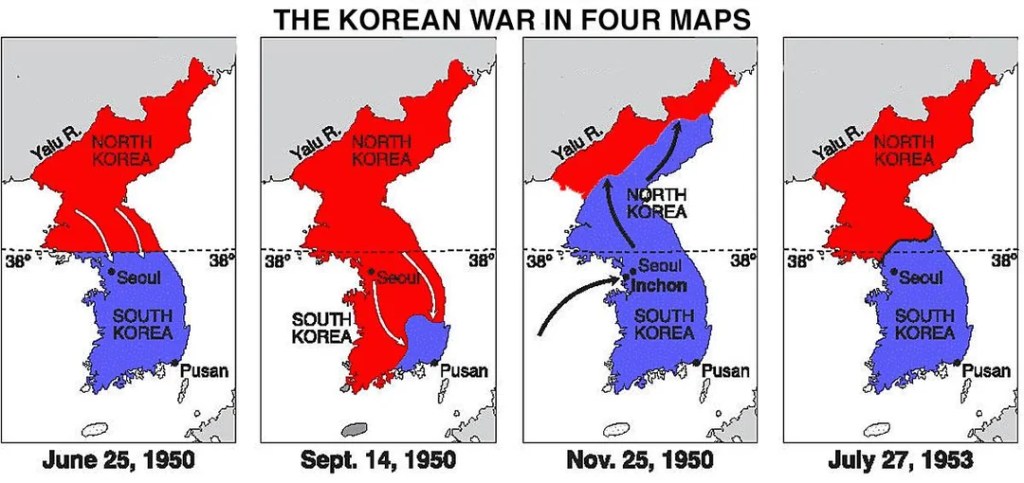
This is the first time that I need to discuss two references together, because in 1950, North and South Korea dominated the news around the planet. At the time, North and South Korea were two separate countries, having been divided at the 38th parallel north, by the Soviet Union and the United States, after the end of the Second World War.

On 25th June 1950, the North Korean army crossed the 38th parallel and invaded South Korea. Given that the Cold War was the political climate at the time, this conflict slowly became a proxy war for democracy vs communism.

On one side, there was the Democratic People’s Republic of Korea (North Korea), and the People’s Republic of China (China), along with the unofficial support of the Soviet Union; against the Republic of Korea (South Korea), along with the United Nation Forces, which consisted of the United States, United Kingdom, Australia, Netherlands, Canada, France, New Zealand, Philippines, Turkey, Thailand, South Africa, Greece, Belgium, Luxembourg, Ethiopia and Colombia; with many more countries supplying support through different means.

This conflict became known as the Korean War and was fought for three years, with the war ending in a stalemate in 1953, with the Korean Armistice Agreement. The war claimed an estimated 2.8 million military and civilian deaths. Much like the Chinese Civil War, the geo-political repercussions of the Korean War are still being felt in 2024.

Sadly, the Korean War will make another entry in the song.

Credit: Map Porn

Marilyn Monroe:

Born Norma Jeane Mortenson, Marilyn Monroe was a model and actress who became an international sex symbol, during the late 1940s-early 1960s. In 1950, Monroe landed some breakthrough roles in films and actually starred in five different films in that year. (A Ticket to Tomahawk, The Asphalt Jungle, All About Eve, The Fireball, and Right Cross). From there, Monroe’s career took off and she soon became a household name.

It’s hard to determine which contemporary model/actress would be like Marilyn Monroe of 1950, so I’ll let you decide on that one. Sorry.

Marilyn Monroe in All About Eve (1950). Credit: 20th Century-Fox

So for 1950, we have covered two US Senators, a failed automobile company, the explosion of television sales, the Korean War, and a model/actress. Like I said last time, this project is going to take some time, so I’ll try and cover 1951-1952 next time. Cool.

That’s it for another week. Thanks once again for reading, following, and subscribing to Some Geek Told Me. Don’t forget to walk your dog, read a banned book, call for a ceasefire in Palestine, and I’ll see you next week because I’m going to be discussing a milestone. It could be interesting.


We Didn’t Start the Fire: 1948-1949

There have been numerous terrible ideas throughout the history of our planet, and unfortunately, many of them have originated from this account. Despite this, we will carry on the tradition and introduce the latest addition to the family of bad ideas, which is Some Geek Told Me.

Last month, I ranted on about my love for We Didn’t Start the Fire, by Billy Joel. In that hot mess of literary foolishness, I explained that I was going to cover all of the historical references in the song; or at least try to, but also relate them to contemporary time. I’ll do this by producing one blog per month. Maybe.

The aim is to cover the 119 references from 1948-1989, so how long will this take me? You tell me and we’ll both know. The lyrics will be in bold and italics because we’re really fancy on this account!

Right, I’m not here to shag spiders, so without too much fanfare, let’s crack on and do this!

Credit: CBS

1948

Harry Truman:

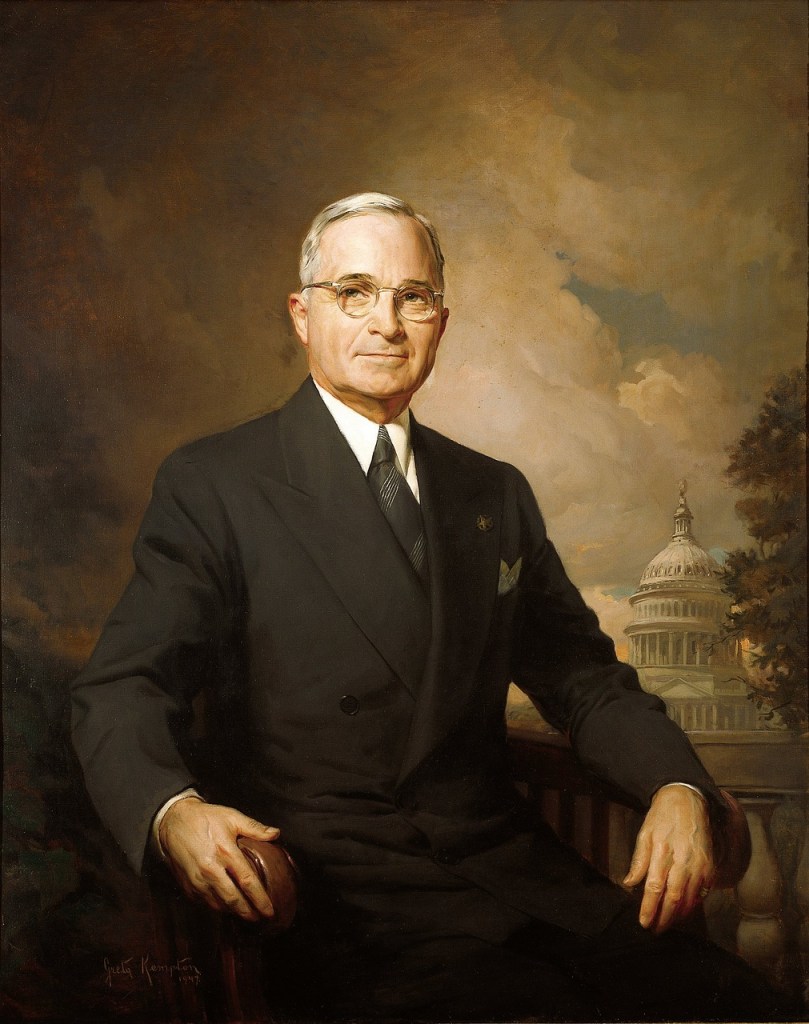
Harry S. Truman was the Vice-President of the United States of America from January-April 1945, then became President after the death of Franklin D. Roosevelt. Truman is a divisive figure in US and world history, much like Elon Musk or George W. Bush.

On one hand, he helped steer the United States through to the end of the Second World War; authorised the Berlin Airlift; recognised the State of Israel; won re-election in 1948; and promoted civil rights. On the other hand, Truman deployed troops into the Korean War and authorised the atomic bombings of the Japanese cities of Hiroshima and Nagasaki. In saying that, George W. Bush would be the modern version of Truman.

Portrait of Harry S. Truman.
Image by WikiImages from Pixabay

Doris Day:

Born Doris Mary Kappelhoff, Doris Day was a major entertainment star in the United States. She was already a successful singer before she turned to acting. Over the years, she became a huge attraction to the television and movie industry.

Billy Joel mentioned her in the song, became her first feature film, Romance on the High Seas, was released in 1948. If you’re still unsure about her impact on pop culture, just think of Jennifer Lopez, Lady Gaga, or Rihanna.

Doris Day in Romance on the High Seas (1948). Credit: Warner Bros. Pictures

1949

Red China:

In 1949, the Chinese Civil War came to a close after causing the deaths of millions of people. Mao Zedong, the leader of the Chinese Communist Party, succeeded in defeating the government led by Chiang Kai-shek and the Kuomintang. As a result, the People’s Republic of China was established.

The Kuomintang, also known as Nationalists, fled mainland China to Taiwan, where they settled and took control. The geo-politics of 2024 concerning China and Taiwan, have their origins in the end of the Chinese Civil War.

The Chinese Civil War, 1949.
(Source: diverse-travel.com)

Johnnie Ray:

Johnnie Ray, a singer, songwriter, and pianist, was born in Oregon, USA. He was widely recognised as the Father of Rock and Roll due to his significant contributions to the genre. During the late 1940s and 1950s, he was one of the most famous singers in the world.

His music and dance moves reinvented the method singers could perform, and paved the way for others to follow him; notably Elvis Presley. When Ray signed to Okeh Records, music was going to be changed forever. For contemporary equivalents, the best people I can think of would be Michael Jackson and Madonna.

Credit: Johnnieray.com

South Pacific:

Not only is it the name of my location, but South Pacific was a Broadway musical, that opened in 1949. The musical was based on the World War Two book, Tales of the South Pacific, and the musical also inspired the 1958 film.

South Pacific is famous; at least to me, for mainly two reasons. The Richard Rodgers and Oscar Hammerstein production became one of the best musicals of all time since it was extremely financially and critically successful.

The other reason was that the musical was progressive for its time, as it tackled racism and prejudice. This was important because the United States was still in its segregation phase. If South Pacific opened in 2024, and not in 1949, you can bet your Black Lives Matter flag, that the musical would be labelled as woke. Very, very woke.

Original poster of South Pacific. Credit: Majestic Theatre

Walter Winchell:

We’re going back to another US icon in the form of Walter Winchell. Winchell was primarily a radio news commentator and newspaper columnist, through the 1930’s-1950’s. His notoriety is that he had outspoken views on a variety of subjects, which included attacking the Nazis and the Ku Klux Klan; as well as denouncing communism.

This led Winchell to join the “McCarthyism” movement, in spreading misinformation about the Second Red Scare, supporting the idea that communists had infiltrated the US Government; in addition to destroying people’s careers and reputations.

If you’re having trouble understanding what I’m talking about with Winchell, just picture Alex Jones from InfoWars and you’re there.

Credit: Encyclopædia Britannica, Inc

Joe DiMaggio:

Born Giuseppe Paolo DiMaggio, Joe DiMaggio was a famous US baseball player. He held multiple batting records and mainly played for the New York Yankees, during the 1940s-1950s. In the world of team sports, DiMaggio would have been Michael Jordan or Lionel Messi. DiMaggio was a star and hero to millions of people.

In 1949, DiMaggio signed a contract with the Yankees worth $100,000. This was a record-breaking contract for a professional sportsman at the time and helped to usher in a new wave of extremely well-paid players.

Credit: Associated Press archives

And with that, we have covered 1948-1949, in the form of a US President, a singer/actor, a civil war, another singer, a musical, a gossip columnist, and a baseball player.

My We Didn’t Start the Fire project is going to take some time, but we’ll get there. Eventually.

Thanks once again for reading, following, and subscribing to Some Geek Told Me. Don’t forget to walk your dog, read a banned book, eat a raw lemon, and I’ll see you next week, because we’re going to check in with my wife and her television shows. It’s going to be riveting.


100 Days of Chaos

Allow me to take a momentary pause from my typical geek-related content to discuss the current status of the Coalition of Chaos in New Zealand. It has been well over 100 days since the ex-Air New Zealand CEO was elected to lead the country by 38.08% of the voting population. Furthermore, 8.64% of voters supported a party that believes National is not hardcore enough, while 6.08% voted for a party that’s notorious for its frequent changes in allegiances.

To my non-New Zealand followers and subscribers, this blog may be awkward and unrelatable, so I’m very sorry. Please give it a chance, because you probably know of similar politicians in your country.

As for my New Zealand followers and subscribers, I’m a box of birds, and we’re going to have a chin wag about some ginormous eggs.

After the 2023 New Zealand General Election, the parties of National, ACT, and NZ First formed an alliance, centred on a conservative coalition. They go by many names, like the Government, Lupesey, The Three-Headed Taniwha, the enemy of Maori, and my favourite, the Coalition of Chaos.

It’s been over 100 days since the Coalition of Chaos took the steering wheel of the 52nd-largest national economy in the world. In that time, they have been quite busy, because they have been dropping some brain-melting quotes.

In honour of the first 100 days of the Coalition of Chaos, may I present some awful quotes, from their finest members.


Credit: Newshub

The Honourable Chris Bishop MP: Minister for Sport and Recreation, Minister Responsible for RMA Reform, Minister for Infrastructure, and Minister for Housing.

10th March 2024

When asked by a reporter about the government and Bishop’s accountability towards environmental damage in New Zealand because of new fast-tracked energy projects legislation, Bishop replied:

Ultimately, the public will be able to judge the performance of the Government in late 2026.”

{Bishop means that the next New Zealand General Election is in late 2026, so that’s when the Government can face accountability, but not before that time}

In the same interview, when asked on whether fast-tracked consents incentivised lobbying, Bishop said:

“But you know, lobbying is not illegal and it’s not necessarily a bad thing.”

{Bishop is a former tobacco lobbyist for Phillip Morris, now known as Altria. This tobacco company is one of world’s largest producers and promoters of cigarettes, tobacco, and related products}


The Honourable David Seymour MP: Leader of ACT New Zealand Party, Minister for Regulation, Associate Minister of Education, Associate Minister of Finance, and Associate Minister of Health.

9th March 2024

Seymour made a post on X concerning the Hurricanes Poua rugby team’s haka, that criticised the government.

“More time practicing, less time on politics.”

{Seymour is a free speech advocate and opposes hate speech laws}


The Right Honourable Winston Peters MP: Leader of New Zealand First Party, Deputy Prime Minister of New Zealand, Minister of Foreign Affairs, and Minister for Racing.

24th November 2023

At the press conference discussing the coalition agreement, Peters was pressed by reporters about the length of time it took for negotiations to happen. Peters responded by saying:

“Please don’t be mathematical morons…”

{Peters had a fragile relationship with the New Zealand Media}

17th March 2024

During his State of the Nation speech, Peters talked about co-governance.

“Some people’s DNA made them, sadly, according to these people and condoned by their cultural fellow travellers, their DNA made them somehow better than others. I’ve seen that sort of philosophy before. I saw it in Nazi Germany. We all did. We’ve seen it elsewhere around the world in the horrors of history.”

{Peters was born in April 1945, so he was still a baby when the Second World War was being fought. Also his comparison of Nazi Germany to co-governance in New Zealand has been criticised by Holocaust survivors}


The Right Honourable Christopher Luxon MP: Leader of the National Party, Prime Minister of New Zealand, and Minister for National Security and Intelligence.

18th December 2023

When speaking to reporters about scrapping the bonuses civil servants were receiving for being fluent in Te Reo Maori, Luxon said:

“In the real world outside of Wellington and outside the bubble of MPs, people who want to learn te reo or want to learn any other education actually pay for it themselves.”

{The irony is that Luxon used taxpayers money to pay for his Te Reo lessons. Luxon is the second wealthiest person to become Prime Minister of New Zealand, valued at over $21 million}

18th February 2024

During his State of the Nation speech, Luxon said:

“A justice system which had a deliberate strategy to empty New Zealand’s prisons, even as violent crime soared.

{Luxon was implying that Labour had a policy of releasing all of the prisoners in New Zealand. This was not true}

20th February 2024

On X, Luxon said:

“The days of taxpayers being treated like a bottomless ATM are over.

{Just over a week later, Luxon was at the centre of the accommodation supplement scandal, where he was claiming the supplement of $1,000 per week, to live in his mortgage free apartment in Wellington}

I can’t forget to include Luxon’s 1st March interview about his accommodation supplement, where he repeated several times: “I’m entitled.”

I do realise Simeon Brown, Nicola Willis, and Brooke van Velden have said some awful quotes as well, but they are light-weights compared to Bishop, Seymour, Peters, and Luxon.

So, let’s look forward to the next 100 days of chaos, though my Spider-Sense is telling me that we need to buckle up because they’re probably going to be worse.


Did I miss any cringe-worthy or clueless quotes from the Coalition of Chaos? As always, please let me know. That’s it for another week because I’m off to watch Last Week Tonight for my weekly 30-minute lecture.

Thanks once again for reading, following, and subscribing to Some Geek Told Me. Don’t forget to walk your dog; read a banned book; and praise Putin, since he won six more years. What a shock. I’ll see you next week because we’re going to revisit We Didn’t Start the Fire. Good times.