15th March 2019: Six years later

I’ve mentioned this before, but sometimes I struggle to find humour in discussing certain topics. Not that I’m an expert in comedy—far from it—but today’s blog post is one of those times when I can find very little humour.

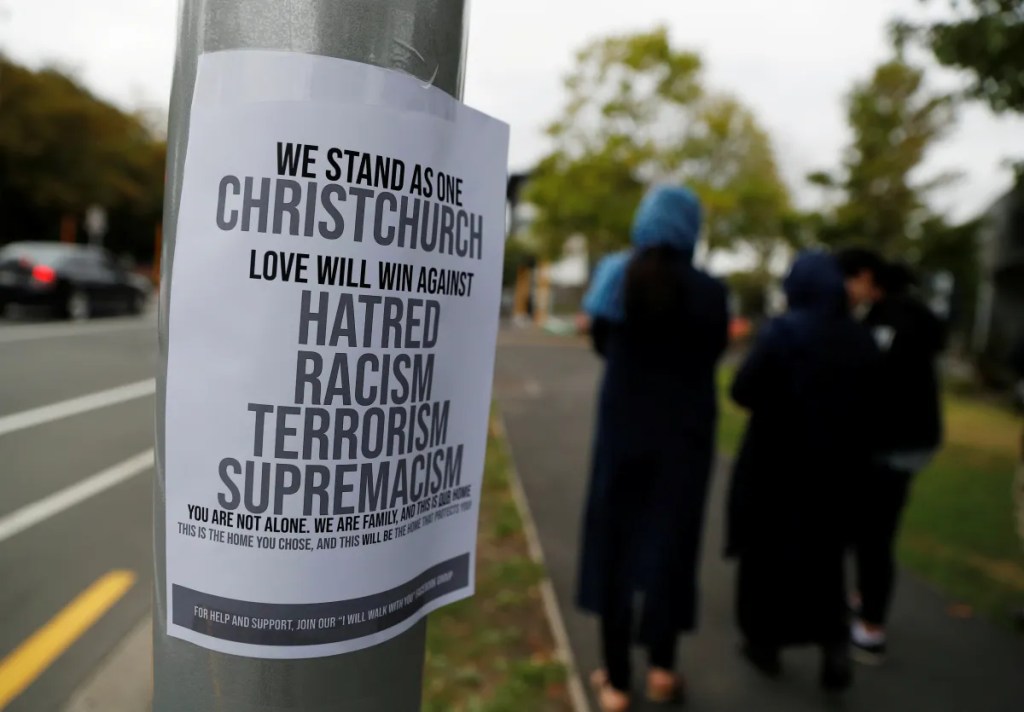
To make sure we all understand what I’m talking about, let’s very quickly establish the facts. On 15th March 2019, a lone gunman, armed with a collection of firearms, including semi-automatic rifles, shot and killed 51 people and injured 89, at the Al Noor Mosque, and Linwood Islamic Centre, in Christchurch, New Zealand. This event became known as the Christchurch mosque shootings or the Christchurch mosque attacks.

I’m not going to rehash the events of 15th March 2019, minute by minute. Professional journalists and reporters have done that already, so I can’t add anything new to the conversation.

The purpose of this blog post is to express my feelings and emotions about the sixth anniversary of the deadliest shootings in modern New Zealand history.

I have a strong connection to Christchurch, even though I no longer live there. I attended university in the city, played football, and met my wife there. It’s where we got married, and additionally, my first child, UMC1, was born in Christchurch. I was even present during the ML6.3 earthquake that struck on 22nd February 2011, which tragically resulted in the loss of 185 lives.

We moved away from Christchurch in early 2016, but it’s still important to us.

Christchurch features a large public open space in the city centre known as Hagley Park, which was one of my favourite places to run. I would always run in an anti-clockwise direction around the park, with Al Noor Mosque on my right-hand side, directly across from the park. The mosque is a famous and significant site for both the city and the Muslim community.

As for the Linwood Islamic Centre, it was only opened in 2018, but I lived only three blocks from the future site, so I know the area quite well. I wasn’t in Christchurch when the shootings happened, but six years later, I am still a mixed bag of emotions surrounding it.

Before I continue, I want to clarify that I did not know anyone who was shot or injured, so families of the victims and survivors will have a much more personal experience than I do. I don’t want to disrespect anyone’s experience, I simply want to express my emotions and feelings because I believe our country and the world are forgetting the lessons that day taught us.


Credit: Combating Terrorism Center

Let’s start with easy emotions, like shame and sadness. Six years later, I’m still ashamed and saddened those murders happened in Christchurch, let alone in New Zealand. The city and country are forever linked to that day and will have to carry an albatross around their necks, until the end of time. Granted, the albatross will gradually decrease in mass and weight, but it will always be there.

There’s also the sadness and shame in educating and explaining to our tamariki (children) about that day, because it relates to them, directly and indirectly.

This brings us to the shame and sadness towards the Muslim community of Christchurch, New Zealand, and the world. Some of the people attending the two mosques were born in New Zealand, while others were born overseas, with some being refugees.

I still feel sad and ashamed for the families having to travel; especially from other countries to mourn their loved ones, because they should have been safe here in New Zealand. They should’ve been, and it was disgusting and unforgivable.

Besides the location, a place of worship like a mosque, church, synagogue, or temple, should be a place of safety and protection for people. It still upsets me that this evil act of hatred was committed, not just against Muslims, or Christchurch or New Zealand, but it happened at all.

My experiences of feeling shame and sadness towards the attacks are also deeply connected to my anger and rage.

  • I’m still angry someone was able to amass a collection of firearms of that magnitude with ease.
  • I’m angry that he was able to livestream the first shootings on Facebook.
  • I’m angry that a white migrant shot and killed other migrants because they were from a different ethnic background to him.
  • I’m angry that the gunman believed in the conspiracy theory of the Great White Replacement. Long-time followers and readers of this account will understand my views towards conspiracy theorists and the garbage they peddle.
  • I’m angry that it happened in New Zealand, and of course, Christchurch.
  • I’m angry not only for the Muslims in Christchurch, New Zealand, and around the world, but also for the Muslims where I live.
  • I’m angry that this evil act empowered supporters of conspiracy theories, the alt-right, and anti-Islam groups in New Zealand to speak up.
  • I’m angry for the victims and their families because this should not have happened.
  • And I’m angry as a white, straight non-Muslim New Zealand male. This country has been slowly working towards diversity and inclusion for over 170 years, so the whole thing is a nightmare.

Having said that, you can’t have light without the dark, and just like the Christchurch earthquakes, you can’t have dark without the light. The 15th of March 2019 was one of the worst days in living memory for my country, but it allowed hope and pride to take centre stage.

  • The way the city, country and government, rallied around the victims and their families, was and still is excellent.
  • The flowers, hakas, and tributes were wonderful.
  • The denouncing of hatred towards people of our community and country was powerful.
  • The work towards pressuring social media companies to regulate more of their content, especially around hate speech and livestreaming, was impressive.
  • Closing the gun law loopholes and making semi-automatic firearms illegal was swift and direct.
  • There were stories of bravery, love, compassion, and humanity that were uplifting.
  • The backlash over the upcoming film, detailing the shootings was glorious by the New Zealand public.

Ultimately, what gave me hope and made me proud as a New Zealander, was the amazing response to the shootings. The world looked at New Zealand at one of our lowest and darkest days, so we did what New Zealanders only know how to: we embraced the victims and families because they were us; and told hate groups to fuck off, because this event would not stop us from doing the right thing, as in being a nation of diversity and inclusion.

There are many other emotions I could talk about, but the main one that remains is frustration, which concerns what’s currently happening in New Zealand and around the world.

  • In New Zealand, our new government have said they are open to rolling back the assault weapons ban, “…because it punishes the good and responsible gun owners.”
  • Taking his cues from the President of the United States of America, our Deputy Prime Minister Winston Peters, wants to start an anti-woke crusade, to weed out DEI hires, because, according to him, diversity and inclusion are tools of the left.
  • Attacks and prejudice towards the LGBTQIA+ community are increasing the world over.
  • Because of Hamas’ actions, anti-Muslim attacks are rising, along with antisemitism, because of the actions of the Israeli government.
  • For all the optics, the richest man in the world, Elon Musk, seems to be at the very least, a Nazi-sympathiser.
  • The Great White Replacement conspiracy theory is still being pushed by popular anchors, hosts, and influencers.
  • People are still making racist jokes online and in person; along with spewing hate speech on social media platforms, with little or no recourse.
  • Fascism is being dragged into the 21st century for a reboot.

I feel frustrated, because to me, a lot of the lessons of tolerance, compassion, diversity and inclusion, surrounding the shootings, are getting lost in the noise of prejudice, hatred, nationalism and extreme behaviour; even here in New Zealand.

We have been slowly falling back into the mindset of, “…if another group of people are different from me, or if I don’t understand them, that makes them wrong.”

It’s frustrating to witness the tremendous efforts that have been made to rebuild and move forward from the shootings, been slowly eroded due to everyday life. The rise of disinformation, misinformation, conspiracy theories, and hate groups, along with various governments claiming that diversity and inclusion weaken us, is both disheartening and morally wrong.

We already have enough violence in Ukraine, Palestine, Congo, South Sudan, and Myanmar; we don’t need to add to it. We need to get back to educating our family, friends, and the public, that diversity, inclusion, tolerance, and compassion are strengths, and they are the glue that binds us together, not separating us. And we do this through actions, not just words.

I think that’s enough for today. I need my precious beauty sleep because my wrinkles are becoming deeper and wider. Thanks once again for reading, following, and subscribing to Some Geek Told Me.

Just like last week, please don’t forget to walk your dog, read a banned book, continue to tell Nazis to fuck off, and I’ll see you next week.


We Didn’t Start the Fire: 1956

I know the last We Didn’t Start the Fire was released in December 2024, and you might have thought it was over. But just like Rambo, it’s never truly over. One day, this project will be finished—if I ever manage to write faster. However, that day is not today. So, without further ado, Some Geek Told Me proudly presents one of my least well-conceived ideas: discussing the historical references in We Didn’t Start the Fire.

For any unlucky readers who have missed the previous entries, the list is here:

 We Didn’t Start the Fire: The Beginning 

We Didn’t Start the Fire: 1948-1949.

We Didn’t Start the Fire: 1950

We Didn’t Start the Fire: 1951

We Didn’t Start the Fire: 1952

We Didn’t Start the Fire: 1953

We Didn’t Start the Fire: 1954

We Didn’t Start the Fire: 1955

We are well and truly committed to this insane project because this blog post is the ninth entry, which is tragic and hilarious, in equal measure. So, just like the eight previous entries, strap yourself in, because we are going back in time, to 1956 to be precise. Let’s go!

Credit: 68.media.tumblr.com

1956

Bardot 

Our first historical reference is about the French actress, singer, and model, Brigitte Bardot. Bardot started acting in 1952, but in 1956, she starred in four movies; Naughty Girl, Plucking the Daisy, The Bride Is Much Too Beautiful, and And God Created Woman.

These films put the world’s spotlight on Bardot, which made her one of the first women to be given the name, sex kitten, which describes a woman who exhibits sexual aggression.

Bardot quickly became a global icon for sexual revolution, with And God Created Woman becoming the highest-grossing foreign film ever released in the United States at the time, earning $4 million. Bardot went on to a have a successful career in entertainment, and retired from the industry in 1973.

She also became involved with animal rights, setting up The Brigitte Bardot Foundation in 1986, for animal protection.

Some contemporary examples, although similar, but different, could be famous female actresses and animal rights activists like Alicia Silverstone or Evanna Lynch.

Bridget Bardot in the 1956 film “And God Created Woman.” Credit: Iéna Productions

Budapest 

In 1956, the Hungarian People’s Republic was controlled and influenced by policies from the Soviet Union. Economic decline and political repression were slowly eating away at the country, so on 23rd October, university students and other citizens, began to protest in the capital city of Budapest. What happened next was known as the Hungarian Revolution of 1956, or the Hungarian Uprising.

They were against the Soviet Union’s policies and its influence on Hungary, and demanding Hungarian independence. The students clashed with the ÁVH (State Protection Authority), which was a special police group. These protests started a revolution across the country, but the Soviet Union started to push back.

On 4th November, Soviet tanks rolled into Budapest to end the uprising, which led to some infamous and iconic images, and by 11th November, the uprising was crushed. Soviet forces had brutally cracked down on the protests with over 30,000 troops and over 1,000 tanks.

The human cost of the failed revolution was 2,500-3,000 Hungarian citizens were killed, 13,000 were wounded, and 200,000 fled the country in exile. 26,000 people were arrested, with 22,000 sentenced and imprisoned, and 13,000 were interned. 229 people were executed. The Soviets suffered 722 killed and 1,540 wounded.

The revolution was famous around the world, not just for the brave actions of the students and citizens, but also for the awful and bloody response from the Soviet Union.

Some modern examples of revolutions and brutal crackdowns from oppressive governments include the Second Intifada with Palestine and Israel (2000-2005), the Arab Spring (2010-2012), the Tulip Revolution (2005), the Hong Kong protests (2019-2020), along with civil wars involving Syria, Libya, Yemen, and Sudan.

Though to be fair, I think the best/worst example would be the 1989 Tiananmen Square protests and massacre.

The Soviet repression of the Hungarian Revolution saw T-54 tanks patrolling the streets of Budapest. Credit: Nagy Gyula

Alabama 

Alabama refers to three events in 1956, with the first being the Montgomery bus boycott, in Montgomery, Alabama, United States. This was during the American Civil Rights movement, with the boycott centred on social and political protests, campaigning against racial segregation on the local public bus network.

The campaign lasted from 5th December 1955-20th December 1956, and it brought national and international attention to the cause, with the now famous Rosa Parks, an African-American woman, refusing to surrender her seat to a white person on a bus. This action led to her arrest.

The Montgomery bus boycott was a key moment in the civil rights movement, because the Montgomery Bus Line mandated that African-Americans were not to be employed as drivers, but were also forced to ride in the back of the bus, and were often ordered to give up their seats to white people. 75% of the bus system’s riders were African-Americans.

Reports detailed that many African-American passengers were assaulted on the buses, short-changed, treated poorly by the drivers, and sometimes were left stranded, even after paying their fare. The boycott led to the 1956 Supreme Court decision Browder v. Gayle, which ruled that Alabama’s segregation laws for buses were unconstitutional. Martin Luther King, Jr., the MIA’s (Montgomery Improvement Association) president, became a major civil rights leader because of the boycott.

The second event was on 10th April 1956. Tensions were running high, with some white men attacking Nat King Cole during a performance in Birmingham, Alabama.

The third event involved Autherine Lucy, who became the first African-American student to enrol at the University of Alabama. There were many riots protesting Lucy’s attendance at the university, but despite them, she continued to attend. Three days later, the university suspended her “for her own safety,” prompting the university’s president to resign in protest.

Montgomery Bus Boycott March. Credit: Socialist Alternative

Khrushchev

Nikita Khrushchev was the First Secretary of the Communist Party of the Soviet Union, which effectively meant he was the leader of the Soviet Union, from 1953 to 1964. Now if you cast your mind back to the 1953 blog post, you’ll remember that Joseph Stalin, the positive and uplifting Soviet Union leader, had died after 30 years in power, then Georgy Malenkov took his place. He only governed for 186 days, before Khrushchev had him removed.

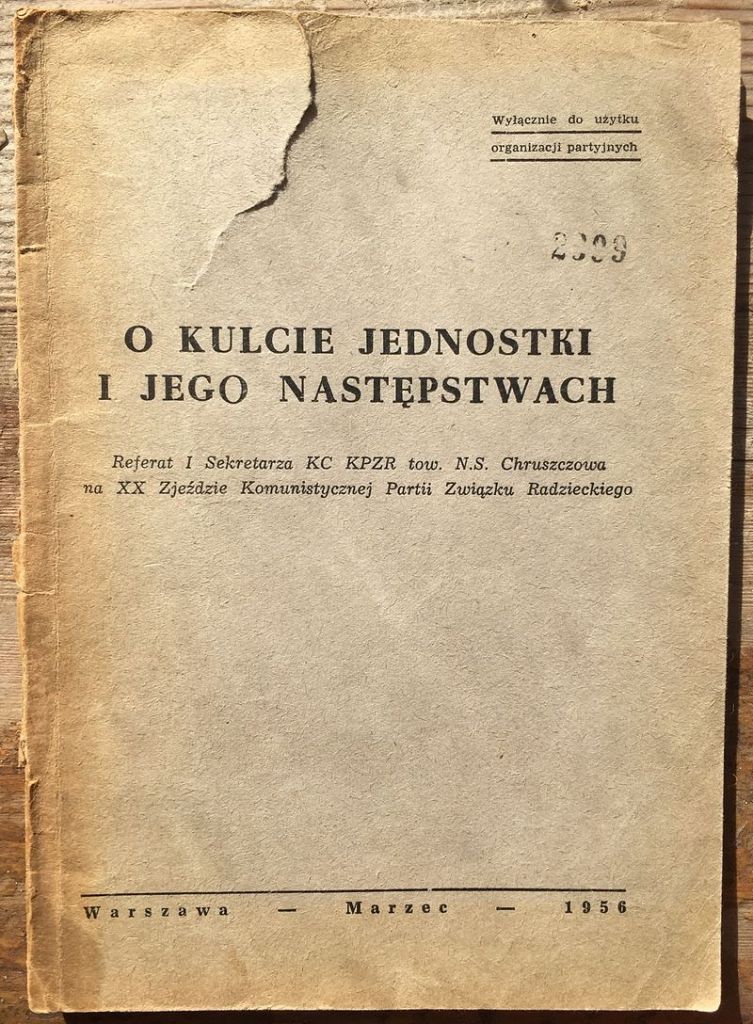
On 25th February 1956, at the closed session of the 20th Congress of the Communist Party of the Soviet Union, Khrushchev gave a speech and report officially called, On the Cult of Personality and Its Consequences. Unofficially, it became known as the Secret Speech. It was the speech that shook the world.

In this speech, Khrushchev did something unthinkable at the time; he started trash-talking Stalin. Even though Stalin had been dead for nearly three years, the Soviet Union had been altered, changed, influenced, and controlled by Stalin’s policies, over the course of decades.

Khrushchev was highly critical of Stalin and the way his followers still worshipped him. He also talked about the negative impacts of the purges, along with spitting out accusations and defamations towards the government.

Khrushchev wanted to introduce some reforms to the nation, which helped to kickstart the Soviet space programme, ease censorship policies, and have more open negotiations and discussions with Western leaders. In saying that, Khrushchev was in power when the Soviet Union went into Hungary to crush the uprising.

I can’t fully emphasise how important Khrushchev’s Secret Speech was, not just for the Soviet Union to move forward, but also to openly criticise the cult of Stalin and the damage Stalin had done to the country.

Drawing a contemporary comparison to the Secret Speech is challenging, as there have been numerous speeches delivered by leaders to their governments over the years, both public and private. With this in mind, I encourage you to make your own comparisons. A part of me believes that there may not be an equivalent to the Secret Speech, given its monumental impact—perhaps it is unparalleled.

Warsaw, March 1956, Polish print of the Secret Speech. Credit: Wikiwlh

Princess Grace

Grace Patricia Kelly was an American stage and screen actress, who gained international fame. She won an Academy Award, three Golden Globes and starred in classic movies like High Noon (1952), Dial M for Murder (1954), Rear Window (1954), and To Catch a Thief (1955), in addition to many television appearances.

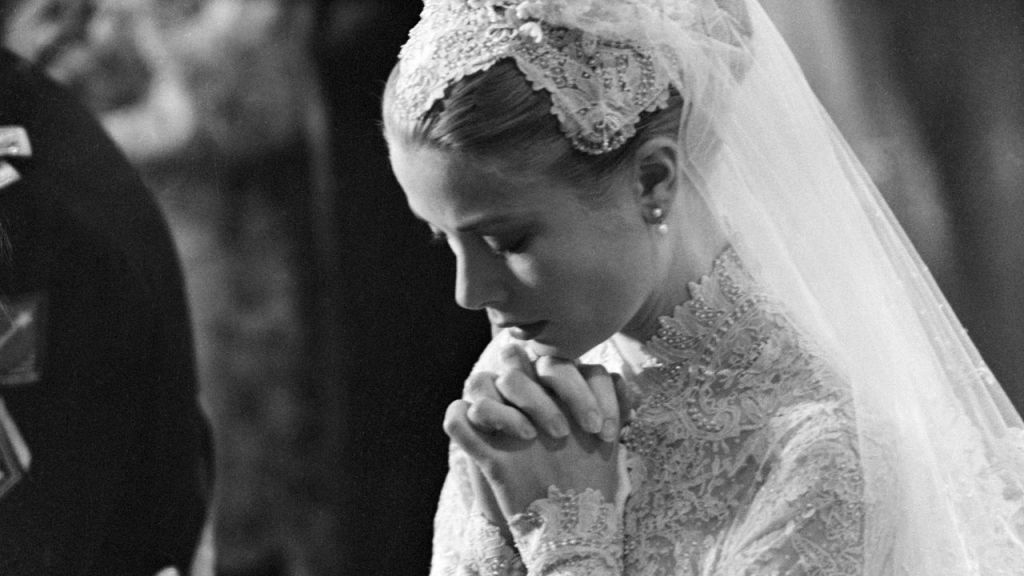
While Kelly was at the Cannes Film Festival in 1955, with the world at her feet, she was invited to a photo session by Prince Rainier III of Monaco, at the Prince’s Palace of Monaco. From there, Kelly and Rainer started dating, and after a year, they were married, with two ceremonies occurring on the 18th April and 19th April 1956.

Kelly is on the list for two reasons; she retired from acting at age 26 years to marry Rainer, with High Society (1956) being her final film. The second reason was that by marrying Prince Rainier III, Kelly got a name upgrade, becoming the Princess of Monaco, though the public called her Grace of Monaco, or simply, Princess Grace.

A modern example of Grace Kelly would be (Rachel) Meghan Markle, the American actress. She married Prince Harry, Duke of Sussex, of the British Royal family, on 19th May 2018. With this marriage, she became the Duchess of Sussex.

Grace Kelly, kneeing at the altar on her wedding day, April 1956. Credit: Getty Images

Peyton Place

This is the first and only book for 1956’s list. Peyton Place was written by Grace Metalious and was released in 1956. Peyton Place deals with a lot of issues, including abortion, adultery, lust, murder, incest and premarital sex, which were subjects that were quite taboo in 1956.

60,000 copies of the book were sold within the first ten days of release, and it remained for 59 weeks on The New York Times best seller list. The subject matter of the book divided many people, with some banning the book; or at least trying to ban it, because of the “shocking and disgusting” themes of the book. Other people were amazed at the material, and loved reading about the sex lives of people, living in a small New Hampshire town.

The book was a best-seller and helped to usher in the sexual liberation movement, along with Metalious’ other works in the franchise. For a 21st century equivalent, maybe Fifty Shades of GreyFifty Shades Darker, and Fifty Shades Freed, by E. L. James, known as The Fifty Shades Trilogy.

Cover of the first edition of Peyton Place. Credit: Simon & Schuster

Trouble in the Suez

There is so much to this entry, I’ll try and cram it all in. The Suez Canal is a 193 km-long waterway, located in Egypt. It links the Mediterranean Sea to the Red Sea, and by definition, Africa to Asia, and Europe to Asia. It is one of the busiest waterways in the world, with an average of 56 vessels traveling the canal per day. Construction on the Suez Canal started in 1859, and 10 years later in 1869, it was completed and opened.

I could be oversimplifying this, but the Suez Crisis, as it was called, started on 29th October 1956. At the time, the canal was operated by Egypt, with the backing of the United Kingdom and France. After the 1952 Egyptian revolution, our old friend, Gamal Abdel Nasser Hussein, from the 1953 blog post, was in power in 1956.

Basically, Egypt was flirting with the Soviet Union, so the United Kingdom and the United States got jealous of this, and removed their funding for the Aswan Dam. Nasser decided to play the game as well, and nationalised the canal on 26 July 1956, from the British and French company that controlled it.

He then transferred it to the Suez Canal Authority and closed the Straits of Tiran to all Israeli ships, because of the ill will of the 1948 Arab–Israeli War, also known as the First Arab–Israeli War.

This was as popular as employing zombies as babysitters. The international community, namely the United Kingdom, France, and Israel invaded Egypt to take control of the Suez Canal. This become known as Second Arab–Israeli War, and lasted from 29th October to 7th November 1956. It didn’t last for long, but the damage was significant. At the end of the fighting, Egypt was still in control of the Suez Canal.

Pressure applied by the United States, the Soviet Union, and the United Nations, along with Egypt’s war effort, forced the three countries to retreat. The war strengthened Nasser’s position in the Arab world, but it also humiliated the British and French invasions.

Their roles as the world’s superpowers had ended, with the United States and the Soviet Union, having emerged as the two prominent superpowers in the world.

The Suez Crisis resulted in 3,200 deaths, with 177 of those deaths on the Israeli side. The crisis also left around 5,500 people wounded and around 6,000 fighters taken hostage.

The legacy of the Suez Crisis is still being felt in 2025, which is covered by two current events. The first is about the Gaza Strip. At the time, Gaza was controlled by Egypt, after the First Arab–Israeli War.

During the invasion of Egypt, Israel gained control of the Gaza Strip and Egypt’s Sinai Peninsula. Israeli forces held a four-month-long occupation of the region, before withdrawing, but not before winning freedom of navigation through the Straits of Tiran.

Years later, Israel recaptured and occupied the Gaza Strip and has never left. The Israeli military occupation of Gaza in 2025, is still relevant as it was with the wars in 1973, 1967 and 1956.

The second event is the escalating crisis concerning the Panama Canal. The United States government is demanding that the canal be handed over to them to ensure that the Panama Canal Authority is not influenced by China or other foreign countries and companies.

Will this be a repeat of the Suez Crisis, or can common sense and negotiation prevail? With the current US president, who the hell knows?

Credit: The Los Angeles Examiner

So for 1956, we covered a French actress, a failed revolution, a bus boycott, a speech, an American actress, a book, and a 10-day war. The more things change, the more they stay the same. 1957’s historical references are just as crazy as 1956, but that’s for next month.

And that’s it for another week. Thanks again for reading, following, and subscribing to Some Geek Told Me. I’m still lurking about on Twitter and Mastodon, so drop in to say hello.

Please remember to walk your dog, read a banned book, Slava Ukraini, and just like last time, go and tell a Nazi to fuck off. I’ll see you next week because I’m doing the Captain America: Brave New World: Movie preview. The preview should be terrible. Awesome.


A 78-year-old convicted felon gets his facts wrong

Welcome back to New Zealand’s 5th least favourite website! I’ve had my break, so Some Geek Told Me is ready for 2025, with more incoherent rants and poorly written topics. I was going to start with something a lot more positive, but my OCD got the better of me.

You see, a certain 78-year-old convicted felon held a press conference the other day and made some fascinating and entertaining statements that were, in the nicest way possible, incorrect.

Before I stumble my way through this blog post, I need to go over something with you. A few weeks ago, I posted a blog about TIME’S Person of the Year. When talking about a certain 78-year-old convicted felon, I said,

Any attention that man gets is good attention, because it means people are talking about him, and that’s what he wants. And we have all given it to him, which is why he has dominated the news cycle.

By ignoring his crazy rants and lies, along with his illegal dealings, we are condoning his behaviour; therefore, we are enabling him. By calling out his crazy rants and lies, along with his illegal dealings, he can play the “I’m a billionaire victim because the false news and the deep state are out to get me” card; therefore, we are enabling him.

He’s like a male succubus, but instead of feeding and living off sexual energy and activity, he thrives on communication. The more people discuss him, the stronger he becomes. His ego feeds off the attention.”

Moving forward into 2025 and beyond, I’m going to talk about him, without talking about him. I’m going to do this by doing two things:

  • If his behaviour is truly that terrible, I will name him. Otherwise, I will do my best to avoid naming him. Words have power, so I won’t give him any more attention than he needs or deserves, starting with his name.
  • If I discuss his antics, I won’t repeat the lies or absurdities; instead, I will provide a counterpoint or the truth to his unfounded claims. For instance, if he were to say, “We’re going to cure people of being gay because it’s a disease,” or “Vaccines are immoral and illegal,” or “Sour Cream and Chives is the greatest flavour in the world,” I will not echo the falsehoods.
  • Instead, I will explain that homosexuality is not a disease, vaccines are legal and one of humanity’s greatest inventions, and as for the last claim, I’ll make an emphatic argument in favour of Salt and Vinegar.

What I’m trying to say is that if he or anyone from the League of Losers makes a false statement or says something that’s utterly outrageous, I won’t repeat it here. Instead, I’ll counter with his kryptonite: facts and logic. Even if Mark Zuckerberg no longer agrees with it, I believe that #FactsMatter.


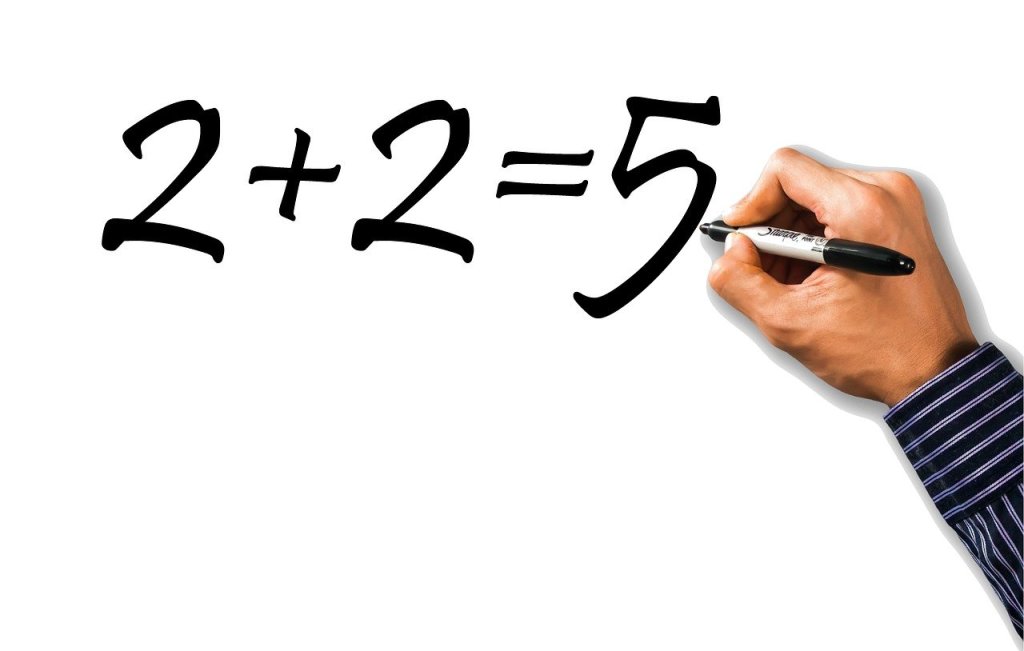
Image by Tumisu from Pixabay

So, without further delay, let’s establish the facts over six things the famous 78-year-old convicted felon boasted about at his recent press conference concerning the Western Hemisphere. Someone is in big trouble for showing him either a globe or an atlas.

1.) There is no scientific evidence of any type to suggest that wind turbines hurt or kill whales, let alone drive them crazy.

Credit: ABC

2.) There is no criminal evidence of any type to suggest that Hezbollah were involved in the United States Capitol attacks and riots on 6th January 2021.

Rioters storm the Capitol on Jan. 6, 2021. Credit: Ricky Carioti / The Washington Post via Getty Images file

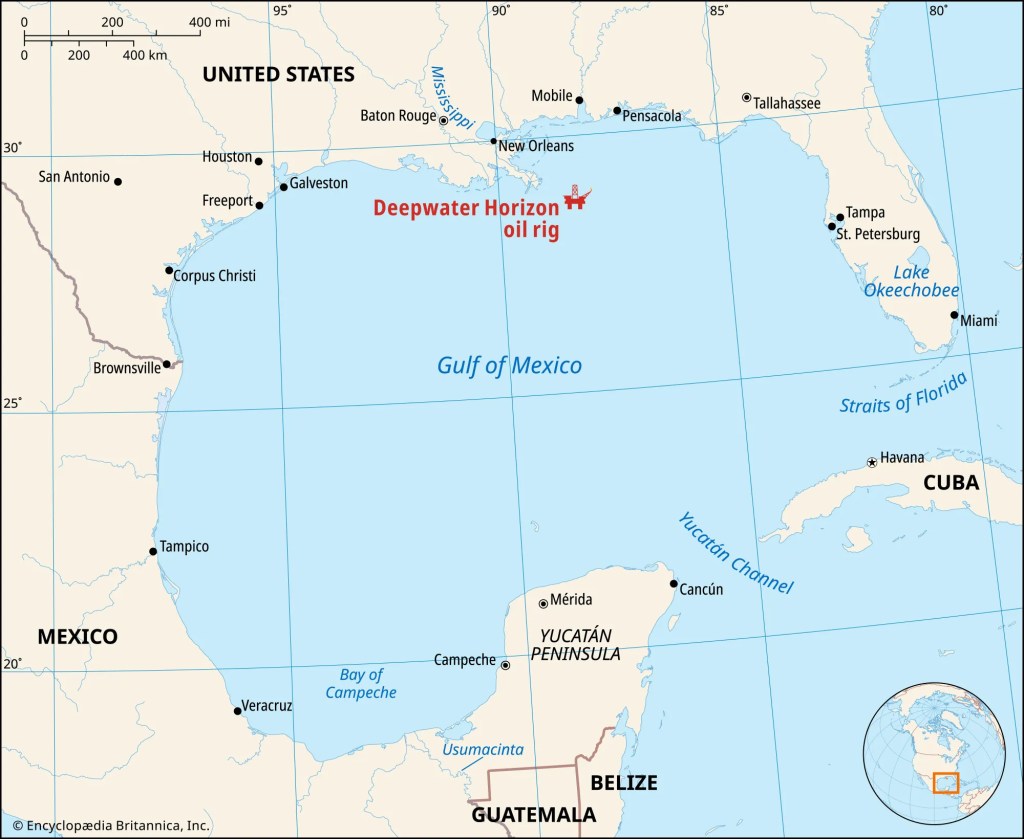
3.) The Gulf of Mexico shares a border with Mexico, Cuba, and the United States. The gulf’s name first appeared on maps used by Spanish explorers from the 16th century. Apparently, there is a map that displays the name, Gulf of Mexico, from 1607.

No single individual can change the name of a body of water. Such a decision would need to be made by a recognised authority, like the International Hydrographic Organization. Even if the United States were to change the name from the Gulf of Mexico to the Gulf of America, countries like Mexico, Cuba, and others around the world would not be obligated to adopt the new name.

Millions, if not billions of dollars would be wasted in changing maps, websites, and books to alter the name, which only one country on the planet would use. And there’s no guarantee it would last because the next administration could just change it back.

Map of the Gulf of Mexico. Credit: Encyclopædia Britannica, Inc.

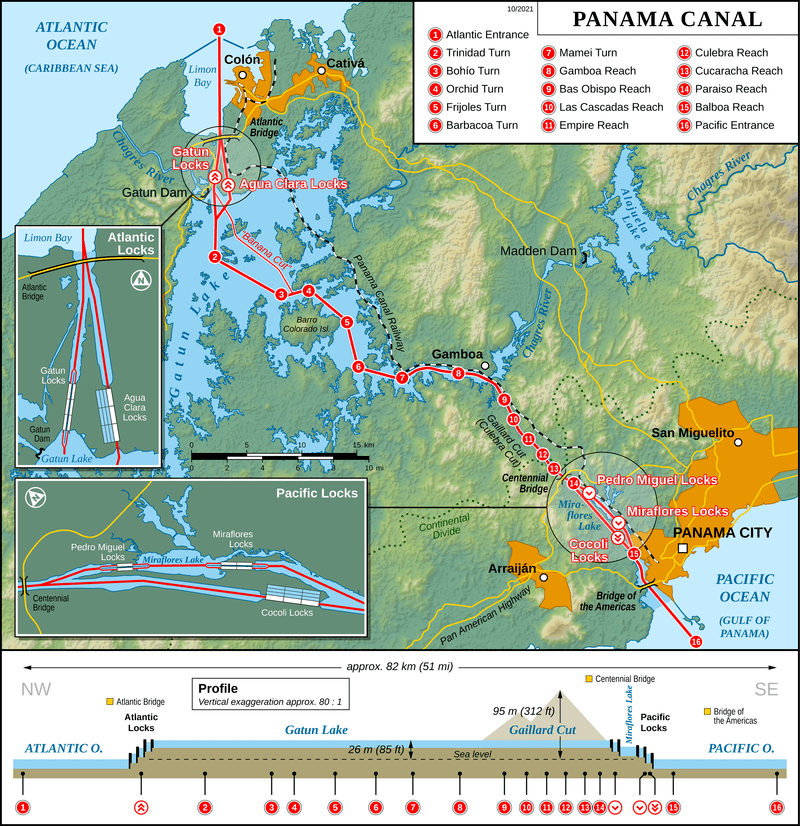
4.) The Panama Canal, to everybody’s surprise, is located in Panama. It’s a shortcut that allows ships access to the Atlantic and Pacific Oceans, through the use of locks. Construction started in 1904 and was only finished in 1914, at a cost of roughly, at the time, US$500 million.

The waterway stretches 82 km, and it is vital to shipping and trade around the world. Yes, it is true that the United States did build the canal in Panama, through negotiations for economic, geopolitical, and strategic reasons, among others.

It’s also true that the United States owned and administered the Panama Canal, which was a very lucrative operation for them. That changed in the 1970s when President Jimmy Carter transferred the administration to a joint agency of the United States and Panama. Panama gained full control of the canal in 1999. 

It’s been recently criticised that Carter was wrong and stupid for giving up control of the Panama Canal for nothing, but there were valid reasons for this.

  • Carter wanted to show the countries of Central and South America, that the United States was their friend and ally, not a bully. Basically, it was because of peaceful diplomacy.
  • The 1956 Suez Canal crisis, reinforced the notion that the world’s waterways should be neutral and for everybody; even communist countries like the Soviet Union and China, to prevent them from constructing their own canals.
  • The cost of keeping and maintaining the Panama Canal, especially since the introduction of nuclear silos, instead of deploying warships with nuclear weapons, meant that administering the canal outweighed the benefits.

The Panama Canal is owned by the Government of Panama, and operated by the Panama Canal Authority, not the Chinese Government. The United States has no legal right to annex the Panama Canal.

Map of the Panama Canal Credit: Thomas Römer

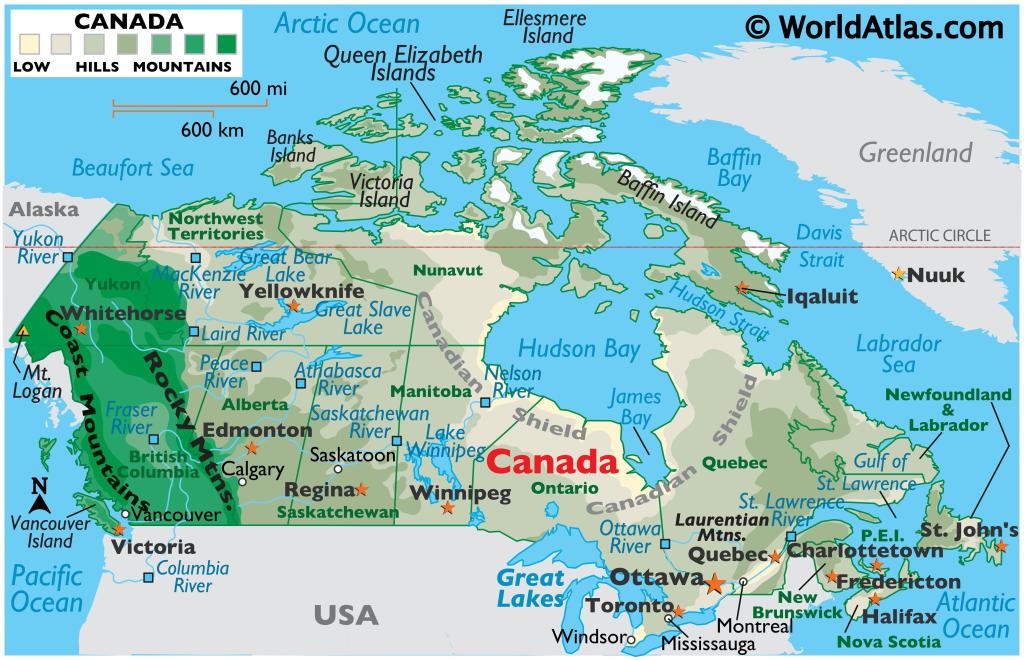
5.) Canada is the United States’ northern neighbour and shares the world’s longest international land border with them. Canada is made up of 10 provinces and 3 territories and has a population of about 40 million people. The country’s head of government is the Prime Minister, currently Justin Trudeau, but not for long; while the Governor General is Mary Simon, and the Monarch is King Charles III.

Although Canada and the United States are distinct independent sovereign countries, they share significant cultural and historical ties, as well as being crucial trading partners, allies, and friends. Both countries must address the harm done to Indigenous and First Nations peoples, but their relationships with the United Kingdom have varied. This has led the two countries into conflict with each other.

Having said that, the Dominion of Canada is not the United States of America, and the United States of America is not the Dominion of Canada. The United States has no legal right to annex Canada.

Canada is also a member of NATO, which means if the United States, a member of NATO itself, invades or attacks Canada, Canada could invoke Article 5 of the NATO charter, so all of the other charter NATO members will come to the defence of Canada, against the United States.

Map of Canada Credit: WorldAtlas

6.) Greenland is the world’s largest island at 2,166,086 km2 and has a population of 55,000 people. Greenland is physically and geographically closer to North America, but it is economically and politically tied to Europe, Denmark in particular.

Greenland is an autonomous territory of Denmark, but it has an interesting history because people have lived in Greenland for at least 4,500 years. However, in the context of the Greenland/Denmark debate, the following history is this:

  • In 1721, the first Danish settlement was established in Greenland.
  • In 1814, the Treaty of Kiel (Unification with Denmark) brought Greenland formally under Danish control.
  • In 1940, Nazi Germany invaded and occupied Denmark, cutting links to Greenland. The United States steps in and administers the island.
  • In 1945, after Nazi Germany’s surrender, Denmark is given control back over Greenland, but the United States kept a base of operations there.
  • In 1949, Denmark joined NATO.
  • In 1953, having integrated with Denmark and representation in the Danish parliament, the citizens of Greenland were also citizens of Denmark.
  • From 1979-2008, Greenland attains home rule and greater autonomy.

Simply put, Greenland has autonomy, but it has limits and restrictions, as it’s still formally under Danish control. There has been a push for greater autonomy for Greenland, in the form of independence, over the last decade.

Having said that, the United States has no legal right to annex Greenland, and just like Canada, if it did, Denmark could invoke Article 5 of the NATO charter, so all other charter NATO members would come to the defence of Denmark, against the United States.

Now why this 78-year-old convicted felon said those inaccurate statements, could be boiled down to five things:

a.) He made up some of those things on the spot to sound powerful and important, forgot what he said, read about what he said, and then talked about what great ideas they were, so he’ll take the advice and follow them through.

b.) He knows how to gaslight and scare people and the media, so he has no intention to follow through with any of them. He’s saying it because he can, just for shits and giggles since there is no such thing as bad attention for him. He loves and craves the drama.

c.) He’s serious about some of them, and less so about the others, but it’s the media’s job to figure out which ones are which.

d.) He’s honestly going to invade Canada, annex Greenland and the Panama Canal, and rename the Gulf of Mexico.

e.) The whole thing is a distraction, to stop people from realising that his campaign promises will go unfulfilled, like ending the war in Palestine and Ukraine quickly, decreasing the cost of groceries and fuel, and increasing employment.

Credit: BBC

As for the correct answer, take your pick, because maybe he doesn’t even know. Anyway, buckle up because the next four years will be chaos.

That’s another rant for another week. Thanks again for reading, following, and subscribing to Some Geek Told Me. Please be generous and donate to the aid and refugee funds for the conflicts in Sudan, Palestine, and Ukraine, as well as for the emergency responses in Tibet and California.

Look after yourself and I’ll see you next week, because nobody’s favourite Tour of the Solar System is back!


TIME’s Person of the Year is not what you think it is

I realise there are more pressing issues confronting the world currently. These include the danger of climate change, the Sudanese civil war, the cryptocurrencies of Cristiano Ronaldo and the Hawk Tuah girl, Israel’s genocide of Palestine, when the Superman trailer is going to drop, and whether The Lord of the Rings: The War of the Rohirrim, will rule them all at the box office.

In saying that, I must acknowledge last week’s announcement of TIME’s 2024 Person of the Year. If you’ve been living under a rock or listening to Chumbawamba’s Tubthumping at full volume for a week, then you would have heard that the lucky winner was 2016’s winner, Donald John Trump. You know, the star of Zoolander, Home Alone 2: Lost in New York, Two Weeks Notice, The Little Rascals, and Eddie.

As you can imagine, the concept of Donald Trump winning TIME’s 2024 Person of the Year, has delighted millions of people and equally enraged millions more. On one hand, people are praising the decision, because he’s the OG of MAGA, defeated Kamala Harris in the US Presidential election, survived an assassination attempt, and is the proud father of three of his five children.

On the other hand, Trump’s been busy. He was convicted on 34 felony charges for falsifying business records related to hush money payments to a porn star, found liable for sexual assault and defamation, and has more legal issues concerning the IRS, and the Trump Organisation, among others.

So the two questions on many people’s minds are, yes, bananas do grow upside down, but also, why was a convicted felony and President-elect selected as TIME’s 2024 Person of the Year? Sadly, the answer is boring and nuanced, because, and say it with me, TIME’s Person of the Year is not what you think it is.


Credit: TIME

Let’s go back a few steps to 1927, when TIME, the American news magazine, first introduced the award of Person of the Year to Charles Lindbergh.1 Now you would think gracing the cover of TIME for the Person of the Year, would be a great honour, worthy of the amazing contributions you have made to humanity for the past year.

Again, you could imagine that it was because you had developed a vaccine, brokered a peace treaty and ended a war, discovered a new early human species, won the World Cup, was the star of a $2 billion blockbuster, or won an election. If you thought this, you would be wrong, oh so wrong.

According to TIME editors, to be awarded Person of the Year, you need to fit this criteria:

“Featuring a person, group, idea, or object that “for better or for worse … has done the most to influence the events of the year.”

I’m going to let that sink in for you. Influence the events of the year. Not curing children’s diseases; not clearing mines from a warzone; not freeing sex slaves; not persecuting racists, like the Ku Klux Klan, or Neo-Nazis; not developing carbon capture devices; or not fighting for human and animal rights; but influence the events of the year.

After reading that, and for better or for worse, tell me that person(s) is not Donald Trump. Did I want it to be him? Of course not, because both my grandfathers would return from the grave to beat some sense into me if I did.

However, this is the reason Donald Trump was awarded the title; not because he’s a good, honest, positive, decent, law-abiding and amazing person, but because he has dominated the news cycle in 2024. He really has. Even here in New Zealand, we have read and watched his shenanigans this year, whether they were election-based or legal-based.

To highlight the selection, I give you two quotes from TIME”s website on the announcement, to better explain the choice from their point of view:

“For 97 years, the editors of TIME have been picking the Person of the Year: the individual who, for better or for worse, did the most to shape the world and the headlines over the past 12 months. In many years, that choice is a difficult one. In 2024, it was not.”

“Today, we are witnessing a resurgence of populism, a widening mistrust in the institutions that defined the last century, and an eroding faith that liberal values will lead to better lives for most people. Trump is both agent and beneficiary of it all. For marshaling a comeback of historic proportions, for driving a once-in-a-­generation political realignment, for reshaping the American presidency and altering America’s role in the world, Donald Trump is TIME’s 2024 ­Person of the Year.”

Nobody on the planet had dominated and influenced the news cycle in 2024 more than Donald Trump. Even Palestine was drowned out by the MAGA Emperor. Using TIME’s definition of “Featuring a person, group, idea, or object that “for better or for worse … has done the most to influence the events of the year”, Donald Trump is the clear winner.

I know this decision has upset people, but I want to leave you with two things; one negative and one positive. If you’re angry about the choice, don’t blame Trump. He’s a 78-year-old narcissist, who doesn’t have the need, desire, or ability to change.

Don’t blame TIME, by trash-talking or boycotting them. It’s their rules and they are just following them.

If you want someone to blame for Trump winning this award, blame yourself. Blame your parents, children, spouse, siblings, neighbours, and politicians. Blame teachers, lawyers, journalists, reporters, scientists, librarians, talk show hosts, activists, social influencers, podcasters, singers, actors, and world leaders, for this mess.

You could blame everybody and anybody you’ve ever talked to in the last 10 years. Hell, you can even blame me. The reason is that all of these people, regardless of their political philosophy and beliefs, or mine, all have something in common: whether it’s positive or negative, we all talk about Trump.

Any attention that man gets is good attention, because it means people are talking about him, and that’s what he wants. And we have all given it to him, which is why he has dominated the news cycle.

By ignoring his crazy rants and lies, along with his illegal dealings, we are condoning his behaviour; therefore, we are enabling him. By calling out his crazy rants and lies, along with his illegal dealings, he can play the “I’m a billionaire victim because the false news and the deep state are out to get me” card; therefore, we are enabling him.

He’s like a male succubus, but instead of feeding and living off sexual energy and activity, he thrives on communication. The more people discuss him, the stronger he becomes. His ego feeds off the attention. But hey, what do I know? Even writing this stupid post will probably mean Trump will reach Super Saiyan God status now.

As for the positive part, just remember that even though Trump won this award, he joins some other previous top-quality winners of the award like Chiang Kai-shek and Soong Mei-ling (1937), Adolf Hitler (1938), Joseph Stalin (1939 and 1942), Richard Nixon (1971 and 1972), Henry Kissinger (1972), Ruhollah Khomeini (1979), Jeff Bezos (1999), Vladimir Putin (2007), and Mark Zuckerberg (2010).

Trump and the rest of the League of Losers can’t hold a candle to recent winners like The Ebola Fighters (2014), Angela Merkel (2015), The Silence Breakers (2017), and Greta Thunberg (2019); along with my favourites, The Protester (2011), The Guardians (2018), and Volodymyr Zelensky and The Spirit of Ukraine (2022).

And with that, I’m going to shut my mouth and go to bed. We are well into Summer here, which I’ll discuss somewhat next week. Thanks again for reading, following, and subscribing to Some Geek Told Me. Please remember to walk your dog, read a banned book, keep watching Syria and Palestine, and I’ll see you next week. Christmas is coming!


1 The award was actually first named Man of the Year, but eventually, equality caught up.

We Didn’t Start the Fire: 1955

And here we go again! One of my infamous bad ideas is still continuing to pay dividends, with the 7th entry detailing the historical references in We Didn’t Start the Fire by Billy Joel. Yes, I know the song is 35 years old, and other people have already done this before, but they haven’t done it this badly.

For the uninitiated, here are the previous entries:

Because you’re clever and eat carrots, you will realise we are up to the glorious year of 1955. And just like last time, strap yourself in because I’m going to be firing some facts at you! Good luck!


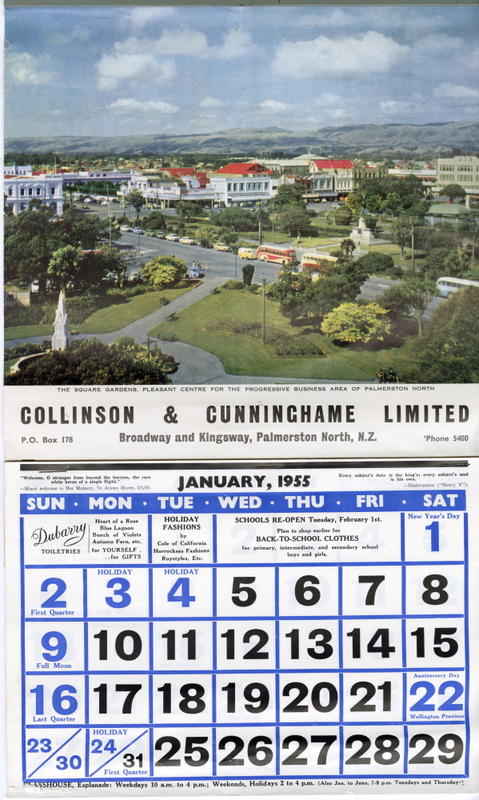
Credit: Collinson & Cunninghame Ltd: Publisher

1955

Albert Einstein 

Arguably, the most famous scientist of the 20th century, if not for the last 3,000 years, was Albert Einstein. Born in 1879, Einstein was a theoretical physicist who researched and published work on the photoelectric effect, Brownian motion and the Einstein relation, special relativity, the principle of mass-energy equivalence (E=mc2), statistical mechanics, and many more outstanding contributions to science.

I would be as mad as a guest at one of the Mad Hatter’s tea parties if I didn’t mention his work on general relativity, which changed the world. Einstein’s theory of general relativity was once described as, “…the highest intellectual achievement in the history of humanity.” In my poor opinion, I believe it’s an accurate statement.

Einstein died on 18th April 1955, at Princeton, New Jersey, USA. In scientific and academic circles, Einstein was a rock-star scientist, and he crossed over to become a pop culture icon. For the death of a modern famous scientist, I’m going to offer the late great British theoretical physicist and cosmologist, Stephen Hawking, who died in 2018.

Albert Einstein (1879-1955) at home in Princeton. 1944. Credit: Unknown

James Dean

1955 was a difficult year for science lovers and movie fans because just five months after Einstein died, James Dean died on 30th September 1955, aged only 24 years old.

Dean was a Hollywood heartthrob, who had a bad boy image. He became a professional actor in 1951, and his acting experience covered theatre, television, and film. In saying that, the two films, East of Eden and Rebel Without a Cause, helped to boost his rising star into the stratosphere, both being released in 1955.

Dean was driving his new Porsche 550 Spyder on U.S. Route 466, when he crashed at the junction of SR 46 and SR 41 near Cholame, California. His passenger, Rolf Wütherich, survived and sustained multiple injuries, but Dean was killed instantaneously.

A contemporary example would be the actor, Paul Walker, who died in a car accident on 30th November 2013.

James Dean in the 1955 film “Rebel Without a Cause.” Credit…John Kobal Foundation/Hulton Archive, via Getty Images

Brooklyn’s got a winning team 

We’re going to break free of celebrities dying and focus on a sports team. A baseball team to be precise. In the 1950s, the Brooklyn Dodgers were a Major League Baseball team operating out of, you guessed it, Brooklyn, in New York City.

They were in the National League, where they had won the pennant 10 times previously. However, 1955 was a big year for the Dodgers, because they won the National League again, but this time over the Milwaukee Braves. In the World Series, they met the New York Yankees, which was the fifth time in nine years that the Dodgers and the Yankees met in that format.

The 1955 World Series was special for the Dodgers, since they defeated their rivals 4-3, winning the trophy for the first time. If you remember Roy Campanella from the 1953 post, you’ll also remember that Campanella played for the Brooklyn Dodgers.

In 1957, the New York Giants and the Brooklyn Dodgers moved to California, becoming the San Francisco Giants and the Los Angeles Dodgers.

I’ve said this before, but baseball is not in my wheelhouse of expertise, so I’ll leave it up to a baseball fan to give us a modern equivalent for the 1955 Brooklyn Dodgers, because I have no idea. However, I do know that the Los Angeles Dodgers won the 2024 World Series, beating the New York Yankees again, 4-1.

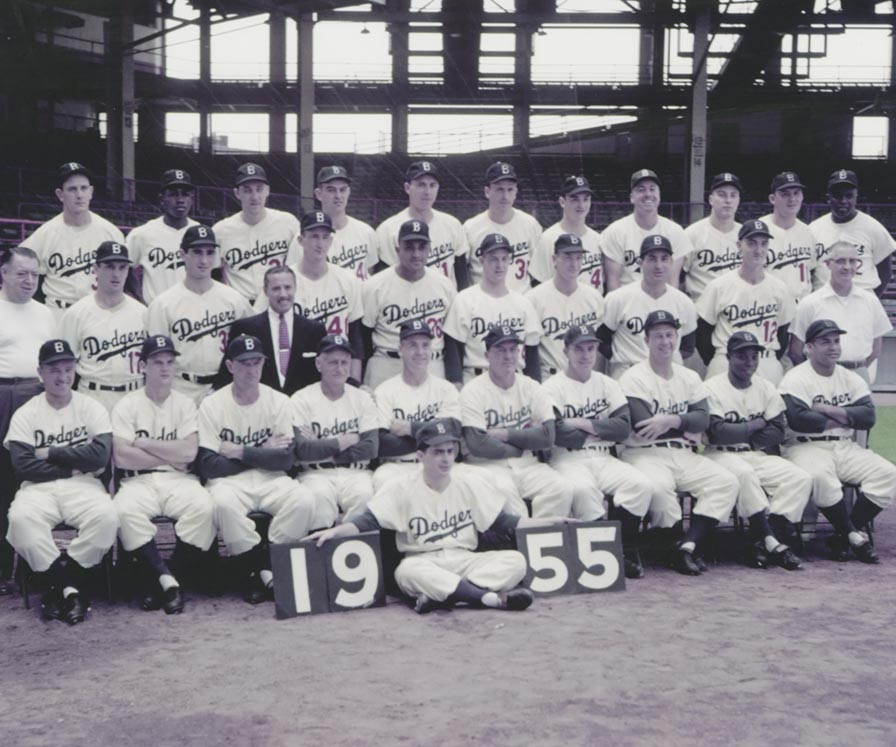
The team photo of the 1955 World Champion Brooklyn Dodgers at Ebbets Field. The Dodgers won their first World Championship in Brooklyn. Credit: walteromalley.com

Davy Crockett

This is an odd one, but I’m sure we’ll bumble our way through it. The great Davy (David) Crockett was a folk hero in American culture, being a politician, militia officer and frontiersman, from 1786-1836. He became famous for his hunting, coonskin cap, politics, military service, and his death, at the Battle of the Alamo.

In 1954, a television mini-series named Davy Crockett was released, and it became extremely popular as Davy Crockett-mania swept the United States, with Davy Crockett merchandise exploding everywhere. The show had five episodes, with Fess Parker starring as the “King of the Wild Frontier.”

In 1955, Walt Disney Productions edited and recut the original first three episodes into a theatrical film named Davy Crockett: King of the Wild Frontier. The film made $2.15 million at the box office, which would be $25.3 million today, adjusted for inflation.

In contemporary times, turning a television programme into a movie, via means of a reboot, is commonplace now. Just look at 21 Jump Street, Alvin and the Chipmunks, Baywatch, Charlie’s Angels, and so many more.

But even though Hollywood of 2024 can be guilty of rehashing and rebooting movies, as well as pumping out sequels, editing episodes of a television show and repackaging them as a theatrical film, is a line that Hollywood of 2024 would not cross. Maybe.

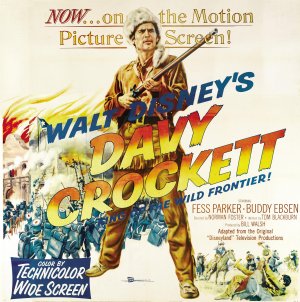
This is a poster for Davy Crockett, King of the Wild Frontier. Credit: Walt Disney Studios

Peter Pan

The character of Peter Pan, the leader of the Lost Boys, and eternal foe of Captain Hook, has been translated into many mediums over the years, such as plays, literature, animated and live-action films, and television programmes, since his creation in 1902.

On 7th March 1955, NBC Television did something quite radical. The Peter Pan Broadway Show was ending soon, so the studio decided to broadcast a television adaption of Peter Pan, using the original Broadway cast.

What makes this production so special, was that it was broadcast live and in colour. It amassed 65 million viewers, even though colour television sets were still developing in popularity. It was such a success, that NBC did it again in 1956 for a second live broadcast.

Comparing this reference to a modern one is difficult because live colour broadcasts are the standard for television viewing in 2024, however the ability to stream your favourite television programmes via devices like tablets, computers, or phones, has changed the way people interact with the world, but also how we consume our entertainment, for good or for ill.

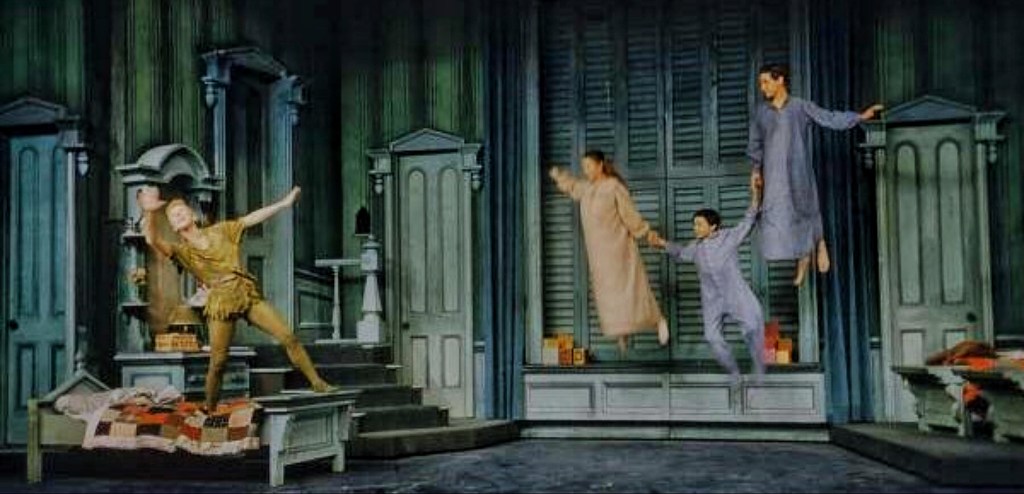
Mary Martin, Kathleen Nolan, Joseph Richard Stafford, and Robert Harrington in Peter Pan (1955) Credit NBC Studios

Elvis Presley

It’s taken us until 1955, but we are ready to talk about the King of Rock and Roll, Elvis Presley. Like James Dean, Presley’s star power was developing, so on either 20th or 21st November 1955, aged only 20 years old, Presley signed a record contract with RCA Records. Although he was legally a minor, technically, his father signed the contract.

His previous contract with Sun Records was purchased for $40,000, which was audacious for the time. During this period, Presley also signed a contract to create two new music businesses to showcase his musical talents and to expand his growing stardom.

I’m not down with the kids today, but some contemporary equivalents would be Justin Bieber, Adele, or Rihanna.

Elvis signs his first contract with RCA Records. Credit: Graceland

Disneyland 

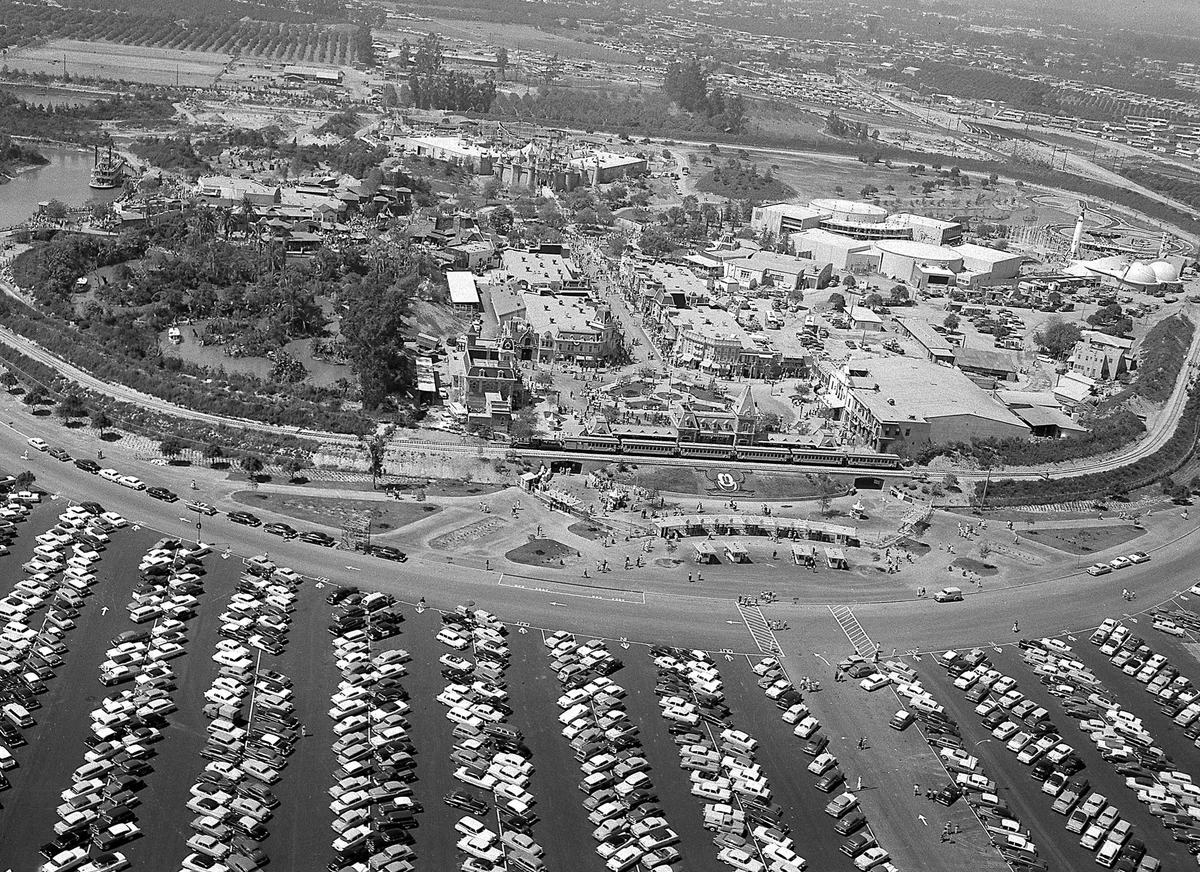
Disneyland opened on 17th July 1955, in Anaheim, California, USA. It was the first theme park created by the Walt Disney Company and the only one that Walt Disney personally designed and constructed.

It took only a year to build for $17 million, which adjusted for inflation, works out to be around $153 million. 28,000 people attended the opening, but things didn’t go exactly to plan, with several mistakes happening, which drew negative attention and press.

Walt Disney went on to refer to the opening day as Black Sunday. In 2024, there are six Disney theme parks located in California, Florida, (United States) Hong Kong, Tokyo (Japan), Paris (France), and Shanghai (China).

An aerial view shows Disneyland as guests attend opening-day festivities in Anaheim, California, on July 17, 1955. Credit: Associated Press.

So for 1955, we covered the deaths of a theoretical physicist and an actor, a baseball team, a movie, a television broadcast, a music contract, and a theme park. This took longer than I had anticipated, so 1956 isn’t going to be any easier. Cool.

And that’s it for another week. Thanks again for reading, following, and subscribing to Some Geek Told Me. I’m still haunting Twitter and Mastodon, so please drop by for some useless daily information.

Before I go, keep your eyes on Syria, because after ruling and brutalising the country for 24 years, Bashar al-Assad has been overthrown and fled to Russia. Having survived 13 years of civil war, will Syria be able to keep moving forward with progress, justice, and democracy, or will Assad’s absence cause more conflict? I have no idea, but I hope it’s the former and not the latter.

Please remember to walk your dog, read a banned book, go and tell a Nazi to fuck off, and I’ll see you next week. Christmas is coming!


We Didn’t Start the Fire: 1954

Because of various reasons, I got distracted last month, which to be fair, was the constant statement throughout my school reports. This distraction meant we didn’t have a We Didn’t Start the Fire blog post, which will soon be fixed. I’m not sure if Billy Joel would approve.

Just like an ejection seat in a helicopter, my We Didn’t Start the Fire references are a bad idea. Nevertheless, it’s back for another month. Previous chapters in this ongoing mess include:

If you’ve been keeping score, we looked at 1953 last time, so we’re moving on to 1954. So, strap yourself in because it’s going to be a bumpy ride! And away we go!


Credit: Jay Blotcher/Twitter

1954

Roy Cohn:

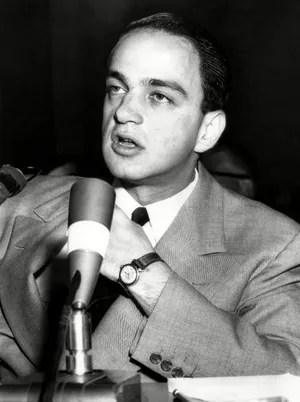
We’re going to kick 1954’s references off with Roy Cohn, who was an American prosecutor and lawyer. To me, Cohn is famous for a few odd things. Hopefully you remember Joseph McCarthy, the communist-hunting senator from the 1950 list. It may not come as a surprise, but not only did Cohn and McCarthy know each other, Cohn worked as chief counsel for McCarthy in the 1954 Army–McCarthy hearings.

The hearings were a political embarrassment for McCarthy and his anti-communism policies, so after the hearings had finished, Cohn fell on his sword and resigned from McCarthy’s staff. This caused a minor scandal across the country, which led Cohn to work as an attorney in New York City.

Do you remember the Rosenbergs (Julius and Ethel Rosenberg) from the 1951 list? Take three guesses to name one of the prosecutors involved in their case. That’s right, it was Cohn.

For a modern context, I previously referred to Joseph McCarthy as everybody’s favourite convicted felony and ex-president, Donald Trump. So, if Trump is McCarthy, then Cohn would be Michael Cohen; if you follow my logic.

Roy Cohn speaking at the Army-McCarthy hearings in 1954. Credit: Everett/Shutterstock.com

Juan Perón:

Juan Perón served as President of Argentina from 1946 to 1955 and then again from 1973 to 1974. He is a significant figure in the history of Argentina and Latin America, with a complex legacy. His policies, known as Peronism, evolved, and he eventually became a dictator. Additionally, he provided refuge to wanted Nazi war criminals, contributing to the ongoing crisis.

During his second term in 1954, Perón was becoming less popular, while Argentina faced economic problems like high inflation, huge debt, and a decrease in productivity. Perón was also having trouble with the Roman Catholic Church. He pushed for the decriminalisation of divorce and prostitution; deported two Catholic priests; promoted a constitutional amendment to separate State and Church; publicly accused bishops and priests of sabotaging his government; and suppressed religious education in schools. He was a busy guy.

Perón was finally deposed in a coup d’état in 1955, mainly because of the bombing of Plaza de Mayo by Argentine military aircraft, which killed over 300 people.

A modern equivalent is somewhat difficult because sadly, we have many choices to select from, like Alexander Lukashenko, Bashar al-Assad, Kim Jong Un, Slobodan Milošević, Vladimir Putin, Augusto Pinochet, Pol Pot, Francisco Franco, Teodoro Obiang Nguema Mbasogo, Muammar Gaddafi, or Idi Amin. Take your pick, because they all suck.

President Juan Perón. Credit: Unknown

Arturo Toscanini:

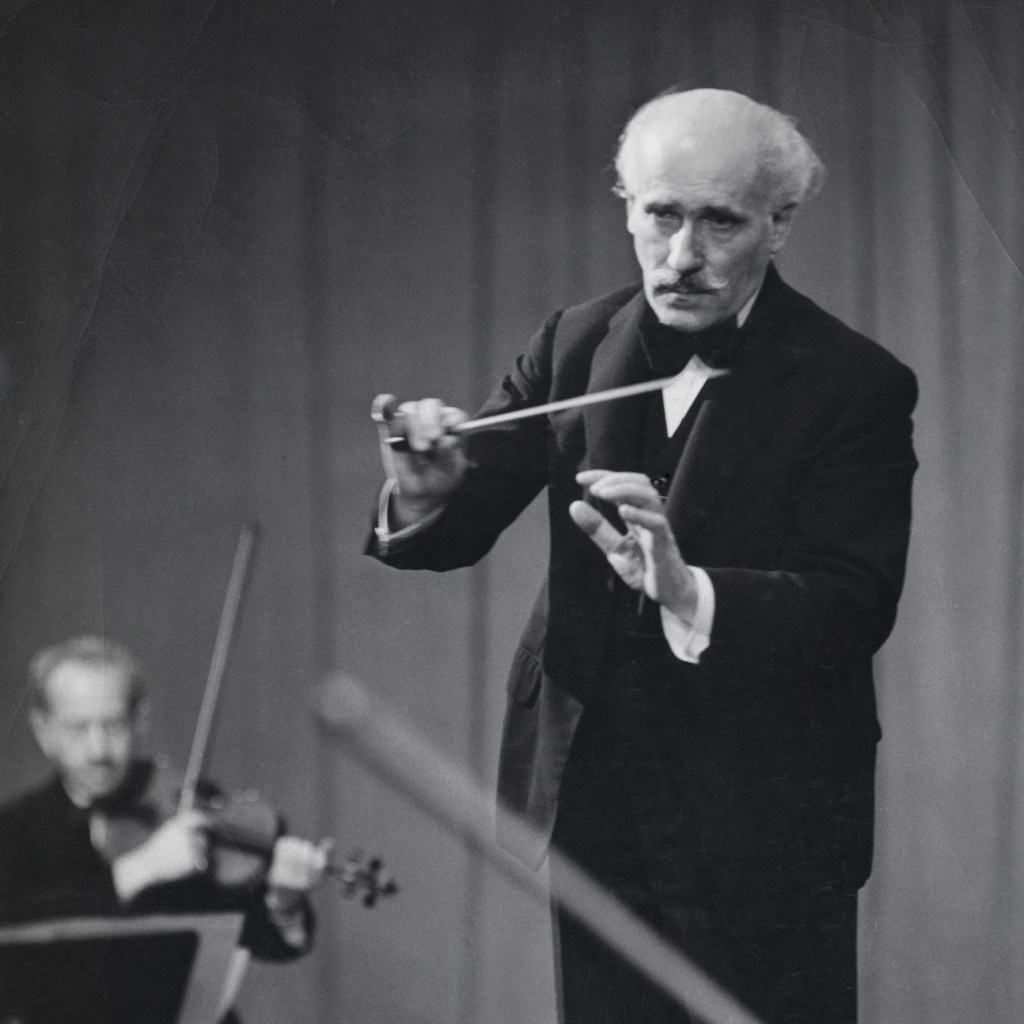
The beloved Arturo Toscanini was one of the most famous conductors on the planet. After years of working around the world, Toscanini moved to the United States. He worked with several symphony orchestras before securing a position with the NBC Symphony Orchestra, which was a radio orchestra.

This job lasted from 1937 to 1954 when Toscanini stepped down from the position of conductor and retired at 87 years old. That was his last live public performance.

For a modern conductor, I don’t want to start a fight about which conductor is the best in the world. This is outside of my lane, but some examples could be Sir Simon Rattle, Marin Alsop, Gustavo Dudamel, Seiji Ozawa, Nathalie Stutzmann, Sir Neville Marriner, Daniel Barenboim, Sir Antonio Pappano, Susanna Mälkki, Carlos Kleiber, or maybe Bernard Haitink.

The conductor Arturo Toscanini. Photograph by Bettmann / Getty

Dacron:

This is the first non-human entry on the list, and it is very useful. In 1954, Polyethylene terephthalate, also known as PET, PETE, and Dacron, was released to the public. Dacron is an artificial fibre that changed the way people live and interact with the world.

It’s recyclable plastic number 1 and was mainly trademarked as a synthetic polyester fabric, but it expanded to all facets of modern life. The demand for this product is insane. The annual production of PET was 56 million tons in 2016, with 30% being made up of bottle production worldwide.

I would give you a modern version, but Dacron is still being used today.

Dien Bien Phu falls:

We are continuing with another non-human entry because this one is a city or rather a battle. Dien Bien Phu, or Điện Biên Phủ, is a city located in Vietnam. Back in 1946, Vietnam was known as French Indochina, and it was supported and controlled by…wait for it…the French.

This resulted in the First Indochina War, with the French fighting the Viet Minh, aka the Democratic Republic of Vietnam, the newly minted nation.

In 1954, the French Far East Expeditionary Corps fought the Viet Minh, at the French encampment in Dien Bien Phu, between 13th March and 7th May. History remembers this as the Battle of Dien Bien Phu. The size of the armies, along with the casualties, vary to different records, but whatever the case, the Viet Minh claimed victory.

This was a humiliating defeat for the French, as it was the decisive battle of the war. The legacy of this battle resulted in the creation of North Vietnam (the Democratic Republic of Vietnam) and South Vietnam (the Republic of Vietnam). Eventually, the Second Indochina War started a year later, though it’s known by another name; The Vietnam War.

An image of Viet Minh troops planting their flag over the captured French headquarters at Dien Bien Phu, 1954. Credit: Vietnam People’s Army Museum System.

Rock Around the Clock:

One, two, three o’clock, four o’clock, rock
Five, six, seven o’clock, eight o’clock, rock
Nine, ten, eleven o’clock, twelve o’clock, rock
We’re gonna rock around the clock tonight

Dubbed as the first rock-and-roll song, Rock Around the Clock was a smash hit. Released in May 1954 by Bill Haley & His Comets, Rock Around the Clock only lasted 2:08 minutes, but it changed music history.

The single sold 25 million copies and became the unofficial anthem for the growing rebellious youth around the world, and brought this developing sound of music to mainstream audiences.

It defined a generation, much like Michael Jackson’s “Billie Jean”, Nirvana’s “Smells Like Teen Spirit”, and Lady Gaga’s “Poker Face.”

So for 1954, we covered a prosecutor, a dictator, a conductor, an artificial fabric, a battle, and a song. This was a strange and mixed list, but we will have seven entries for 1955, so I need to start planning for next month. I mean, maybe the writing will get better.

And that’s it for another week. Thanks again for reading, following, and subscribing to Some Geek Told Me. Please remember to walk your dog, read a banned book, and if you’re a US citizen, please vote to send a certain 78-year-old into retirement. Take care and I’ll see you next week.


We Didn’t Start the Fire: 1953

That’s right, ladies and gentlemen, one of the world’s worst ideas is back for another month. No, it’s not Some Geek Told Me’s The Tour of the Solar System. That hurt by the way. It’s Some Geek Told Mes We Didn’t Start the Fire’s historical references.

If you missed the previous entries of this colossal mistake, they include:

I’ve been behind with writing the 1953 references to Billy Joel’s song, because the weather here has been terrible, and I’ve been trying to stay dry and warm in winter, so I’m fighting a losing battle.

Anyway, without any more time wasting; because that’s a striker’s or centre forward’s job, let’s dissect the We Didn’t Start the Fire’s historical references for 1953.

Can’t wait.

Credit: Tavern Trove/Jacob Ruppert, Inc.

1953

Joseph Stalin:

This entry on the list is not one of the most well-liked people who have ever lived. Born Joseph Vissarionovich Stalin, though known to the world as Stalin, was the brutal ruler of the Soviet Union from 1924-1953.

Stalin is a contentious figure in world history. He helped bring about the end of Adolf Hitler and the Third Reich, with the Soviet Union accounting for between 20-27 million people killed during the Second World War, the greatest death toll from any country. The bulk of these deaths came from fighting Nazi Germany.

However, before the war started, Stalin signed a non-aggression pact known as the Molotov–Ribbentrop Pact with Hitler. The pact was a plan for Nazi Germany and the Soviet Union to carve up Europe for themselves. And just like every villain team-up ever, there was betrayal when Nazi Germany invaded the Soviet Union in 1941, breaking the pact.

Viewed and regarded in the same shitty category as Hitler, Stalin seemed to look at Hitler’s crimes against humanity and said, “Hold my vodka.”

Through his leadership and regime known as Stalinism, some of Stalin’s crimes include, but not all: creating the Gulag system; the Great Famine; Collectivization, Dekulakization and Special Settlements; the Great Purge; Order No. 227; punishing Soviet prisoners of war; and refusing to punish Soviet soldiers’ war crimes.

Stalin’s direct actions like imprisonment and executions, but also his negligence, paranoia, and incompetency, caused the deaths of between 7-20 million Soviet citizens. When he died on 5th March 1953, people worldwide celebrated, after he was in power for 29 years.

Credit: The New York Times

Malenkov:

After Stalin died, there was a power vacuum that many people were trying to fill. The (un)lucky winner of that contest was Georgy Malenkov. Things did not go easily for Malenkov, because only after one week as leader, he was forced to give up control of the Communist Party of the Soviet Union.

After some time, Malenkov and Nikita Khrushchev, the party’s First Secretary, entered a power struggle over the leadership of the Soviet Union. History tells us that Malenkov lost and was removed from power, with Khrushchev becoming the new leader. Malenkov lasted only 186 days in power.

A modern equivalent would be Ex-British Prime Minister, Liz Truss, who only lasted 50 days as leader and failed to outlast a lettuce.

Official portrait of Georgy Malenkov, 1953. Credit: Dutch National Archives.

Nasser:

Nasser refers to Gamal Abdel Nasser Hussein, otherwise known as Gamal Abdel Nasser. Nasser was an Egyptian army officer, who along with Mohamed Naguib, led the 1952 Egyptian revolution, against the United Kingdom, and deposed the monarch, King Farouk I.

In 1953, Egypt was declared a republic, with Naguib becoming Egypt’s first president. Eventually, Nasser placed Naguib under house arrest and became the de facto leader of Egypt, until his election in 1956. He served as Egypt’s second president until he died in 1970.

In contemporary times, we only need to look at Venezuela’s Nicolás Maduro, Hungary’s Viktor Orbán, Cuba’s Raúl Castro, or Eritrea’s Isaias Afwerki.

President Gamal Abdul Nasser in Cairo. (Keystone / Getty Images)

Prokofiev:

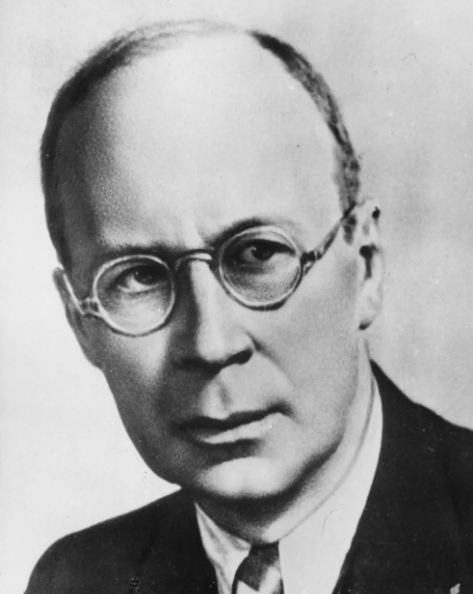
On 5th March 1953, (the same day Stalin died) Russian composer Sergei Prokofiev died at the age of 61. He had composed seven operas, seven symphonies, eight ballets, five piano concertos, two violin concertos, a cello concerto, a symphony concerto for cello and orchestra, and nine completed piano sonatas.

Some of his most beloved works were The Love for Three Oranges, the suite Lieutenant Kijé, the ballet Romeo and Juliet, and the eternal favourite, Peter and the Wolf.

For a modern composer, well, I don’t want to start a fight with anybody. If you want to choose someone for yourself, be my guest because we are blessed to live in a world full of amazing composers, and to choose one over another seems criminal, at least to me.

However, my wife added that John Williams is the cat’s pyjamas.

Sergei Prokofiev. Credit: Keystone/Hulton Archive/Getty Images

Rockefeller:

Winthrop and Barbara Rockefeller were married on 14th February 1948. Winthrop was part of the wealthy and famous Rockefeller dynasty, being John D. Rockefeller’s grandson, and John D. Rockefeller Jr.’s son. Not to be outdone, Barbara was also a successful Hollywood actress. Barbara gave birth to their son, Winthrop Paul “Win” Rockefeller, on 17th September 1948.

Fast forward to two years later, the happy couple were estranged. By 1953, divorce proceedings had started, with both parties haggling over a settlement. This was a very publicised celebrity divorce and was a constant story in the news cycle. By 1954, they had finally divorced, with Barbara receiving a $5.5 million settlement, which was a record for the time.

Three of the biggest publicised celebrity divorces in recent times would be Brad Pitt and Angelina Jolie; Ye (Kanye West) and Kim Kardashian; and Johnny Depp and Amber Heard. There are others, but come on, I need to sleep.

Winthrop Rockefeller and Barbara Sears Rockefeller walk together at the wedding, 1948. Credit: University of Arkansas at Little Rock Center for Arkansas History and Culture

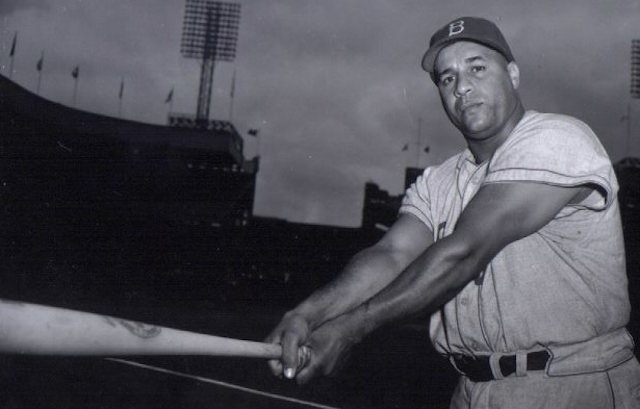
Campanella

Making the 1953 list is our first and only sportsperson, Roy Campanella. Campanella was a baseball player, who mainly played as a catcher. He started his Major League Baseball career in 1948, when he played for the Brooklyn Dodgers, until his early retirement in 1957 from a car accident.

In 1953, Campanella won the National League’s Most Valuable Player Award for the second time, after winning it in 1951, and for a third time in 1955. Campanella won the World Series in 1955 and was also inducted into the Baseball Hall of Fame in 1969.

Selecting a contemporary equivalent is difficult for me because even though I follow baseball to a certain extent, I don’t know it well enough to choose a player. I’m a rugby, cricket, football, and rugby league supporter, so baseball is not really in my wheelhouse. However, any followers and subscribers of New Zealand’s 5th least favourite website, who are also baseball fans, please let me know your opinions on the matter.

Roy Campanella. Credit: Dodger Blue

Communist Bloc:  

You may recall that during the 1950s, the Cold War had started, and 1953 was a flashpoint for Europe. “The Communist Bloc” refers to the Eastern Bloc, or the Soviet Bloc; which was a term given to the countries that were Communist states.

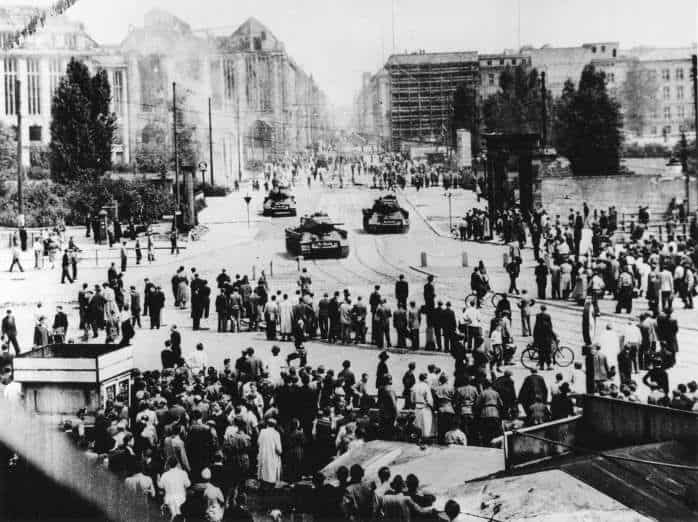
In the case of the song, we are looking at the 1953 East German uprising. This happened when construction workers rose in protest against government demands to increase productivity. The protests soon spread across East Germany, with people starting to demand better living standards and resisting the Sovietization way of life in East Germany.

At the height of the protests, one million people were on the streets, demanding more from the ruling government and the Socialist Unity Party. The main protest lasted only about two days before The Kasernierte Volkspolizei (a militarised police force) and Soviet forces rolled in and violently crushed the protests with tank support.

This was only three months after Stalin’s death, so the government wanted to stop the protests as quickly as possible. At least 125 people were killed during the crackdown.

A modern example of the 1953 East German Uprising; even though it’s not that modern, would be the 1989 Tiananmen Square protests and massacre.

Soviet tanks in East Berlin broke up the crowds, and mass arrests followed in their wake. Credit: Pinterest

So for 1953, we covered a dictator’s death and his successor’s removal, an Egyptian political icon, a composer’s death, a celebrity divorce, a baseball player, and a failed uprising. 1953 was busy, but wait until we discuss 1954! Wow!

So, that’s it for another week. Thanks again for reading, following, and subscribing to Some Geek Told Me. Please remember to walk your dog, read a banned book, watch the Paralympics Games1 and I’ll see you next week, when we check in on the Coalition of Chaos.


1 Seriously, go and watch the Paralympics Games. They deserve all the attention and support.

We Didn’t Start the Fire: 1952

We are deep into winter at the moment, so what better way to bring some light into the world than to revisit events from 72 years ago, inspired by a 35-year-old song? Yes, it’s that time again for Some Geek Told Me to take a look at We Didn’t Start the Fire.

Previous entries on this terrible series have been:

Surprisingly, Beetroot Awareness Aotearoa issued no statement about last month’s post, concerning 1951. Maybe they were too busy being knee-deep in beetroot to notice; though honestly, that sounds like a nightmare to me.

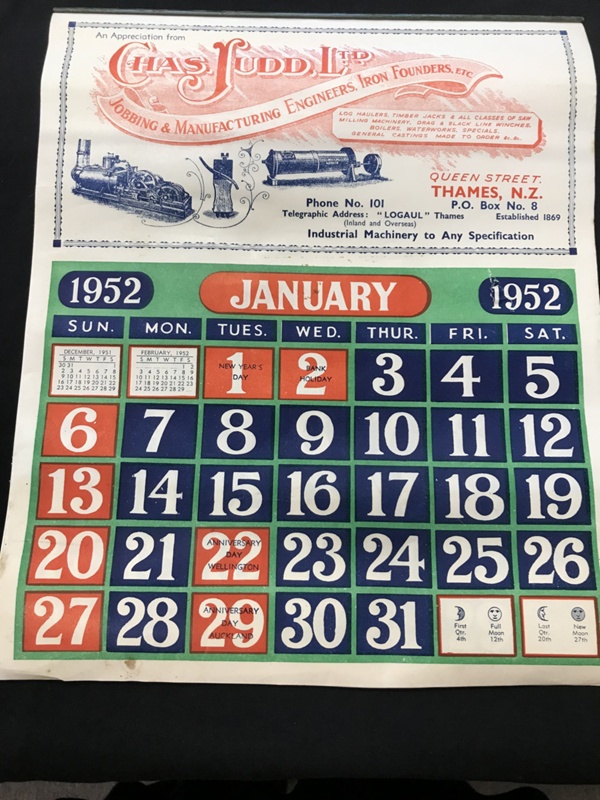
Before we start, 1952 is another special year for me, because that’s when my mother was born. So, without further fanfare, let’s give the non-ticket-paying audience what they want, and dive into We Didn’t Start the Fire’s historic references for 1952.


Credit: Chas Judd Ltd

1952

Eisenhower:

Dwight D. Eisenhower was the Supreme Commander of the Allied Expeditionary Force, during the Second World War, but that’s not why he’s on the list. In 1952, Eisenhower ran as the Republican nominee in the US Presidential election, against Illinois Governor Adlai Stevenson II.

In a landslide victory, Eisenhower won the presidency with 442 electoral votes to 89, becoming the 34th President of the United States of America. Some other recent landslide victories include Ronald Reagan, who won in 1980 with 489 electoral votes, and in 1984 with 525 electoral votes, as well as George H. W. Bush in 1988 with 426 electoral votes.

An official portrait of Dwight D. Eisenhower. Credit: Eisenhower Presidential Library

Vaccine:

This particular case highlights the incredible potential of humanity. Polio is a highly contagious infectious disease that can cause paralysis and even death, especially in children worldwide. In the 20th century, polio killed millions of people each year and became one of the most feared diseases.

A polio vaccine had been in development for several years, but it wasn’t until virologist and biomedical scientist, Jonas Salk and a team of researchers, developed the first effective one in 1952. By the end of the decade, the Salk vaccine had reached about 90 countries.

The legacy of Salk’s vaccine is that it has helped to eliminate polio from the majority of the world, saving millions of lives each year. Unlike smallpox, polio is not eradicated yet, but both IPV and OPV vaccines are helping to achieve that goal.

Credit: Yousuf Karsh

England’s got a new Queen: 

Some of the references in We Didn’t Start the Fire need some explanation and context. Others, like our next one, don’t.

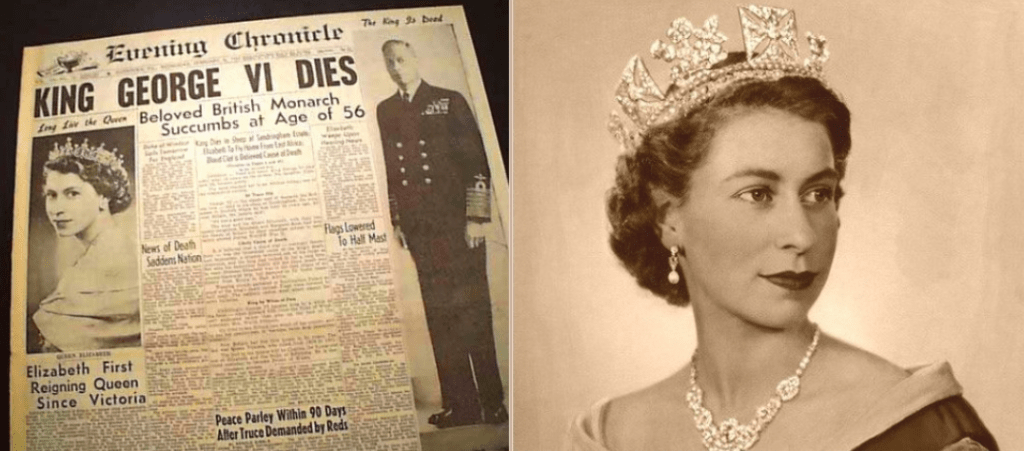
England’s got a new Queen, is exactly what you think it’s about. On 6th February 1952, 56-year-old King George VI of the United Kingdom and the Dominions of the British Commonwealth died, leaving his 25-year-old daughter, Elizabeth as the monarch. Although Elizabeth was coronated in 1953, she became Queen Elizabeth II when her father died.

The obvious equivalent for this was when on 8th September 2022, Queen Elizabeth II died at 96 years old, having reigned for 70 years. Her son, Charles, Prince of Wales, became King Charles III, with his coronation in 2023.

Credit: Evening Chronicle

Marciano:

Rocco Francis Marchegiano, otherwise known as Rocky Marciano, was a professional boxer in the heavyweight division. On 23rd September 1952, Marciano fought a title match against World Heavyweight Champion, Jersey Joe Walcott. Marciano knocked Walcott out, to become the new heavyweight champion of the world.

Marciano went on to hold the title from 1952 until 1956 when he retired from boxing at 32 years old. Marciano had 49 fights, with 49 wins, and 43 by knockouts; which included six title defence fights. He remains the only heavyweight champion to finish his career undefeated. Marciano died in a plane crash in 1969.

For modern times, there is a collection of boxers that we could compare to Marciano, but ultimately I won’t. I mean, why would you?

Liberace:

One of the great American TV entertainers was born Władziu Valentino Liberace, though he became known as just Liberace. He was a pianist, singer, actor and showman. In 1952, he was given a 15-minute network television programme, called The Liberace Show. The show displayed his many different abilities, and it quickly grew in popularity, along with Liberace.

The show ran from 1952-1969 and was made famous for the costumes, productions, performances, and Liberace’s flamboyance. The legacy of The Liberace Show was the promotion of musical variety shows, but also the creation an international cultural icon.

Santayana goodbye:

On 26th September 1952, Jorge Agustín Nicolás Ruiz de Santayana y Borrás, died aged 88. George Santayana, as he became known in English, was a famous essayist, novelist, philosopher, and poet. In academic circles, Santayana was a pillar of 20th-century thinking and coined the immortal phrase:

“Those who cannot remember the past are condemned to repeat it.”

Santayana was beloved around the world for his work and helped usher in a new understanding of the human condition. For a modern equivalent, I’m going out on a limb, but I would name Carl Sagan, but to each their own.

Credit: Harvard Square Library

So for 1952, we covered a US President, the polio vaccine, a British queen, a boxer, a music variety show, and a philosopher. That’s not bad at all, so I’ll be covering 1953 next time if you didn’t guess.

So, that’s it for another week. Thanks again for reading, following, and subscribing to Some Geek Told Me. Please remember to walk your dog, read a banned book, pat a goose, and I’ll see you next week. Look after yourself until I return.


We Didn’t Start the Fire: 1951

When it comes to making terrible ideas, this blog has had some crackers over the last few years. However, the concept of talking about the historical references from a song that came out in 1989; after multiple people have already done it, ranks quite high on that list.

My previous entries in this terrible endeavour include:

Beetroot Awareness Aotearoa seem to have a bee in the bonnet about this, because their press release about my We Didn’t Start the Fire: 1950 blog is downright mean.

“This human skid mark has done another We Didn’t Start the Fire, now there’s four of them! One was too many. We wonder what idiotic new idea, he’ll think of next. Listing how many people have puked on his $5 shoes, maybe? How about listing the number of times the All Blacks have won the World Cup? No, we have it; he will name the colours of the rainbow because nobody has done that before! This moron should be kept away from spoons because he’ll cut himself. What a joke.”

Is it my imagination, or do you think a Springboks supporter may have helped in drafting this release?

Haters are going to hate, I suppose. And with that, let’s check out the We Didn’t Start the Fire’s historic references for 1951.


Credit: Pinterest

1951

Rosenbergs:

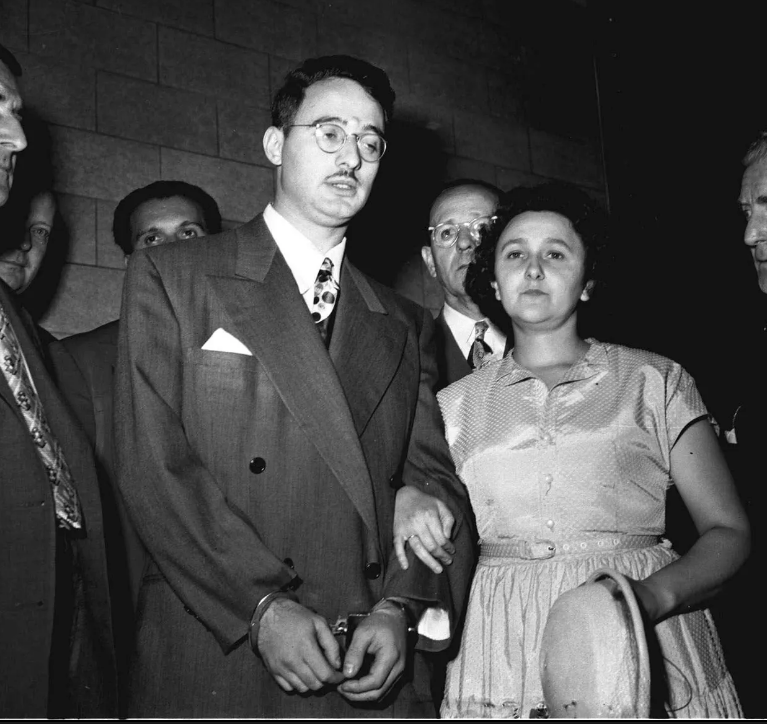
Julius and Ethel Rosenberg were a married couple, who were both born in Manhattan, New York. Being married or born in Manhattan does not automatically qualify you for this list, though. At this time, the Cold War had been established, and the Rosenbergs were part of that drama.

In 1950, Julius and Ethel were arrested and convicted in 1951 for espionage. They were spying for the Soviet Union by providing top-secret information about American technology, especially nuclear secrets. In 1953, both Julius and Ethel were executed by electrocution, at Sing Sing Prison.

The Rosenbergs are also infamous for being the first American civilians executed for espionage. Even though they’re not a 2024 equivalent for the Rosenbergs, I feel Aldrich Ames and Robert Hanssen would be the closest.

Credit: AP Images

H-bomb:

This is an odd one to discuss because it isn’t about a person, place, or event, but rather an object; a very destructive object. No, I’m not talking about Hellboy’s right hand, but rather the H-bomb.

This weapon has been given various monikers over the last 70 years, such as H-bomb, thermonuclear weapon, fusion weapon, or the most well-known, the hydrogen bomb.

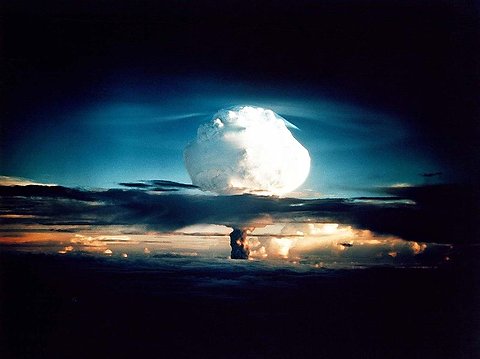
In 1951, during the Cold War, the United States focused on developing the next generation of nuclear weapons. The goal was to combine atomic fission and nuclear fusion to create a more powerful nuclear explosion that could release more energy than a primary nuclear weapon. The first hydrogen bomb test took place in the Marshall Islands in 1952.

As a result, the design of the hydrogen bomb has had a lasting impact, with most of the world’s nuclear warheads being based on its design.

National Nuclear Security Administration/Nevada Site Office Photo Librar. The first hydrogen bomb tested by the United States vaporized the islet of Elugelab in the Marshall Islands in the North Pacific on Nov. 1, 1952.

Sugar Ray:

Born Walker Smith Jr., Sugar Ray Robinson was a professional boxer, who fought across the Lightweight, Welterweight, Middleweight, and Light heavyweight divisions, becoming world champion six times (1 x welterweight and 5 x middleweight).

Robinson is in the song for his fight against Jake LaMotta, for the World Middleweight title in 1951. This was the sixth time the two men had fought, and the fight has been named the “St. Valentine’s Day Massacre” over Robinson’s combinations that beat the world champion, LaMotta to a bloody pulp.

In modern times, this is quite awkward. It could go either two ways; the first could be rematches between the same two boxers like Muhammad Ali vs. Joe Frazier, Erik Morales vs. Marco Antonio Barrera, Pongsaklek Wonjongkam vs. Daisuke Naito, or Manny Pacquiao vs. Juan Manuel Marquez.

As for the second way, it could be because a particular boxer went on to become an icon and legend in their weight division. For that answer, the choice is yours.

Panmunjom:

Do you remember how I mentioned that I’ll be discussing the Korean War again, from last’s month 1950 blog? Well, here we are. Panmunjom is a former village that’s near the Demilitarized Zone (DMZ), along the North Korean and South Korean border. The Joint Security Area (JSA) is also referred to as Panmunjom, and vice versa.

Panmunjom makes this list because, during the Korean War in 1951, North Korean and Chinese officials first met United Nations forces at Panmunjom for truce talks.

In 2005, I was lucky enough to visit Panmunjom, and I made a badly written blog about it. The legacy of Panmunjom is that it still provides a point of contact and meetings for the leaders of North Korea, South Korea, and others.

North Korean and U.S. militaries attempt to iron out an armistice at Panmunjom in the Korean Demilitarized Zone, October 1951. (National Archives photograph)

Brando:

Brando refers to the Godfather himself, Marlon Brando, the great actor and activist. Brando starred in the 1951 film, A Streetcar Named Desire, as the lead male role, Stanley Kowalski. In certain circles, people say that Brando’s performance of Stanley was the best of his long career, which resulted in him being nominated for Best Actor at the 1952 Oscars.

The problem was that Brando didn’t win the award, instead, it went to Humphrey Bogart’s role as Charlie Allnut in The African Queen. This snub, as it’s been referred to, has been recorded as one of the biggest in the history of the Academy Awards.

A modern equivalent for a person being snubbed for acting at the Oscars can be somewhat subjective. However, in the spirit of the blog, maybe Margot Robbie (Barbie), Glenn Close (The Wife), Jim Carrey (The Truman Show), Amy Adams (Arrival), or Pam Grier (Jackie Brown)

Marlon Brando in A Streetcar Named Desire (1951). Credit: Warner Bros. Pictures

The King and I:

We’re back with another Rodgers and Hammerstein production, in the form of The King and I. The musical was based on Margaret Landon’s 1944 novel, Anna and the King of Siam, and also inspired the 1956 film.

The King and I first opened on Broadway in 1951, and it was a commercial and critical success, playing 1,246 performances. It also won five Tony Awards in 1952, including Best Musical. From there, the musical has been revived over the years, with the latest in 2015 (Broadway) and 2018 (West End). It remains a beloved story around the world.

Original poster for The King and I. Credit: St. James Theatre

The Catcher in the Rye:

For the first time in We Didn’t Start the Fire, a book has been mentioned. As you would expect, The Catcher in the Rye, was released in 1951, and it was written by J. D. Salinger. If you haven’t heard of the novel, then you may have heard of its protagonist, the teenager Holden Caulfield.

The novel makes the list because of the various themes it contains, like belonging, connection, sex, identity, loss, depression, innocence, and a whole lot of angst; which were unexplored topics for teenagers in early 1950s literature. The character of Holden Caulfield has become a symbol of rebellion and, you guessed it, teenage angst. Like I said before, this book has a whole lot of angst.

The Catcher in the Rye has sold more than 65 million copies, and remains a solid-selling book, even in 2024. This controversial novel has also been banned several times in various places around the world in the 20th century, which is sadly becoming a growing trend in the 21st century.

An unwanted caveat for the novel is that in 1980, a 25-year-old Mark David Chapman, shot and killed John Lennon, outside his apartment in New York. Chapman had developed an obsession with The Catcher in the Rye; among other things, and especially with Holden Caulfield, and tried to emulate his misadventures.

First-edition cover of The Catcher in the Rye (1951) by author J. D. Salinger. Credit: Wikipedia.

So for 1951, we covered two spies, the hydrogen bomb, a boxer, a Korean village, an actor, a musical, and a novel. A useless piece of information is that 1951 holds a special connection to me, because it’s the year my father was born.

Next month, I’ll look at 1952, and if I feel motivated enough, 1953 as well, but I don’t like the odds of that. I think it’s 34-1. Did I mention that I suddenly like the number 34?

Anyway, that’s it for another week. If you’re enjoying my We Didn’t Start the Fire project, or maybe you think I’m wasting my time, please let me know.

Thanks again for reading, following, and subscribing to Some Geek Told Me. Don’t forget to walk your dog, read a banned book, watch the T20 World Cricket Cup, and I’ll see you next week, where I’m going to be petty and mean. You’ll love it.


We Didn’t Start the Fire: 1950

Welcome to the latest instalment of my breakdown of Billy Joel’s We Didn’t Start the Fire. The two previous entries in this strange franchise are We Didn’t Start the Fire: The Beginning and We Didn’t Start the Fire: 1948-1949.

This is where I’m attempting to talk about the historical references in the song and try to relate them to our contemporary society. I know this sounds like a terrible idea, but apparently, the group known as Beetroot Awareness Aotearoa sort of agrees. After publishing my blog post concerning 1948-1949, this New Zealand-based group released their own harsh review:

Does this idiot know that the song came out in 1989, and since then, numerous people have already talked about the historical references? Can he not think of anything original or does he just steal other people’s ideas? What a buffoon!”

And with that positive and uplifting feedback, let’s check out the We Didn’t Start the Fire’s historic references for 1950.


Image from the We Didn’t Start the Fire music video

1950

Joseph McCarthy:

We briefly discussed Joseph McCarthy last time with 1949’s Walter Winchell, but we’ll expand it like a dog taking over your bed. McCarthy was a US senator for Wisconsin, who had a few issues that he liked to talk about. Early on in the Cold War, and during his Lincoln Day speech, McCarthy launched an anti-communist crusade.

He promoted the concept that Soviet Union and communist spies and sympathizers had infiltrated American society, through the federal and local governments, as well as in academic and entertainment circles. This led to the persecution and political repression of many people, based on being un-American and their opinions. It was during this period that the terms “The Second Red Scare” and “McCarthyism” were born.

For a modern equivalent to McCarthy, just think of everybody’s favourite twice impeached, four times criminally indicted, ex-US President, Donald Trump.

Credit: Biography.com

Richard Nixon:

Richard Nixon makes the list because in 1950, the future President of the United States of America was first elected to represent California, in the US Senate. If you’re a student of history, you’ll realise this will not be the last time Nixon makes the list. He will return.

For a modern version, I’m a bit stumped over this. I can’t compare Richard Nixon of 1950 to Richard Nixon of 1972, because they are two people with different life experiences. However, when comparing Nixon of 1950 to modern times, it would be any young politician moving up the ladder, to become a long-term politician. I’m sure every country has some. I’m looking at you Winston Peters, I’m looking at you.

Nixon in Yorba Linda, California, c. April 1950. Credit: Orange County Archives.

Studebaker:

Studebaker was an automobile manufacturer, which was based in the United States. For about 50 years, Studebaker was one of the leaders in the car industry and had built up a great reputation for their vehicles.

That changed around 1950 when Studebaker started having some major financial problems. In 1954, they merged with Packard, another automobile company to ease their financial difficulties. It didn’t work the way they thought it would, so in 1967, Studebaker ceased production and the company shut down.

Some modern equivalents would be Oldsmobile and Pontiac, or even some non-automobile companies like Kenner and Toys “R” Us.

Studebaker’s “Lazy S” logo, designed by Raymond Loewy, was used from the 1950s until 1966/1950 Studebaker Champion. Credit: Андрей Перцев/Classic Auto Mall.

Television:

Is there a greater icon for the 20th century other than television? I think not. Television or TV had been developed, improved and marketed for years before 1950, but it was slowly becoming an important household product. In the context of US history, TV was becoming an attractive way to transmit information to the public.

Data on sales of TV sets in the United States for 1950 varies. An estimated 9%-20% of households in the United States had at least one television set, but by the end of the decade, that figure had grown to nearly 90%. The age of television was upon us, and it changed the way people from around the world, consumed news and entertainment forever.

In the 21st century, the easiest and best example of a different communication network would be the Internet. You can watch your favourite team play live while riding on the train, watch your favourite TV show on your lunch break, or stream the latest news via your phone or laptop. Outrageous.

Credit: © Frank Martin/ Getty Images

North Korea, South Korea:

This is the first time that I need to discuss two references together, because in 1950, North and South Korea dominated the news around the planet. At the time, North and South Korea were two separate countries, having been divided at the 38th parallel north, by the Soviet Union and the United States, after the end of the Second World War.

On 25th June 1950, the North Korean army crossed the 38th parallel and invaded South Korea. Given that the Cold War was the political climate at the time, this conflict slowly became a proxy war for democracy vs communism.

On one side, there was the Democratic People’s Republic of Korea (North Korea), and the People’s Republic of China (China), along with the unofficial support of the Soviet Union; against the Republic of Korea (South Korea), along with the United Nation Forces, which consisted of the United States, United Kingdom, Australia, Netherlands, Canada, France, New Zealand, Philippines, Turkey, Thailand, South Africa, Greece, Belgium, Luxembourg, Ethiopia and Colombia; with many more countries supplying support through different means.

This conflict became known as the Korean War and was fought for three years, with the war ending in a stalemate in 1953, with the Korean Armistice Agreement. The war claimed an estimated 2.8 million military and civilian deaths. Much like the Chinese Civil War, the geo-political repercussions of the Korean War are still being felt in 2024.

Sadly, the Korean War will make another entry in the song.

Credit: Map Porn

Marilyn Monroe:

Born Norma Jeane Mortenson, Marilyn Monroe was a model and actress who became an international sex symbol, during the late 1940s-early 1960s. In 1950, Monroe landed some breakthrough roles in films and actually starred in five different films in that year. (A Ticket to Tomahawk, The Asphalt Jungle, All About Eve, The Fireball, and Right Cross). From there, Monroe’s career took off and she soon became a household name.

It’s hard to determine which contemporary model/actress would be like Marilyn Monroe of 1950, so I’ll let you decide on that one. Sorry.

Marilyn Monroe in All About Eve (1950). Credit: 20th Century-Fox

So for 1950, we have covered two US Senators, a failed automobile company, the explosion of television sales, the Korean War, and a model/actress. Like I said last time, this project is going to take some time, so I’ll try and cover 1951-1952 next time. Cool.

That’s it for another week. Thanks once again for reading, following, and subscribing to Some Geek Told Me. Don’t forget to walk your dog, read a banned book, call for a ceasefire in Palestine, and I’ll see you next week because I’m going to be discussing a milestone. It could be interesting.