
Flags, flags, flags, I love a good flag. I live in an area where there are four houses within walking distance of my home that have a flagpole. A few weeks ago, I was walking along when I noticed a flag slightly flying on one of them. I could make out that the flag had orange and black on it.
I suddenly realised I had no idea whose country it belonged to, let alone the continent. Orange and black, orange and black. I was going to memorise the flag, then search for it later on. What country just had orange and black on their flag?!
As I walked closer and closer, I searched the bottom of the flag knowledge file in my mind for any possible answers. Because of the angle I was facing, the majority of the flag wasn’t revealed until I was three houses away.
It was then that I made the discovery that delighted and frustrated me; it was a Halloween flag featuring a witch. This mundane incident obviously triggered my Geek-sense, and the idea grew into the amazing blog post you are now reading.
Just over three years ago, I published my first and only blog post about flags, which can be discovered here. In that literary masterpiece, I discussed four countries’ flags that are no longer in use, for various reasons.
In some circles, three years is the perfect length of time for a sequel, so where is The Batman: Part II? To extend upon this, I have decided to create a sequel to that blog post, but this time, to simply discuss one country, whose history of name changing and flag swapping would make a swinger’s head swivel.
So, sit back, relax, and put your tray table away, because we’re going to look at one country’s many failed flags.
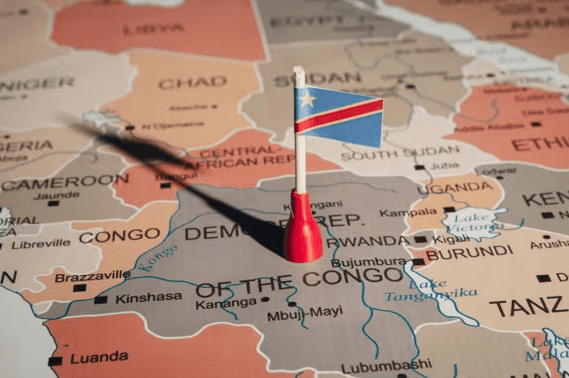
Democratic Republic of the Congo (Formerly known as the Congo Free State/Belgian Congo/Republic of the Congo/Democratic Republic of the Congo/Zaire)
The Democratic Republic of the Congo is odd because it doesn’t just have a few national flags, but several, although it’s the same country; but at the same time, it’s six countries. I told you it was odd.
We have to venture to Central Africa, and to explain the Democratic Republic of the Congo, I need to explain Zaire. In order to explain Zaire, I need to explain the Democratic Republic of the Congo; and to explain the Democratic Republic of the Congo, I need to explain the Republic of the Congo. But to explain the Republic of the Congo, I need to explain the Belgian Congo. However, to explain the Belgian Congo, I need to explain the Congo Free State. It’s like Russian nesting dolls filled with flags and countries.
The Congo Free State

Credit: Public domain, via Wikimedia Commons
Starting with the Congo Free State is arguably the best country to begin with. The flag has a blue background with a yellow star in the centre. It was first introduced when the Congo Free State was a de facto African colony of Belgium, but more importantly, it was controlled by King Leopold II of Belgium.
Also, in a totally random and unrelated coincidence, the Congo Free State shared its flag with the International Association of the Congo or the International Congo Society, which was set up by King Leopold II of Belgium, to further his interests in the region. What are the odds of that happening?!
Belgian Congo

Credit: Public domain, via Wikimedia Commons
In 1908, the Congo Free State was officially annexed by the Belgian government, so the country was renamed the Belgian Congo, but they decided to retain the flag. That was nice of them, considering the atrocities the Belgians committed upon the Congolese, in the pursuit of rubber, ivory and minerals.
Republic of the Congo or Congo-Léopoldville (Not to be confused with its neighbour, the Republic of the Congo)

In 1960, the Belgian Congo declared independence from Belgium. Among civil unrest and wars that plagued the newly (re)minted country, the nation’s name changed for a second time to the Republic of the Congo, along with a tweaked version of the original flag, namely, the vertical column of six five-pointed stars on the left-hand side.1

Three years later, in 1963, the flag was changed yet again to another similar, but different version. This new flag still had the original yellow star, but it was smaller and had been moved to the top corner of the left-hand side. It also had a red and yellow-lined band that ran diagonally across the centre. The star represented unity, the yellow symbolised prosperity, the blue stood for hope, and the red reflected the people’s blood.
In 1964, the call was made to change the official name of the Republic of the Congo to the Democratic Republic of the Congo, because why the hell not?
Democratic Republic of the Congo

Just like how a classic comic book character like Daredevil is relaunched with a new #1, and then three years later, he has yet another relaunch with another #1, the same applies here. In 1966, because three years in an eternity in politics, the government decided the national flag needed an update, because if the country has a new name…it needs a new flag.
This flag was identical to the previous one, but for two small changes. The red band has widened, and the yellow star has decreased in size.
Zaire
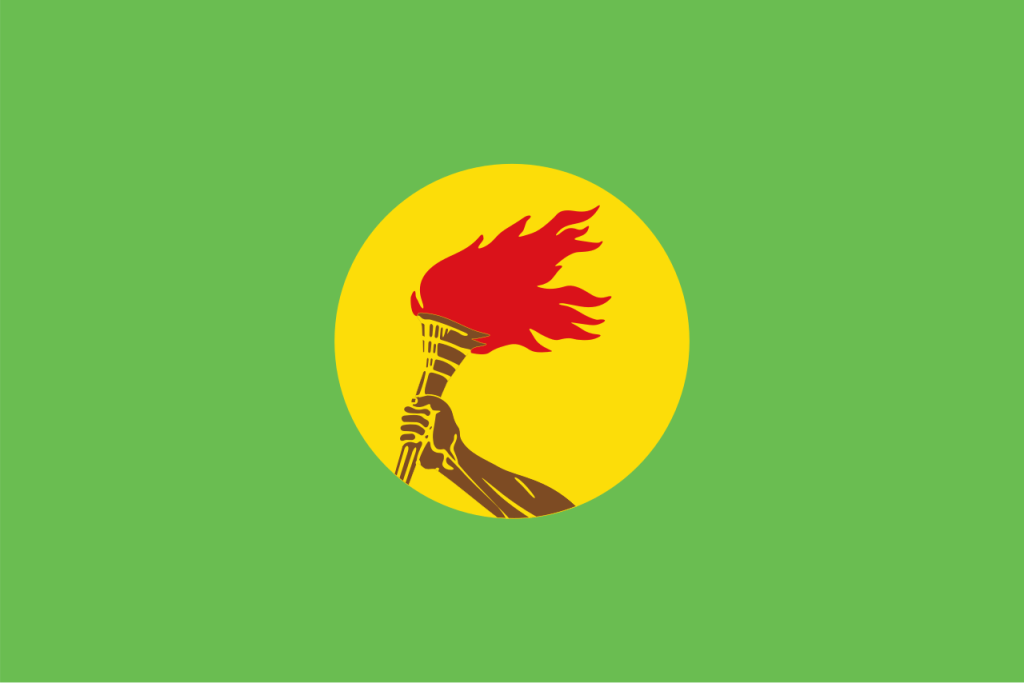
To offer a recap, the Congo Free State rebranded itself to become the Belgian Congo, then changed into the Republic of the Congo; along with several flag alternations, and another name change to the Democratic Republic of the Congo. By 1971, you would think that the days of the country’s name and flag changing were over. However, to quote John Rambo, “Nothing is over! Nothing!”
The Democratic Republic of the Congo was renamed Zaire to shake off its colonial past and embrace its African heritage and culture. The new name came with a new flag, which included the Pan-African colours of red, yellow, and green.
The green background represented hope and the country’s fertile land; the yellow symbolised the country’s prosperity and bountiful natural resources, and the red stood for the blood shed for independence and the nation’s martyrs.
The circle with the flaming torch represented the unity of the Zairean people, as well as being a symbol of the ruling party, the Popular Movement of the Revolution (MPR).
Democratic Republic of the Congo (Again)

The government was overthrown in 1997, which, you guessed it, brought about a new name and flag. The name Zaire was dissolved, and the Democratic Republic of the Congo was reintroduced, along with updating the flag. Instead of looking to contemporary times for inspiration to redesign the flag, it was decided to dive back into the past, 1960, to be correct, to find the next flag.
The new, but old flag was a variation of the first Republic of the Congo’s flag, which was adopted in 1960. The number of stars and their yellow colour didn’t change, but the central star is slightly smaller, along with a lighter blue background.

When the Democratic Republic of the Congo was just six years old, a decision was made that the national flag needed to be updated. As a result, the flag underwent a makeover. Perhaps someone was allergic to the original blue or felt that it wasn’t light enough, but whatever the reason, the blue on the flag was changed to a lighter shade, and the size of the central star was also adjusted.
In my personal opinion, I think some ministers’ OCD was out of control.

By now, you would have guessed what happened in 2006, three years after the Democratic Republic of the Congo’s third flag was revealed. Yes, we have another flag change. 10 points to Hufflepuff!
You can’t make this stuff up, but in 2006, the wheel turned again, and another flag was introduced. It’s a hybrid of the Democratic Republic of the Congo’s first and third flags, combining the design of the 1966 flag, but using the blue from 2003’s flag.
If I understand it properly, the star represents the future for the country, red is for “the blood of the country’s martyrs”, the country’s wealth is yellow, and the blue stands for peace.
Next year will mark the 20th anniversary of the Democratic Republic of the Congo’s current flag, and long may it last. However, like a married man having a midlife crisis, who starts dating a woman old enough to be his daughter, will the Democratic Republic of the Congo have another makeover, via a name and flag change? Who knows?
I hope this blog post was coherent enough to understand, because as I was writing it, I kept saying to myself, “This makes no sense, but it’s true.” As always, please let me know your thoughts on the subject.
Writing about the Democratic Republic of the Congo’s flags and name changes has given me a small headache, so I’m done. Thanks again for reading, following, and subscribing to Some Geek Told Me.
Please remember to walk your dog, read a banned book, the world is a vampire, and I’ll see you next week.
1.) When the Republic of the Congo was named, its neighbour was also called the Republic of the Congo. To sort through the confusion and help the international community differentiate between the two Congos, the flags were different.
In addition to this, the Republic of the Congo was referred to as Congo-Léopoldville, acknowledging its Belgian past. And not to be outdone, the Republic of the Congo was known as Congo-Brazzaville, acknowledging its French heritage. Not confusing at all.


 SOME GEEK TOLD ME
You must be logged in to post a comment.