
Well, this blog post has been years in the making. I’ve hinted at this for some time, and now that my sponsorships are under control and I’ve completed the press tours, I feel it’s the right moment to write a blog post about the Star Wars: The High Republic series. I’m now rich and famous for running New Zealand’s fifth least favourite website, so it seems like the perfect opportunity to share my thoughts on this important subject.
Let’s establish an ugly truth before we begin: not every person on this planet has seen a Star Wars movie or TV show, or read a Star Wars novel or comic book; while some people, for some strange and unexplained reason, don’t like Star Wars. I know, it’s difficult to believe, but it’s true.
It’s been well and truly documented that I’m a geek and a fan of the world’s most famous space opera. This shouldn’t be a surprise to any of you. Seriously, it shouldn’t.
In terms of my Star Wars diet, I’ve been reading Star Wars literature in the form of novels and comic books for decades. Yes, I enjoyed the films, and since I won’t dive into that today, they left a void in me. I wanted more from that fictional universe, especially learning about the Jedi and events before A New Hope.
Enter Tales of the Jedi from Dark Horse Comics, and my prayers were answered. I think I discovered Tales of the Jedi at a library, and I was instantly hooked. Stories about the Jedi, set thousands of years before the Battle of Yavin? Sign me up.
It was a chance to tell new and exciting tales about the Star Wars universe, without being bogged down with continuity problems, since they were set thousands of years ago. I read the trades, then sourced all of the single issues, because I felt the entire series was made for me. I loved it.
Dark Horse later released Star Wars: Knights of the Republic, Star Wars: The Lost Tribe of the Sith-Spiral, Star Wars: Knight Errant, Star Wars: Jedi vs Sith, Star Wars: Republic, Star Wars: Dark Times, and one of my favourites, Star Wars: Dawn of the Jedi, among others.
Since then, various novels have been released, detailing thousands of years of Jedi and Sith, as well as the years leading up to The Phantom Menace and The Clone Wars. This also does not take away from the Canon stories exploring everything after A New Hope, either. I’ve enjoyed the Star Wars books I have read, but my love for Tales of the Jedi was enduring.
I felt I was starved for new Canon Star Wars content that was set hundreds or thousands of years before the Battle of Yavin. Legends’ stories were all over that, but the new stories seemed to be focused elsewhere. However, that changed with Star Wars: The High Republic.

Essentially, The High Republic was1 a massive multi-media project, spanning novels (adult, young adult, middle-grade, young readers) comic books, audio drama, web series, manga, reference books, and short stories, with one animated TV show (Star Wars: Young Jedi Adventures), and one live action TV show (Star Wars: The Acolyte). The creators were a mix of seasoned Star Wars writers and new writers, not including the multiple artists.
The High Republic was set about 150 years before A New Hope, with both the Galactic Republic and the Jedi Order being at their prime. This is a time when thousands of Jedi patrol the galaxy, and new worlds are being discovered, and are invited to join the Republic. It’s an era of potential and exportation, when relative peace and security are a steady theme within the galaxy.
That sounds amazing, but would people want to read stories about Jedi travelling to distant worlds to mediate, or just enjoy having easy and stress-free lives? No, the Jedi needed a challenge to push them to become better. The Sith are still hiding throughout this time, so if the Sith aren’t the villains, the Jedi need someone else to fight!
This beautiful transition brings us the Drengir and the Nihil. The best way to explain the Drengir is that they are a sentient carnivorous plant species who have a connection to the Dark Side of the Force. They also have a hive-mind that is controlled by the Great Progenitor, who acts like the Borg Queen.
They had tentacles, thorns, various poisons, huge mouths, and an unending appetite for meat, which came in the form of whatever organisms they could find. During the series, the Drengir were wiping out villages, settlements, and colonies scattered across the galaxy.
The main villains of the series were the Nihil, who were described as space vikings. The creators put in a lot of effort in fleshing them out, since they were led by Marchion Ro, an Evereni who had an all-consuming hatred of the Republic and the Jedi.
The Nihil had a caste system, and they terrorised worlds and spaceships with raids, killing anyone that got in their way and taking whatever they wanted. Their spaceships had Path Engines, which were an engineering masterpiece and a secret weapon.
As I understood it, a normal spaceship that had a hyperdrive could make jumps through hyperspace across massive distances. However, Path engines allowed the Nihil to make micro-jumps through hyperspace, or even within a planet’s atmosphere. It meant the Nihil could make micro-jumps within a space battle and destroy or conquer spaceships with ease.
Throughout the series, they executed various gigantic plans across the galaxy to spread fear, terror, and to lay claim to new territories, as well as humiliating the Republic and destroying the Jedi Order. They did this through the aforementioned plans, but they also had an ace up their sleeve.
Marchion Ro used unique creatures. Called by several names, like The Shrikarai, the Nameless, and Shrii-ka-rai, these creatures were Force Eaters, which meant they survived and consumed the Living Force. As you can guess, their Force-sensitive victims were drained of the Living Force, and their bodies were converted to husks. And if their victims were Force-sensitive, it meant that their greatest strength became their greatest weakness.
Having a Nameless approach someone who was Force-sensitive would distort reality for that person, and affect them emotionally, physically, and mentally; but the main reason the Nameless were deadly was that Jedi were supposed to be mindful of their feelings and be able to suppress fear, but the Nameless made the Jedi afraid. They made the Jedi feel fear.
It’s an interesting take to see the brave Jedi being reduced to crying and screaming messes on the ground, when a non-Force-sensitive lifeform would be unaffected.
And speaking of Force-sensitive people, the creators have, in my opinion, been courageous in presenting other organisations that are connected to the Force, other than the Jedi and the Sith. Just because you are sensitive to the Force does not automatically mean you are destined to fall into the two camps of Jedi or Sith. It was great to see other organisms using the Force and helping communities, by not using a lightsabre.2
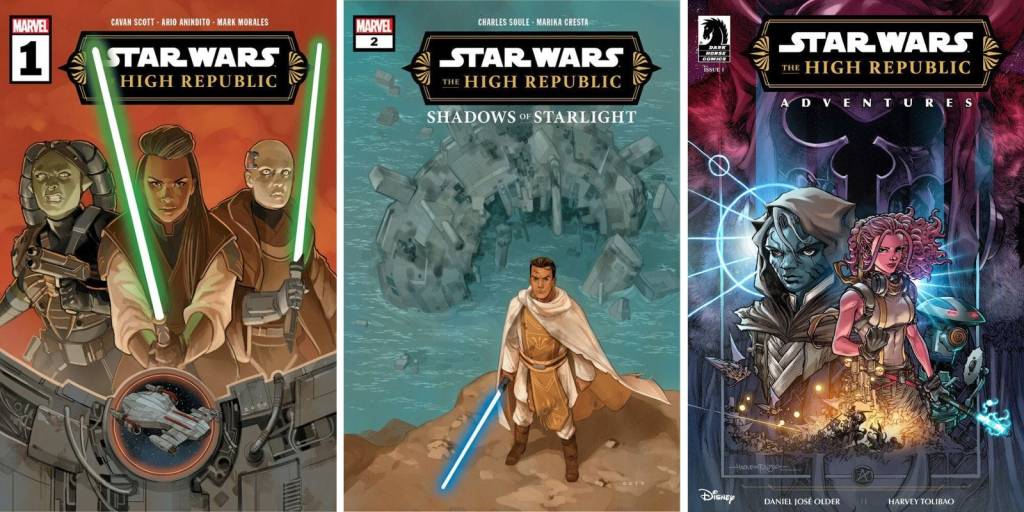
Across the series, we have been introduced to many new and different Jedi. This relates to their species, type of lightsabre they use, and rank in the Jedi order, which is nothing new, since we were exposed to this with The Phantom Menace. However, the creators introduced something I believe I have never seen or heard of before: the way organisms feel, experience, and perceive the Force is different.
Albert Einstein explained with his theory of special relativity that there is no universal clock, so nobody experiences time the same way; we all experience time differently. This is much the same as how a lifeform experiences and perceives the Force, which will be different from everybody else. One Jedi experiences the Force as an ocean, another as music, and another as a forest. It was a cool concept.
We met new Jedi like OrbaLin, Burryaga Agaburry, Lily Tora-Asi, Sav Malagán, Ram Jomaram, Qort, Lula Talisola, Vernestra Rwoh, and Porter Engle, to name but a few. It was interesting to read about them in a novel, then discover them in a comic book, and vice versa. Star Wars: The High Republic also introduced lots of non-Jedi characters like Chancellor Lina Soh, Sevran Tarkin, Alys “Crash” Ongwa, Ty Yorrick, Tey Sirrek, Zeen Mrala, and Geode, along with many more.
The series was released in phases, which included the various media from January 2021 to June 2025. The main focus was the novels, with the comics, manga, and audio dramas still accessible to stand alone. The web series was released before the launch, so readers could understand the characters better and the time period.
With each phase, new content would slowly be released across, roughly 18 months, then go into hiatus, to reset for the new phase. Each phase was divided into Waves (1-3), which would include a novel, a young adult novel, and a middle-grade novel, so three books per wave meant nine books per phase.
Through the different phases, two main comic books were running, Star Wars: The High Republic from Marvel, and Star Wars: The High Republic Adventures, first released from IDW, then Dark Horse took over publication with Phase II.
Multiple comic book mini-series were also released through the three phases, along with one-shots, six manga, and three audio dramas (also available as scripts). The picture, art, and reference books were published near the end of each phase, but I could be wrong about that.
Phase I: Light of the Jedi was the first entry into the series, with nine novels. They set up the scene for the golden era of the Republic and the Jedi, which was about 150 years before A New Hope, where Jedi numbers were in their thousands. The Nihil, Drengir and their mischief-making were introduced across the phase.
Phase II: Quest of the Jedi was different for two reasons. The first reason was that the time period shifted, because we journeyed back another 100 years, before Phase I, to where the Outer Rim was still being explored. I think it was done to allow the readers to process the events of Phase I and to answer some questions that were raised. The other reason was that, instead of nine novels being released like in Phase I, only six were published in Phase II.
Phase III: Trials of the Jedi had another time jump and picked up the story one year after the events of Phase I. Some characters had died, and others grew through character development. I would like to add extra information to Phase III, but I can’t.
The thing is, even though Star Wars: The High Republic has finished, I have not finished reading Phase III. Nine books were published in this phase, and not counting the comic books and manga, I have only read the first four: Escape from Valo, The Eye of Darkness, Defy the Storm, and Temptation of the Force.
My local bookstore is still waiting for the paperback editions of Beware the Nameless, Tears of the Nameless, Into the Light, A Valiant Vow, and Trials of the Jedi, along with the script of the Tempest Breaker audio drama.
I have the final chapter in the series, the Marvel one-shot, Star Wars: The High Republic: Finale, waiting patiently to be read, only after the other six books have been located and read. It’s difficult because I really want to read it, but I’ve waited this long, so I can wait some more.
I’ve really enjoyed reading Star Wars: The High Republic. Meeting both old3 and new characters and travelling to new planets has been a thrilling experience. I’ve been eagerly waiting for a massive Star Wars project like this for over half my life.
The motivations behind the actions of characters, along with their visual designs, have been quite beneficial in the different media, which have allowed the creators to explore and showcase various characters in new ways.
A lot of them were complex, because as children, we were taught a person is either good or bad, but life isn’t as binary as that, with people having the potential for both good and bad. I thought it was a mature choice from the creators to reflect that.
As for reflection, I know a lot of people complained about the inclusion of many LGBTQIA+ characters in the stories. Personally, I found their complaints to be hilarious, because it’s a fact that not every Star Wars fan is a middle-aged straight white male.
As a business model, if you’re selling products involving fictional characters, you want any person, of any background, to be able to pick one of your products and to be able to see themselves in it. You want to cater to as many people as possible. Star Wars should be for anybody, not just the die-hard fans, because you want the next generation to fall in love with it, just like you did.
It’s also been clever not to have the Sith as the antagonists, because other factions hate the Jedi as well. They were hiding at the time, so why expose themselves? Because they do that in The Phantom Menace, after thousands of years of waiting, planning, and killing themselves.
I loved this series, but I have only two small disadvantages with it. The first is the cost, though that depends on how far you want to dive into the project. If you’re only interested in the novels, then the story will make sense. And if only comic books float your boat, then you can still enjoy the story as well.
However, if you’re anything like me, you would want to read as much as you can, to fully explore this time period, with novels and comic books, so it’s going to cost you. Though in saying that, you can take your time with the collection, so there’s no hurry.
The other point is probably criticism towards me rather than the series. Because there were so many characters, I sometimes found myself reading about a character that I couldn’t remember. I would have to stop, quickly research that character, curse myself for being stupid for forgetting them, then continue reading.
I hope the Star Wars franchise creates another multi-media project like The High Republic, because if they do, I’m there. When UMC1 and UMC2 are interested, the novels are waiting for them. Not the comics, though, that’s another discussion.
And with that, this overly bloated blog post is finished. Have you read any of the Star Wars: The High Republic or have any thoughts about it? As always, please let me know.
Thanks again for reading, following, and subscribing to Some Geek Told Me. Please remember to walk your dog, read a banned book, try to close a revolving door, and I’ll see you next week.
1 I believe the main High Republic story has finished, but some comics from Phase II are being released to expand upon this time period.
2 Yes, I know I have used “lightsabre” rather than “lightsaber.” I use British/New Zealand English, not American English, so I’m sorry, but not sorry.
3 I’m looking at you, Yoda.










 SOME GEEK TOLD ME
You must be logged in to post a comment.